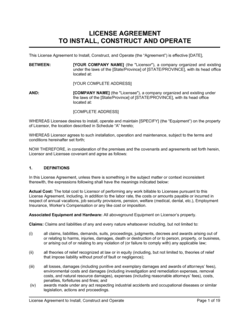
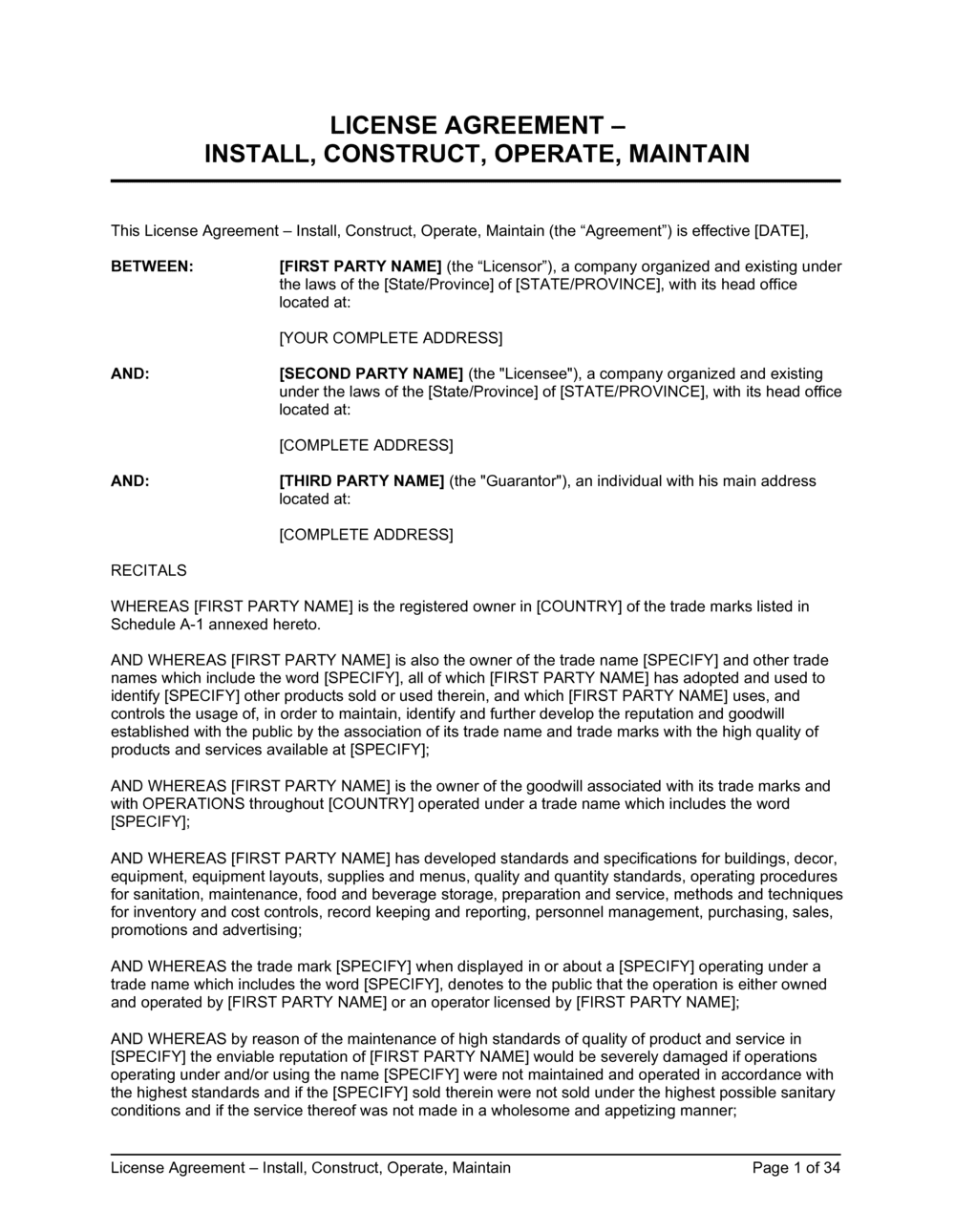
License Agreement Install, Construct, Operate, Maintain Template

Free Word download • Edit online • Save & share with Drive • Export to PDF

34 pages40–55 min to fillDifficulty: ExpertSignature requiredLegal review recommended
Learn more ↓
FreeLicense Agreement Install, Construct, Operate, Maintain Template

At a glance

What it is
A License Agreement Install Construct Operate Maintain is a legally binding contract in which a licensor grants a licensee the right to access a defined area or property for the purpose of installing, constructing, operating, and maintaining a facility, infrastructure, or equipment. This free Word download covers the full lifecycle of the licensed activity — from groundbreaking through daily operations — and can be exported as PDF and executed by both parties before any work begins.
When you need it
Use it when a private company, utility, or government entity needs to place infrastructure — pipelines, telecommunications equipment, solar arrays, signage, or similar installations — on land or property owned or controlled by another party. It is also used when a licensee needs ongoing rights to access, repair, and upgrade the installation over a multi-year term.
What's inside
Grant of license and permitted use, description of the licensed area, construction and installation conditions, operational and maintenance obligations, fees and compensation, insurance and indemnification, restoration requirements, and termination provisions.

What is a License Agreement Install Construct Operate Maintain?

A License Agreement Install Construct Operate Maintain is a legally binding contract in which a property owner or controlling party (the licensor) grants a company or entity (the licensee) defined rights to access a specified area of land or property for the purpose of installing equipment or structures, constructing a facility, running ongoing operations, and performing maintenance — all within an agreed term, geographic footprint, and set of conditions. Unlike a general lease, this agreement governs the full operational lifecycle of a specific infrastructure project: from initial site access and groundbreaking through years of active use, routine servicing, and eventual decommissioning and site restoration. It is widely used in the energy, telecommunications, utilities, and renewable energy sectors, wherever one party needs durable, enforceable rights to place and operate infrastructure on land it does not own.

Why You Need This Document

Operating infrastructure on another party's property without a written license exposes both parties to serious legal and financial risk. For the licensee, an undocumented arrangement can be revoked without notice, leaving capital investment stranded and operations interrupted with no legal recourse. For the licensor, the absence of a written agreement means no guaranteed fees, no insurance requirements, no restoration obligations, and no enforceable boundary on what the licensee can build or do. A properly executed license agreement fixes all of this: it locks in the licensee's rights for the agreed term, obligates the licensee to carry insurance and restore the site at the end of the license, and gives the licensor a clear contractual basis to collect fees, enforce operational standards, and terminate for breach. This template gives you a professionally structured starting point that covers every stage of the licensed activity — from first shovel to final removal — while preserving the flexibility to tailor the permitted use, fee structure, and risk allocation to your specific project.

Which variant fits your situation?

If your situation is…Use this template
Granting rights to use land for a telecommunications towerCell Tower Lease Agreement
Licensing intellectual property rather than physical accessIntellectual Property License Agreement
Granting a right-of-way across private land for a pipelineEasement Agreement
Allowing a contractor to build on land the licensor will later own outrightBuild Operate Transfer Agreement
Short-term access for a single construction project onlyConstruction Access License Agreement
Licensing a building or space for general commercial operationsCommercial Lease Agreement
Authorizing a vendor to install and service equipment inside a leased facilityEquipment Installation Agreement

Common mistakes to avoid

❌ Vague or missing licensed area description

Why it matters: Without a precise legal description and attached survey, the boundaries of the license are undefined — enabling the licensee to exceed its footprint and the licensor to dispute what was authorized.

Fix: Attach a surveyed site plan as a numbered exhibit and cross-reference it in the grant clause. Require the exhibit to be initialed by both parties at signing.

❌ No construction completion deadline

Why it matters: A licensee with no drop-dead construction date can occupy and disrupt the property indefinitely, with the licensor having no contractual basis to demand progress or terminate.

Fix: Include a specific completion date and a licensor termination right if the milestone is missed by more than a defined grace period — typically 30 to 60 days.

❌ Omitting a restoration security deposit or performance bond

Why it matters: If the licensee becomes insolvent or abandons the project, the licensor inherits the cost of removing infrastructure and remediating the site — which can run into hundreds of thousands of dollars for energy or telecom installations.

Fix: Require a cash deposit, letter of credit, or surety bond sized to the estimated decommissioning cost, held for the full term of the license.

❌ Allowing unrestricted assignment without licensor consent

Why it matters: Infrastructure licenses are granted based on the specific technical capability and financial standing of the named licensee. An unrestricted assignment right allows transfer to a party the licensor never evaluated or agreed to.

Fix: Require prior written consent for any assignment, with an express carve-out for transfers to creditworthy affiliates or successors — and maintain a reasonable approval standard to avoid being held to have unreasonably withheld consent.

❌ Setting insurance limits without reviewing facility-specific risk

Why it matters: Standard template insurance minimums ($1M general liability) are often inadequate for high-risk infrastructure. An incident involving a ruptured pipeline or collapsed tower can generate claims in the tens of millions.

Fix: Have a commercial insurance broker review the facility type and geographic location before finalizing coverage limits, and update minimums at each major renewal.

❌ No cure period for non-monetary breaches

Why it matters: Immediate termination rights for any breach — including minor operational failures — expose the licensee to disproportionate consequences and are routinely challenged in court, creating expensive litigation even when the licensor has a legitimate grievance.

Fix: Distinguish monetary defaults (10-day cure period) from non-monetary defaults (30-day cure period, with a reasonable extension if the breach cannot be cured within 30 days but the licensee is diligently pursuing a cure).

The 10 key clauses, explained

Recitals and defined terms

In plain language: Sets out the background of the agreement — who the parties are, what property is involved, and what the licensee intends to do — and defines key terms used throughout the document.

Sample language
WHEREAS, Licensor owns certain real property located at [PROPERTY ADDRESS] (the 'Property'); and WHEREAS, Licensee desires to obtain a license to install, construct, operate, and maintain [DESCRIPTION OF FACILITY] on the portion of the Property described in Exhibit A (the 'Licensed Area').

Common mistake: Leaving the Licensed Area description vague or referencing an exhibit that is never attached. An ambiguous area description creates boundary disputes and may void the grant entirely.

Grant of license and scope of permitted use

In plain language: The operative clause that formally grants the licensee the rights to install, construct, operate, and maintain, and precisely limits what activities are authorized.

Sample language
Licensor hereby grants to Licensee a non-exclusive, non-transferable license to access the Licensed Area solely for the purpose of installing, constructing, operating, and maintaining [FACILITY NAME] in accordance with the plans attached as Exhibit B.

Common mistake: Failing to specify whether the license is exclusive or non-exclusive. A non-exclusive grant allows the licensor to grant identical rights to a competitor on the same property.

Construction and installation conditions

In plain language: Governs how and when the licensee may begin construction, what plans must be pre-approved, which contractors may be used, and what safety and regulatory standards apply.

Sample language
Licensee shall not commence construction without Licensor's prior written approval of construction plans and shall complete installation by [COMPLETION DATE]. All work shall comply with applicable building codes and be performed by licensed contractors.

Common mistake: No completion deadline and no consequence for missing it. Without a drop-dead date and a remedy — such as termination right — projects can drag on indefinitely, burdening the licensor's property.

Operation and maintenance obligations

In plain language: Defines the licensee's ongoing duties to keep the facility and licensed area in good repair, comply with regulatory requirements, and avoid nuisance or interference with the licensor's use of adjacent property.

Sample language
Licensee shall operate and maintain the [FACILITY] in good working order and in compliance with all applicable laws, regulations, and permits. Licensee shall promptly repair any damage to the Licensed Area or adjacent property caused by its operations.

Common mistake: Omitting a maintenance standard — 'good working order' is better than silence, but 'industry-standard practices for [FACILITY TYPE]' is more enforceable and avoids disputes about what 'good' means.

License fees and payment terms

In plain language: States the amount the licensee pays the licensor, the payment schedule, escalation formula (if any), and consequences for late payment.

Sample language
Licensee shall pay Licensor a license fee of $[AMOUNT] per [month/year], due on the [DAY] of each [month/year], subject to an annual escalation of [X]% or CPI, whichever is greater. Payments more than [10] days late accrue interest at [X]% per annum.

Common mistake: No escalation clause in a long-term agreement. A fixed fee over a 10- or 20-year term can lose significant real value — an annual CPI or fixed-percentage escalator protects the licensor.

Insurance requirements

In plain language: Sets out the minimum insurance coverages the licensee must maintain — commercial general liability, workers' compensation, property, and umbrella — and requires the licensor to be named as an additional insured.

Sample language
Licensee shall maintain, at its own expense: (a) Commercial General Liability insurance with limits of not less than $[X] per occurrence and $[X] aggregate; (b) Workers' Compensation as required by law; and (c) such other coverages as Licensor may reasonably require. Licensor shall be named as an additional insured on all policies.

Common mistake: Setting insurance limits without reviewing current market standards for the specific facility type. A $1M general liability limit may be grossly inadequate for a high-voltage substation or large pipeline installation.

Indemnification and liability

In plain language: Allocates risk between the parties — typically the licensee indemnifies the licensor for claims arising from the licensee's construction, operations, or negligence, while each party may retain liability for its own gross negligence or willful misconduct.

Sample language
Licensee shall indemnify, defend, and hold harmless Licensor from and against any and all claims, damages, losses, and expenses (including reasonable attorneys' fees) arising out of or relating to Licensee's installation, construction, operation, or maintenance of the Facility, except to the extent caused by Licensor's gross negligence or willful misconduct.

Common mistake: A mutual indemnification clause that treats both parties symmetrically when the licensee is the only party conducting operations on the property. One-sided risk should be reflected in one-sided indemnification.

Term and termination

In plain language: Specifies the initial license term, any renewal options, the notice period required to terminate for convenience or cause, and what constitutes a material breach triggering termination rights.

Sample language
This Agreement shall commence on [START DATE] and continue for an initial term of [X] years, unless earlier terminated. Either party may terminate for material breach upon [30] days' written notice, provided the breach remains uncured at the end of such period. Licensor may terminate for convenience upon [X] days' written notice after the [X]-year anniversary.

Common mistake: No cure period for non-monetary breaches. Immediate termination rights for minor operational infractions expose the licensee to disproportionate risk and are frequently litigated.

Restoration and surrender

In plain language: Requires the licensee to remove all installed equipment, restore the licensed area to its original or agreed condition, and surrender possession to the licensor upon expiration or termination.

Sample language
Upon expiration or termination, Licensee shall, within [60] days, remove all equipment and restore the Licensed Area to substantially its pre-installation condition at Licensee's sole cost and expense, including remediation of any environmental disturbance.

Common mistake: No security deposit or performance bond to guarantee restoration. If the licensee becomes insolvent, the licensor may be left with a decommissioning bill for equipment it never wanted.

Governing law, dispute resolution, and assignment

In plain language: Specifies which jurisdiction's law governs the agreement, how disputes are resolved (arbitration, mediation, or litigation), and whether the licensee may assign its rights to a successor or affiliate.

Sample language
This Agreement shall be governed by the laws of [STATE/PROVINCE/COUNTRY]. Any dispute shall be resolved by binding arbitration in [CITY] under [AAA/JAMS/applicable rules], except that either party may seek injunctive relief in any court of competent jurisdiction. Licensee may not assign this Agreement without Licensor's prior written consent, not to be unreasonably withheld.

Common mistake: Allowing free assignment by the licensee without licensor consent. Infrastructure licenses are granted based on the specific creditworthiness and technical capability of the licensee — an assignment to an undercapitalized successor can leave the licensor with an unmaintained facility and no recourse.

How to fill it out

  1. 1

    Identify and describe both parties precisely

    Enter the full legal name and registered address of the licensor and licensee. For corporate entities, confirm the exact entity name from the relevant corporate registry.

    💡 If the licensor is a trust or government body, confirm the correct legal capacity in which it is entering the agreement — this affects enforcement and assignment rights.

  2. 2

    Define the licensed area with a legal description and exhibit

    Describe the licensed area by metes and bounds, legal lot and block reference, or GPS coordinates, and attach a survey or site plan as Exhibit A. Vague descriptions are the single most litigated element of infrastructure licenses.

    💡 Even for small installations, commission a licensed surveyor to mark the licensed area — the cost ($500–$2,000) is trivial compared to boundary litigation.

  3. 3

    Specify the permitted use in precise operational terms

    List every specific activity the licensee is authorized to perform — installation of specific equipment types, access routes, permitted hours of operation, and the technical scope of maintenance activities.

    💡 Use the facility's permit application or engineering drawings to populate this section — operational scope described in legal language should mirror what regulators have approved.

  4. 4

    Set construction conditions and a completion deadline

    Attach the approved construction plans as Exhibit B, specify the construction start window, and state a firm completion date with a remedy — typically a termination right — if the deadline is not met.

    💡 Include a pre-construction site inspection requirement so both parties document baseline conditions before any ground disturbance.

  5. 5

    Fill in the fee, escalation, and payment terms

    Enter the periodic license fee, payment due date, and an annual escalation formula — CPI-linked or a fixed percentage (typically 2–3%). Add a late-payment interest rate of 1–2% per month.

    💡 For long-term agreements (10+ years), consider a scheduled fee review at the 5-year mark in addition to annual escalation, to account for material changes in market rates.

  6. 6

    Confirm insurance minimums with a risk advisor

    Insert the required coverage types and minimum limits. For high-risk installations — high-voltage, high-pressure, or environmentally sensitive — have an insurance broker or risk manager confirm the limits are adequate before execution.

    💡 Require certificates of insurance to be delivered before construction begins, not just at signing — and require 30 days' notice of cancellation or material change.

  7. 7

    Set the term, renewal options, and termination triggers

    Enter the initial term in years, the number and duration of renewal options, notice periods required to exercise or decline renewal, and the material breach cure period (typically 30 days for non-monetary, 10 days for monetary defaults).

    💡 For renewable energy projects with long capital payback periods (15–25 years), ensure the initial term plus renewal options cover the full project finance horizon.

  8. 8

    Execute before any site access or construction begins

    Both parties must sign and date the agreement — along with all exhibits — before the licensee enters the property for any purpose, including preliminary surveys.

    💡 Use a countersigned transmittal process so you have a clear record of when each party executed — this matters if a dispute arises about when the license was effective.

Frequently asked questions

What is a license agreement to install, construct, operate, and maintain?

A license agreement to install, construct, operate, and maintain is a contract in which a property owner (licensor) grants a company or entity (licensee) the right to access a specific area of land or property to install infrastructure, build a facility, run ongoing operations, and perform maintenance — all within a defined term and set of conditions. It governs the full lifecycle of the licensed activity, from initial construction through eventual decommissioning and site restoration.

What is the difference between a license agreement and an easement?

A license grants a personal, contractual right to use property — it is generally revocable (subject to the contract terms) and does not transfer with the land if the property is sold. An easement is a real property interest that typically runs with the land and binds future owners regardless of whether they were party to the original agreement. For infrastructure projects where long-term certainty of access is critical, an easement may offer stronger protection than a license; however, licenses are faster and simpler to negotiate and are widely used for telecom, energy, and utility installations.

When should I use this agreement instead of a standard lease?

Use a license agreement when the primary purpose is to authorize specific infrastructure activities — installation, construction, and operation of equipment — rather than to grant general occupancy of a space. A lease transfers broader possessory rights, triggers landlord-tenant protections, and may be harder to terminate. License agreements are better suited to pipelines, towers, solar arrays, and similar infrastructure where the licensee needs defined operational rights without exclusive occupancy.

Does this agreement need to be recorded with a land registry?

Recording is not legally required in most jurisdictions for a license agreement, but it is generally advisable for long-term infrastructure licenses. Recording provides constructive notice to future purchasers of the property, protecting the licensee's rights if the licensor sells. Without recording, a bona fide purchaser for value who takes title without actual notice of the license may not be bound by it in some jurisdictions. Consider consulting a real property lawyer before deciding whether to record.

What insurance should a licensee carry under this agreement?

At minimum, a licensee should carry commercial general liability insurance (typically $2M–$5M per occurrence for infrastructure projects), workers' compensation as required by applicable law, commercial automobile if vehicles are used on site, and an umbrella policy for excess coverage. For high-risk facilities such as pipelines or high-voltage installations, pollution liability and contractor's professional liability coverage are also typically required. The licensor should be named as an additional insured on all applicable policies.

Can the licensor terminate this agreement early?

The agreement typically allows termination for material breach after a defined cure period, and may also allow termination for convenience by the licensor after a specified minimum term with advance notice. Courts in most jurisdictions will enforce a well-drafted termination-for-convenience clause but may require the licensor to compensate the licensee for unamortized capital costs if termination occurs before the licensee has had a reasonable opportunity to recoup its investment. Review this risk with a lawyer when negotiating long-term infrastructure licenses.

Who is responsible for environmental remediation under this agreement?

Typically, the licensee bears primary responsibility for any environmental contamination arising from its construction or operations on the licensed area. The restoration and surrender clause should expressly require the licensee to remediate any environmental disturbance to the standard required by applicable environmental regulations. Landowners should also conduct a pre-construction baseline environmental survey so that pre-existing conditions are documented and cannot later be attributed to the licensee.

Is a license agreement for infrastructure the same across US states?

No. While the core contractual framework is similar across states, key issues — including whether a license can become irrevocable, required disclosures for utility installations, pipeline safety regulations, and the interaction with state recording statutes — vary significantly. California, Texas, and New York each have industry-specific overlay regulations for energy and telecom infrastructure. A lawyer familiar with the state where the property is located should review the agreement before execution.

What happens to the installed infrastructure when the license ends?

Under a standard restoration clause, the licensee is required to remove all installed equipment and restore the licensed area to its pre-installation condition within a defined period after expiration or termination — typically 30 to 90 days. If the parties agree, the licensor may elect to retain some or all of the installed infrastructure in lieu of removal, typically at no cost. A performance bond or cash security deposit sized to the estimated removal cost ensures the licensor has recourse if the licensee fails to perform its restoration obligations.

Do I need a lawyer to prepare or review this agreement?

For straightforward, short-term installations with modest capital investment, a well-drafted template is a practical starting point. Legal review is strongly recommended whenever the installation involves significant capital expenditure, hazardous materials, environmental permits, a term exceeding five years, or multiple jurisdictions. Real property counsel should confirm whether the agreement should be recorded, whether any third-party consents (such as a mortgagee's consent) are required, and whether the indemnification and insurance provisions are adequate for the specific facility type.

How this compares to alternatives

vs Easement Agreement

An easement is a real property right that runs with the land and binds successor owners, providing long-term certainty for the holder. A license agreement is a personal, contractual right that is generally revocable and does not automatically bind new owners if the property is sold. Use an easement when permanence of access is critical and the parties can accept the complexity of a real property filing; use a license for defined-term, revocable infrastructure arrangements.

vs Commercial Lease Agreement

A commercial lease grants the tenant broad possessory rights over a defined space and triggers landlord-tenant statutory protections in most jurisdictions. A license agreement grants narrower, activity-specific rights without creating a tenancy, making it faster to negotiate, easier to terminate, and better suited to infrastructure where occupancy — not space use — is the goal. Use a lease when general occupancy and exclusive possession are required.

vs Build Operate Transfer Agreement

A build-operate-transfer (BOT) agreement is a project delivery structure in which the licensee finances, builds, and operates a facility for a defined period, then transfers ownership to the grantor. A license agreement to install, construct, operate, and maintain does not contemplate a transfer of ownership — the licensee retains its equipment and removes it at the end of the term. Use a BOT when the grantor's objective is to receive a completed, operating facility.

vs Independent Contractor Agreement

An independent contractor agreement engages a party to perform construction or maintenance services for a fee — no property rights are granted and the contractor has no ongoing operational role. A license agreement grants the licensee independent rights to occupy, operate, and maintain its own infrastructure over a multi-year term. Use a contractor agreement for one-off construction services; use a license agreement when the licensee will own and operate the installed facility.

Industry-specific considerations

Energy and utilities

Pipeline rights-of-way, substation siting, transmission line corridors, and metering equipment installations each require tailored permitted-use definitions and environmental indemnification language.

Telecommunications

Cell tower ground leases and rooftop antenna licenses typically require interference covenants, equipment upgrade rights, and access provisions for third-party technicians operating on a 24/7 basis.

Renewable energy

Solar and wind project licenses often run 20–30 years, require shadow flicker and noise covenants for adjacent land, and must align with project finance lender requirements for collateral assignment.

Construction and infrastructure

Construction access licenses for staging areas, temporary roads, and material storage require precise area descriptions, phased termination rights, and bonding requirements tied to construction milestones.

Jurisdictional notes

United States

Infrastructure license agreements in the US are governed primarily by state law, which varies significantly. California requires specific disclosures for solar and utility installations; Texas applies the Rule of Capture to pipeline easements differently than other states. The FCC regulates certain aspects of telecom tower licenses. Recording the agreement with the county recorder's office is advisable for terms exceeding one year to protect the licensee's rights against bona fide purchasers.

Canada

In Canada, provincial land titles and real property statutes govern the enforceability and registration of infrastructure licenses. Alberta and British Columbia have active oil and gas surface rights frameworks with mandatory compensation regimes for landowners. Quebec's civil law system treats licenses differently from common-law provinces and may require notarization for certain real property instruments. Federal environmental assessment requirements apply to major infrastructure projects crossing provincial boundaries or affecting navigable waters.

United Kingdom

UK infrastructure licenses are subject to the Land Registration Act 2002, which requires registration at HM Land Registry for leases or licenses exceeding seven years to be enforceable against third parties. The Electronic Communications Code governs telecoms operators' rights to install and maintain apparatus on private land and imposes a specific dispute resolution regime. Environmental permits from the Environment Agency or Natural Resources Wales may be required for construction in or near sensitive areas. Business tenancy protections under the Landlord and Tenant Act 1954 may apply if the license inadvertently creates a tenancy — careful drafting is essential.

European Union

EU member states each maintain distinct real property and construction licensing regimes, but common frameworks apply across sectors. The European Electronic Communications Code requires member states to facilitate infrastructure sharing and access. Environmental impact assessment requirements under the EIA Directive apply to large-scale energy and infrastructure installations. GDPR considerations arise when operational monitoring systems collect personal data. Indemnification clauses must be reviewed against mandatory consumer and commercial protection rules that vary by member state.

Template vs lawyer — what fits your deal?

PathBest forCostTime
Use the templateShort-term licenses for low-risk equipment installations with modest capital investment and a single domestic jurisdictionFree30–60 minutes
Template + legal reviewInfrastructure licenses exceeding 5 years, involving environmental permits, or where a performance bond or lender consent is required$500–$1,5003–7 days
Custom draftedHigh-value energy, pipeline, or telecom infrastructure; multi-jurisdiction projects; or agreements requiring recordation and project finance lender approval$3,000–$15,000+2–6 weeks

Glossary

Licensor
The party who owns or controls the property or rights being licensed and grants permission for the licensee to use them.
Licensee
The party receiving the right to access, install, construct, operate, and maintain a facility or equipment under the terms of the agreement.
Licensed Area
The specific parcel, zone, or footprint of land or property to which the licensee's rights are limited, typically described by legal description or attached survey.
Grant of License
The operative clause in which the licensor formally conveys the specific rights — access, construction, operation, and maintenance — to the licensee.
Restoration Obligation
The licensee's duty to return the licensed area to its original or agreed condition upon expiration or termination of the agreement.
Right of Entry
A provision granting the licensee (and its contractors or agents) the legal right to physically access the licensed area to carry out permitted activities.
Force Majeure
A clause excusing a party from performance obligations when a specified extraordinary event — flood, earthquake, government action — makes performance impossible or impractical.
Indemnification
A contractual obligation by one party to compensate the other for specified losses, damages, or liabilities arising from the indemnifying party's actions or omissions.
Easement
A real property right allowing one party to use another's land for a specific purpose — distinct from a license in that an easement typically runs with the land and survives ownership transfer.
License Fee
Monetary compensation paid by the licensee to the licensor in exchange for the rights granted, expressed as a lump sum, periodic payment, or revenue-based formula.
Permitted Use
The specific and exclusive activities the licensee is authorized to carry out under the agreement — any activity outside this scope is a breach.
Revocability
The degree to which a licensor can terminate or withdraw the license; unlike an easement, a license is generally revocable unless the agreement expressly provides otherwise.

Part of your Business Operating System

This document is one of 3,000+ business & legal templates included in Business in a Box.

  • Fill-in-the-blanks — ready in minutes
  • 100% customizable Word document
  • Compatible with all office suites
  • Export to PDF and share electronically

Create your document in 3 simple steps.

From template to signed document — all inside one Business Operating System.
1
Download or open template

Access over 3,000+ business and legal templates for any business task, project or initiative.

2
Edit and fill in the blanks with AI

Customize your ready-made business document template and save it in the cloud.

3
Save, Share, Send, Sign

Share your files and folders with your team. Create a space of seamless collaboration.

Save time, save money, and create top-quality documents.

★★★★★

"Fantastic value! I'm not sure how I'd do without it. It's worth its weight in gold and paid back for itself many times."

Managing Director · Mall Farm
Robert Whalley
Managing Director, Mall Farm Proprietary Limited
★★★★★

"I have been using Business in a Box for years. It has been the most useful source of templates I have encountered. I recommend it to anyone."

Business Owner · 4+ years
Dr Michael John Freestone
Business Owner
★★★★★

"It has been a life saver so many times I have lost count. Business in a Box has saved me so much time and as you know, time is money."

Owner · Upstate Web
David G. Moore Jr.
Owner, Upstate Web

Run your business with a system — not scattered tools

Stop downloading documents. Start operating with clarity. Business in a Box gives you the Business Operating System used by over 250,000 companies worldwide to structure, run, and grow their business.

Free Forever Plan · No credit card required