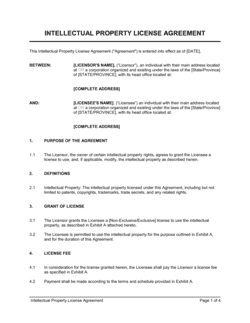
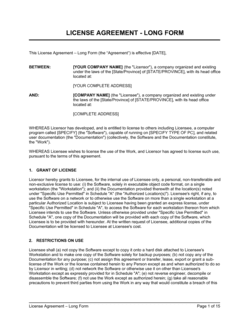
License Agreement to Install, Construct and Operate Template

Free Word download • Edit online • Save & share with Drive • Export to PDF

19 pages35–45 min to fillDifficulty: ComplexSignature requiredLegal review recommended
Learn more ↓
FreeLicense Agreement to Install, Construct and Operate Template

At a glance

What it is
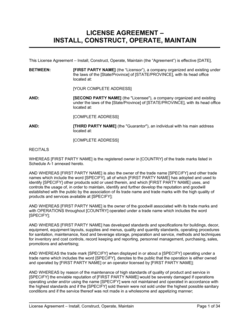
A License Agreement to Install, Construct, and Operate is a legally binding document that grants a licensee the right to access a third party's property for the purpose of installing, constructing, and operating specified equipment, structures, or facilities. This free Word download gives you a complete, professionally structured agreement you can edit online and export as PDF for immediate execution.
When you need it
Use it when a business needs to place physical infrastructure — such as telecommunications equipment, energy systems, pipelines, signage, or machinery — on land or within a building it does not own. It is also appropriate when a property owner wants to formally authorize and control third-party access for construction and ongoing operations.
What's inside
The agreement covers the grant of license and permitted use, a precise description of the licensed premises, installation and construction conditions, operational rights and restrictions, fee and compensation terms, insurance and indemnification obligations, term and termination provisions, and governing law. Together these clauses define exactly what the licensee may do, for how long, at what cost, and what happens when things go wrong.

What is a License Agreement to Install, Construct, and Operate?

A License Agreement to Install, Construct, and Operate is a legally binding contract that grants one party — the licensee — a defined, typically revocable right to access a property owned or controlled by another party — the licensor — for the specific purpose of installing equipment or structures, performing construction activities, and operating those installations over a stated term. Unlike a commercial lease, this type of agreement does not transfer exclusive possession of the property; the licensor retains ownership and general control while authorizing a narrowly scoped set of activities within a described area. The agreement governs what can be built, where, under what conditions, for how long, and at what cost, while allocating risk through insurance and indemnification obligations.

This document is most commonly used in telecommunications, renewable energy, utilities, and infrastructure industries where businesses need to place physical assets — cell towers, solar arrays, pipelines, signage, or specialized machinery — on land or within buildings they do not own. It is available as a free Word download that you can edit online, populate with your specific parties and property details, and export as a PDF for immediate execution.

Why You Need This Document

Operating on someone else's property without a written license agreement exposes both parties to serious risk. The licensor has no documented control over what is built, no guaranteed compensation, no insurance protection, and no enforceable removal obligation when the relationship ends — leaving them potentially responsible for dismantling infrastructure they never agreed to. The licensee, on the other hand, has no documented right to remain on the property, no protection against summary eviction, and no certainty about the term of their investment. Verbal permissions or informal arrangements have been invalidated by courts when properties change hands, leaving licensees to lose access to infrastructure representing hundreds of thousands of dollars in capital expenditure overnight.

A properly executed license agreement closes all of these gaps: it documents the permitted use, sets the fee structure, mandates insurance coverage, allocates liability, and creates enforceable restoration obligations that protect the property long after the licensee has departed. For any installation involving real capital expenditure, regulatory obligations, or a term longer than a few months, this agreement is not optional — it is the document that makes the entire arrangement enforceable and commercially sound. This template provides a complete, professionally structured starting point that can be adapted to your specific installation type and jurisdiction in under an hour.

Which variant fits your situation?

If your situation is…Use this template
Installing telecommunications equipment on a building rooftopRooftop License Agreement
Granting rights to use land for solar or wind energy infrastructureLand Lease Agreement for Renewable Energy
Placing a billboard or advertising structure on private propertySign License Agreement
Authorizing access to land for a defined period only, without constructionProperty Access Agreement
Granting long-term exclusive real property rights with full possessionCommercial Lease Agreement
Installing equipment inside a shared commercial facilityEquipment Installation and Service Agreement
Granting rights to extract resources from land alongside operational accessMineral Rights License Agreement

Common mistakes to avoid

❌ No site plan or exhibit attached

Why it matters: Without a mapped boundary, the licensee may install equipment beyond the area the licensor intended to grant, leading to encroachment claims and costly disputes.

Fix: Always attach a scaled site plan or survey diagram as a numbered exhibit and cross-reference it in the licensed premises clause. Both parties should initial the exhibit at signing.

❌ Fixed license fee with no escalation clause

Why it matters: On a 10-year or 15-year agreement, a static fee means the licensor receives below-market compensation as property values and operating costs increase.

Fix: Add an annual escalation provision — typically 2–3% per year or CPI adjustment — tied to a published index so neither party can dispute the calculation.

❌ Omitting the restoration and removal obligation

Why it matters: Without a clear removal deadline and cost-allocation provision, licensees have left behind towers, pipelines, and concrete foundations that cost the property owner tens of thousands of dollars to remove.

Fix: Include a specific removal deadline (e.g., 60 days after termination), state that restoration is at the licensee's sole cost, and give the licensor the right to remove and bill for removal if the deadline is missed.

❌ No termination-for-convenience right for the licensor

Why it matters: If the licensor sells the property, begins a redevelopment, or finds the installation incompatible with new uses, being locked in for the full term with no exit creates significant financial and operational harm.

Fix: Include a licensor termination-for-convenience clause with reasonable notice — typically 90 to 180 days for infrastructure — and specify whether any compensation is owed to the licensee for early termination.

❌ Treating the license as an easement

Why it matters: A license is a personal right that does not automatically bind future property owners. If the licensor sells the property, the new owner is not automatically bound by an unrecorded license, and the licensee may lose access overnight.

Fix: If continuity of access is critical, record a memorandum of the license agreement against the property title, and include a clause requiring the licensor to notify and bind any successor owner to the terms.

❌ Signing after construction has already begun

Why it matters: Work performed before a signed agreement exposes the licensor to unjust enrichment claims from the licensee and eliminates leverage over construction standards, insurance, and fees.

Fix: Execute all documents — agreement, exhibits, and insurance certificates — before the licensee takes possession or commences any site preparation or construction activity.

The 10 key clauses, explained

Grant of license and permitted use

In plain language: Establishes that the licensor grants a limited, non-exclusive right to access the property and defines exactly what the licensee is allowed to install, construct, and operate.

Sample language
[LICENSOR NAME] hereby grants to [LICENSEE NAME] a non-exclusive, revocable license to access the Licensed Premises located at [ADDRESS] for the sole purpose of installing, constructing, and operating [DESCRIPTION OF EQUIPMENT/FACILITY] as further described in Schedule A.

Common mistake: Describing permitted use too broadly — for example, 'all necessary activities' — which allows the licensee to expand operations beyond what was originally contemplated and creates disputes over scope.

Description of licensed premises

In plain language: Identifies the precise physical area covered by the license using a legal description, site plan, or coordinates so both parties agree on exactly what land or space is included.

Sample language
The Licensed Premises consists of approximately [X] square feet located at [SPECIFIC LOCATION DESCRIPTION], as depicted in the site plan attached hereto as Exhibit A, and incorporated by reference.

Common mistake: Using a verbal description only, without an attached site plan or survey. Vague boundary descriptions are a leading cause of encroachment disputes and costly litigation.

Installation and construction conditions

In plain language: Sets the rules for how and when construction may occur, including approval requirements for plans, compliance with building codes, working hours, and the licensor's right to inspect.

Sample language
Licensee shall submit construction plans to Licensor for written approval no fewer than [30] days prior to commencing work. All construction shall comply with applicable local building codes and shall be conducted between [HOURS] on [DAYS]. Licensor reserves the right to inspect the Licensed Premises at any time during construction with [24 hours'] notice.

Common mistake: Omitting a requirement for prior written approval of construction plans. Without it, the licensee can begin building non-conforming structures that the licensor has no contractual right to stop.

License fee and payment terms

In plain language: States the amount the licensee pays, the payment schedule, the method of payment, and what happens if payment is late — including interest or termination rights.

Sample language
Licensee shall pay Licensor a monthly license fee of $[AMOUNT], due on the [1st] day of each calendar month, via [PAYMENT METHOD]. Fees not received within [10] days of the due date shall accrue interest at [X]% per month. Licensor may terminate this Agreement upon [30] days' written notice if fees remain unpaid for [60] or more days.

Common mistake: Fixing the license fee for the entire term without an escalation clause. For multi-year agreements, this erodes the licensor's real return as costs and inflation rise.

Term and renewal

In plain language: Defines the start date, initial term length, and the process for renewal — whether automatic or by written notice — and the conditions under which renewal can be refused.

Sample language
This Agreement shall commence on [START DATE] and continue for an initial term of [X] years. This Agreement shall automatically renew for successive [1]-year periods unless either party provides written notice of non-renewal at least [90] days prior to the expiration of the then-current term.

Common mistake: Allowing automatic renewal with no fee escalation at each renewal. Licensees benefit from perpetual below-market rates while the licensor's opportunity cost grows.

Insurance requirements

In plain language: Specifies the types and minimum coverage amounts of insurance the licensee must maintain throughout the term, and requires the licensee to name the licensor as an additional insured.

Sample language
Licensee shall maintain, at its own expense, commercial general liability insurance with minimum limits of $[X,000,000] per occurrence and $[X,000,000] aggregate, naming [LICENSOR NAME] as an additional insured. Certificates of insurance shall be delivered to Licensor prior to commencement of any work.

Common mistake: Failing to require the licensor to be named as an additional insured. Without this, the licensor has no direct claim against the licensee's insurer if a third-party injury occurs on the licensed premises.

Indemnification and liability

In plain language: Allocates risk between the parties by requiring the licensee to defend and hold harmless the licensor from claims arising from the licensee's activities, and typically carves out the licensor's own negligence.

Sample language
Licensee shall indemnify, defend, and hold harmless Licensor and its officers, employees, and agents from and against any and all claims, damages, losses, and expenses, including reasonable attorneys' fees, arising out of or resulting from Licensee's installation, construction, operation, or use of the Licensed Premises, except to the extent caused by Licensor's gross negligence or willful misconduct.

Common mistake: Drafting an indemnification clause without a carve-out for the licensor's own gross negligence. Many jurisdictions refuse to enforce indemnification obligations that cover the indemnitee's own intentional or grossly negligent acts.

Restoration and removal obligations

In plain language: Requires the licensee to remove all installed equipment and structures and restore the premises to their original condition — or better — upon expiration or termination, at the licensee's sole cost.

Sample language
Upon expiration or earlier termination of this Agreement, Licensee shall, within [60] days, remove all equipment, structures, and improvements installed by Licensee and restore the Licensed Premises to substantially the same condition as existed prior to Licensee's entry, reasonable wear and tear excepted, at Licensee's sole cost and expense.

Common mistake: No specified timeframe for removal. Without a deadline, the licensee can delay removal indefinitely while the property owner is left with abandoned infrastructure and no legal mechanism to force clearance cheaply.

Termination for cause and convenience

In plain language: Identifies the events that allow either party to terminate early — including material breach, insolvency, regulatory non-compliance — and any termination-for-convenience right available to the licensor.

Sample language
Either party may terminate this Agreement upon [30] days' written notice if the other party materially breaches any provision and fails to cure such breach within [30] days of receiving written notice. Licensor may terminate this Agreement for convenience upon [90] days' written notice to Licensee.

Common mistake: Omitting a termination-for-convenience clause for the licensor. Without it, the licensor is trapped for the full term even if the licensed use becomes incompatible with a sale, redevelopment, or change in circumstances.

Governing law and dispute resolution

In plain language: Specifies which jurisdiction's law governs the agreement and establishes the mechanism for resolving disputes — arbitration, mediation, or litigation — and the venue.

Sample language
This Agreement shall be governed by the laws of the State of [STATE], without regard to its conflict-of-laws principles. Any dispute arising under this Agreement shall be resolved by binding arbitration administered by [AAA/JAMS] in [CITY, STATE], except that either party may seek injunctive or equitable relief in a court of competent jurisdiction.

Common mistake: Selecting a governing law jurisdiction with no connection to the property's physical location. Courts in several states apply local property law to land-based agreements regardless of the contractual choice-of-law provision.

How to fill it out

  1. 1

    Identify and name the parties correctly

    Enter the full legal names of both the licensor and licensee — use registered entity names, not trade names or abbreviations. Include the state or country of incorporation and the registered address for each party.

    💡 Confirm the licensor is the actual owner of record or has authority to grant a license — a tenant cannot license rights they do not hold.

  2. 2

    Describe the licensed premises with precision

    Provide a legal description or address, attach a site plan or survey diagram as Exhibit A, and specify the exact square footage or area. Reference the exhibit in the body of the agreement so it is incorporated by law.

    💡 Commission a simple site sketch or use a scaled floor plan even for small installations — the cost is trivial compared to a boundary dispute.

  3. 3

    Define the permitted use narrowly

    List the specific equipment, structures, or systems the licensee is authorized to install and operate. Anything not listed is excluded — be specific about model types, quantities, and operational scope where relevant.

    💡 Future-proof the permitted use clause by specifying technology upgrades or replacements are covered only if capacity and footprint remain within stated limits.

  4. 4

    Set the license fee with an escalation mechanism

    State the initial fee amount, payment frequency, and due date. Add an annual escalation clause — typically tied to CPI or a fixed percentage (e.g., 2–3% per year) — so the fee keeps pace with inflation over multi-year terms.

    💡 For revenue-generating installations like cell towers, consider a hybrid structure: a base fee plus a percentage of gross revenue from the site.

  5. 5

    Specify term, renewal, and notice periods

    Enter the start date, initial term length, automatic-renewal cycle, and the advance notice period required to prevent renewal. Confirm that the notice period is long enough for the licensor to plan for alternative uses.

    💡 A 90-day non-renewal notice period is standard for infrastructure installations; 30 days is too short for the licensor to find replacement revenue or plan a construction project.

  6. 6

    Complete the insurance and indemnification requirements

    Insert minimum coverage amounts appropriate to the risk level of the installation — $2M per occurrence is a common baseline for heavy infrastructure. Confirm the licensor is named as an additional insured and request a certificate before work begins.

    💡 Ask your insurance broker for the coverage minimums typical in your industry — under-insuring exposes the licensor to unrecovered losses and may void coverage in a serious claim.

  7. 7

    Set the restoration obligations and removal deadline

    Specify that all structures must be removed and the premises restored within a defined number of days after termination. Include a provision allowing the licensor to remove abandoned equipment at the licensee's expense if the deadline is missed.

    💡 Add a security deposit equal to one to three months' license fee, held against restoration obligations — particularly important for permanent structures or subsurface installations.

  8. 8

    Execute before any work begins

    Both parties must sign the agreement — and any required exhibits — before the licensee enters the property. Ensure the date of execution is recorded and that both parties retain a fully executed original.

    💡 For high-value infrastructure projects, use witnessed or notarized signatures and record a memorandum of the license against the property title to protect the licensee from a subsequent property sale that could eliminate the license.

Frequently asked questions

What is a license agreement to install, construct, and operate?

A license agreement to install, construct, and operate is a legal contract that grants one party the limited, typically revocable right to access another party's property for the purpose of placing, building, and running specified equipment or structures. Unlike a lease, it does not grant exclusive possession of the property. Common uses include telecommunications towers, solar installations, pipelines, signage, and kiosks placed on land or buildings the licensee does not own.

What is the difference between a license and a lease for property use?

A lease transfers an exclusive possessory interest in real property — the tenant has the right to exclude others, including the landlord, from the leased space. A license is a personal permission to use property for a specific purpose; it does not transfer possession and is generally revocable. Licenses are typically easier to terminate and do not automatically bind future owners of the property, making them more flexible for infrastructure arrangements where the owner needs to retain control of the land.

Does a license agreement need to be recorded with the property title?

Recording is not legally required for a license to be valid between the original parties, but it is strongly advisable for long-term or high-value installations. Without recording, a buyer of the property takes title free of any unrecorded license, meaning the licensee can lose access when the property changes hands. Recording a memorandum of the license agreement against the title protects the licensee and puts prospective buyers on notice of the existing arrangement.

What permits are typically required before installation begins?

Required permits vary by installation type, jurisdiction, and property location. Most construction activities require a building permit from the local municipality. Telecommunications equipment may require zoning approvals or FCC registration. Energy installations often need utility interconnection approvals. Environmental permits apply to installations near waterways or protected lands. The license agreement should state that the licensee is solely responsible for obtaining all necessary permits before work begins.

Can a licensor terminate the agreement and require removal of installed equipment?

Yes, if the agreement includes a termination-for-cause or termination-for-convenience clause. Upon termination, the licensor can typically require the licensee to remove all installed structures and restore the premises within a defined period. If the agreement does not address removal, the licensor may face a legal dispute over whether installed structures have become fixtures that transfer with the land. Always include explicit restoration and removal obligations with a deadline and cost-allocation provision.

How is the license fee typically calculated for infrastructure installations?

License fees vary widely depending on property type, location, and the commercial value of the installation. Flat monthly fees are most common for straightforward equipment placements. Revenue-sharing structures — where the licensor receives a percentage of the licensee's gross revenues from the site — are standard in telecommunications tower agreements. Multi-year agreements typically include annual escalation of 2–3% or a CPI-linked adjustment. A fair market appraisal is advisable for any installation expected to generate significant revenue from the licensed site.

Who is responsible for damage to the property during installation or operation?

The licensee is generally responsible for any damage caused by its installation, construction, or operational activities. The indemnification clause in the agreement should allocate this responsibility explicitly, requiring the licensee to compensate the licensor for any losses arising from the licensee's activities. The insurance requirements clause backs this up by mandating that the licensee carry adequate coverage and name the licensor as an additional insured so the licensor has a direct claim against the policy.

Can the licensee assign the agreement to a third party?

Only if the agreement expressly permits it. Most license agreements restrict assignment without the licensor's prior written consent, which protects the licensor from having the license transferred to a party they did not vet or approve. Licensees operating in industries with frequent asset sales — such as telecommunications or energy — often negotiate a carve-out allowing assignment to affiliates or in connection with a sale of substantially all business assets, subject to the assignee assuming all obligations under the agreement.

Do I need a lawyer to draft this type of agreement?

For low-value, short-term installations on non-sensitive property, a high-quality template is generally sufficient. Legal review is advisable when the installation involves significant capital expenditure, when the term exceeds three years, when the property is in a regulated zone (floodplain, heritage site, or near utilities), or when the licensee will generate material revenue from the site. A one-to-two hour attorney review typically costs $400–$800 and provides meaningful protection relative to the investment in the installation.

How this compares to alternatives

vs Commercial Lease Agreement

A commercial lease grants the tenant exclusive possession of a defined space, creating a landlord-tenant relationship with statutory protections and obligations. A license agreement grants a limited, non-possessory right of access for a specific purpose without exclusive possession. Licenses are generally easier to terminate and do not carry the same statutory tenant protections, making them more appropriate for equipment placements and infrastructure installations than for occupied business premises.

vs Easement Agreement

An easement is a real property right that runs with the land and binds all future owners automatically. A license is a personal right that is generally revocable and does not bind successors unless recorded and structured carefully. Easements are more appropriate when permanent, irrevocable access is essential — such as utility corridors. Licenses are preferred when the property owner wants to retain maximum control and the ability to terminate or renegotiate over time.

vs Independent Contractor Agreement

An independent contractor agreement governs the relationship between a business and a service provider performing defined work for compensation. A license agreement governs property access and use rights. Where a contractor is hired to install equipment on a client's property, both documents may be needed: the contractor agreement covers the work and payment, while the license agreement covers the ongoing right to operate the installed equipment after the construction phase is complete.

vs Property Access Agreement

A property access agreement grants temporary, typically one-time entry to a property for inspection, surveying, or due diligence — with no right to construct or leave permanent installations. A license agreement to install, construct, and operate grants ongoing access for the full term to build, maintain, and run equipment. Use a property access agreement at the pre-construction phase and transition to a full license agreement once construction and operational rights have been negotiated.

Industry-specific considerations

Telecommunications

Tower, antenna, and conduit installations require precise site plans, RF interference clauses, access-at-all-hours provisions, and revenue-share fee structures tied to colocation agreements.

Renewable Energy

Solar and wind installations involve long initial terms of 20–30 years, environmental compliance obligations, utility interconnection conditions, and decommissioning bonds ensuring full site restoration.

Retail and Hospitality

Kiosk, vending machine, and ATM placements in host properties use short renewal cycles, gross-revenue royalty structures, and maintenance obligation splits between the operator and the property owner.

Construction and Infrastructure

Pipeline, utility, and access-road installations require environmental permits, right-of-entry insurance, safety compliance obligations, and detailed restoration specifications tied to engineering standards.

Jurisdictional notes

United States

License agreements for land-based installations are primarily governed by state property law. Recording a memorandum of the license against the title is advisable in all states to protect the licensee from bona fide purchasers. Telecommunications installations on private property may also be subject to FCC regulations and local zoning ordinances. California, New York, and Texas have specific statutory frameworks affecting license duration, termination rights, and fixture ownership that should be reviewed before execution.

Canada

Canadian provinces each maintain their own land title and real property legislation. In Ontario, British Columbia, and Alberta, licenses can be registered as interests against title under provincial land title systems to bind future owners. Quebec operates under civil law, where the distinction between personal and real rights differs from common-law provinces — agreements affecting immovable property should be reviewed by a Quebec notary for Quebec-based installations. Municipal zoning approvals are required for most structural installations regardless of province.

United Kingdom

In England and Wales, a license does not create an interest in land and is therefore not registrable at HM Land Registry, which limits protection against a change of ownership. Where continuity of access is critical, parties may prefer a formal easement or a lease registered at the Land Registry. Scottish law treats licenses similarly but operates under a distinct legal system. Planning permission from the local authority is required for most permanent structures, and certain telecommunications equipment benefits from permitted development rights under the Electronic Communications Code.

European Union

EU member states apply their own property and contract law to license agreements, with no unified EU-level framework for land-use licenses. Germany, France, and the Netherlands each have distinct rules governing the distinction between leases and licenses, and local courts may recharacterize a license as a lease — triggering stronger statutory tenant protections — if the licensee has exclusive use. GDPR compliance is relevant where the licensed installation involves data collection or processing, such as telecommunications or smart-city infrastructure. Environmental impact assessments may be required for larger installations under EU Directive 2011/92/EU.

Template vs lawyer — what fits your deal?

PathBest forCostTime
Use the templateShort-term or low-value installations on uncontested private property where both parties are sophisticated and the installation involves no permanent structuresFree30–45 minutes
Template + legal reviewMulti-year agreements, revenue-generating installations, or property in regulated or sensitive zones$400–$800 (1–2 hour attorney review)2–5 business days
Custom draftedTelecommunications tower agreements, long-term energy infrastructure, government-owned land, or installations with material capital expenditure exceeding $100,000$2,000–$8,000+2–6 weeks

Glossary

Licensor
The property owner or rights holder who grants permission for installation, construction, and operation activities on their premises.
Licensee
The party that receives the limited right to access, install, construct, and operate on the licensor's property under the terms of the agreement.
Licensed Premises
The specifically described portion of the property — including coordinates, square footage, or a site plan — where the licensee is authorized to operate.
License Fee
Periodic compensation paid by the licensee to the licensor in exchange for the rights granted, typically structured as a fixed monthly amount or a percentage of revenue.
Revocable License
A license that the licensor may cancel at will or upon defined notice, as opposed to an irrevocable license that runs for a fixed term regardless of the licensor's wishes.
Easement
A real property right that, unlike a license, runs with the land and binds future owners — licenses are personal rights that do not automatically transfer with the property.
Restoration Obligation
The licensee's contractual duty to return the licensed premises to their original condition upon expiration or termination, including removing installed structures.
Indemnification
A contractual obligation by one party to compensate the other for losses, damages, or legal costs arising from specified events — typically negligence or breach.
Force Majeure
A clause excusing a party's non-performance when extraordinary events beyond their control — floods, earthquakes, government actions — make performance impossible.
Holdover
The situation where a licensee continues to occupy and use the licensed premises after the agreement's expiration without executing a renewal, typically triggering increased fees or liability.
Assignment
The transfer of a party's rights and obligations under the agreement to a third party, which typically requires the other party's written consent in license agreements.
Permitted Use
The specific activities the licensee is authorized to perform on the licensed premises, listed explicitly in the agreement to limit the scope of the grant.

Part of your Business Operating System

This document is one of 3,000+ business & legal templates included in Business in a Box.

  • Fill-in-the-blanks — ready in minutes
  • 100% customizable Word document
  • Compatible with all office suites
  • Export to PDF and share electronically

Create your document in 3 simple steps.

From template to signed document — all inside one Business Operating System.
1
Download or open template

Access over 3,000+ business and legal templates for any business task, project or initiative.

2
Edit and fill in the blanks with AI

Customize your ready-made business document template and save it in the cloud.

3
Save, Share, Send, Sign

Share your files and folders with your team. Create a space of seamless collaboration.

Save time, save money, and create top-quality documents.

★★★★★

"Fantastic value! I'm not sure how I'd do without it. It's worth its weight in gold and paid back for itself many times."

Managing Director · Mall Farm
Robert Whalley
Managing Director, Mall Farm Proprietary Limited
★★★★★

"I have been using Business in a Box for years. It has been the most useful source of templates I have encountered. I recommend it to anyone."

Business Owner · 4+ years
Dr Michael John Freestone
Business Owner
★★★★★

"It has been a life saver so many times I have lost count. Business in a Box has saved me so much time and as you know, time is money."

Owner · Upstate Web
David G. Moore Jr.
Owner, Upstate Web

Run your business with a system — not scattered tools

Stop downloading documents. Start operating with clarity. Business in a Box gives you the Business Operating System used by over 250,000 companies worldwide to structure, run, and grow their business.

Free Forever Plan · No credit card required