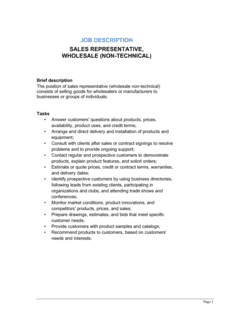
Interview Guide Sales Representative_Wholesale (Non-technical)

Free to read β€’ Save or share with one click

FreeInterview Guide Sales Representative_Wholesale (Non-technical) Template

At a glance

What it is
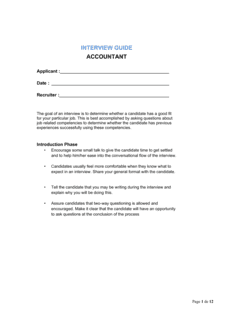
An Interview Guide for a Sales Representative (Wholesale, Non-Technical) is a structured document that equips hiring managers with a consistent set of scored questions, evaluation criteria, and rating scales for assessing candidates for a wholesale sales role. This free Word download gives you a ready-to-use interview framework you can edit online and export as PDF for use across every interviewer on your panel.
When you need it
Use it whenever you are hiring for a wholesale sales role β€” whether it is your first rep, a backfill, or a team expansion β€” to ensure every candidate is evaluated against the same competencies and none are hired or rejected for the wrong reasons.
What's inside
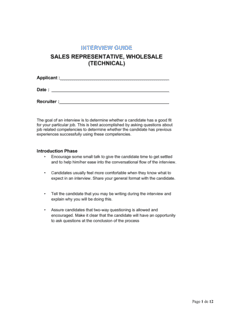
Role context and interview instructions, competency-based and behavioral questions covering territory management, relationship selling, pipeline discipline, and objection handling, plus a scored rating rubric, red-flag indicators, and a final recommendation section for consolidating panel feedback.

What is an Interview Guide for a Sales Representative (Wholesale, Non-Technical)?

An Interview Guide for a Sales Representative β€” Wholesale, Non-Technical is a structured evaluation document that equips hiring managers and interview panels with a consistent set of competency-based questions, behavioral prompts, scoring rubrics, and a panel recommendation framework for assessing candidates applying for a wholesale field sales role. Unlike an unscripted interview or a generic question list, this guide maps every question to a measurable competency β€” territory management, buyer relationship development, pipeline discipline, objection handling, and performance metrics β€” and provides anchor descriptions so that a "strong" answer means the same thing to every interviewer on the panel.

Why You Need This Document

Without a structured interview guide, hiring decisions for sales roles default to first-impression bias and interviewer instinct β€” which research consistently shows predicts first-year quota attainment poorly. In wholesale sales, where the cost of a bad hire includes lost territory coverage, damaged buyer relationships, and a six-month ramp cycle wasted, an unstructured process is an expensive gamble. Candidates who perform well in unscripted conversations are not always the ones who will build account relationships, manage a territory plan, or consistently close reorders. This template gives every panelist the same framework β€” scored before the debrief call, not shaped by the most vocal voice in the room β€” so your hiring decision is grounded in job-relevant evidence rather than chemistry alone.

Which variant fits your situation?

If your situation is…Use this template
Hiring a technical sales engineer or pre-sales consultantInterview Guide Sales Engineer
Evaluating a candidate for a retail sales floor roleInterview Guide Retail Sales Associate
Assessing a senior sales manager or VP of Sales candidateInterview Guide Sales Manager
Interviewing a candidate for an inside sales or SDR roleInterview Guide Inside Sales Representative
Screening candidates for a key account or national accounts roleInterview Guide Key Account Manager
Evaluating a candidate for a customer service representative roleInterview Guide Customer Service Representative
Running a structured onboarding process after the hire is madeSales Representative Onboarding Plan

Common mistakes to avoid

❌ Asking hypothetical questions instead of behavioral ones

Why it matters: Questions like 'What would you do if a buyer rejected your price?' reveal how a candidate thinks in theory, not how they actually perform under pressure. Past behavior is a far stronger predictor of future performance.

Fix: Replace every 'what would you do' question with 'tell me about a time when' β€” then follow up with 'what was the outcome?' to confirm the example is real and complete.

❌ Skipping the scoring rubric and relying on gut feel

Why it matters: Interviewers who score from memory after three back-to-back sessions produce wildly inconsistent ratings, and gut-feel hiring in sales roles correlates poorly with first-year quota attainment.

Fix: Require all interviewers to complete the rubric in writing within two hours of the interview, before the debrief call, using the anchor descriptions rather than a personal impression.

❌ Accepting activity descriptions instead of outcome data

Why it matters: A candidate who says 'I called on 50 accounts a month' but cannot state their quota attainment, close rate, or revenue growth has described effort, not results. Wholesale sales roles pay for outcomes.

Fix: For every claim about sales activity, follow up with 'and what did that produce in revenue or attainment?' β€” if the candidate cannot answer, treat it as a yellow flag.

❌ Using the same guide for technical and non-technical sales roles

Why it matters: Technical sales roles require product-knowledge evaluation, demo assessment, and solution-design questions that are irrelevant β€” and misleading β€” when scoring a relationship-driven wholesale rep candidate.

Fix: Use a role-specific guide that focuses on territory management, buyer relationship depth, and distribution-channel knowledge rather than product specifications or technical demonstrations.

❌ Conducting the panel debrief before interviewers record independent scores

Why it matters: Once a senior interviewer shares a strong positive or negative view, anchoring bias causes other panelists to revise their scores toward the group consensus β€” erasing the value of a structured process.

Fix: Enforce a rule that all scoresheets are submitted before the debrief call begins. Use a shared form or ATS scorecard field with a submission timestamp to make this enforceable.

❌ Omitting a red-flag section from the guide

Why it matters: Without defined red flags, interviewers have no standard for when to escalate a concern β€” a candidate who cannot name a single lost deal or refuses to state a quota number may sail through a panel that has no shared risk criteria.

Fix: Add a red-flag checklist to the guide (e.g., 'unable to state quota attainment', 'no specific account examples', 'blames all losses on factors outside their control') so every panelist flags the same warning signs.

The 10 key sections, explained

Interview header and role context

Interview instructions for the hiring panel

Opening and rapport-building questions

Territory and account management questions

Relationship selling and buyer engagement questions

Pipeline management and prospecting questions

Objection handling and negotiation questions

Achievement and performance metrics questions

Scoring rubric and rating summary

Panel debrief notes and hiring recommendation

How to fill it out

  1. 1

    Complete the interview header before the session

    Fill in the candidate name, date, role, territory or region, and the interviewer's name. Distribute a completed header to every panelist so they share the same role frame of reference.

    πŸ’‘ Include the job requisition number if you use an ATS β€” it simplifies attaching scoresheets to the candidate record after the interview.

  2. 2

    Brief all interviewers on how to use the scoring rubric

    Walk the panel through the 1–5 scale and the anchor descriptions before the first interview. Confirm that each interviewer will score independently before sharing ratings.

    πŸ’‘ A 15-minute panel calibration call before the first interview round reduces score variance by ensuring everyone applies the same standard to 'strong' versus 'adequate' answers.

  3. 3

    Assign question sections to specific interviewers

    Divide the guide so each interviewer owns one or two sections β€” for example, the hiring manager covers achievement metrics and territory management, while HR covers opening questions and panel logistics.

    πŸ’‘ Avoid having every interviewer ask all sections β€” candidates notice repeated questions across back-to-back interviews and give rehearsed answers by the second session.

  4. 4

    Ask the behavioral questions exactly as written

    Read each behavioral question verbatim for the first delivery. If the candidate gives a vague or general answer, follow up with the probing question listed beneath it.

    πŸ’‘ The most productive probe for any vague answer is 'Can you give me a specific example from your last role?' β€” use it any time a candidate describes what they 'typically do' rather than what they actually did.

  5. 5

    Record the candidate's answer in the notes field immediately

    Write brief notes β€” key phrases, numbers, and specific account or deal references β€” in real time. Do not rely on memory when completing the score after the interview.

    πŸ’‘ Note any number the candidate volunteers β€” quota, close rate, account count, revenue β€” these are the data points that differentiate strong performers from average ones during panel debrief.

  6. 6

    Score each question before the panel debrief

    Complete your scores and recommendation section within two hours of the interview, while details are fresh. Lock your scores before joining the debrief call.

    πŸ’‘ If you find yourself unable to score a question because the candidate gave no real answer, record a 1 and note 'no specific example provided' β€” do not leave blanks for the debrief to fill in.

  7. 7

    Consolidate panel scores and make the hiring decision

    On the debrief call, each interviewer shares their weighted total and top concern before any group discussion. Calculate the average weighted score across panelists to anchor the conversation.

    πŸ’‘ A candidate who scores a 5 from one panelist and a 1 from another on the same competency is more interesting β€” and more risky β€” than one who scores 3s across the board. Investigate score outliers before deciding.

Frequently asked questions

What is an interview guide for a wholesale sales representative?

An interview guide for a wholesale sales representative is a structured document that gives hiring managers and interviewers a consistent set of scored, competency-based questions for evaluating candidates for a non-technical field or territory sales role in a wholesale or distribution context. It includes opening questions, behavioral questions covering territory management and relationship selling, a scoring rubric, and a panel recommendation section β€” so every candidate is assessed against the same criteria.

What questions should you ask a wholesale sales rep candidate?

Effective questions focus on five competency areas: territory and account planning, relationship development with wholesale buyers, pipeline discipline and prospecting habits, objection handling on price and competition, and quantified performance metrics such as quota attainment and close rate. Behavioral questions in the STAR format β€” 'tell me about a time when' β€” produce more useful data than hypothetical questions about what the candidate would do in a given situation.

What is the difference between a technical and non-technical sales interview guide?

A technical sales interview guide includes sections for assessing product or solution knowledge, demo delivery, and the ability to translate technical specifications into customer value β€” skills relevant for engineering, SaaS, or medical device sales roles. A non-technical guide focuses on relationship-selling skills, territory organization, buyer negotiation, and pipeline management β€” the competencies that drive performance in wholesale, distribution, and commodity sales environments.

How do you score a sales interview fairly across multiple interviewers?

Use a numeric rubric with anchor descriptions for each score level β€” for example, a 1 means no specific example was provided, a 3 means a clear example with partial outcome data, and a 5 means a specific, quantified example with a clear result. Require each interviewer to submit scores independently before the panel debrief. Then average weighted scores across interviewers to anchor the group discussion rather than letting the most senior voice dominate.

How many interviewers should be on a wholesale sales rep panel?

Two to three interviewers is the standard for a non-technical sales rep role β€” typically the direct hiring manager, an HR or recruiting partner, and optionally a peer or cross-functional stakeholder such as a customer service lead or a senior sales rep. More than four panelists adds scheduling friction without meaningfully improving prediction accuracy. Each interviewer should own a distinct section of the guide rather than covering all questions.

Can this interview guide be used for both in-person and video interviews?

Yes. The guide is format-agnostic β€” the behavioral questions, scoring rubric, and panel debrief structure work identically in person, over video, or in a phone screen. For video interviews, add a note in the instructions section reminding interviewers to allow for connection lag before marking a candidate as slow to respond, and to complete their scoresheet immediately after the session rather than between back-to-back calls.

What red flags should I watch for when interviewing a wholesale sales rep?

Key red flags include an inability to state a specific quota attainment percentage, no concrete examples of managing a territory plan or account tiering, attributing every lost deal entirely to external factors like pricing or product, an inability to name a specific buyer relationship they built from scratch, and vague pipeline descriptions with no numbers. A strong wholesale sales rep can speak in specifics β€” revenue, account count, close rate, call frequency β€” without being prompted repeatedly.

How often should a sales interview guide be updated?

Review the guide at least once a year or after any significant change in the role β€” new territories, a shift in your buyer profile, updated compensation structure, or a change in the products being sold. Also update it after each hiring cycle by reviewing which questions produced the most useful differentiation between candidates and which generated uniformly vague answers that should be reframed.

How this compares to alternatives

vs Interview Guide Sales Manager

A sales manager interview guide evaluates leadership competencies β€” team coaching, pipeline review cadence, performance management, and hiring. A wholesale sales rep guide focuses on individual contributor skills: territory coverage, buyer relationships, and personal quota attainment. Using the manager guide for a rep hire produces misaligned scoring and misleads the panel.

vs Interview Guide Inside Sales Representative

An inside sales guide emphasizes high-volume outbound activity, scripted prospecting, CRM hygiene, and metrics like dials per day and conversion from call to demo. A wholesale guide focuses on in-person buyer relationships, territory management, and order-based selling cycles. The two roles require different competencies and should never share the same evaluation instrument.

vs Job Description Sales Representative

A job description defines what the role requires and is used to attract candidates. An interview guide is used after candidates apply to evaluate how well each person meets those requirements. Both documents should reference the same competencies, but the interview guide adds scored questions, rubrics, and debrief structure that a job description cannot provide.

vs Performance Review Sales Representative

A performance review evaluates an employee's results against agreed targets after they are in the role. An interview guide assesses a candidate's potential before they are hired. The competencies overlap β€” quota attainment, pipeline management, relationship depth β€” but the performance review uses actual data while the interview guide uses behavioral evidence from past roles.

Industry-specific considerations

Wholesale Distribution

Focus on territory call planning, buyer relationship tenure, and reorder rate as the primary performance metrics evaluated in the interview.

Food and Beverage

Assess experience with route-based selling, shelf placement negotiation, and managing high-frequency buyer touchpoints with grocery and foodservice accounts.

Building Materials and Construction Supply

Evaluate experience selling to contractors and trade buyers, managing project-based pipeline timing, and handling margin pressure from competing distributors.

Consumer Goods and Retail Distribution

Probe for experience managing retailer or distributor accounts, handling deductions and returns, and executing promotional sell-in conversations with buyers.

Template vs pro β€” what fits your needs?

PathBest forCostTime
Use the templateSales managers and HR teams hiring non-technical wholesale sales reps without a dedicated recruiting functionFree30–60 minutes to customize per role
Template + professional reviewGrowing distribution businesses standardizing interview processes across multiple hiring managers or regions$200–$500 for an HR consultant or talent advisor review2–3 days
Custom draftedEnterprise distributors or staffing agencies building a validated, psychometrically calibrated competency framework for high-volume sales hiring$2,000–$8,000 for an I/O psychologist or organizational assessment firm3–6 weeks

Glossary

Competency-Based Interview
An interview format that evaluates candidates against a defined set of job-relevant skills and behaviors using structured, scored questions.
Behavioral Question
A question that asks a candidate to describe a past situation to predict future performance, typically using the STAR format.
STAR Format
A structured answer framework β€” Situation, Task, Action, Result β€” used to evaluate the quality and completeness of a candidate's behavioral response.
Scoring Rubric
A predefined scale (typically 1–5) that defines what a weak, acceptable, and strong answer looks like for each interview question.
Pipeline Discipline
A candidate's demonstrated ability to systematically build, manage, and advance a sales pipeline rather than relying on reactive or inbound opportunities.
Territory Management
The skill of organizing and prioritizing a geographic or account-based sales territory to maximize coverage, call efficiency, and revenue per account.
Objection Handling
The ability to address buyer concerns β€” on price, competition, timing, or need β€” in a way that advances the sale rather than stalling it.
Wholesale Sales Cycle
The end-to-end process of acquiring and retaining a business buyer β€” from prospecting and first contact through negotiation, order placement, and reorder management.
Red-Flag Indicator
A candidate response or behavior during the interview that signals a meaningful risk β€” such as inability to name a lost deal or refusal to discuss specific numbers.
Panel Interview
An interview format in which two or more interviewers assess the same candidate simultaneously or sequentially, then consolidate feedback using a shared scoring guide.

Part of your Business Operating System

This document is one of 3,000+ business & legal templates included in Business in a Box.

  • Fill-in-the-blanks β€” ready in minutes
  • Compatible with all office suites
  • Export to PDF and share electronically

Create your document in 3 simple steps.

From template to signed document β€” all inside one Business Operating System.
1
Download or open template

Access over 3,000+ business and legal templates for any business task, project or initiative.

2
Edit and fill in the blanks with AI

Customize your ready-made business document template and save it in the cloud.

3
Save, Share, Send, Sign

Share your files and folders with your team. Create a space of seamless collaboration.

Save time, save money, and create top-quality documents.

β˜…β˜…β˜…β˜…β˜…

"Fantastic value! I'm not sure how I'd do without it. It's worth its weight in gold and paid back for itself many times."

Managing Director Β· Mall Farm
Robert Whalley
Managing Director, Mall Farm Proprietary Limited
β˜…β˜…β˜…β˜…β˜…

"I have been using Business in a Box for years. It has been the most useful source of templates I have encountered. I recommend it to anyone."

Business Owner Β· 4+ years
Dr Michael John Freestone
Business Owner
β˜…β˜…β˜…β˜…β˜…

"It has been a life saver so many times I have lost count. Business in a Box has saved me so much time and as you know, time is money."

Owner Β· Upstate Web
David G. Moore Jr.
Owner, Upstate Web

Run your business with a system β€” not scattered tools

Stop downloading documents. Start operating with clarity. Business in a Box gives you the Business Operating System used by over 250,000 companies worldwide to structure, run, and grow their business.

Free Forever PlanΒ Β·Β No credit card required