1
Define your employment classifications first
Before writing any policy, decide how you classify workers — full-time, part-time, temporary, and contractor — and what each classification means for benefits eligibility. These definitions cascade through every other section.
💡 Align your FLSA exempt and non-exempt classifications with actual job duties before publishing — misclassification is one of the most common and costly HR compliance errors.
2
Draft the EEO and anti-harassment policy
State your non-discrimination commitment, list protected classes under applicable federal, state, and local law, and name a specific reporting channel for complaints. Define what an investigation looks like.
💡 Check your state's protected class list — many states add categories beyond federal law, including sexual orientation, gender identity, and military status.
3
Write compensation and payroll policies
Specify pay periods, payday schedule, overtime eligibility by classification, and how expense reimbursements are processed. Include a clear statement about paycheck corrections.
💡 State your jurisdiction's final pay rules explicitly — some states require final wages within 24–72 hours of termination, and handbook silence creates risk.
4
Outline leave and time-off policies
Cover PTO accrual or grant method, sick leave, all statutory leaves (FMLA, state parental leave, bereavement, jury duty), and the request-and-approval process. State what happens to unused PTO at separation.
💡 In states with mandatory sick leave laws (California, New York, Illinois, and others), your accrual rate must meet or exceed the statutory minimum — confirm before publishing.
5
Write the code of conduct
Address professionalism, conflicts of interest, confidentiality, social media, and workplace relationships. Be specific about what constitutes a conflict and how to disclose it.
💡 Have your social media and confidentiality sections reviewed against NLRA guidance — overbroad restrictions on discussing wages or working conditions are routinely struck down by the NLRB.
6
Document disciplinary procedures and grounds for termination
Describe your progressive discipline steps and list conduct categories — misconduct, gross negligence, fraud — that may result in immediate termination. Add a catch-all for serious violations not explicitly listed.
💡 Avoid the word 'will' in discipline policies — 'the company will issue a written warning' creates an obligation. Use 'may' to preserve management discretion.
7
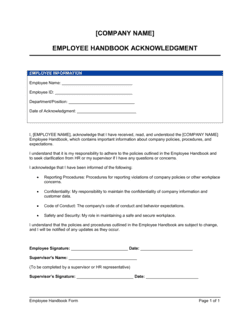
Add the at-will disclaimer and acknowledgment form
Include a clear statement that the handbook is not an employment contract and does not alter at-will status. Attach a detachable acknowledgment form employees sign and return to HR.
💡 Store signed acknowledgment forms in each employee's personnel file — electronic or paper. In a wrongful termination claim, this is often the first document your attorney will ask for.
8
Review for consistency and distribute
Read the complete handbook for internal contradictions — especially between the discipline section and termination policy. Have a manager or HR professional who was not involved in drafting review it cold before distribution.
💡 Date-stamp every version and retain superseded copies. When a policy is updated, distribute a written notice and collect a new acknowledgment from all affected employees.