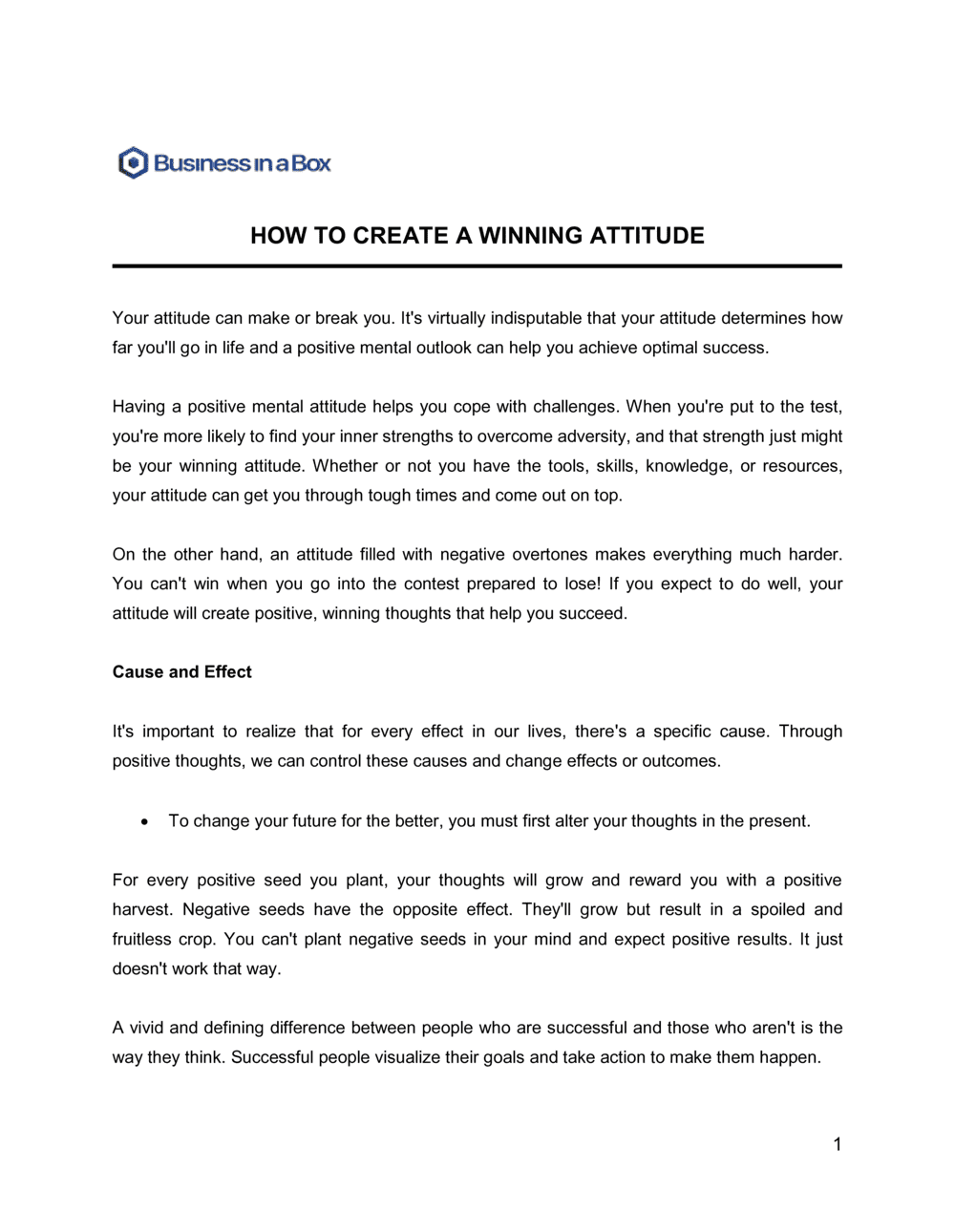
How To Create A Winning Attitude

Free to read β€’ Save or share with one click

FreeHow To Create A Winning Attitude Template

At a glance

What it is
How To Create A Winning Attitude is a structured guide that gives managers, coaches, and team leaders a repeatable framework for building and sustaining a high-performance mindset across individuals and teams. This free Word download lays out the principles, habits, and reinforcement strategies that translate a positive attitude into measurable results β€” edit it online and share it as PDF with your staff, sales team, or coaching clients.
When you need it
Use it when onboarding new team members, relaunching a team after a setback, rolling out a culture initiative, or preparing managers to coach performance through mindset rather than just metrics.
What's inside
A mindset assessment baseline, goal-alignment exercises, resilience and self-talk frameworks, daily habit protocols, feedback and accountability structures, and reinforcement strategies for sustaining attitude over time.

What is a How To Create A Winning Attitude guide?

A How To Create A Winning Attitude guide is a structured operational document that gives managers, coaches, and team leaders a repeatable framework for building a high-performance mindset across individuals and teams. It moves beyond inspirational language to provide concrete exercises, daily habit protocols, self-talk reframe scripts, resilience response procedures, and accountability structures that translate attitude principles into observable, measurable behaviors. Unlike a one-off motivational resource, this guide is designed to be facilitated over 30 to 90 days, with built-in measurement to show whether attitude and behavior have actually shifted.

Why You Need This Document

Teams and individuals operating without a structured attitude framework default to whatever mindset habits they already have β€” including avoidance, blame, and withdrawal under pressure β€” because no one has given them a better protocol. The cost of that default is concrete: missed follow-ups after rejection, low initiative in ambiguous situations, slow recovery from setbacks, and disengagement during high-pressure periods. A winning attitude guide closes that gap by giving every participant a personal baseline, a named set of principles, a daily practice, and an accountability partner before the first challenge arrives. This template gives you the complete structure to run that program yourself β€” no external consultant required for teams of up to 20 people β€” so the investment is 90 days of facilitation, not a five-figure L&D budget.

Which variant fits your situation?

If your situation is…Use this template
Running a structured mindset workshop over one or two daysWorkshop Facilitation Guide
Creating a 30-60-90 day onboarding plan with mindset components30-60-90 Day Plan
Setting individual performance goals tied to attitude metricsEmployee Performance Improvement Plan
Building a full team culture document beyond individual attitudeCompany Culture Plan
Coaching a single employee through a persistent attitude issueEmployee Coaching Plan
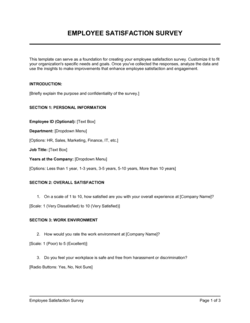
Measuring team engagement and attitude before and after the programEmployee Satisfaction Survey
Reinforcing winning attitude principles in a formal training curriculumEmployee Training Plan

Common mistakes to avoid

❌ Delivering the guide as a one-time event with no follow-up

Why it matters: A single session creates short-term enthusiasm but no lasting behavior change. Research on habit formation consistently shows that new behavioral patterns require 30–66 days of reinforcement before they stabilize.

Fix: Build in at least four scheduled touchpoints β€” a kick-off, a 2-week check-in, a 30-day review, and a 90-day assessment β€” before the program goes live.

❌ Using generic motivational language instead of specific, operational principles

Why it matters: Phrases like 'believe in yourself' and 'stay positive' do not tell participants what to actually do differently on Monday morning. Vague language produces vague results.

Fix: Replace every abstract principle with a specific behavior: 'When a prospect says no, write down one thing you will try differently on the next call within 24 hours.'

❌ Skipping the baseline assessment to save time

Why it matters: Without a baseline, there is no way to know which attitude gaps are most acute, whether the program is working, or where to invest coaching attention. The program becomes unjustifiable to leadership after 90 days.

Fix: Administer the five-minute baseline questionnaire before the first session and store the results. Even a simple 10-question Likert scale is sufficient to anchor progress measurement.

❌ Making accountability optional

Why it matters: Voluntary accountability structures are abandoned by the majority of participants within two to three weeks, leaving only those who needed the least support and discarding those who needed the most.

Fix: Assign named accountability partners and schedule the first three check-ins before participants leave the launch session. Opt-out should require a deliberate action, not the default.

❌ Measuring only sentiment without linking to observable behaviors

Why it matters: Reporting that 'the team feels more positive' after 90 days gives leadership no basis to continue investment, and gives participants no concrete signal of what to keep doing.

Fix: Identify two to three observable behavior proxies before the program begins β€” call attempts per day, deals re-engaged after rejection, absenteeism β€” and track them alongside the attitude assessment.

❌ Applying the same guide to every team regardless of context

Why it matters: A winning attitude looks different for a customer service team managing complaint volume than for a sales team chasing quota. Generic principles fail to resonate because they do not reflect the participants' actual daily challenges.

Fix: Spend 15 minutes customizing the core principles and daily habit examples to the specific role and pressures of each audience before distribution.

The 9 key sections, explained

Mindset Baseline Assessment

Core Principles of a Winning Attitude

Goal Alignment and Personal Vision

Self-Talk and Internal Narrative Framework

Resilience and Response to Setbacks

Daily Habits and Winning Routines

Feedback and Accountability Structure

Team Culture Reinforcement

Progress Measurement and Review

How to fill it out

  1. 1

    Define the audience and context

    Identify whether the guide is for an individual, a team, or an organization-wide rollout. Note any recent events β€” a missed target, a team restructure, a culture survey result β€” that make the timing relevant.

    πŸ’‘ Naming the specific context ('we missed Q2 by 18%' or 'three top performers left') makes the guide feel necessary rather than generic.

  2. 2

    Administer the mindset baseline assessment

    Distribute the baseline questionnaire before the first session. Collect individual responses anonymously if trust is low, or openly if the team has sufficient psychological safety.

    πŸ’‘ Aggregate scores by section to identify which principle gap β€” resilience, self-talk, goal connection β€” is the most acute for your specific group.

  3. 3

    Customize the core principles to your context

    Replace the placeholder principles with 4–6 beliefs that are specific to your team's role and challenges. A sales team's principles will differ from an operations team's.

    πŸ’‘ Involve two or three team members in drafting the principles β€” co-ownership dramatically increases buy-in.

  4. 4

    Complete the goal alignment section individually

    Have each participant fill in their 90-day goal, personal motivation, and required attitude shift before the first group session. This becomes the anchor for every subsequent coaching conversation.

    πŸ’‘ Goals written in specific, measurable terms ('close 8 deals in 90 days' vs. 'do better at sales') produce significantly stronger attitude commitment.

  5. 5

    Run the self-talk and resilience exercises in a workshop setting

    Facilitate the self-talk reframe and resilience protocol exercises in a group session of 60–90 minutes. Pair participants to share their limiting beliefs and reframes β€” hearing a colleague voice a similar belief reduces shame and increases engagement.

    πŸ’‘ Set a no-judgment ground rule before the self-talk exercise. Participants who fear ridicule will write safe, surface-level answers rather than real ones.

  6. 6

    Assign accountability partners and set the check-in cadence

    Pair each participant with an accountability partner β€” ideally a peer rather than their direct manager β€” and schedule the first three weekly check-ins before leaving the room.

    πŸ’‘ Accountability partnerships between people of equal seniority outperform manager-subordinate pairs for attitude work because they carry less evaluation anxiety.

  7. 7

    Embed reinforcement into existing team rituals

    Choose one current meeting β€” a weekly standup, a monthly all-hands, or a daily huddle β€” and add a single attitude-reinforcement element: a win share, a principle spotlight, or a resilience story.

    πŸ’‘ Adding to an existing ritual costs zero extra meeting time and signals that attitude is part of operations, not a side program.

  8. 8

    Schedule the 30-day and 90-day reviews

    Book the review sessions on every participant's calendar before the program begins. Re-administer the baseline assessment at 30 days and compare scores item by item.

    πŸ’‘ Share aggregate (not individual) score changes with the whole team at the 30-day mark β€” visible progress is one of the strongest drivers of continued engagement.

Frequently asked questions

What is a winning attitude in a business context?

A winning attitude in a business context is a consistent orientation toward personal accountability, continuous improvement, and resilient response to setbacks. It is not blind optimism β€” it is the practical belief that effort, learning, and persistence drive outcomes more reliably than talent alone. Teams and individuals with a winning attitude recover faster from failure, take more initiative, and maintain performance under pressure compared to those operating from a fixed or avoidance mindset.

Who should use this guide?

Managers, team leaders, executive coaches, HR professionals, and business owners who want to develop high-performance mindset in individuals or teams. It is particularly useful after a significant setback β€” a missed target, a restructure, or a period of low engagement β€” when the team needs a structured framework rather than a motivational speech to reset and rebuild momentum.

How long does it take to implement a winning attitude program?

A meaningful attitude shift requires a minimum of 30 days of deliberate practice with accountability, and 90 days to produce observable behavior change. A single workshop without follow-up produces enthusiasm but not results. Plan for a kick-off session of 60–90 minutes, weekly 15-minute check-ins for the first month, and formal reviews at 30 and 90 days.

What is the difference between a winning attitude guide and a motivational speech?

A motivational speech creates an emotional peak that typically fades within 48–72 hours because it provides no behavioral protocol or accountability structure. A winning attitude guide gives participants specific frameworks β€” self-talk reframes, resilience protocols, daily habits, and accountability cadences β€” that convert the initial motivation into lasting behavioral change. The guide is the system that makes the inspiration operational.

Can this template be used for individual coaching, or only for teams?

Both. For individual coaching, the guide serves as a structured program a coach works through with a single client over 90 days β€” each section becomes a coaching conversation. For teams, the baseline assessment, core principles, and accountability structure are run in group sessions with individual goal-alignment and self-talk exercises completed privately. The template supports both formats with minimal customization.

How do you measure whether a winning attitude program is working?

Combine the re-administered baseline assessment score with two to three observable behavior metrics selected before the program begins β€” for example, number of follow-up attempts after a rejection, days absent, or volume of proactive communication. A 10–15% improvement in assessment scores paired with a measurable shift in one behavior metric at 30 days is a reliable indicator the program is taking hold.

What is the role of the manager in sustaining a winning attitude culture?

The manager is the primary reinforcement mechanism. Attitude principles stated in a guide but contradicted by managerial behavior are abandoned within weeks. Managers must embed winning-attitude language and recognition into their regular one-on-ones, team meetings, and performance conversations β€” not delegate the program entirely to HR. The guide includes a team culture reinforcement section specifically designed to equip managers with the rituals and language to do this consistently.

How is this template different from a motivational poster or values statement?

A values statement names aspirational beliefs; a motivational poster states them visually. Neither provides the behavioral protocols, accountability structures, or measurement frameworks needed to change how people actually think and act under pressure. This template is an operational guide with exercises, scripts, check-in formats, and progress metrics β€” it is designed to be worked through, not displayed.

Should participants complete this guide privately or in a group?

The most effective delivery combines both. The mindset assessment, goal-alignment section, and self-talk exercise work best when completed individually first β€” private reflection produces more honest answers. The resilience protocol, core principles discussion, and accountability partnership formation benefit from group facilitation because shared vulnerability and peer reinforcement accelerate commitment. Run individual exercises before each group session, not after.

How this compares to alternatives

vs Employee Coaching Plan

An employee coaching plan is a manager-driven document focused on developing a specific individual's skills or addressing a performance gap. A winning attitude guide is a self-directed and group-facilitated framework for mindset development applicable to an entire team. Use the coaching plan for one-on-one performance work; use the winning attitude guide for culture-wide mindset initiatives.

vs Performance Improvement Plan (PIP)

A PIP is a formal corrective document triggered by underperformance, with defined consequences if targets are not met. A winning attitude guide is a proactive development tool used before performance problems arise or to rebuild culture after a setback β€” not a disciplinary instrument. Using a winning attitude guide as a substitute for a PIP misrepresents the seriousness of a formal performance issue.

vs Employee Training Plan

An employee training plan addresses knowledge and skill gaps through structured learning modules β€” technical, compliance, or role-specific content. A winning attitude guide addresses belief systems, habits, and emotional response patterns. The two complement each other: training builds capability; attitude work builds the willingness and resilience to apply that capability under pressure.

vs 30-60-90 Day Plan

A 30-60-90 day plan is an action-and-milestone roadmap used during onboarding or a role transition to structure the first three months. A winning attitude guide is a mindset and behavior-change program that can be embedded within that plan but focuses on internal orientation rather than external tasks. The 30-60-90 plan defines what to do; the winning attitude guide shapes how to approach it.

Industry-specific considerations

Sales and Business Development

Rejection resilience and persistence protocols are the highest-value application; attitude directly correlates with call volume, follow-up rate, and pipeline conversion.

Professional Services

Billable-hour pressure and client-facing performance make self-talk management and resilience after critical feedback particularly relevant for consultants and advisors.

Retail and Hospitality

High customer-interaction volume and repetitive task environments require daily habit protocols and team recognition rituals to sustain engagement and service quality.

Technology / SaaS

Fast-changing product environments and high-stakes launch cycles make growth mindset and failure-recovery protocols especially valuable for engineering and product teams.

Healthcare

Burnout risk and high-stakes decision environments make resilience frameworks and psychological safety components critical adaptations for clinical and administrative staff.

Manufacturing and Operations

Shift-based work and process-improvement cultures benefit from accountability structures and habit protocols that tie winning-attitude principles to safety and quality metrics.

Template vs pro β€” what fits your needs?

PathBest forCostTime
Use the templateTeam leaders, managers, and small business owners running the program internally without a dedicated L&D functionFree2–4 hours to customize, 90 days to run
Template + professional reviewHR teams embedding the guide into a formal onboarding or culture program who want an external facilitator for the kick-off session$500–$2,000 for a one-day workshop facilitation1–2 weeks to prepare, 90 days to run
Custom draftedOrganizations commissioning a fully tailored mindset program for 50+ employees with custom assessment tools and executive coaching components$5,000–$25,000 for a bespoke organizational development program4–8 weeks to design, 6–12 months to deploy

Glossary

Growth Mindset
The belief that abilities and intelligence can be developed through effort, learning, and persistence β€” as opposed to being fixed at birth.
Self-Talk
The internal narrative a person uses to interpret events, set expectations, and motivate or limit their own behavior.
Resilience
The capacity to recover quickly from setbacks, adapt to change, and maintain focus and effort under pressure.
Locus of Control
A person's belief about how much control they have over outcomes β€” internal locus means attributing results to own actions; external means attributing them to outside forces.
Accountability Partner
A colleague, manager, or coach who regularly checks progress against stated commitments and provides honest feedback.
Affirmation
A deliberate, positive statement repeated consistently to reinforce a desired belief or behavioral standard.
Psychological Safety
A team environment in which members feel safe to take risks, voice concerns, and acknowledge mistakes without fear of punishment.
Habit Loop
The three-part cycle β€” cue, routine, reward β€” that governs how habits form and can be redesigned to support new behaviors.
Performance Mindset
A consistent orientation toward continuous improvement, outcome focus, and learning from failure rather than avoiding it.
Reinforcement
Any action β€” recognition, feedback, incentive, or consequence β€” that increases the likelihood a desired behavior will be repeated.

Part of your Business Operating System

This document is one of 3,000+ business & legal templates included in Business in a Box.

  • Fill-in-the-blanks β€” ready in minutes
  • Compatible with all office suites
  • Export to PDF and share electronically

Create your document in 3 simple steps.

From template to signed document β€” all inside one Business Operating System.
1
Download or open template

Access over 3,000+ business and legal templates for any business task, project or initiative.

2
Edit and fill in the blanks with AI

Customize your ready-made business document template and save it in the cloud.

3
Save, Share, Send, Sign

Share your files and folders with your team. Create a space of seamless collaboration.

Save time, save money, and create top-quality documents.

β˜…β˜…β˜…β˜…β˜…

"Fantastic value! I'm not sure how I'd do without it. It's worth its weight in gold and paid back for itself many times."

Managing Director Β· Mall Farm
Robert Whalley
Managing Director, Mall Farm Proprietary Limited
β˜…β˜…β˜…β˜…β˜…

"I have been using Business in a Box for years. It has been the most useful source of templates I have encountered. I recommend it to anyone."

Business Owner Β· 4+ years
Dr Michael John Freestone
Business Owner
β˜…β˜…β˜…β˜…β˜…

"It has been a life saver so many times I have lost count. Business in a Box has saved me so much time and as you know, time is money."

Owner Β· Upstate Web
David G. Moore Jr.
Owner, Upstate Web

Run your business with a system β€” not scattered tools

Stop downloading documents. Start operating with clarity. Business in a Box gives you the Business Operating System used by over 250,000 companies worldwide to structure, run, and grow their business.

Free Forever PlanΒ Β·Β No credit card required