- Freeware
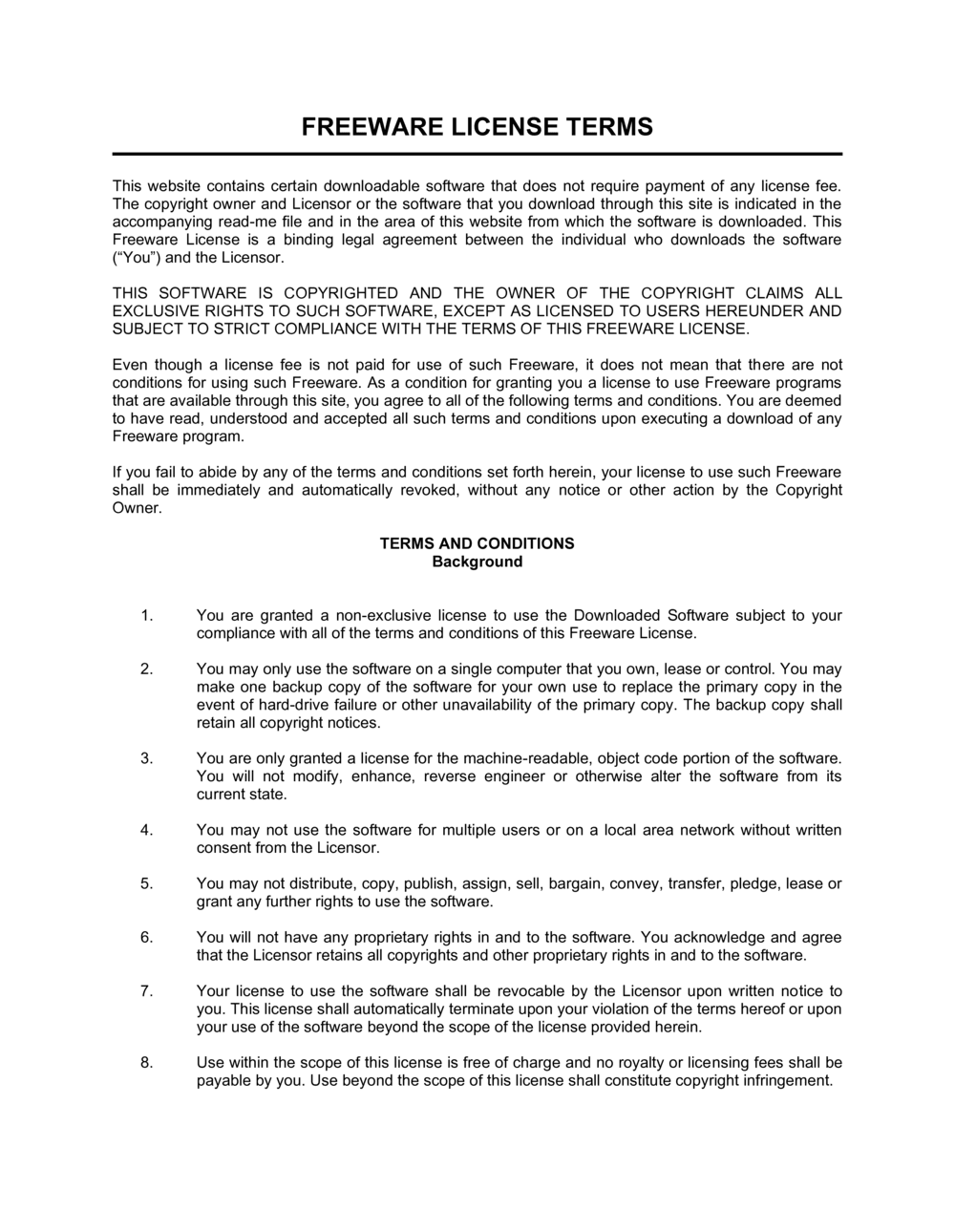
- Software made available at no monetary cost to the end user, but whose source code remains proprietary and whose use is governed by a license.
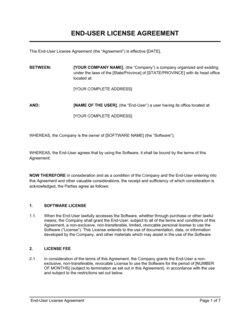
- Grant of License
- The clause that gives the user permission to install and use the software under defined conditions — without this, no lawful use exists.
- Intellectual Property Ownership
- A clause confirming that the developer retains all copyright, patents, trademarks, and trade secrets in the software regardless of the free distribution.
- Reverse Engineering
- The process of decompiling or disassembling software to reconstruct its source code or underlying logic — typically prohibited in freeware licenses.
- Warranty Disclaimer
- A provision stating the software is provided 'as is' with no guarantees of fitness, accuracy, or uninterrupted operation.
- Limitation of Liability
- A cap on the damages a developer can be held responsible for, typically excluding indirect, incidental, or consequential losses.
- Termination Clause
- The conditions under which the license ends — usually automatic upon breach — and what the user must do afterward (uninstall, destroy copies).
- Permitted Use
- The specific, affirmative acts the license allows — for example, personal use only, or use within a single organization.
- Redistribution Restriction
- A prohibition on the user passing the software to third parties, uploading it to other platforms, or bundling it with other products.
- Governing Law
- The jurisdiction whose laws apply to interpreting and enforcing the license agreement in the event of a dispute.
- End User
- The individual or entity that downloads, installs, or otherwise uses the software under the terms of the freeware license.
- Indemnification
- A clause requiring the user to compensate the developer for losses arising from the user's violation of the license terms.