Email Disclaimer Notice English_French_Spanish Template

Free Word download • Edit online • Save & share with Drive • Export to PDF

1 page15–25 min to fillDifficulty: Standard
Learn more ↓
FreeEmail Disclaimer Notice English_French_Spanish Template

At a glance

What it is
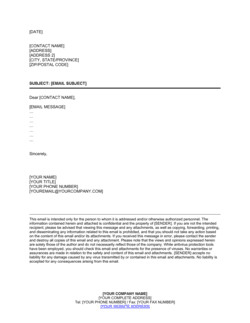
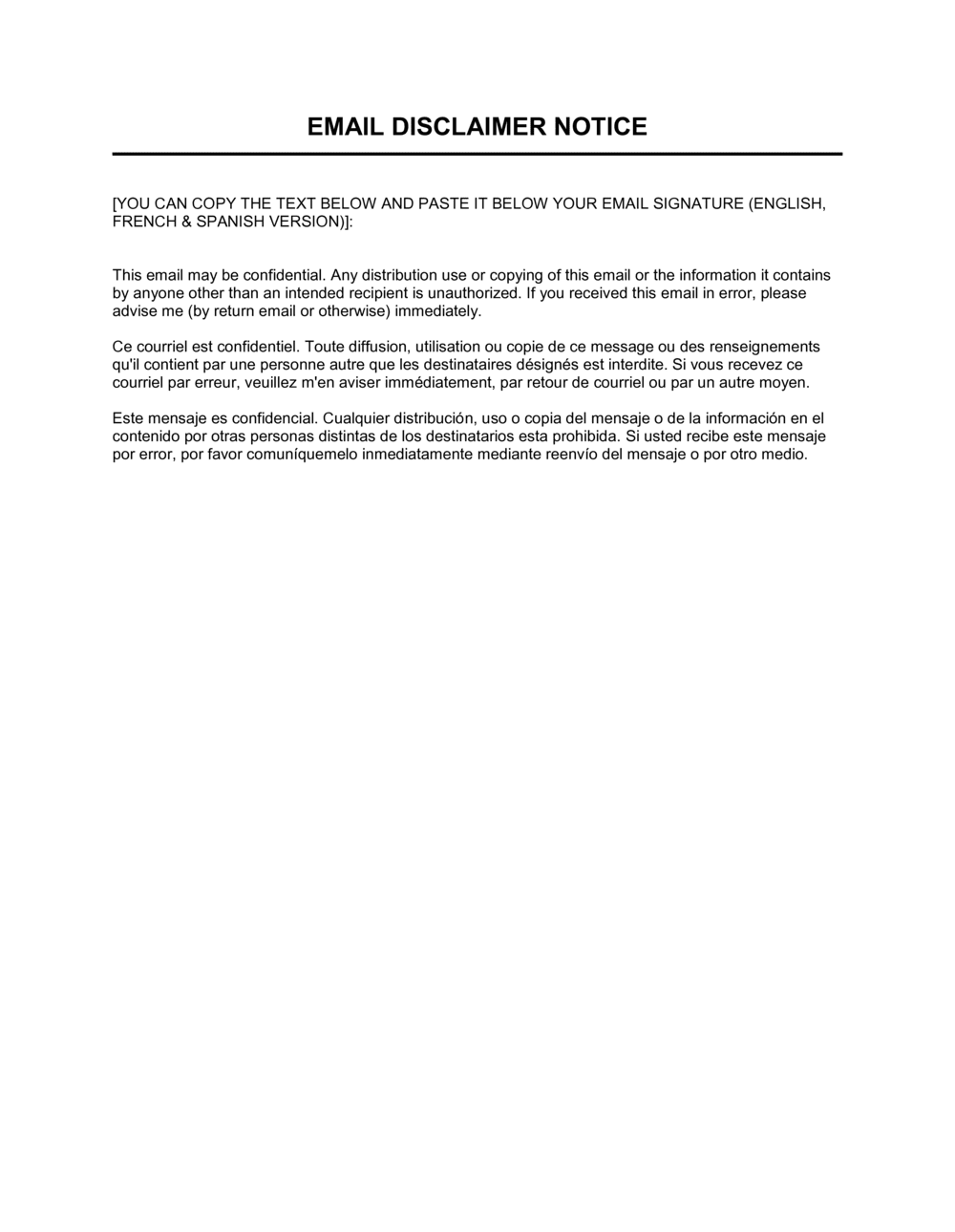
An Email Disclaimer Notice is a standardized block of text appended to outgoing business emails to notify recipients of confidentiality obligations, misdirected-message protocols, liability limitations, and legal privilege where applicable. This free Word download provides the notice in English, French, and Spanish so multinational and bilingual organizations can deploy a single consistent policy across all three languages.
When you need it
Use it whenever your organization sends external emails that may contain proprietary, confidential, or legally privileged information — or whenever you operate in markets where French or Spanish is an official or preferred business language.
What's inside
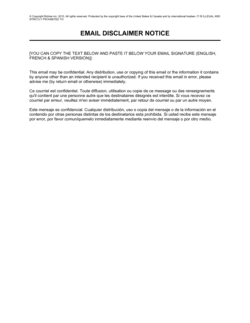
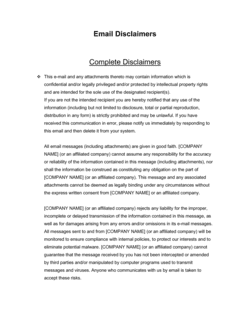
Confidentiality statement, legal privilege notice, misdirected-email instructions, liability limitation, virus/malware disclaimer, and the full notice reproduced in French and Spanish. All three language versions are formatted consistently so they can be pasted directly into your email client's signature settings.

What is an Email Disclaimer Notice?

An Email Disclaimer Notice is a standardized block of text appended to the footer of outgoing business emails to formally notify recipients of confidentiality obligations, misdirected-message protocols, liability limitations, and legal privilege where applicable. This template provides the complete notice in English, French, and Spanish — giving multinational and bilingual organizations a single, ready-to-deploy resource that covers all three languages without requiring separate documents. Each language version is formatted consistently so it can be copied directly into an email client's signature settings or configured as a server-level footer policy.

Why You Need This Document

Sending business emails without a disclaimer leaves your organization without even a basic record of having put recipients on notice of your confidentiality expectations. When a message is accidentally delivered to the wrong address — which occurs routinely in high-volume business correspondence — the absence of misdirected-email instructions means the recipient has no prompt to delete the message or notify you, creating potential exposure under GDPR, PIPEDA, and US state privacy laws. For professional services firms and legal departments, omitting a privilege notice on sensitive communications can weaken a claim of attorney-client protection if the matter reaches litigation. Operating in French- or Spanish-speaking markets without a corresponding language version signals either that you overlooked your audience or that your legal notices do not reach them at all. This template closes all four gaps in under 30 minutes, with professionally translated French and Spanish versions ready to customize with your company name and deploy across your organization.

Which variant fits your situation?

If your situation is…Use this template
Email sent by or to legal counsel covering privileged mattersEmail Disclaimer Notice (Attorney-Client Privilege)
Email sent by a healthcare provider containing patient informationHIPAA Email Disclaimer Notice
Internal-only disclaimer policy for employee communicationsInternal Email Policy Notice
Single-language English disclaimer for a domestic-only operationEmail Disclaimer Notice (English)
Disclaimer required for financial services or investment communicationsFinancial Services Email Disclaimer
Disclaimer for marketing or promotional emails subject to anti-spam lawMarketing Email Footer and Unsubscribe Notice
Company-wide email signature policy document for staff distributionEmail Signature Policy

Common mistakes to avoid

❌ Including legal privilege language for non-legal staff

Why it matters: Privilege only attaches to communications made for the purpose of obtaining or giving legal advice. Applying the label indiscriminately to all company emails trains recipients to ignore it and can dilute genuine privilege claims in litigation.

Fix: Restrict the legal privilege clause to disclaimers used by lawyers, in-house counsel, and legal support staff. Use a simpler confidentiality-only disclaimer for all other employees.

❌ Using machine translation for the French and Spanish versions without review

Why it matters: Automated translations frequently mistranslate legal terms — 'liability' rendered as 'responsabilité civile' versus 'responsabilité' carries different weight in French legal contexts, and the wrong word can make the clause meaningless.

Fix: Have a qualified bilingual reviewer or professional legal translator check both versions before deploying to external recipients.

❌ Setting an absolute liability exclusion with no carve-outs

Why it matters: Courts in the UK, Canada, and EU member states routinely refuse to enforce liability exclusions that cover fraud, willful misconduct, or personal injury. An absolute clause may be struck down entirely rather than narrowed.

Fix: Add a standard carve-out: 'Nothing in this disclaimer excludes liability for fraud, willful misconduct, or any liability that cannot be excluded by law.'

❌ Omitting the misdirected-email notification request

Why it matters: Without an instruction to notify the sender, an unintended recipient has no prompt to act, and the organization loses the chance to assess whether a data breach notification is required under GDPR, PIPEDA, or state privacy laws.

Fix: Always include an explicit request to notify the sender by reply email and to delete all copies, so the sender can initiate a breach assessment if necessary.

The 9 key clauses, explained

Intended recipient notice

In plain language: States that the email and any attachments are intended solely for the named addressee.

Sample language
This email and any attachments are intended solely for the use of the individual or entity to whom they are addressed.

Common mistake: Omitting 'and any attachments' — without this phrase, attached documents may not be covered by the disclaimer, leaving confidential files unprotected.

Confidentiality statement

In plain language: Declares the contents confidential and prohibits unauthorized use, copying, or distribution.

Sample language
The information contained in this email is confidential and may be legally privileged. If you are not the intended recipient, any use, disclosure, copying, or distribution of this message is strictly prohibited.

Common mistake: Using only 'confidential' without 'legally privileged' — for law firms and legal departments, omitting the privilege language weakens the case for protecting the communication in litigation.

Misdirected-email instruction

In plain language: Instructs an unintended recipient to delete the message immediately and notify the sender.

Sample language
If you have received this email in error, please notify the sender immediately by reply email and permanently delete this message and any copies from your system.

Common mistake: Asking the recipient only to 'delete' the message without requesting they notify the sender — the sender loses the opportunity to confirm deletion and assess any data breach risk.

Legal privilege notice

In plain language: Flags that the email may be protected by legal professional privilege and that privilege is not waived by misdirection.

Sample language
This communication may be protected by legal professional privilege. Disclosure to a person other than the intended recipient does not constitute a waiver of that privilege.

Common mistake: Including privilege language in all-staff disclaimers regardless of role — only communications involving legal counsel actually attract privilege, and overclaiming it can dilute the protection in practice.

Liability limitation

In plain language: States that the sender accepts no liability for losses arising from the recipient's use of or reliance on the email's contents.

Sample language
[COMPANY NAME] accepts no liability for any damage, loss, or expense of any kind arising from the use of, or reliance on, the information contained in this email.

Common mistake: Using an absolute liability exclusion without carving out willful misconduct or fraud — courts in many jurisdictions will not enforce a clause that purports to exclude liability for intentional wrongdoing.

Virus and malware disclaimer

In plain language: Notifies recipients that the sender cannot guarantee the email is free from viruses or malware and limits responsibility for any infection.

Sample language
Although [COMPANY NAME] has taken reasonable steps to ensure this email is free from viruses, [COMPANY NAME] cannot guarantee that this message or any attachment is virus-free. The recipient is advised to check for viruses before opening any attachment.

Common mistake: Omitting the virus disclaimer when sending attachments — without it, the organization may face exposure for malware inadvertently transmitted to a recipient's systems.

Views and opinions disclaimer

In plain language: States that opinions expressed in the email are those of the individual sender and do not necessarily represent the organization's official position.

Sample language
Any opinions expressed in this email are those of the individual sender and do not necessarily reflect the views of [COMPANY NAME] unless specifically stated.

Common mistake: Skipping this clause for customer-facing staff — without it, an employee's casual email opinion may be attributed to the company and relied on as a representation or commitment.

French language version

In plain language: A complete French-language reproduction of the full disclaimer, formatted identically to the English version for use with francophone recipients.

Sample language
Ce courriel et toutes les pièces jointes sont destinés uniquement à l'usage de la personne ou de l'entité à qui ils sont adressés. Les informations contenues dans ce message sont confidentielles...

Common mistake: Using machine-translated French without review — legal terminology in French (particularly Quebec French vs. European French) has specific conventions; a mistranslated liability clause may not carry the intended legal weight.

Spanish language version

In plain language: A complete Spanish-language reproduction of the full disclaimer for use with Spanish-speaking recipients across Latin America and Spain.

Sample language
Este correo electrónico y sus archivos adjuntos están destinados exclusivamente al uso de la persona o entidad a la que van dirigidos. La información contenida en este mensaje es confidencial...

Common mistake: Using a single Spanish translation without noting regional variations — legal and business terminology differs between Spain, Mexico, and other Latin American markets; confirm the translation suits your primary audience.

How to fill it out

  1. 1

    Insert your company name and contact details

    Replace every [COMPANY NAME] placeholder with your registered business name. Add your organization's registered address, phone number, and website in the contact block if your policy or jurisdiction requires it.

    💡 Use your full legal entity name — not a trading name — so the disclaimer is clearly attributable to the correct legal entity.

  2. 2

    Select the clauses relevant to your organization

    Review each clause and remove any that do not apply — for example, omit the legal privilege notice if no employees are lawyers or legal advisors. Keeping only relevant clauses keeps the disclaimer concise and credible.

    💡 A disclaimer longer than 150 words is frequently ignored or filtered as clutter; trim unused clauses to stay under that threshold.

  3. 3

    Confirm which language versions you need

    Retain English, French, and Spanish versions if your organization communicates regularly in all three languages. If you operate in only one or two language markets, remove the unused versions to keep the footer manageable.

    💡 Have a bilingual colleague or professional translator review the French and Spanish versions before deployment, particularly the liability and privilege language.

  4. 4

    Adjust the liability clause to match your legal environment

    If your organization's legal counsel has advised specific liability language — for example, a cap tied to contract value — replace the general limitation with your approved wording.

    💡 Do not rely on a disclaimer alone to limit liability for high-value professional advice; a written engagement letter or contract is the appropriate instrument for that.

  5. 5

    Format the disclaimer for your email platform

    Copy the final text into your email client's signature editor (Outlook, Gmail, or your server-side mail relay). Use plain text rather than HTML tables to ensure consistent rendering across all recipient mail clients.

    💡 Test the disclaimer by sending a test email to an external address on a different platform — formatting often breaks between clients.

  6. 6

    Distribute to staff and configure server-level deployment

    Share the approved disclaimer text with IT or your email administrator. For organizations with more than 10 staff, configure the disclaimer as a server-level footer so it appends automatically to every outbound message.

    💡 Document the approved version and store it in your policy library so future updates are tracked and rolled out consistently across all users.

Frequently asked questions

What is an email disclaimer notice?

An email disclaimer notice is a standardized block of text appended to the bottom of outgoing business emails. It typically covers confidentiality obligations, misdirected-email instructions, liability limitations, and legal privilege where relevant. Its purpose is to put recipients on notice of the sender's legal position and to establish a consistent organizational policy for all outbound correspondence.

Are email disclaimers legally enforceable?

The enforceability of an email disclaimer depends on the jurisdiction and the specific clause. Confidentiality notices and misdirected-email instructions are generally treated as reasonable requests rather than binding obligations — a recipient who reads a confidential email by mistake is not typically criminally liable simply because a disclaimer says so. Liability limitation clauses can be enforceable if they meet local reasonableness standards, but courts in the UK, EU, and Canada will not enforce clauses that exclude fraud or statutory rights.

Why do I need the disclaimer in three languages?

French and Spanish are official business languages in a significant number of markets — Quebec and francophone Africa for French; Latin America, Spain, and large US Hispanic business communities for Spanish. A trilingual disclaimer ensures your legal notices are understood by recipients in those markets and signals professional respect for the recipient's language. It also reduces the risk that a recipient claims they did not understand the confidentiality obligation because it was only in English.

Should I include the email disclaimer in internal emails too?

Internal disclaimers are generally unnecessary and add visual clutter that staff quickly learn to ignore. Most organizations apply disclaimers only to external outbound email. If your IT policy requires a server-level footer on all messages, consider a shorter internal variant that omits the misdirected-email clause and legal privilege language, which are irrelevant between colleagues.

Does an email disclaimer protect against GDPR or privacy law liability?

A disclaimer alone does not satisfy GDPR, PIPEDA, or CCPA obligations. Those regulations impose positive duties — lawful basis for processing, data minimization, breach notification timelines — that cannot be waived by a footer notice. A disclaimer can complement a broader privacy program by instructing misdirected recipients to delete data promptly, but it is not a substitute for a privacy policy or data processing agreement.

Can I configure the disclaimer to append automatically to all outgoing emails?

Yes. Most business email platforms — Microsoft 365, Google Workspace, and major mail relay services — support server-side transport rules or signature policies that append a standard text block to every outbound message automatically. This is the preferred approach for organizations with more than a handful of staff, as it ensures consistent application without relying on individual employees to maintain their own signatures.

How often should I update my email disclaimer?

Review the disclaimer annually or whenever there is a material change in the laws or regulations applicable to your business — for example, a new privacy regulation taking effect in a market you serve, or a change in your legal entity name or registered address. The disclaimer text itself is relatively stable, but the translations and any jurisdiction-specific language should be checked when expanding into new markets.

What is the difference between a confidentiality notice and a legal privilege notice?

A confidentiality notice simply asks the recipient to treat the message as private and not to disclose it to others — it applies to any business email. A legal privilege notice makes the additional assertion that the communication is protected by attorney-client or legal professional privilege, shielding it from disclosure in legal proceedings. Privilege only attaches when the communication is made for the purpose of obtaining or giving legal advice, so the privilege notice should only appear on emails involving legal counsel.

How this compares to alternatives

vs Privacy Policy

A privacy policy is a comprehensive public document explaining how an organization collects, uses, stores, and shares personal data — it satisfies statutory disclosure obligations under GDPR, PIPEDA, and CCPA. An email disclaimer is a brief footer notice appended to individual messages. The two serve different purposes and neither substitutes for the other.

vs Non-Disclosure Agreement

An NDA is a binding bilateral contract in which both parties formally agree to keep specified information confidential, with enforceable remedies for breach. An email disclaimer is a unilateral notice that requests confidentiality but is not a contract. For genuinely sensitive business information, an NDA provides far stronger legal protection than a disclaimer footer.

vs Email Policy

An email policy is an internal governance document setting rules for acceptable use of company email by employees — covering tone, retention, personal use, and security. An email disclaimer is the external-facing legal notice appended to outgoing messages. Organizations typically need both: the policy governs staff behavior; the disclaimer notifies external recipients.

vs Terms of Service

Terms of service are a binding agreement between an organization and users or customers governing the use of a product or service. An email disclaimer is not an agreement — it is a notice. If you need recipients to be contractually bound by specific obligations regarding your communications, a formal agreement is required rather than a footer.

Industry-specific considerations

Legal and Professional Services

Law firms and accounting practices use privilege language alongside confidentiality notices, and often require French or Spanish versions for clients in Quebec, Latin America, or Spain.

Financial Services

Banks and investment firms add regulatory non-reliance language to disclaimers, specifying that email content does not constitute financial advice or an offer to buy or sell securities.

Healthcare

Healthcare providers include HIPAA-aligned language noting that emails may contain protected health information and instructing misdirected recipients on mandatory deletion and notification.

Technology / SaaS

Tech companies operating across North America and Latin America use trilingual disclaimers to support distributed teams and international client bases, and often configure server-level deployment across cloud email platforms.

Template vs pro — what fits your needs?

PathBest forCostTime
Use the templateSmall to mid-sized businesses needing a standard trilingual disclaimer for general business correspondenceFree15–30 minutes to customize and deploy
Template + professional reviewProfessional services firms, financial institutions, or any organization where privilege or regulatory language must be precise$150–$400 for a one-hour legal or translation review1–2 days
Custom draftedHeavily regulated industries (healthcare, financial services) or organizations with complex multi-jurisdiction liability exposure$500–$1,500 for a lawyer-drafted, jurisdiction-specific disclaimer3–7 days

Glossary

Email Disclaimer
A standardized block of text appended to outgoing emails that sets out legal notices, confidentiality obligations, and liability limitations.
Confidentiality Notice
A statement informing the recipient that the email's contents are intended only for the named addressee and must not be disclosed to third parties.
Attorney-Client Privilege
A legal protection that keeps communications between a lawyer and their client confidential and shielded from disclosure in legal proceedings.
Legal Privilege
A broader category of protection covering communications made in confidence for the purpose of obtaining or giving legal advice.
Misdirected Email
An email accidentally sent to the wrong recipient; a disclaimer instructs such recipients to delete the message and notify the sender.
Liability Limitation
A clause stating that the sender or organization is not responsible for losses caused by the recipient's reliance on the email's contents.
Virus Disclaimer
A notice stating that while the sender has taken precautions, they accept no responsibility for malware or viruses transmitted via email attachments.
Server-Level Disclaimer
A disclaimer automatically appended to all outgoing emails by the mail server or email platform, rather than individually by each sender.
CASL
Canada's Anti-Spam Legislation, which regulates commercial electronic messages sent to or from Canadian recipients and requires specific footer content.
GDPR
The EU General Data Protection Regulation, which governs how personal data in emails must be handled, stored, and disclosed.

Part of your Business Operating System

This document is one of 3,000+ business & legal templates included in Business in a Box.

  • Fill-in-the-blanks — ready in minutes
  • 100% customizable Word document
  • Compatible with all office suites
  • Export to PDF and share electronically

Create your document in 3 simple steps.

From template to signed document — all inside one Business Operating System.
1
Download or open template

Access over 3,000+ business and legal templates for any business task, project or initiative.

2
Edit and fill in the blanks with AI

Customize your ready-made business document template and save it in the cloud.

3
Save, Share, Send, Sign

Share your files and folders with your team. Create a space of seamless collaboration.

Save time, save money, and create top-quality documents.

★★★★★

"Fantastic value! I'm not sure how I'd do without it. It's worth its weight in gold and paid back for itself many times."

Managing Director · Mall Farm
Robert Whalley
Managing Director, Mall Farm Proprietary Limited
★★★★★

"I have been using Business in a Box for years. It has been the most useful source of templates I have encountered. I recommend it to anyone."

Business Owner · 4+ years
Dr Michael John Freestone
Business Owner
★★★★★

"It has been a life saver so many times I have lost count. Business in a Box has saved me so much time and as you know, time is money."

Owner · Upstate Web
David G. Moore Jr.
Owner, Upstate Web

Run your business with a system — not scattered tools

Stop downloading documents. Start operating with clarity. Business in a Box gives you the Business Operating System used by over 250,000 companies worldwide to structure, run, and grow their business.

Free Forever Plan · No credit card required