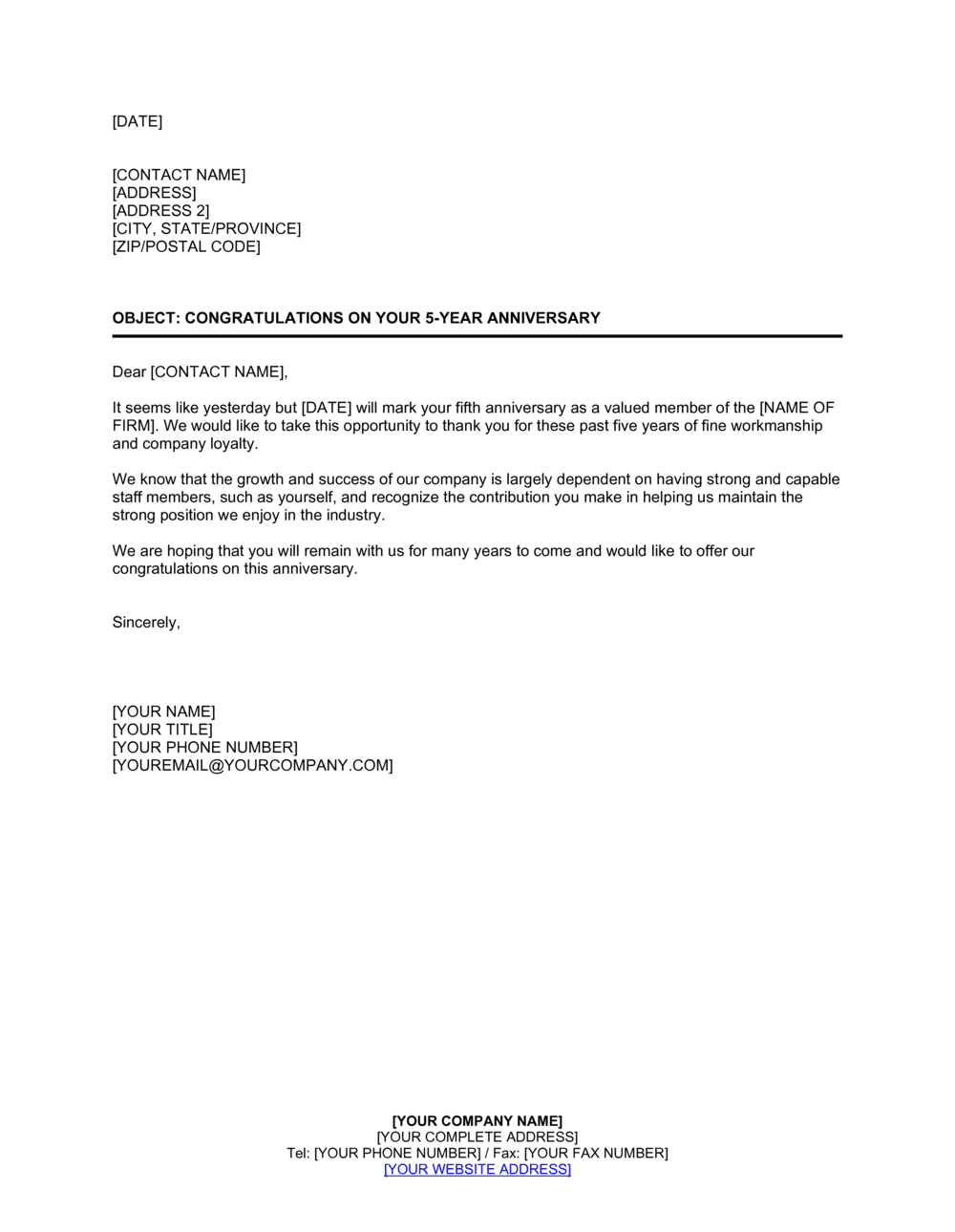
Congratulations to an Employee on 5-Year Anniversary Template

Free Word download β€’ Edit online β€’ Save & share with Drive β€’ Export to PDF

1 pageβ€’20–25 min to fillβ€’Difficulty: Standardβ€’Signature requiredβ€’Legal review recommended
Learn more ↓
FreeCongratulations to an Employee on 5-Year Anniversary Template

At a glance

What it is
A Congratulations to an Employee on 5 Year Anniversary letter is a formal written communication issued by an employer to recognize and document an employee's five consecutive years of service. This free Word download gives you a professionally structured template you can edit online, personalize with the employee's name and achievements, and export as PDF for delivery or inclusion in the employee's personnel file.
When you need it
Use it when an employee reaches their five-year employment anniversary and you want to formally acknowledge their tenure, reinforce organizational loyalty, and create a documented record of recognition that supports retention, morale, and any associated service award or benefit.
What's inside
A formal salutation and opening acknowledgment, a statement of the milestone date, recognition of specific contributions, an expression of ongoing confidence in the employee, any associated award or benefit language, and a signed closing from a senior leader or HR representative.

What is a Congratulations to an Employee on 5 Year Anniversary Letter?

A Congratulations to an Employee on 5 Year Anniversary letter is a formal written communication issued by an employer to recognize and document an employee's five consecutive years of service with the organization. It acknowledges the specific milestone date, highlights the employee's individual contributions, communicates any associated service award or benefit, and creates an official record of recognition suitable for placement in the employee's personnel file. Unlike a casual verbal acknowledgment or a generic email, a properly drafted and signed anniversary letter carries organizational authority and serves as a permanent document that supports both retention strategy and HR record-keeping.

Why You Need This Document

Failing to formally recognize a five-year tenure milestone is one of the most consistently cited drivers of disengagement among mid-tenure employees β€” a demographic that represents your highest-value, lowest-replacement-cost workforce. Without a written letter, the recognition exists only as a verbal exchange that cannot be documented, referenced, or filed. From a legal and HR standpoint, a signed anniversary letter that references a service award creates a clear paper trail confirming the award was properly authorized, communicated, and delivered β€” protecting the employer in the event of a payroll dispute or benefit audit. A letter that omits a non-contractual disclaimer, however, can inadvertently create implied employment obligations that complicate future termination decisions. This template gives you the structure to recognize the milestone compellingly and correctly, with the right disclaimers in place, in under 30 minutes.

Which variant fits your situation?

If your situation is…Use this template
Recognizing a 1-year employment anniversaryCongratulations to an Employee on 1 Year Anniversary
Recognizing a 10-year employment milestoneCongratulations to an Employee on 10 Year Anniversary
Recognizing an employee's retirement after long serviceEmployee Retirement Congratulations Letter
Formally praising exceptional performance rather than tenureEmployee Recognition Letter
Issuing a promotion alongside the anniversary acknowledgmentEmployee Promotion Letter
Presenting a formal bonus tied to the service milestoneEmployee Bonus Letter
Welcoming the employee back after a leave of absence near the milestoneReturn from Leave Welcome Letter

Common mistakes to avoid

❌ Using a fully generic template with no personalization

Why it matters: An employee who receives a letter indistinguishable from a form notice perceives the recognition as bureaucratic rather than genuine, reducing its retention impact to near zero.

Fix: Include at least two specific, named contributions drawn from performance records or manager input before sending the letter.

❌ Omitting the non-contractual disclaimer

Why it matters: Enthusiastic language about the employee's future at the company β€” without a disclaimer β€” can be interpreted as an implied promise of continued employment, creating legal exposure in termination scenarios.

Fix: Always include the disclaimer clause confirming the letter does not alter existing employment terms, and review its phrasing with an employment lawyer if the letter also references a new benefit or award.

❌ Committing to an award amount before finance approval

Why it matters: A signed letter stating a specific dollar figure is an enforceable commitment. If payroll later corrects the amount downward, the company may be in breach of the stated obligation.

Fix: Confirm the exact award amount with payroll or finance and obtain written internal approval before inserting any dollar figure into the signed letter.

❌ Having an unauthorized staff member sign the letter

Why it matters: A letter signed by an administrative assistant or junior HR coordinator carries less motivational weight and may not meet the signatory-authority standard required for personnel file documentation.

Fix: Identify the appropriate signatory authority β€” at minimum, HR director or the employee's skip-level manager β€” and route the letter for their signature before delivery.

❌ Delaying delivery past the anniversary date

Why it matters: A recognition letter delivered weeks after the anniversary date signals that the milestone was an afterthought, actively damaging morale rather than boosting it.

Fix: Set a calendar reminder 30 days before the anniversary date to draft, approve, and schedule the letter so delivery occurs on or before the exact date.

❌ Copying too many senior leaders on the letter

Why it matters: An extensive CC list transforms a personal recognition into what feels like a mass announcement, making the employee feel processed rather than valued.

Fix: Limit the CC to the employee's direct manager and the HR file. If broader recognition is appropriate, handle it separately through a team communication or announcement.

The 8 key clauses, explained

Date and formal salutation

In plain language: Records the date the letter is issued and addresses the employee by full name and preferred title, establishing the letter as an official piece of correspondence.

Sample language
[DATE] Dear [EMPLOYEE FULL NAME],

Common mistake: Using a generic 'Dear Team Member' salutation instead of the employee's name β€” this immediately signals a form letter, undermining the personal impact the letter is meant to create.

Milestone acknowledgment statement

In plain language: Explicitly states that the employee is being recognized for completing five years of continuous service, naming the exact anniversary date.

Sample language
On behalf of [COMPANY NAME], I am delighted to congratulate you on the occasion of your five-year employment anniversary, which you reached on [ANNIVERSARY DATE].

Common mistake: Omitting the exact anniversary date. Without it, the letter cannot be matched to payroll records or used to substantiate a service award in an audit.

Specific contribution acknowledgment

In plain language: Identifies two to three concrete contributions or achievements the employee has made during their tenure, making the recognition specific rather than generic.

Sample language
Over the past five years, your contributions to [SPECIFIC PROJECT / DEPARTMENT / INITIATIVE] have directly supported [OUTCOME]. Your commitment to [SPECIFIC BEHAVIOR OR VALUE] has set a standard that benefits the entire team.

Common mistake: Writing only generic praise such as 'your hard work and dedication.' Vague language reduces the motivational effect and fails to document which contributions the employer is recognizing.

Expression of ongoing confidence

In plain language: Communicates the employer's expectation and enthusiasm for the employee's continued role, reinforcing forward-looking commitment to the relationship.

Sample language
We are proud to have you as a member of the [COMPANY NAME] team and look forward with confidence to your continued contributions in the years ahead.

Common mistake: Framing the ongoing confidence statement as a guarantee of future employment β€” language like 'your position is secure' can create implied contract obligations.

Service award or benefit statement

In plain language: Describes any tangible award, bonus, additional PTO, or gift associated with the milestone, including the amount or item and how it will be delivered.

Sample language
In recognition of this milestone, [COMPANY NAME] is pleased to present you with [AWARD DESCRIPTION β€” e.g., a $[AMOUNT] gift card / [X] additional days of paid time off / a service award], which will be [delivered / credited to your account / presented] on [DATE].

Common mistake: Committing to an award amount in the letter before confirming the value with payroll or finance. A specific dollar figure in a signed letter creates an enforceable obligation regardless of later internal corrections.

At-will or non-contractual disclaimer

In plain language: Clarifies that the letter is a recognition document only and does not alter, amend, or supersede the employee's existing employment agreement or at-will status.

Sample language
This letter is intended solely as an expression of appreciation and does not constitute an amendment to your existing employment agreement or alter the terms and conditions of your employment with [COMPANY NAME].

Common mistake: Omitting the disclaimer entirely. A warm, enthusiastic letter that promises continued engagement without a disclaimer can be cited by an employee as evidence of an implied ongoing employment commitment.

Senior leader or HR signatory block

In plain language: Closes the letter with the name, title, and signature of the appropriate organizational authority β€” CEO, HR director, or direct manager β€” lending the recognition formal weight.

Sample language
Sincerely, [SIGNATORY FULL NAME] [TITLE] [COMPANY NAME] [DATE SIGNED]

Common mistake: Having an administrative staff member sign without authority notation. The letter carries more retention value when signed by someone senior to the employee's direct manager.

CC and file notation

In plain language: Notes any additional recipients β€” such as the employee's direct manager or HR file β€” and confirms that a copy has been placed in the official personnel file.

Sample language
cc: [EMPLOYEE'S DIRECT MANAGER NAME], [HR FILE / PERSONNEL RECORDS]

Common mistake: Distributing the letter widely without restricting the CC list. Copying multiple senior leaders can inadvertently signal hierarchy issues or make the recognition feel more administrative than personal.

How to fill it out

  1. 1

    Confirm the anniversary date from HR records

    Pull the employee's official hire date from your HRIS or payroll system before drafting. Verify the date matches the original signed employment agreement to ensure accuracy.

    πŸ’‘ Cross-check the hire date against any amended start dates that may have been recorded following a leave of absence or contract conversion from contractor to employee.

  2. 2

    Personalize the salutation and opening

    Replace all placeholders with the employee's legal name and preferred form of address. Confirm spelling with HR β€” an error in the recipient's own name on a milestone letter is especially damaging.

    πŸ’‘ If the employee uses a preferred name different from their legal name, use the preferred name in the salutation and the legal name only in the file notation.

  3. 3

    Identify two to three specific contributions

    Review the employee's performance reviews, project records, or manager notes to identify concrete achievements from the past five years. Choose contributions that reflect both the employee's effort and the company's values.

    πŸ’‘ Ask the employee's direct manager for one specific example before drafting β€” it takes two minutes and makes the letter significantly more meaningful.

  4. 4

    Complete the service award or benefit section

    Confirm the award type and value with payroll or finance before inserting it into the letter. Enter the exact delivery method and date so there is no ambiguity about when and how the employee will receive it.

    πŸ’‘ If the award is discretionary and the amount has not yet been finalized, omit the specific value and describe the award by category only β€” e.g., 'a service recognition gift' β€” until confirmed.

  5. 5

    Add the at-will or non-contractual disclaimer

    Ensure the disclaimer clause is present and unedited. It should appear before the closing and be phrased neutrally so it does not diminish the celebratory tone of the letter.

    πŸ’‘ In jurisdictions where at-will employment does not apply β€” Canada, UK, EU β€” replace the at-will language with a general non-amendment statement referencing the employee's existing contract.

  6. 6

    Route for signatory approval and signature

    Send the draft to the designated signatory β€” typically the CEO, HR director, or department head β€” for review and wet or electronic signature before delivery to the employee.

    πŸ’‘ Use Business in a Box eSign to capture a timestamped signature and store the executed copy automatically in the employee's digital personnel file.

  7. 7

    Deliver and file the executed letter

    Deliver the signed letter to the employee in person when possible, or via a formal email with a PDF attachment. File the executed original in the employee's personnel file and note the delivery date.

    πŸ’‘ Pair the letter delivery with a brief in-person acknowledgment from the signatory β€” even a two-minute conversation doubles retention impact compared to an email-only delivery.

Frequently asked questions

What is an employee 5-year anniversary congratulations letter?

An employee 5-year anniversary congratulations letter is a formal written document issued by an employer to recognize an employee's five consecutive years of service. It acknowledges the milestone date, highlights specific contributions, communicates any associated service award, and creates a documented record of recognition for the employee's personnel file. Done well, it reinforces loyalty and contributes directly to retention.

Is an employee anniversary letter a legally binding document?

On its own, a congratulations letter is generally not a binding contract. However, language that commits the employer to a specific monetary award or implies continued employment can create enforceable obligations in certain jurisdictions. Including a clear non-contractual disclaimer β€” and having the letter reviewed before it references any new benefit β€” protects the employer from unintended legal exposure.

Does a 5-year anniversary letter need to be signed?

Signing the letter is strongly recommended. A signed letter carries significantly more personal and organizational weight than an unsigned form, and the signature creates a clear record of who issued the recognition. For personnel file purposes, a signed and dated original is the standard documentation practice across most HR frameworks.

Who should sign an employee anniversary letter?

Typically the CEO, HR director, or the employee's skip-level manager β€” whoever carries enough organizational authority to make the recognition feel meaningful. A letter signed exclusively by the employee's direct manager is appropriate for smaller organizations. The key is that the signatory's seniority visibly exceeds the employee's level.

Should the letter mention a service award or bonus?

Yes, if one is being provided β€” but only after the amount and delivery method have been confirmed with payroll or finance. A specific dollar figure in a signed letter is an enforceable commitment. If the award has not been finalized, describe it by category only until the amount is approved and ready to communicate.

What should I include in the specific contributions section?

Choose two to three concrete examples drawn from performance reviews, project records, or direct manager input β€” not generic adjectives. Name the project or initiative, state the outcome the employee contributed to, and connect it to a company value or objective. Specific, factual praise is retained and appreciated far longer than vague acknowledgments of 'hard work and dedication.'

Can this letter be delivered electronically?

Yes. A PDF of the signed letter delivered via a formal email to the employee and HR is accepted practice in most organizations. Electronic delivery with an eSign timestamp provides a stronger audit trail than a paper letter that may not be acknowledged. Wherever possible, pair the digital delivery with an in-person acknowledgment from the signatory.

Does this letter need to vary based on jurisdiction?

The core recognition content is jurisdiction-neutral, but two elements require localization. First, the disclaimer should reference the employee's existing contract rather than at-will status in Canada, the UK, and the EU, where at-will employment does not apply. Second, any service award that constitutes taxable income must be processed and disclosed in accordance with local tax rules, which differ across jurisdictions.

How far in advance should I prepare the letter?

Begin drafting at least 30 days before the anniversary date to allow time for gathering specific contribution examples, routing the letter for signatory approval, confirming any award amounts with finance, and scheduling delivery. A letter prepared the day before the anniversary is rarely as specific or well-signed as one prepared a month in advance.

How this compares to alternatives

vs Employee recognition letter

An employee recognition letter acknowledges exceptional performance or a specific achievement at any point in time, not a tenure milestone. A 5-year anniversary letter is tied to a calendar date and length of service, often paired with a service award. Use the recognition letter for performance-based praise and the anniversary letter when the occasion is specifically the milestone date.

vs Employee promotion letter

A promotion letter formally amends the employee's title, responsibilities, and compensation. An anniversary letter is purely celebratory and does not alter employment terms. If a promotion coincides with a 5-year anniversary, issue both documents separately β€” combining them creates ambiguity about which terms are being changed and which are purely ceremonial.

vs Employee bonus letter

A bonus letter is a formal notice of a specific monetary payment with payroll and tax implications. An anniversary letter may reference a service award, but it is not a substitute for a standalone bonus letter when the award is a taxable cash payment. Issue both when a cash bonus accompanies the milestone recognition.

vs Employment contract

An employment contract establishes the binding terms of the employment relationship at hire. An anniversary letter is a recognition document issued during employment that must explicitly confirm it does not amend those contract terms. Never use anniversary letter language to adjust salary, duties, or benefits β€” those changes require a formal contract amendment.

Industry-specific considerations

Professional Services

Five-year recognition letters often accompany a title review or expanded client portfolio assignment, making the specific contributions section particularly important for documenting the employee's growth.

Healthcare

High turnover and licensing requirements make documented milestone recognition a formal retention tool; letters are often filed alongside credentialing records.

Retail / Hospitality

Service-award letters in high-turnover environments signal organizational stability; many hospitality employers pair the letter with a tangible service pin or gift card to reinforce brand culture.

Manufacturing

Safety record and operational contributions are the most common specific acknowledgments in manufacturing anniversary letters, directly linking tenure to quality and productivity outcomes.

Jurisdictional notes

United States

At-will employment is the default in 49 states, so the non-contractual disclaimer is especially important to include. Service awards valued above $400 per employee per year are taxable income under IRS rules and must be processed through payroll. Non-cash awards may qualify for the de minimis fringe benefit exclusion depending on value and frequency.

Canada

At-will employment does not exist in Canada β€” replace at-will disclaimer language with a general statement that the letter does not amend the employee's existing employment agreement. Service awards that constitute a taxable benefit must be reported on the employee's T4 slip under CRA rules. Quebec employers should ensure the letter is available in French for provincially-regulated workplaces.

United Kingdom

Employees with five or more years of service have accrued significant statutory employment rights, including unfair dismissal protection and enhanced redundancy entitlements. The anniversary letter should not contain any language that could be read as varying the written statement of employment particulars. Non-cash long-service awards up to Β£50 per year of service are exempt from income tax under HMRC rules.

European Union

Employment protections vary significantly by member state, but five-year employees across the EU typically have strong unfair dismissal and severance rights. Any monetary award referenced in the letter must be coordinated with local payroll to ensure correct social contribution and income tax treatment. In Germany and France, works council consultation may be required before implementing a formal service award program.

Template vs lawyer β€” what fits your deal?

PathBest forCostTime
Use the templateStandard domestic employee milestone recognition with no attached monetary award or contract amendmentFree15–30 minutes
Template + legal reviewLetters accompanying a taxable service award, a new benefit, or an employee in a sensitive HR situation$150–$400 for a one-hour HR counsel review1–2 business days
Custom draftedExecutive-level milestone letters where recognition language intersects with equity vesting, severance, or deferred compensation$500–$1,5003–5 business days

Glossary

Service Anniversary
The annual recurrence of the date an employee was first hired, used to mark tenure milestones and trigger recognition or benefit events.
Personnel File
The official employer-maintained record for each employee, containing employment documents, performance records, and formal correspondence including recognition letters.
Milestone Recognition
A formal acknowledgment of a specific achievement or tenure marker β€” such as a 5-year anniversary β€” intended to reinforce employee engagement and loyalty.
Service Award
A tangible or monetary reward β€” gift card, extra PTO, bonus, or physical award β€” presented to an employee upon reaching a defined length of service.
Retention Strategy
An employer's deliberate effort to keep valued employees through compensation, recognition, development opportunities, and positive workplace culture.
Implied Contract
An unwritten employment obligation that can arise from consistent employer conduct β€” such as routinely awarding bonuses at each milestone β€” making formal, consistent documentation important.
Constructive Recognition
Recognition structured to reinforce specific behaviors or contributions, rather than simply acknowledging time served, making the letter more meaningful and legally defensible.
Signatory Authority
The organizational title or role authorized to sign formal correspondence on behalf of the employer β€” typically a CEO, HR director, or direct manager at or above the employee's reporting level.
At-Will Acknowledgment
Language included in formal employment correspondence confirming that nothing in the letter alters the at-will nature of the employment relationship, preventing unintended contractual obligations.
Consideration
In contract law, something of value exchanged between parties; a letter that commits the employer to a specific monetary award may create a contractual obligation requiring fresh consideration.

Part of your Business Operating System

This document is one of 3,000+ business & legal templates included in Business in a Box.

  • Fill-in-the-blanks β€” ready in minutes
  • 100% customizable Word document
  • Compatible with all office suites
  • Export to PDF and share electronically

Create your document in 3 simple steps.

From template to signed document β€” all inside one Business Operating System.
1
Download or open template

Access over 3,000+ business and legal templates for any business task, project or initiative.

2
Edit and fill in the blanks with AI

Customize your ready-made business document template and save it in the cloud.

3
Save, Share, Send, Sign

Share your files and folders with your team. Create a space of seamless collaboration.

Save time, save money, and create top-quality documents.

β˜…β˜…β˜…β˜…β˜…

"Fantastic value! I'm not sure how I'd do without it. It's worth its weight in gold and paid back for itself many times."

Managing Director Β· Mall Farm
Robert Whalley
Managing Director, Mall Farm Proprietary Limited
β˜…β˜…β˜…β˜…β˜…

"I have been using Business in a Box for years. It has been the most useful source of templates I have encountered. I recommend it to anyone."

Business Owner Β· 4+ years
Dr Michael John Freestone
Business Owner
β˜…β˜…β˜…β˜…β˜…

"It has been a life saver so many times I have lost count. Business in a Box has saved me so much time and as you know, time is money."

Owner Β· Upstate Web
David G. Moore Jr.
Owner, Upstate Web

Run your business with a system β€” not scattered tools

Stop downloading documents. Start operating with clarity. Business in a Box gives you the Business Operating System used by over 250,000 companies worldwide to structure, run, and grow their business.

Start freeΒ Β·Β No credit card required