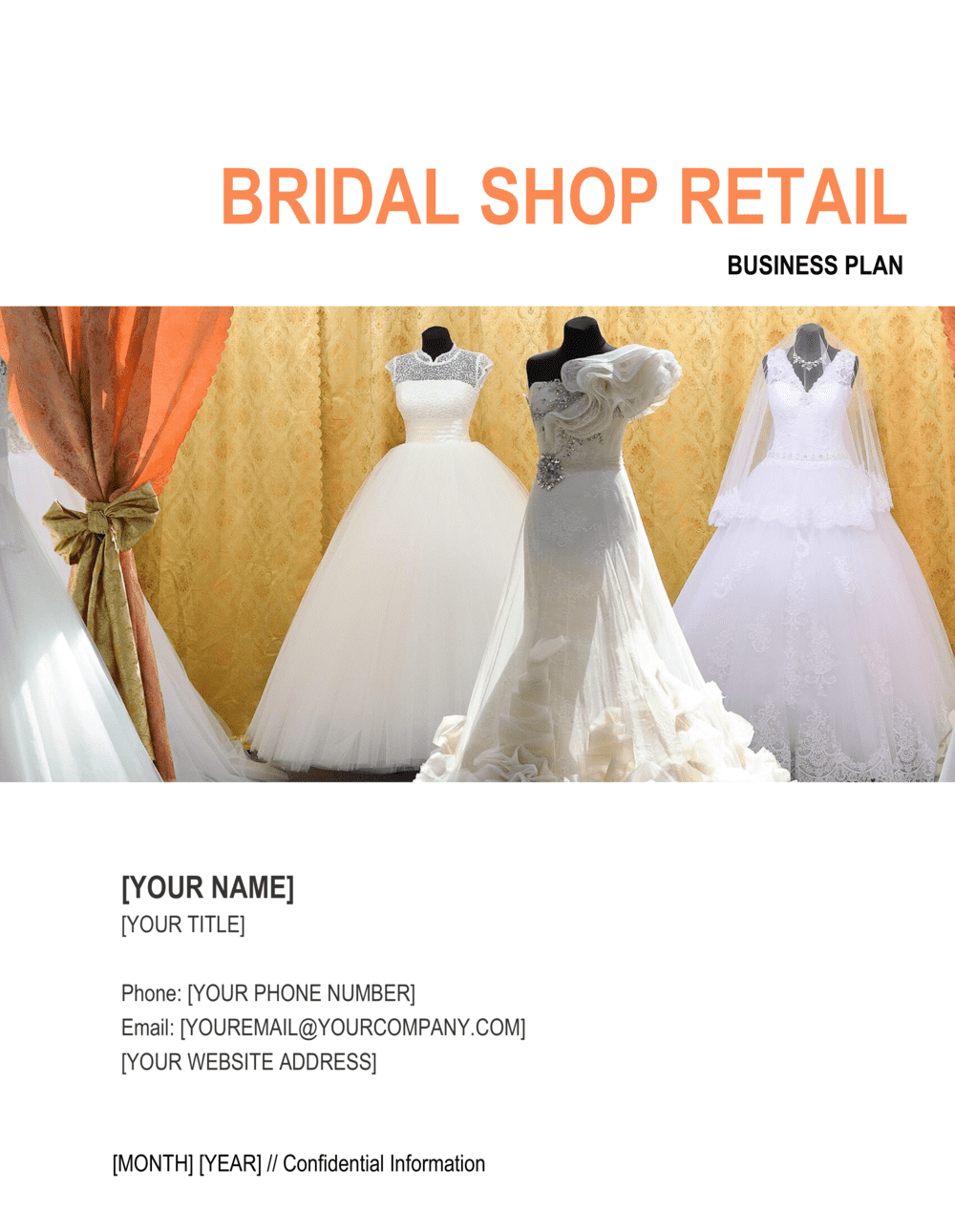
Bridal Shop Retail Plan Template

Free Word download β€’ Edit online β€’ Save & share with Drive β€’ Export to PDF

33 pagesβ€’40–55 min to fillβ€’Difficulty: Expert
Learn more ↓
FreeBridal Shop Retail Plan Template

At a glance

What it is
A Bridal Shop Retail Plan is a structured operational and strategic document that maps out every core element of running a bridal boutique β€” from inventory sourcing and pricing to marketing, staffing, and financial projections. This free Word download gives you a ready-to-edit template you can export as PDF to share with lenders, investors, or business partners.
When you need it
Use it when opening a new bridal boutique, applying for a retail business loan, or repositioning an existing shop around a clearer product mix, pricing strategy, or target customer segment.
What's inside
Executive summary, business overview, market and competitor analysis, product and inventory plan, pricing strategy, marketing and customer experience plan, staffing and operations, and 3-year financial projections including revenue forecast, cost of goods, and break-even analysis.

What is a Bridal Shop Retail Plan?

A Bridal Shop Retail Plan is a structured operational and financial document that outlines every material aspect of launching or growing a bridal boutique β€” from designer sourcing, inventory investment, and pricing strategy to marketing, staffing, and multi-year financial projections. Unlike a generic retail business plan, it accounts for the specific mechanics of bridal selling: appointment-based conversion funnels, made-to-order gown lead times of 16–24 weeks, designer minimum order requirements, and the high-margin alteration revenue stream that experienced boutique owners use to meaningfully improve profitability. This free Word download gives you a ready-to-edit framework you can adapt to your local market and export as PDF for lenders, investors, or business partners.

Why You Need This Document

Opening a bridal boutique without a written retail plan is one of the most common reasons new shops fail within their first two years. Without a documented inventory plan, owners routinely open with too few floor samples to convert appointments into sales. Without a financial model built from the appointment funnel up, revenue projections are guesses β€” and lenders know it. Banks and SBA loan programs require a formal plan with market analysis and financial projections before approving any retail financing. Beyond financing, the plan forces you to stress-test the decisions that matter most: whether your local market can support your price point, whether your conversion rate assumption is realistic given your appointment capacity, and whether your startup capital covers both inventory and the working capital reserve you will need to survive the slow winter and summer months. This template gives you the structure to answer all of those questions before you sign a lease.

Which variant fits your situation?

If your situation is…Use this template
Opening a bridal boutique from scratch with startup fundingBridal Shop Retail Plan
Raising capital from angel investors with a pitch-ready deckRetail Business Plan
Planning a quick internal roadmap without full financial detailOne-Page Business Plan
Opening a clothing boutique outside the bridal nicheClothing Store Business Plan
Adding an e-commerce channel to an existing bridal shopE-Commerce Business Plan
Franchising your bridal shop concept to a new locationBusiness Expansion Plan
Aligning a multi-year growth strategy for an established shopStrategic Planning Template

Common mistakes to avoid

❌ Underestimating opening inventory investment

Why it matters: A boutique with fewer than 80 floor samples cannot give brides enough choice to find a gown they love, leading to low conversion rates and early cash flow problems.

Fix: Budget opening inventory as the largest single line item in your startup capital plan β€” typically 35–45% of total startup costs for a bridal retail business.

❌ Projecting revenue without an appointment funnel model

Why it matters: A Year 1 revenue target with no underlying model of appointments Γ— conversion rate Γ— ATV is unverifiable, and lenders and investors will discount it immediately.

Fix: Build revenue projections from the appointment funnel up β€” monthly appointment capacity times your conversion rate assumption times average gown sale value.

❌ Ignoring lead time in the inventory plan

Why it matters: Made-to-order bridal gowns require 16–24 weeks from order to delivery. Failing to account for this means brides who buy in Month 1 cannot receive their gowns before their weddings.

Fix: Map every order date to a required ship date based on the bride's wedding date and the designer's current lead time, and factor this into your cash flow model.

❌ Skipping local wedding planner and venue partnerships in the marketing plan

Why it matters: Instagram and Google ads generate awareness, but referrals from planners and venues convert at two to three times the rate of paid channels and cost a fraction of the CAC.

Fix: Include a formal referral partnership program with at least five local wedding venues and planners as a named initiative in your marketing plan, with a target number of referrals per partner per year.

❌ Allocating too little working capital in the funding plan

Why it matters: Bridal retail has a seasonal revenue pattern β€” spring and fall are peak; summer and winter are slow. Insufficient working capital means the shop cannot cover fixed costs during slow months.

Fix: Include at least four to six months of fixed operating expenses as a working capital reserve in your startup funding requirements.

❌ Omitting the alterations revenue stream from the financial model

Why it matters: Alterations typically represent 10–20% of bridal shop revenue and carry higher gross margins than gown sales β€” leaving them out understates both revenue and profitability.

Fix: Model alterations revenue separately based on the percentage of gown buyers who use in-house tailoring and the average alteration invoice at your shop.

The 9 key sections, explained

Executive Summary

Business Overview

Market and Competitor Analysis

Product and Inventory Plan

Pricing Strategy

Marketing and Customer Experience Plan

Staffing and Operations Plan

Financial Projections

Funding Requirements and Use of Funds

How to fill it out

  1. 1

    Complete the business overview and concept statement

    Enter your shop's legal name, entity type, location, appointment model, and a one-paragraph concept statement that names your target bride, price range, and designer positioning.

    πŸ’‘ Nail the price range before anything else β€” every other decision, from inventory budget to lease location, flows from where your average gown transaction sits.

  2. 2

    Research and size your local bridal market

    Pull local marriage license data from your county clerk, estimate the percentage of brides who shop locally, and cross-reference with national bridal industry revenue figures from sources like The Wedding Report or IBISWorld.

    πŸ’‘ A trade area of 20 miles typically captures 60–70% of a boutique's customers. Size the market within that radius, not nationally.

  3. 3

    Map your competitors and define your whitespace

    Visit or call at least four competitors β€” two direct bridal boutiques and two indirect options (department stores, online retailers) β€” and document their price range, designer roster, appointment model, and any visible gaps.

    πŸ’‘ Shop your competitors as a customer. The experience gap you feel firsthand is exactly the differentiation story your plan needs.

  4. 4

    Build your product and inventory plan

    List the designers you plan to carry, their wholesale price range, the number of samples you need per designer, and the total opening inventory cost. Add accessory categories and alteration services with their own cost and margin assumptions.

    πŸ’‘ Contact designer sales reps before finalizing this section β€” minimum opening orders and territory exclusivity requirements vary significantly and affect your budget.

  5. 5

    Set your pricing strategy and margin targets

    Apply your markup formula to each product category and confirm the resulting retail prices are competitive in your market. Set an explicit gross margin target β€” typically 50–55% for bridal gowns at keystone pricing.

    πŸ’‘ Check each designer's MAP policy before publishing prices. Some designers require price approval for any promotional or sample sale pricing.

  6. 6

    Define your marketing channels and appointment model

    Choose two to three primary acquisition channels and estimate CAC for each. Document the appointment booking process, duration, capacity per day, and any deposit or cancellation policy.

    πŸ’‘ Build a referral program into the plan from day one β€” a bride who refers a friend is worth 2–3Γ— her own transaction value and costs near zero to acquire.

  7. 7

    Build the financial model from the appointment funnel up

    Start with monthly appointment capacity, apply your conversion rate assumption, multiply by average transaction value to get revenue, then layer in COGS, operating expenses, and owner draw to reach net income.

    πŸ’‘ Run a conservative scenario at 60% of projected appointments for the first six months β€” most new boutiques underestimate how long local brand awareness takes to build.

  8. 8

    Write the executive summary last

    Pull the single most compelling figure from each section β€” market size, conversion rate, Year 1 revenue, funding ask, and break-even timeline β€” and compress them into one to two pages.

    πŸ’‘ Lead the summary with the funding ask and the milestone it funds, not with the history of your passion for bridal fashion. Lenders fund milestones.

Frequently asked questions

What is a bridal shop retail plan?

A bridal shop retail plan is a structured business document that maps out the operational and financial strategy for opening or growing a bridal boutique. It covers market analysis, inventory sourcing, pricing, marketing, staffing, and 3-year financial projections. It functions as both an internal operating roadmap and an external document for securing financing from banks or investors.

Do I need a bridal shop retail plan to get a business loan?

Yes β€” most commercial lenders and SBA loan programs require a formal business plan that includes financial projections, a market analysis, and a use-of-funds breakdown before approving a retail loan. A well-structured bridal shop retail plan demonstrates to lenders that you understand the market, have a credible revenue model, and have planned for the capital requirements of bridal inventory and seasonal cash flow.

How much does it cost to open a bridal boutique?

Startup costs for a bridal boutique typically range from $80,000 to $285,000 depending on location, store size, and inventory depth. The largest cost categories are store build-out and fixtures ($20,000–$75,000), opening gown inventory ($30,000–$120,000), and working capital reserve ($15,000–$50,000). Your retail plan should itemize each category with specific quotes or estimates before you approach a lender.

What is a realistic gross margin for a bridal boutique?

Bridal gowns sold at standard keystone pricing (2.0–2.2Γ— wholesale) produce a gross margin of 50–55%. Accessories typically carry higher margins of 55–65%. Alterations, when performed in-house, can reach 70–80% gross margin. Your blended gross margin across all categories will depend on your product mix and whether you carry consignment inventory alongside owned stock.

How many appointments per day can a bridal boutique realistically handle?

A single bridal consultant can typically manage three to four 90-minute appointments per day with proper scheduling. For a two-consultant shop operating five days per week, that translates to 120–160 appointments per month at full capacity. Your financial model should project appointments at 50–70% of capacity in Year 1 to account for the time needed to build local brand awareness.

What conversion rate should I assume in my bridal shop financial plan?

Industry benchmarks suggest that well-run bridal boutiques convert 25–40% of appointments into a gown purchase. New shops in their first six months often see conversion rates closer to 15–20% as consultants build their selling skills and the sample inventory reaches its full depth. Use a conservative 20–25% conversion rate for Year 1 projections and document the assumptions driving your estimate.

How do I differentiate my bridal boutique from competitors in the plan?

Identify at least two concrete differentiators that are visible to the bride before she books an appointment β€” examples include exclusive designer territory rights, a defined price range that underserves the local market, a private appointment model with champagne service, or a specialization in plus-size or sustainable bridal. State the differentiator in one sentence in your executive summary and support it with competitor data in the market analysis section.

Should my bridal shop retail plan include e-commerce?

For a startup boutique, it is generally better to focus the plan on the physical retail and appointment experience first. E-commerce for bridal is complex β€” brides want to try gowns on, and made-to-order sizing creates significant return risk. If you plan to add an online channel in Year 2 or 3, note it as a future initiative in the plan but do not model it in Year 1 revenue projections unless you have a specific, tested strategy.

How often should I update my bridal shop retail plan?

Review and update the plan at least annually, aligning revisions to your fiscal year-end. Update the financial projections against actual results quarterly. If you are actively seeking additional financing, update the plan before every lender conversation to reflect current inventory value, YTD revenue, and any changes to your competitive landscape.

How this compares to alternatives

vs Retail Store Business Plan

A general retail store business plan covers the fundamentals of any product-based retail business β€” store layout, supplier relationships, and sales forecasting. A bridal shop retail plan adds the industry-specific layers that matter most in bridal: appointment conversion funnels, designer sourcing and MAP policies, made-to-order lead times, and alteration revenue modeling. Use the bridal-specific plan if your boutique's financials depend on gown inventory and appointment-based selling.

vs One-Page Business Plan

A one-page plan is a rapid-alignment tool useful for early ideation or internal team communication. It lacks the financial depth, inventory detail, and market evidence that lenders require. Use the one-page format to test your concept, then build the full bridal shop retail plan before approaching a bank or investor.

vs Marketing Plan

A marketing plan focuses exclusively on customer acquisition channels, campaign budgets, and brand positioning. A bridal shop retail plan covers marketing as one of ten sections and ties acquisition spending directly to appointment volume and revenue projections. If your shop is already open and you need a dedicated channel strategy, a standalone marketing plan is the right tool β€” but it does not replace the full retail plan for financing purposes.

vs Strategic Planning Template

A strategic plan focuses on 3–5 year goals, initiatives, and KPIs for an existing business β€” it assumes operations are already underway. A bridal shop retail plan is the foundational document for a new or early-stage boutique, covering startup costs, inventory investment, and break-even analysis that a strategic plan presupposes have already been resolved.

Industry-specific considerations

Bridal and Wedding Retail

Appointment-based sales model, designer minimum orders, made-to-order lead times, and seasonal revenue patterns tied to peak wedding months.

Fashion and Apparel Retail

Keystone pricing, sample inventory management, trunk show event planning, and sample sale clearance cycles to manage aging inventory.

Professional Services

In-house alteration services structured as a high-margin revenue line, with seamstress staffing and per-service pricing built into the operational model.

Franchise and Multi-Location Retail

Standardized inventory buying processes, consistent appointment experience protocols, and centralized marketing spend across multiple boutique locations.

Template vs pro β€” what fits your needs?

PathBest forCostTime
Use the templateFirst-time boutique owners applying for an SBA loan or presenting to a local bankFree2–3 weeks (30–50 hours including financial modeling)
Template + professional reviewOwners seeking financing above $200K or entering a competitive urban market with multiple established boutiques$500–$2,000 for a retail business advisor or accountant review3–4 weeks
Custom draftedMulti-location operators, franchise concepts, or boutiques seeking equity investment from outside investors$3,000–$8,000 for a professional business plan writer with retail experience4–6 weeks

Glossary

Trunk Show
A scheduled in-store event where a designer brings their full collection to a boutique, giving brides access to styles not carried in regular inventory.
Sample Sale
A clearance event where a bridal shop sells floor-sample gowns at a significant discount to free up inventory space and recover sunk costs.
Gross Margin
Revenue minus the cost of goods sold, expressed as a percentage of revenue β€” the primary measure of retail profitability before operating expenses.
Lead Time
The number of weeks or months between placing a gown order with a designer and receiving the finished garment β€” typically 16–24 weeks for made-to-order bridal.
Consignment
An inventory arrangement where the shop displays a designer's gowns but only pays for them when they sell, reducing upfront capital risk.
Average Transaction Value (ATV)
Total revenue divided by number of transactions in a period β€” a key retail metric that captures upsell performance on accessories and alterations.
Conversion Rate
The percentage of bridal appointments that result in a gown purchase β€” a primary operational KPI for bridal boutiques, typically ranging from 20–40%.
Alterations Revenue
Income generated by in-house tailoring services, which for bridal shops can represent 10–20% of total revenue and carries higher margins than gown sales.
CAC (Customer Acquisition Cost)
Total marketing and sales spend divided by the number of new brides who book an appointment, used to evaluate the efficiency of each marketing channel.
Break-Even Point
The monthly revenue level at which total sales revenue exactly covers all fixed and variable costs, with no profit or loss β€” a critical milestone for new retail locations.

Part of your Business Operating System

This document is one of 3,000+ business & legal templates included in Business in a Box.

  • Fill-in-the-blanks β€” ready in minutes
  • 100% customizable Word document
  • Compatible with all office suites
  • Export to PDF and share electronically

Create your document in 3 simple steps.

From template to signed document β€” all inside one Business Operating System.
1
Download or open template

Access over 3,000+ business and legal templates for any business task, project or initiative.

2
Edit and fill in the blanks with AI

Customize your ready-made business document template and save it in the cloud.

3
Save, Share, Send, Sign

Share your files and folders with your team. Create a space of seamless collaboration.

Save time, save money, and create top-quality documents.

β˜…β˜…β˜…β˜…β˜…

"Fantastic value! I'm not sure how I'd do without it. It's worth its weight in gold and paid back for itself many times."

Managing Director Β· Mall Farm
Robert Whalley
Managing Director, Mall Farm Proprietary Limited
β˜…β˜…β˜…β˜…β˜…

"I have been using Business in a Box for years. It has been the most useful source of templates I have encountered. I recommend it to anyone."

Business Owner Β· 4+ years
Dr Michael John Freestone
Business Owner
β˜…β˜…β˜…β˜…β˜…

"It has been a life saver so many times I have lost count. Business in a Box has saved me so much time and as you know, time is money."

Owner Β· Upstate Web
David G. Moore Jr.
Owner, Upstate Web

Run your business with a system β€” not scattered tools

Stop downloading documents. Start operating with clarity. Business in a Box gives you the Business Operating System used by over 250,000 companies worldwide to structure, run, and grow their business.

Start freeΒ Β·Β No credit card required