10 Essential Traits For Achieving Wealth and Financial Success Template

Free to read • Save or share with one click

Free10 Essential Traits For Achieving Wealth and Financial Success Template

At a glance

What it is
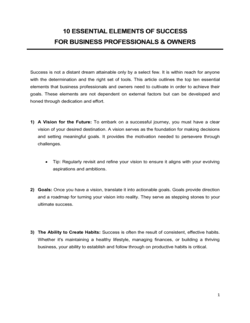
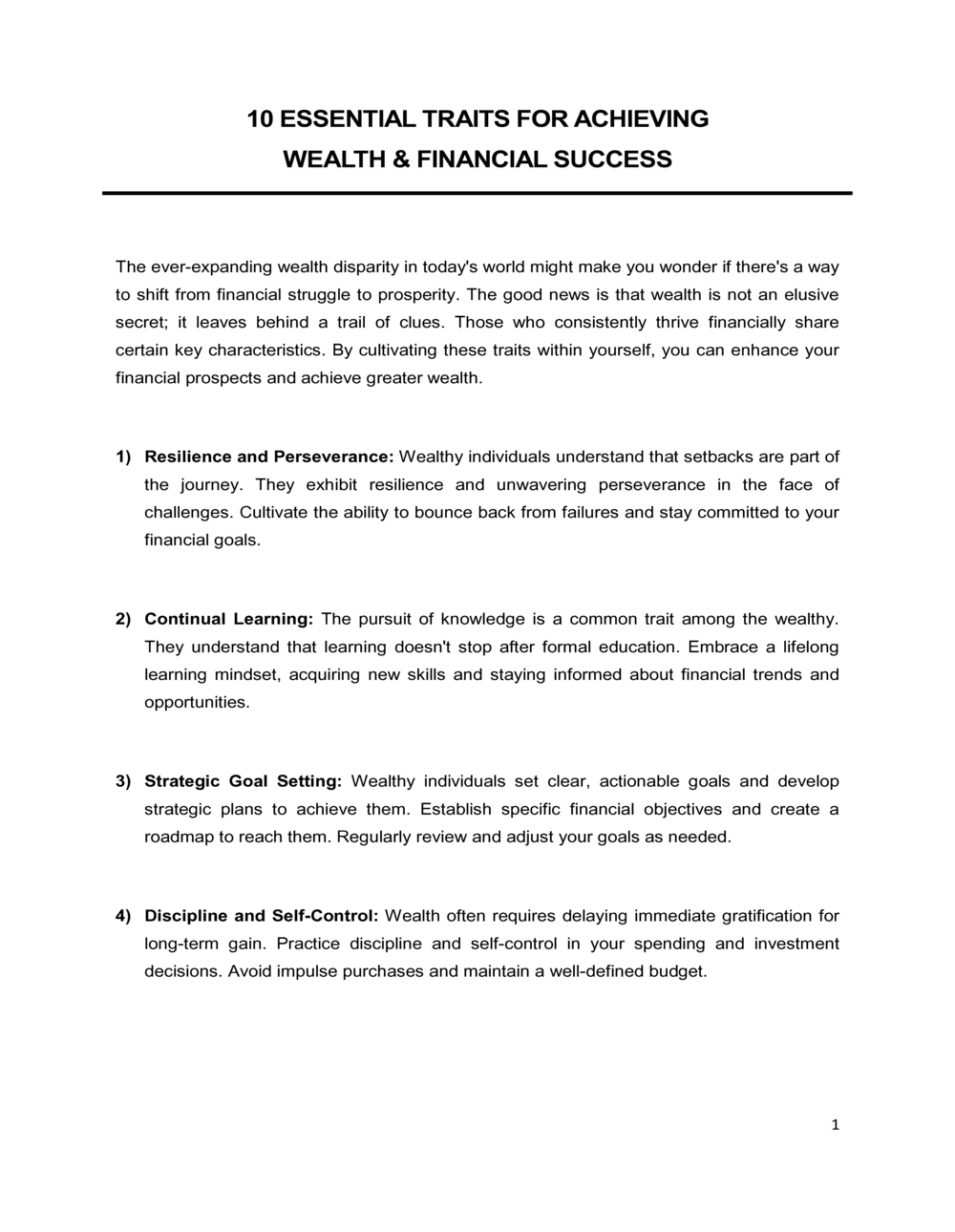
The 10 Essential Traits For Achieving Wealth And Financial Success is a structured Word document that outlines the core behavioral, mindset, and strategic habits consistently linked to long-term wealth building and financial independence. It provides a free download you can edit online and export as PDF, giving individuals and business owners a concrete framework to self-assess, set priorities, and build an actionable development plan.
When you need it
Use it when starting a personal financial development program, coaching employees or clients on wealth-building habits, or building the foundational mindset framework that supports a broader financial plan or business strategy.
What's inside
The document covers ten sequenced traits — from goal clarity and delayed gratification to continuous learning and strategic risk tolerance — each with a plain-language explanation, self-assessment prompt, and recommended action steps to develop that trait in practice.

What is the 10 Essential Traits For Achieving Wealth And Financial Success?

The 10 Essential Traits For Achieving Wealth And Financial Success is a structured self-assessment and personal development document that identifies the ten behavioral habits, mindset patterns, and strategic practices most consistently linked to long-term financial independence and wealth accumulation. Unlike a financial plan — which sets quantitative targets — this framework addresses the behavioral layer underneath: the daily decisions, cognitive patterns, and relationship practices that determine whether any financial strategy is actually followed through. Each section covers one trait with a plain-language explanation, a scored self-assessment prompt, concrete action steps with specific placeholders, and a 90-day review mechanism to track behavioral change over time.

Why You Need This Document

The gap between knowing what to do financially and actually doing it is almost entirely behavioral. Most people with a financial plan fail not because the plan is wrong, but because the underlying habits — discipline, delayed gratification, consistent learning, and resilience after setbacks — have never been explicitly developed. Without a structured framework to identify and address those gaps, financial plans get abandoned after the first market downturn, spending discipline erodes during periods of higher income, and wealth accumulation stalls despite strong earnings. This template makes the invisible visible: it turns abstract character traits into scored, measurable behaviors with specific action commitments and a quarterly accountability loop. For financial coaches and advisors, it provides a client-facing tool that surfaces the behavioral patterns most likely to undermine an otherwise sound financial plan before they cost the client years of compounding.

Which variant fits your situation?

If your situation is…Use this template
Mapping wealth-building traits to a full personal financial planPersonal Financial Plan
Translating personal financial habits into a business growth strategyBusiness Plan
Coaching employees on financial wellness as part of an HR programEmployee Development Plan
Setting specific wealth milestones and tracking progress quarterlySMART Goals Template
Identifying strengths and gaps in a leadership team's strategic mindsetSWOT Analysis
Building a structured investment approach alongside the behavioral frameworkInvestment Policy Statement
Applying wealth-building principles to a startup's operating strategyStrategic Planning Template

Common mistakes to avoid

❌ Treating the document as a one-time read rather than a live tool

Why it matters: A self-assessment completed once and filed away produces no behavioral change. Financial habits are built through repeated measurement and adjustment, not a single reflection.

Fix: Schedule and complete the quarterly review on a fixed calendar date and update scores, action steps, and supporting resources at each cycle.

❌ Scoring the baseline based on aspirations instead of current behavior

Why it matters: An inflated baseline makes progress invisible — you cannot measure improvement if you started by overrating where you already are.

Fix: Score each trait based on what you actually did in the last 90 days, not what you intend to do. Use transaction records, calendar data, and account statements as evidence.

❌ Selecting too many traits to develop simultaneously

Why it matters: Trying to improve all 10 traits at once dilutes attention and produces shallow progress on every front rather than meaningful change on any one.

Fix: Commit to no more than two or three traits per 90-day cycle. Depth of habit change on a few traits compounds faster than surface-level attention across all ten.

❌ Leaving action steps in vague or relative language

Why it matters: Commitments like 'save more' or 'invest consistently' have no measurable threshold — it is always possible to rationalize compliance without changing behavior.

Fix: Replace every vague commitment with a specific number, date, and tool: 'Transfer $500 on the 1st of each month to my Vanguard index fund account, starting June 1.'

The 10 key sections, explained

Trait 1 — Goal clarity and specificity

Trait 2 — Delayed gratification and impulse control

Trait 3 — Financial discipline and consistency

Trait 4 — Continuous learning and financial literacy

Trait 5 — Strategic risk tolerance and calculated decision-making

Trait 6 — Resilience and adaptability to setbacks

Trait 7 — Proactive income diversification

Trait 8 — Strategic networking and relationship capital

Trait 9 — Long-term orientation and patience

Trait 10 — Accountability and structured self-review

How to fill it out

  1. 1

    Complete the baseline self-assessment

    Before editing any section, score yourself 1–5 on each of the 10 traits based on your current behavior — not your aspirations. Use the self-assessment prompts in each section.

    💡 Be honest rather than aspirational on the baseline. An inflated starting score makes it impossible to measure real progress at the 90-day review.

  2. 2

    Prioritize two or three traits to develop first

    Review your lowest scores from the baseline and select the two or three traits that, if improved, would have the greatest immediate impact on your financial position.

    💡 Trait 3 (financial discipline) and Trait 1 (goal clarity) affect every other trait — if either scores below 3, prioritize them regardless of where other scores land.

  3. 3

    Fill in the action steps for each prioritized trait

    For each selected trait, complete the sample-language blocks with your specific numbers — dollar amounts, dates, timelines, and tools. Vague commitments produce vague results.

    💡 Use amounts and dates you can actually commit to today, not aspirational targets. You can scale up at the 90-day review once the habit is established.

  4. 4

    Attach supporting tools and resources

    Link or reference the specific budgeting tool, investment account, book list, or mentor relationship you will use to develop each prioritized trait.

    💡 Each trait should have exactly one primary tool or resource — multiple options create decision fatigue and reduce follow-through.

  5. 5

    Set a 90-day review date and calendar it immediately

    Enter your first quarterly review date at the top of the document and add it to your calendar before closing the file. Include a second and third review date 90 and 180 days after that.

    💡 Scheduling the review as a recurring calendar event — not a to-do item — increases completion rates significantly.

  6. 6

    Share the document with an accountability partner

    Send the completed document to a coach, mentor, or trusted peer who will check in on your progress at the 90-day mark. Stating goals to another person measurably increases follow-through.

    💡 Choose an accountability partner who has already achieved the financial outcomes you are working toward — peer accountability from someone with the same gaps is less effective.

  7. 7

    Conduct the quarterly review and update scores

    At each 90-day interval, rescore all 10 traits, compare against your prior scores, and identify any trait where behavior has regressed. Update action steps for the next quarter.

    💡 A regression in any trait score is not a failure — it is data. Document what caused it and adjust the supporting system, not just the intention.

Frequently asked questions

What is the 10 Essential Traits For Achieving Wealth And Financial Success template?

It is a structured Word document that identifies and explains the ten behavioral and mindset traits most consistently linked to long-term wealth building — from goal clarity and financial discipline to strategic networking and long-term orientation. Each section includes a self-assessment prompt and concrete action steps, making it both an educational resource and a personal development planning tool.

Who should use this template?

Entrepreneurs, financial coaches, small business owners, HR professionals, and career professionals working toward financial independence all benefit from this framework. It is equally useful as a personal development tool and as a structured resource for coaching clients or training employees on financial wellness and wealth-building habits.

How is this template different from a financial plan?

A financial plan covers quantitative targets — savings rates, investment allocations, retirement timelines, and tax strategies. This template addresses the behavioral and mindset layer that determines whether a financial plan is actually followed. Both are necessary: the financial plan sets the destination; the traits framework builds the habits that get you there.

How often should I revisit the document?

A quarterly review cycle — every 90 days — is the recommended cadence. At each review, rescore all 10 traits, compare against your prior scores, identify regressions, and update action steps for the next quarter. An annual full reset at the start of each fiscal or calendar year is also useful for broader goal recalibration.

Can this template be used in a coaching or training program?

Yes. Financial coaches and HR professionals regularly use frameworks like this as structured client-facing or employee-facing tools. The self-assessment format supports one-on-one coaching conversations, group workshops, and online courses. The Word format makes it straightforward to customize with your own branding, additional prompts, or program-specific resources.

Do I need financial expertise to use this template?

No specialized financial knowledge is required. The traits and action steps are written in plain language accessible to anyone who wants to improve their financial habits. The template is most effective when paired with a basic budget or financial tracking tool, but it functions as a standalone self-development resource without one.

What makes this framework different from general self-help advice?

The template is structured around traits with documented links to financial outcomes — not generic productivity or success principles. Each trait section includes specific, measurable action steps rather than inspirational statements, and the quarterly scoring system creates an accountability loop that general self-help resources typically omit.

Can a business use this template for team development?

Yes, particularly for leadership teams, sales organizations, and any team where individual financial decision-making affects business outcomes. Adapting the self-assessment to measure business-relevant behaviors — such as disciplined resource allocation, strategic risk-taking, and long-term planning orientation — makes the framework directly applicable to team and organizational development.

How this compares to alternatives

vs Personal Financial Plan

A personal financial plan is a quantitative document covering savings targets, investment allocations, debt reduction schedules, and retirement projections. The traits template addresses the behavioral layer — the habits and mindset that determine whether the financial plan is actually executed. Both are necessary; this template is the prerequisite for making a financial plan stick.

vs Strategic Planning Template

A strategic plan defines an organization's multi-year goals, initiatives, and resource allocation. The traits template focuses on individual behavioral development rather than organizational strategy. Founders and executives often use both — the strategic plan for the business and the traits framework for personal financial discipline that supports it.

vs SWOT Analysis

A SWOT analysis maps internal strengths and weaknesses against external opportunities and threats — typically for a business or project. The traits framework is a personal development self-assessment rather than a situational analysis tool. A SWOT can complement the traits template by surfacing external factors that affect wealth-building strategy, but the two serve distinct purposes.

vs Business Plan

A business plan covers market opportunity, competitive positioning, operations, and financial projections for a venture. The traits template focuses on the individual behavioral habits that support successful execution of any plan. Entrepreneurs benefit from completing the traits self-assessment before finalizing a business plan, as behavioral gaps in discipline or risk management will undermine even a well-constructed plan.

Industry-specific considerations

Financial Services

Financial advisors use the framework as a client onboarding tool to surface behavioral patterns that undermine even technically sound financial plans.

Professional Services

Consultants, lawyers, and accountants apply the traits framework to transition from high-income earners to wealth accumulators by addressing the discipline and diversification gaps common in professional practices.

Technology / SaaS

Startup founders use the framework to distinguish between growth-oriented risk tolerance and undisciplined spending, particularly during periods of rapid revenue scaling.

Retail / E-commerce

Retail owners apply the income diversification and financial discipline sections to reduce overreliance on a single sales channel and build personal wealth separate from business equity.

Template vs pro — what fits your needs?

PathBest forCostTime
Use the templateIndividuals, entrepreneurs, and coaches building a personal or client-facing wealth development frameworkFree1–2 hours for initial self-assessment and action planning
Template + professional reviewProfessionals integrating the framework into a formal coaching program or employee training curriculum$200–$500 for a financial coach or organizational development consultant review2–5 days
Custom draftedOrganizations building a proprietary financial wellness program or certification course$2,000–$8,000 for custom curriculum development3–8 weeks

Glossary

Delayed Gratification
The ability to resist an immediate reward in favor of a larger or more enduring benefit achieved later — a core trait consistently correlated with long-term wealth accumulation.
Financial Discipline
Consistent adherence to a spending, saving, and investing plan regardless of short-term temptations or market fluctuations.
Growth Mindset
The belief that abilities and intelligence can be developed through effort and learning, as opposed to being fixed traits — foundational to adapting to financial setbacks.
Risk Tolerance
An individual's willingness and capacity to endure financial loss or volatility in pursuit of higher returns or greater long-term gains.
Compounding
The process by which investment returns generate their own returns over time, producing exponential growth when reinvested consistently over long periods.
Net Worth
Total assets minus total liabilities — the single most comprehensive measure of an individual's or business's financial position at a point in time.
Financial Independence
A state in which passive income from assets covers all living or operating expenses without requiring active employment or trading time for money.
Opportunity Cost
The value of the next-best alternative foregone when a financial decision is made — a key concept in evaluating how wealth-building choices compound over time.
Self-Efficacy
Confidence in one's ability to execute specific behaviors or achieve specific outcomes — linked in research to higher financial goal attainment.
Strategic Networking
Intentionally building relationships with people who provide access to knowledge, capital, partnerships, or opportunities that accelerate wealth creation.

Part of your Business Operating System

This document is one of 3,000+ business & legal templates included in Business in a Box.

  • Fill-in-the-blanks — ready in minutes
  • Compatible with all office suites
  • Export to PDF and share electronically

Create your document in 3 simple steps.

From template to signed document — all inside one Business Operating System.
1
Download or open template

Access over 3,000+ business and legal templates for any business task, project or initiative.

2
Edit and fill in the blanks with AI

Customize your ready-made business document template and save it in the cloud.

3
Save, Share, Send, Sign

Share your files and folders with your team. Create a space of seamless collaboration.

Save time, save money, and create top-quality documents.

★★★★★

"Fantastic value! I'm not sure how I'd do without it. It's worth its weight in gold and paid back for itself many times."

Managing Director · Mall Farm
Robert Whalley
Managing Director, Mall Farm Proprietary Limited
★★★★★

"I have been using Business in a Box for years. It has been the most useful source of templates I have encountered. I recommend it to anyone."

Business Owner · 4+ years
Dr Michael John Freestone
Business Owner
★★★★★

"It has been a life saver so many times I have lost count. Business in a Box has saved me so much time and as you know, time is money."

Owner · Upstate Web
David G. Moore Jr.
Owner, Upstate Web

Run your business with a system — not scattered tools

Stop downloading documents. Start operating with clarity. Business in a Box gives you the Business Operating System used by over 250,000 companies worldwide to structure, run, and grow their business.

Start free · No credit card required