Supply Chain Templates
★★★★★4.7from 280+ reviews· Trusted by 20M+ businesses
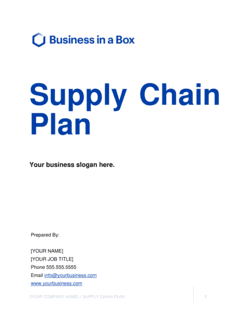
Plan, contract, and manage every link in your supply chain — from raw materials to finished goods.
WordEditable onlinePDF10+ supply chain templates
Other Production & Operations categories
Most popular supply chain templates
Supply and procurement agreements
Planning, hiring, and how-to guides
250K+Clients
20M+Free users
20+Years
190+Countries
10,000+Law firms
50M+Downloads
Trusted across review platforms
- Capterra★★★★☆4.649 reviews
- G2★★★★☆4.713 reviews
- GetApp★★★★☆4.649 reviews
- Google Play★★★★☆4.6179 ratings
- Google Reviews★★★★☆4.567 reviews
Frequently asked questions
What is a supply chain plan and what should it include?
A supply chain plan is a formal document that maps how a business sources materials, manages production, and delivers finished goods to customers. It typically covers supplier relationships, inventory policies, logistics arrangements, risk mitigation strategies, and KPIs. A well-structured plan helps operations teams execute consistently and gives leadership visibility into dependencies and vulnerabilities before they become problems.
What is the difference between a supply agreement and a supply contract?
The two terms are used interchangeably. Both refer to a binding contract between a buyer and a supplier that governs the ongoing sale and purchase of goods or materials. The word "agreement" is simply the more common label in commercial practice.
When should I use a contract manufacturing agreement instead of a general manufacturing agreement?
Use a contract manufacturing agreement when you own the product design, IP, and specifications and you are commissioning a third party to produce to your exact requirements. A general manufacturing agreement is appropriate when the manufacturer has more latitude over production methods. The distinction matters for IP ownership, quality control rights, and liability allocation.
Does a supply agreement need to be signed before I start purchasing?
Yes, in most situations. Purchasing without a signed agreement leaves price, quality, and delivery terms open to dispute. Some businesses operate on purchase orders alone for small or one-off buys, but any recurring or strategic supplier relationship should be governed by a master supply agreement signed before the first order is placed.
What is a toll manufacturing agreement?
A toll manufacturing agreement is a contract in which the buyer provides raw materials and the manufacturer processes them into finished goods for a processing fee. The buyer retains ownership of the inputs and outputs throughout. This arrangement is common in chemicals, food processing, and pharma, where companies want production capacity without transferring material ownership.
How is a value chain analysis different from a supply chain analysis?
A value chain analysis (developed by Michael Porter) maps all internal business activities — from inbound logistics to after-sales service — to identify where value is created and where costs can be reduced for competitive advantage. A supply chain analysis focuses specifically on the flow of materials and information from external suppliers through to the customer. Both are useful, but they answer different strategic questions.
What should an exclusive supply agreement include?
An exclusive supply agreement should clearly define the scope of exclusivity (product category, geography, or both), any minimum purchase or volume commitments that justify the exclusivity, the duration of the exclusive period, and consequences if either party fails to meet its obligations. Without minimum commitments, courts in many jurisdictions may not consider the exclusivity binding on both sides.
Do I need a lawyer to finalize a manufacturing agreement?
For low-volume or straightforward arrangements, a well-drafted template is often sufficient as a starting point. However, manufacturing agreements involving significant IP, cross-border parties, regulated products (food, pharma, medical devices), or high production volumes benefit from legal review before signing. The cost of a 1–2 hour review is small relative to the exposure a poorly worded clause can create.
Supply Chain vs. related documents
A supply agreement is a master contract that governs the ongoing relationship between a buyer and a supplier — setting price, quality, delivery, and exclusivity terms for multiple future transactions. A purchase order is a transaction-level document that triggers a single buy under those terms. Use a supply agreement first; then raise purchase orders against it.
A manufacturing agreement is a broad contract covering a manufacturer's production obligations for a buyer. A contract manufacturing agreement is more specific: the buyer owns the design and IP, and the manufacturer produces to spec. If you own the product and are having someone else make it, use the contract manufacturing variant.
A supply chain plan is an operational document that maps how goods will move from supplier to customer — logistics, risk, timelines, and KPIs. A value chain analysis is a strategic tool that identifies where in your business activities value is created, costs arise, and competitive advantage can be built. You typically do the analysis first, then build the plan around the findings.
An outsourcing agreement transfers a manufacturing function — including management responsibility — to a third party. A toll manufacturing agreement is narrower: the buyer supplies the raw materials and the toll manufacturer processes them for a fee, retaining no ownership of inputs or outputs. Use the toll agreement when you want to keep material ownership and simply pay for processing capacity.
Key clauses every Supply Chain contains
Whether you are drafting a supply agreement or a contract manufacturing contract, the same core clauses appear in almost every supply chain document.
- Scope of supply. Defines exactly what goods, materials, or services are being supplied, including specifications, quantities, and any approved vendor lists.
- Price and payment terms. Sets the unit price or fee, payment schedule, currency, and any price-adjustment mechanism tied to input costs or indices.
- Delivery and lead times. Specifies Incoterms, delivery points, lead time commitments, and consequences for late delivery.
- Quality standards and inspection. Defines acceptance criteria, inspection rights, rejection procedures, and corrective-action obligations.
- Intellectual property ownership. Clarifies who owns designs, tooling, formulations, and improvements created during the engagement.
- Exclusivity and minimum volumes. States whether the supply relationship is exclusive and whether minimum purchase or production volumes apply.
- Confidentiality. Protects specifications, pricing, processes, and business information shared between the parties.
- Term, renewal, and termination. Sets the contract duration, auto-renewal conditions, and grounds and notice periods for early termination.
- Liability and indemnification. Caps financial exposure and allocates responsibility for defective goods, third-party claims, and supply failures.
How to write a supply chain plan
A supply chain plan documents how your business will source, produce, and deliver goods reliably — and what it will do when things go wrong.
1
Map your supply chain from end to end
List every tier of supplier, manufacturer, warehouse, and distribution point involved in getting your product to the customer.
2
Document sourcing and supplier selection criteria
Define how you evaluate and qualify suppliers — quality certifications, lead times, pricing benchmarks, and financial stability.
3
Set inventory and demand planning policies
Specify safety stock levels, reorder points, demand forecasting methods, and any seasonal or promotional adjustments.
4
Formalize supplier agreements
Reference or attach the supply agreements, manufacturing contracts, and quality agreements that govern each key supplier relationship.
5
Define logistics and delivery terms
Document Incoterms, preferred carriers, shipping lanes, lead time targets, and customs or import requirements.
6
Identify risks and mitigation strategies
Map single-source dependencies, geographic concentrations, lead-time vulnerabilities, and the contingency plans for each.
7
Establish KPIs and review cadence
Set measurable targets for on-time delivery, defect rate, cost per unit, and inventory turns, and schedule regular supplier reviews.
At a glance
- What it is
- Supply chain templates are ready-to-use documents that cover the planning, contracting, and operational management of the flow of goods, materials, and services from suppliers to end customers. They reduce drafting time and help ensure the right terms, processes, and analysis frameworks are in place before a deal is signed or a production run begins.
- When you need one
- Any time you source materials, engage a manufacturer, formalize a supplier relationship, or need to document your supply chain strategy, a template gives you a reliable starting point that a blank page cannot.
Which Supply Chain do I need?
The right template depends on whether you are planning, contracting, or analyzing. Match your immediate task to the scenario below.
Your situation
Recommended template
Building a formal end-to-end supply chain strategy document
Covers sourcing, logistics, risk, and KPIs in a single structured plan.Purchasing goods from a supplier on an ongoing basis
Standard terms for price, delivery, quality, and exclusivity of supply.Commissioning a third party to manufacture your product
Defines responsibilities, IP ownership, quality standards, and liability.Locking in a single supplier as your exclusive source
Grants exclusivity rights and sets the obligations that come with them.Outsourcing a manufacturing function to an external party
Purpose-built for manufacturing outsourcing with scope and SLA provisions.Analyzing where your business creates and loses value
Structured framework for mapping primary and support activities against cost and value.Appointing a representative to sell on behalf of your manufacturing business
Sets commission, territory, and authority for the manufacturer's rep.Writing a business plan for a new manufacturing operation
Full business plan structure tailored to manufacturing operations and cost models.Glossary
- Supply chain
- The full network of entities, activities, and resources involved in creating and delivering a product from raw materials to the end customer.
- Incoterms
- Standardized international trade terms (published by the ICC) that define when risk and cost transfer from seller to buyer during shipment.
- Contract manufacturing
- An arrangement where a company outsources production to a third-party manufacturer who builds to the commissioning company's specifications.
- Toll manufacturing
- A processing arrangement where the buyer supplies raw materials and pays a manufacturer a fee to convert them into finished goods.
- Value chain
- The full range of activities a business performs to deliver a product or service, from design and sourcing through production, sales, and after-sales support.
- Exclusive supply
- A contractual arrangement in which a buyer commits to purchasing from one supplier only, or a supplier commits to selling to one buyer only, within a defined scope.
- Safety stock
- Inventory held above normal cycle stock to buffer against unexpected demand spikes or supply delays.
- Single-source supplier
- A supplier that is the only qualified or contracted source for a given component or material, creating a supply chain concentration risk.
- Lead time
- The elapsed time between placing an order and receiving the goods, used as a planning input for inventory and production scheduling.
- Quality agreement
- A contract that defines quality standards, testing protocols, inspection rights, and corrective-action obligations between a manufacturer and a buyer.
- Manufacturer's representative
- An independent agent who sells a manufacturer's products within a defined territory, typically on a commission basis.
What is a supply chain template?
A supply chain template is a professionally structured document — plan, contract, analysis framework, or how-to guide — that gives operations and procurement teams a reliable starting point for managing the flow of goods, materials, and services from suppliers through to the end customer. Rather than drafting from scratch, a template captures the standard clauses, sections, and frameworks that apply to a given supply chain task, reducing drafting time and the risk of missing critical terms.
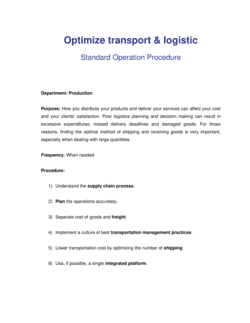
Supply chain documents fall into three broad categories. Planning documents — such as a supply chain plan or value chain analysis — define strategy, map dependencies, and set performance targets. Contracts and agreements — supply agreements, manufacturing agreements, contract manufacturing agreements, and their variants — formalize the obligations between buyers, suppliers, and manufacturers. Operational tools — checklists, how-to guides, and job descriptions — support the day-to-day management of the supply function and the people who run it.
Together, these documents form the operational backbone of any product-based business, whether it sources from a single local supplier or manages a multi-tier global network.
When you need a supply chain template
Whenever a product-based business takes a step that affects the movement, production, or sourcing of goods, a document should go with it. Acting on a handshake or an email thread leaves price, quality, and delivery obligations open to dispute — and supply disruptions are expensive.
Common triggers:
- Formalizing a new supplier relationship with price, quality, and delivery terms
- Commissioning a third-party manufacturer to produce goods to your specification
- Locking in an exclusive supplier or distributor for a key input or territory
- Outsourcing a manufacturing function to reduce capital expenditure
- Building or updating a supply chain strategy document ahead of a funding round or audit
- Conducting a value chain analysis to find cost reduction or margin improvement opportunities
- Hiring a supply chain analyst or manager and needing a precise job description
- Launching a new manufacturing business and requiring a full business plan
Without written agreements, a single supplier failure, a quality dispute, or a price disagreement can halt production and destroy customer relationships. With the right templates in place, every party knows exactly what they agreed to — and enforcement is straightforward.
Award-winning platform
- Great Place to Work 2025
- BIG Award — Product of the Year 2025
- Smartest Companies 2025
- Global 100 Excellence 2026
- Best of the Best 2025