Remote and Flexible Work Templates
★★★★★4.7from 280+ reviews· Trusted by 20M+ businesses
Set clear expectations for remote, hybrid, and flexible workers — with policies your team will actually follow.
WordEditable onlinePDF12+ remote and flexible work templates
Other Human Resources categories
Employee wellness and balance
250K+Clients
20M+Free users
20+Years
190+Countries
10,000+Law firms
50M+Downloads
Trusted across review platforms
- Capterra★★★★☆4.649 reviews
- G2★★★★☆4.713 reviews
- GetApp★★★★☆4.649 reviews
- Google Play★★★★☆4.6179 ratings
- Google Reviews★★★★☆4.567 reviews
Frequently asked questions
Do I need both a remote work policy and a remote work agreement?
Yes, in most cases. The policy sets company-wide rules that apply to all remote employees — it's the baseline standard. The agreement is an individual document that records the specific terms for one person's arrangement: their approved location, schedule, and equipment. The policy without the agreement leaves individual terms undocumented; the agreement without the policy means every manager is making up rules independently.
Is a remote work policy legally required?
In most jurisdictions, no law requires a standalone remote work policy. However, written policies protect employers in wage-and-hour disputes, data breach investigations, and wrongful termination claims. Several countries and US states have wage, expense-reimbursement, and data-privacy laws that effectively require you to document how remote work is administered — even if they don't call the document a "policy." Consult local employment counsel to confirm your obligations.
What should a work-from-home policy include?
A work-from-home policy should cover eligibility, approved locations, core hours and availability requirements, equipment and expense rules, data security obligations, performance expectations, and the conditions under which the arrangement can be modified or revoked. A policy that omits any of these areas typically creates the exact disputes it was intended to prevent.
How do I enforce a remote work policy fairly?
Apply the policy consistently across similar roles and situations. Document every exception with a business justification. Tie enforcement to measurable outputs — missed availability windows, security incidents, or failure to meet agreed deliverables — rather than subjective assessments of "effort." When an arrangement is revoked, follow the notice period stated in the policy and apply it uniformly.
Can I monitor remote employees, and should I disclose it?
Monitoring is legally permitted in most jurisdictions with proper notice, but the rules vary significantly by country and US state. As a general rule, disclose monitoring practices in the remote work policy or a separate monitoring policy, limit monitoring to business systems and business hours, and avoid capturing personal data that isn't relevant to work performance. Failing to disclose monitoring can expose the company to significant legal liability in many jurisdictions.
What's the difference between a compressed work week and a four-day work week?
A compressed work week means employees work the same total hours — usually 40 — over fewer days, such as four 10-hour days. A four-day work week (as commonly piloted in recent years) typically means 32 hours at full pay, reducing the total hours worked. The distinction matters for overtime calculations, labor law compliance, and how you measure productivity, so the policy should specify which model applies.
How do I handle time zones in a remote work policy?
State the company's reference time zone for core hours, meeting scheduling, and deadline calculations. If your team is globally distributed, define a reasonable overlap window — usually 3–4 hours — during which all team members are expected to be available. Document any approved deviations (for example, an employee in a significantly different time zone) in their individual remote work agreement.
Can a remote work arrangement be revoked?
Yes. Most remote work policies and agreements reserve the employer's right to modify or revoke the arrangement with reasonable advance notice — commonly two to four weeks. Clear revocation language protects the employer if business needs change, a role evolves, or an employee fails to meet the performance standards set in the policy. Without this clause, employees may argue the arrangement has become a contractual entitlement.
Remote and Flexible Work vs. related documents
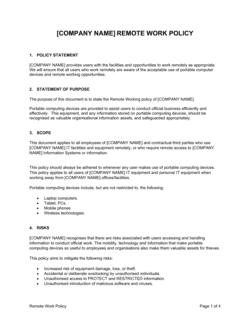
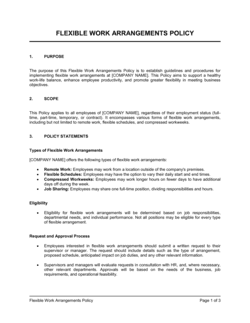
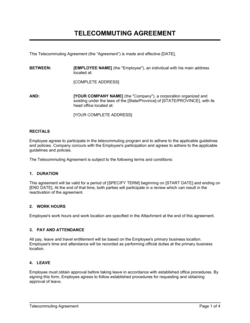
A remote work policy is a company-wide document that sets universal rules for all employees who work remotely. A remote work agreement is an individual contract signed by one employee and their manager that documents the specific terms — hours, location, equipment — for that person's arrangement. You typically need both: the policy establishes the framework, and the agreement applies it to each individual.
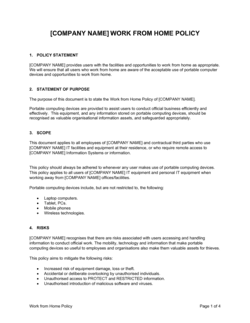
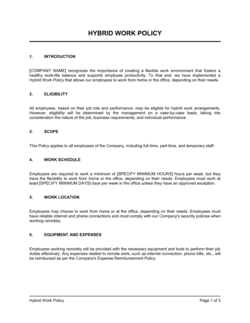
A work-from-home policy covers employees who work remotely full-time or the majority of the time. A hybrid work policy addresses the split between remote and in-office days — defining which days employees must be on-site, how scheduling is coordinated, and how desk or meeting-room resources are shared. Use a hybrid policy when the in-office component is a meaningful part of the arrangement.
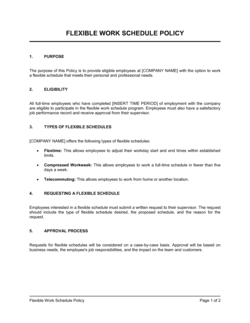
A flexible work schedule policy deals specifically with when people work — variable start and end times, compressed work weeks, or shifted hours. A flexible work arrangements policy is broader, covering not just when but also where and how much employees work, including part-time schedules, job sharing, and remote arrangements. If your flexibility program involves multiple dimensions, use the broader arrangements policy.
A remote work security policy focuses on data protection rules, acceptable use, and incident reporting obligations for remote employees. The equipment and security policy additionally covers who owns which devices, how equipment is procured, maintained, and returned, and what technical standards home setups must meet. Use the combined policy when the company provides or subsidizes equipment.
Key clauses every Remote and Flexible Work contains
Regardless of variant, every remote and flexible work document is built from the same core clauses — the wording adapts to the specific arrangement, but the structure stays consistent.
- Eligibility criteria. Defines which roles, tenure levels, or performance standings qualify for remote or flexible arrangements.
- Approved work location. Specifies where employees may work — home address, co-working space, or any pre-approved location — and prohibits unapproved locations.
- Core hours and availability. Sets the window during which employees must be reachable regardless of their overall schedule.
- Equipment and expense provisions. Clarifies who provides devices, covers internet costs, and defines what reimbursements employees can claim.
- Data security requirements. Outlines VPN use, password standards, prohibited networks, and device encryption obligations.
- Performance expectations. States how output will be measured, how check-ins will occur, and what constitutes a failure to meet remote-work standards.
- Modification and revocation. Explains that the arrangement can be changed or ended by the employer with specified notice, protecting operational flexibility.
- Health and safety acknowledgment. Requires the employee to confirm their remote workspace meets basic ergonomic and safety standards.
How to write a remote or flexible work policy
A clear remote or flexible work policy prevents disputes, aligns manager expectations, and gives employees the confidence to work productively outside the office.
1
Define scope and eligibility
Identify which roles qualify, what performance or tenure conditions apply, and whether eligibility is at manager discretion or automatic.
2
Specify the arrangement type
State whether the policy covers full remote, hybrid, flexible hours, compressed weeks, or a combination — and define each term clearly.
3
Set location and availability rules
Name approved work locations, require prior approval for changes, and establish the core hours during which employees must be reachable.
4
Address equipment, expenses, and tech standards
Clarify what the company provides, what employees must supply, what costs are reimbursable, and what minimum hardware and connectivity standards apply.
5
Write the security requirements
Require VPN use on public networks, define acceptable devices, mandate screen locks and encryption, and outline how to report a data incident.
6
State performance expectations and oversight
Describe how goals are set, how output is tracked, how frequently check-ins occur, and what triggers a review of the arrangement.
7
Include modification and termination terms
Reserve the right to revoke or modify the arrangement with reasonable notice, and explain what happens to company equipment when it ends.
8
Get signatures and store the document
Have the employee and their manager sign the policy or individual agreement, then store a copy in the employee's personnel file.
At a glance
- What it is
- Remote and flexible work templates are pre-written HR policy documents that define the rules, expectations, and procedures governing work performed outside a traditional office setting. They cover everything from eligibility and schedules to equipment, security, and performance expectations.
- When you need one
- Any time you allow employees to work remotely, from home, or on a non-standard schedule, you need a written policy to protect the company and set clear expectations. Without one, disputes over hours, equipment, data security, and productivity are difficult to resolve.
Which Remote and Flexible Work do I need?
The right template depends on whether you're setting company-wide rules, formalizing an individual arrangement, or addressing a specific aspect of remote work such as security or scheduling.
Your situation
Recommended template
Creating a company-wide policy covering all remote work situations
Covers eligibility, expectations, and procedures for all remote employees.Formalizing a specific employee's remote work arrangement
Documents the individual terms agreed between employer and one employee.Offering a mix of in-office and remote days across the team
Sets clear rules for which days employees work on-site versus remotely.Allowing employees to vary their start and end times
Defines core hours, approved time windows, and manager approval process.Protecting company data when employees work outside the office
Covers device standards, VPN use, and acceptable-use rules for remote setups.Piloting or adopting a four-day work week company-wide
Establishes compressed-schedule rules, productivity benchmarks, and eligibility.Managing the performance and engagement of a distributed team
Provides a structured framework for goal-setting, check-ins, and accountability.Setting a consistent schedule for a remote employee's working hours
Documents agreed-upon daily hours and availability windows for one worker.Glossary
- Remote work
- Work performed outside a company's physical office, typically from home or another location approved by the employer.
- Hybrid work
- A working model that splits an employee's time between remote locations and the employer's physical office on a defined schedule.
- Flexible work arrangement
- Any work setup that deviates from a standard fixed-hours, fixed-location schedule, including remote work, flexible hours, compressed weeks, and job sharing.
- Core hours
- The specific window during the workday when all employees must be reachable and available, regardless of their overall flexible schedule.
- Compressed work week
- A schedule in which an employee works the full standard number of hours in fewer than five days, such as four 10-hour days.
- Bring Your Own Device (BYOD)
- A policy allowing employees to use personal devices for work, typically governed by security rules set by the employer.
- VPN (Virtual Private Network)
- A secure encrypted connection that remote employees use to access company systems without exposing data on public or home networks.
- Eligible role
- A position the employer has determined can be performed effectively outside the office, based on job duties, output measurability, and operational requirements.
- Remote work agreement
- An individual signed document between one employee and their employer recording the specific terms of that person's approved remote arrangement.
- Expense reimbursement
- The employer's obligation to pay back employees for work-related costs incurred while working remotely, such as internet, equipment, or office supplies.
- Work-life balance policy
- A formal statement of the company's commitment to preventing overwork, encouraging rest, and supporting employee wellbeing outside work hours.
What is a remote and flexible work policy?
A remote and flexible work policy is a formal HR document that defines the
rules, expectations, and procedures governing work performed outside a standard
office setting or outside standard office hours. These policies cover the full
spectrum of modern work arrangements — fully remote employees, hybrid teams
splitting time between home and office, employees on flexible start-and-end
schedules, and workers on compressed or four-day work weeks.
Remote and flexible work documents serve two purposes at once. For employers,
they create an enforceable framework that protects the company on data security,
wage-and-hour compliance, equipment ownership, and productivity expectations.
For employees, they provide clarity on what's permitted, what's expected, and
what support the company will provide — reducing the ambiguity that causes
friction in distributed teams. The category spans everything from broad
company-wide policies to individual remote work agreements, security-specific
documents, and practical guides for managers overseeing distributed teams.
When you need a remote and flexible work policy
The moment you allow even one employee to work outside the office regularly,
you need written policies in place. Verbal agreements about remote arrangements
are nearly impossible to enforce consistently and leave the company exposed in
disputes about hours worked, equipment ownership, data incidents, and
performance standards.
Common triggers:
- Hiring a fully remote employee or approving a long-term work-from-home request
- Rolling out a hybrid schedule across a department or the whole company
- Introducing flexible start and end times or a four-day work week
- Onboarding contractors or consultants who will access company systems remotely
- Responding to a data security incident involving an employee's home network or device
- Scaling a distributed team across multiple cities, states, or countries
- Formalizing an informal arrangement that has been in place without documentation
- Updating existing policies to reflect changes in labor law or company practice
Without clear written policies, disputes over attendance, reimbursement, data
responsibility, and performance are resolved inconsistently — or not at all.
A well-drafted remote or flexible work policy takes less than an hour to
customize from a template and can save weeks of HR and legal time when a
dispute arises. Start with the policy that matches your most common
arrangement, then layer in individual agreements and security documents
as your program grows.
Award-winning platform
- Great Place to Work 2025
- BIG Award — Product of the Year 2025
- Smartest Companies 2025
- Global 100 Excellence 2026
- Best of the Best 2025