Quality Management Templates
★★★★★4.7from 280+ reviews· Trusted by 20M+ businesses
Build, document, and enforce consistent quality standards across every process and product.
WordEditable onlinePDF10+ Quality Management templates
Other Production & Operations categories
Most popular quality management templates
Audits, checklists, and surveys
250K+Clients
20M+Free users
20+Years
190+Countries
10,000+Law firms
50M+Downloads
Trusted across review platforms
- Capterra★★★★☆4.649 reviews
- G2★★★★☆4.713 reviews
- GetApp★★★★☆4.649 reviews
- Google Play★★★★☆4.6179 ratings
- Google Reviews★★★★☆4.567 reviews
Frequently asked questions
What is a quality management plan and why does a business need one?
A quality management plan is a documented program that defines how an organization will meet its quality standards for a product, service, or project. It typically covers objectives, roles, inspection methods, non-conformance handling, and continuous-improvement cycles. Businesses need one because informal quality practices are inconsistent, difficult to audit, and hard to improve. A written plan creates a shared baseline that every team member and auditor can reference.
What is the difference between quality assurance and quality control?
Quality assurance is a proactive set of activities designed to prevent defects — process design, training, standard-setting. Quality control is a reactive set of activities that detect defects through inspection and testing after a product or service has been produced. Most quality management systems include both: QA builds the conditions for quality; QC verifies that quality was achieved.
Do small businesses need quality management documents?
Yes. Even a 10-person business benefits from a one-page quality checklist or policy because it reduces rework, sets customer expectations, and creates a record if a complaint arises. The document doesn't need to be complex — a simple quality control checklist or short assurance policy is enough to start. Complexity should grow with the scale and risk of the operation.
Is ISO 9001 certification required to use these templates?
No. These templates are designed for general business use and do not require ISO 9001 certification. However, many of the structural elements — quality objectives, documented procedures, non-conformance records, management review — align with ISO 9001 requirements, so the templates are useful as a starting point for organizations pursuing certification. Consult a certified quality consultant if you're preparing for a formal audit.
How often should a quality management plan be reviewed?
Most organizations review their quality management plan at least annually. Additional reviews are typically triggered by significant process changes, new product launches, customer complaints that reveal systemic issues, or failed audits. The plan should be treated as a living document, not a one-time exercise.
What should a manufacturing quality agreement include?
A manufacturing quality agreement should define the product specifications and tolerances both parties agree to, the inspection and testing methods the manufacturer will use, the process for handling non-conforming materials, audit rights for the buyer, and remedies for quality failures. It is a bilateral contract, so both parties must sign it before production begins.
Can quality management templates be adapted for service businesses?
Yes. While quality management language originated in manufacturing, the underlying concepts — defining standards, measuring performance, handling failures, and improving processes — apply equally to service businesses. Adapt template language by replacing references to physical products with service outputs, response times, or customer experience metrics.
What is a quality control checklist used for?
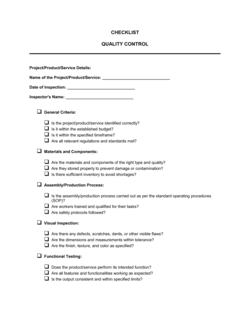
A quality control checklist is a structured list of verification items that a team member works through at a defined inspection point — before shipping a product, completing a service, or releasing software. It ensures every required check is performed in the same order every time, reducing the risk of missed steps and providing a written record of the inspection.
Quality Management vs. related documents
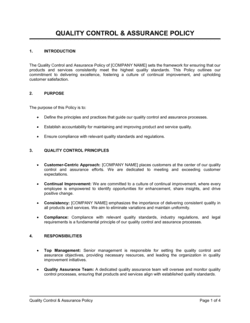
Quality assurance (QA) is proactive — it focuses on building processes that prevent defects from occurring in the first place. Quality control (QC) is reactive — it inspects outputs to detect and correct defects after they occur. Most organizations need both: QA policies and plans set the system; QC checklists and plans operate within it. When in doubt, start with a QA policy to define standards, then add a QC plan to enforce them at the production stage.
A quality management plan (QMP) is the overarching program document — it defines objectives, roles, tools, and metrics for the entire quality system. A quality assurance plan (QAP) is narrower, focusing on the specific activities and checkpoints used to confirm that a product or project meets requirements. A QMP governs the organization; a QAP governs a specific deliverable or project.
A policy is a short governance statement that declares intent and sets rules — it answers "what do we stand for?" A plan translates that policy into actionable steps, timelines, and ownership — it answers "how will we do it?" Both are needed: the policy provides the authority; the plan provides the method.
A manufacturing quality agreement is a bilateral contract that binds a specific supplier to defined quality standards, inspection rights, and non-conformance remedies. A vendor management policy is an internal document that sets your organization's rules for selecting, evaluating, and managing all vendors. Use both: the policy governs your procurement program; the agreement enforces quality with each individual supplier.
Key clauses every Quality Management contains
Regardless of variant, effective quality management documents share a common set of structural elements that give them operational force.
- Scope and applicability. Defines which products, services, processes, or teams the document governs so there's no ambiguity about coverage.
- Quality objectives and standards. States the measurable targets (defect rates, pass/fail thresholds, response times) the organization commits to meeting.
- Roles and responsibilities. Names who owns quality planning, who executes controls, and who has authority to approve or reject outputs.
- Inspection and testing procedures. Describes when and how quality checks are performed, what methods are used, and what acceptance criteria apply.
- Non-conformance and corrective action. Specifies the process for identifying defects, containing them, investigating root causes, and implementing fixes.
- Documentation and recordkeeping. Requires that quality activities, findings, and decisions be recorded in a retrievable format for audit purposes.
- Review and continuous improvement. Sets the cadence for reviewing quality performance data and updating the document when processes or standards change.
- Supplier and third-party requirements. Extends quality obligations to external vendors, manufacturers, or contractors whose outputs affect the final product.
How to write a quality management plan
A quality management plan works when it's specific, owned, and operationally connected to daily work — not when it sits in a shared drive untouched.
1
Define the scope
Identify which products, services, projects, or departments the plan covers and explicitly state what is out of scope.
2
Set measurable quality objectives
Translate business goals into specific, numeric quality targets — defect rates, on-time delivery percentages, customer satisfaction scores.
3
Assign roles and accountability
Name the individual or team responsible for each quality activity, from planning through final review, so ownership is unambiguous.
4
Document your quality standards and references
List any regulatory, industry, or customer standards (ISO 9001, FDA GMP, customer SLAs) the plan must satisfy.
5
Map inspection and testing checkpoints
Identify each stage in the process where a quality check occurs, the method used, and the acceptance criteria that must be met.
6
Define non-conformance procedures
Write a clear process for what happens when something fails a quality check — containment, root-cause analysis, corrective action, and sign-off.
7
Set the review cadence
Schedule periodic reviews (quarterly or after major incidents) to assess quality metrics and update the plan when processes change.
8
Communicate and train the team
Distribute the final plan to all affected staff, confirm they understand their responsibilities, and record the training.
At a glance
- What it is
- A quality management document is a formal record that defines how an organization plans, monitors, and controls the quality of its products, services, and processes. These documents range from high-level policies and plans to operational checklists, audit tools, and supplier agreements.
- When you need one
- Any time a business needs to establish repeatable quality standards, respond to a customer complaint, prepare for an audit, or align a supplier on quality expectations, a written quality management document is the starting point.
Which Quality Management do I need?
The right template depends on whether you're setting strategy, running day-to-day controls, auditing performance, or managing a supplier relationship. Match your immediate need to the scenario below.
Your situation
Recommended template
Building an organization-wide quality management framework from scratch
Covers objectives, responsibilities, processes, and metrics at the program level.Establishing a formal company policy for quality assurance
Sets the top-level commitment and rules that all QA activities must follow.Defining step-by-step quality controls for a specific product or project
Specifies inspection points, acceptance criteria, and responsible parties.Running a structured QA check on a production or service process
Provides a repeatable item-by-item verification format for frontline teams.Formalizing quality expectations with a manufacturer or supplier
Binds both parties to defined quality standards, tolerances, and remedies.Documenting the QA approach for a software development project
Covers testing methods, coverage goals, and defect-management procedures.Auditing current management practices to find quality gaps
Structured audit tool that benchmarks practices against defined standards.Gathering customer feedback on product or service quality
Collects scored customer ratings to quantify perceived quality levels.Glossary
- Quality management system (QMS)
- A formalized set of policies, processes, and procedures used to direct and control how an organization achieves and maintains quality.
- Quality assurance (QA)
- Proactive activities that build quality into processes to prevent defects before they occur.
- Quality control (QC)
- Reactive activities that inspect or test outputs to detect defects and prevent non-conforming products or services from reaching customers.
- Non-conformance
- Any product, service, or process output that fails to meet defined quality requirements or specifications.
- Corrective action
- A documented response to a confirmed non-conformance that identifies root cause and implements a fix to prevent recurrence.
- Acceptance criteria
- The specific, measurable conditions a product or deliverable must meet to be considered acceptable for use or delivery.
- Audit
- A systematic, independent review of quality activities and records to verify that standards are being followed and objectives are being met.
- Continuous improvement
- An ongoing effort to incrementally reduce defects, waste, and variation in processes, typically guided by performance data.
- Root cause analysis
- A structured investigation technique used to identify the underlying reason a defect or failure occurred, rather than just its symptoms.
- Quality management plan (QMP)
- The overarching document that defines a program's quality objectives, responsibilities, methods, and review schedule.
- Specification
- A precise, documented description of the required characteristics of a product, material, or process output.
- Traceability
- The ability to track a product, component, or process decision back through the production or service chain to its origin.

What is a quality management document?
A quality management document is any formal record that defines, directs, or verifies how an organization delivers consistent quality in its products, services, or processes. The category spans a wide range of document types — from a high-level quality management plan that sets program-wide objectives and governance, to an operational quality control checklist a production team runs before every shipment, to a manufacturing quality agreement that binds a supplier to specific standards and inspection rights.
Quality management documents exist because quality cannot be reliably achieved through informal understanding. When standards are written down, they can be trained, audited, measured, and improved. When they are not, variation is inevitable and accountability is impossible. Businesses that operate under regulatory requirements — FDA, ISO 9001, ISO 13485, construction codes — need documented quality systems as a compliance baseline. Businesses that do not operate under formal regulation benefit equally: documented quality practices reduce rework, lower return rates, speed onboarding of new staff, and provide evidence of due diligence when something goes wrong.
The documents in this folder cover the full quality management lifecycle: setting policy and strategy, planning controls for specific products or projects, running audits and checklists, measuring customer perception through surveys, and aligning suppliers and manufacturers through formal quality agreements.
When you need a quality management document
Quality management documents become necessary at any point where an informal approach starts producing inconsistent results — or where an external party (customer, regulator, auditor, or partner) requires written evidence of your quality system.
Common triggers:
- Launching a new product or production line that requires defined inspection checkpoints
- Onboarding a new manufacturer or supplier who needs to understand your quality expectations
- Preparing for an ISO 9001, regulatory, or customer-mandated quality audit
- Responding to a pattern of customer complaints or product returns
- Scaling a team where quality practices can no longer be passed on informally
- Starting a software development project that requires a documented QA testing approach
- Entering a contract where a client requires a quality management plan as a deliverable
- Establishing governance over a new operational process — change management, data handling, or records retention
The cost of operating without quality documentation is rarely one catastrophic failure — it's the steady accumulation of rework, complaints, and audit findings that erode margin and reputation over time. A well-chosen template gives you a structured starting point so you can build your quality system from a proven framework rather than from a blank page.
Award-winning platform
- Great Place to Work 2025
- BIG Award — Product of the Year 2025
- Smartest Companies 2025
- Global 100 Excellence 2026
- Best of the Best 2025