Quality Management Guide

Free to read β€’ Save or share with one click

FreeQuality Management Guide Template

At a glance

What it is
A Quality Management Guide is a structured operational document that defines a company's quality objectives, policies, procedures, and responsibilities for delivering consistent products or services. This free Word download gives you a complete, editable framework you can tailor to your organization's processes and export as PDF for internal use, audits, or certification reviews.
When you need it
Use it when building or formalizing a quality management system, preparing for an ISO 9001 audit, onboarding a new operations team, or responding to a client or regulator requiring documented quality standards.
What's inside
Quality policy, scope and objectives, organizational responsibilities, process controls, document and record management, nonconformance handling, corrective and preventive actions, internal audit procedures, and management review requirements.

What is a Quality Management Guide?

A Quality Management Guide is a structured operational document that defines an organization's quality policies, objectives, roles, and the processes used to ensure consistent delivery of products or services that meet customer and regulatory requirements. It functions as the top-level governance document for a quality management system (QMS) β€” establishing what the organization commits to, who is responsible for each quality function, how processes are controlled and monitored, and how failures are identified, investigated, and resolved. Unlike a single checklist or procedure, a quality management guide covers the full system: from document control and process controls through nonconformance handling, corrective action, internal audits, and management review.

Why You Need This Document

Without a documented quality management guide, quality depends entirely on individual knowledge and informal habits β€” and both walk out the door when staff turn over or teams scale. Client contracts in manufacturing, healthcare, government supply chains, and professional services increasingly require suppliers to demonstrate a functioning QMS before awarding work, with the quality management guide as the primary evidence. Organizations without one face longer onboarding cycles, repeated defects with no systematic path to resolution, and audit findings that delay or cancel certifications. A well-structured guide turns reactive quality management into a repeatable system β€” reducing rework costs, accelerating audit readiness, and giving senior leadership the data they need to make resource decisions. This template gives you a complete, immediately editable framework so you can document your QMS in weeks rather than starting from a blank page.

Which variant fits your situation?

If your situation is…Use this template
Preparing for formal ISO 9001 certificationISO 9001 Quality Manual
Managing quality for a specific project or contractProject Quality Management Plan
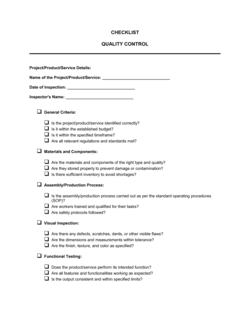
Documenting a single quality control checklistQuality Control Checklist
Tracking and resolving product defects or nonconformancesCorrective Action Report
Conducting a formal supplier quality evaluationSupplier Evaluation Form
Running an internal quality audit from start to finishInternal Audit Report
Documenting a standard operating procedure for a quality-critical processStandard Operating Procedure (SOP)

Common mistakes to avoid

❌ Writing the guide for auditors instead of the people doing the work

Why it matters: A guide full of standard jargon and compliance language that operations staff cannot follow in practice produces zero real improvement and fails audits when auditors interview workers who have never read it.

Fix: Write each section in plain language at the reading level of the person responsible for executing it. Accompany complex processes with a flow diagram or checklist as an appendix.

❌ Setting quality objectives with no baseline data

Why it matters: Without a current-state baseline, you cannot demonstrate improvement β€” and auditors will request historical data to validate that objectives represent real progress rather than arbitrary targets.

Fix: Before finalizing objectives, collect at least three months of historical data on the proposed metric. If no data exists, the first objective should be establishing the measurement system.

❌ Never updating the guide after initial publication

Why it matters: Processes change, equipment is replaced, roles turn over, and regulations evolve. A guide that describes how things worked two years ago creates conformance gaps and misleads new employees.

Fix: Schedule a mandatory annual review of the full guide with a documented outcome β€” even if no changes are needed, record that the review occurred and the guide remains current.

❌ Describing CAPA as a form to complete rather than a problem-solving process

Why it matters: Treating CAPA as paperwork β€” filling in a form and closing it without a genuine root cause investigation β€” means the same defects recur, and the CAPA log becomes evidence of systemic failure at the next audit.

Fix: Mandate a structured root cause analysis tool (5-Why, Ishikawa diagram, or fault tree) for every CAPA, and require verification evidence β€” not just a statement of completion β€” before closing the action.

❌ Assigning document control to no one specifically

Why it matters: Without a named owner for document control, version proliferation is inevitable β€” teams end up working from different revisions of the same procedure, producing inconsistent outputs.

Fix: Designate a single role as document controller with explicit authority to approve, publish, and retire documents. Include this in the roles and responsibilities section with a named backup.

❌ Treating management review as an annual compliance event with no decision outputs

Why it matters: Management reviews that generate discussion but no documented decisions or resource commitments fail to close the loop between quality data and operational change β€” a finding in virtually every external audit.

Fix: Require that every management review concludes with a signed action log listing at minimum three decisions, each with an owner, a due date, and a success criterion.

The 10 key sections, explained

Quality Policy and Objectives

Scope and Applicability

Roles and Responsibilities

Document and Record Control

Process Controls and Work Instructions

Nonconformance Management

Corrective and Preventive Action (CAPA)

Internal Audit Program

Customer Feedback and Complaint Handling

Management Review

How to fill it out

  1. 1

    Define the scope before writing anything else

    Identify which products, services, departments, and locations this guide will cover. Document any intentional exclusions with a brief justification. Scope drives every other section.

    πŸ’‘ If you are pursuing ISO 9001 certification, the scope must align exactly with the scope stated in your certification application β€” mismatches are a common audit nonconformance.

  2. 2

    Write the quality policy and set measurable objectives

    Draft a one-paragraph quality policy signed by senior leadership, then define three to five objectives with a baseline, target, and measurement frequency for each.

    πŸ’‘ Tie at least one quality objective directly to a customer satisfaction metric β€” auditors and clients both look for evidence that quality connects to customer outcomes, not just internal processes.

  3. 3

    Assign roles and responsibilities by title, not name

    Map each quality function β€” document control, audit planning, CAPA ownership, management review facilitation β€” to a job title. Using titles instead of names means the guide stays accurate when staff change.

    πŸ’‘ Build a one-page RACI matrix as an appendix: it makes responsibilities instantly scannable during audits and onboarding.

  4. 4

    Document your process controls and acceptance criteria

    For each quality-critical process, record the control parameter, the acceptable range, the measurement method, the measurement frequency, and the out-of-tolerance response.

    πŸ’‘ Start with the three processes most likely to produce customer complaints or product failures β€” these deliver the highest audit and business value per hour of documentation effort.

  5. 5

    Set up document and record control procedures

    Define your document numbering convention, version control rules, approval workflow, and retention periods. Identify where controlled documents are stored and how obsolete versions are managed.

    πŸ’‘ A simple shared folder with a document register spreadsheet is sufficient for most SMBs β€” you do not need specialized QMS software to pass an ISO audit at the small-business level.

  6. 6

    Build the nonconformance and CAPA workflow

    Define what triggers an NCR, who opens it, how nonconforming output is physically quarantined, and the timeline from identification to root cause to corrective action to verification.

    πŸ’‘ Pilot the CAPA workflow on one real or historical nonconformance before finalizing the guide β€” paper workflows often have handoff gaps that only appear when you walk through a real case.

  7. 7

    Schedule the internal audit program

    Create an annual audit calendar covering all in-scope processes, assign auditor roles (ensuring independence), and link to the audit report template and finding resolution process.

    πŸ’‘ Stagger audits across the year rather than scheduling all at once β€” spreading them out distributes the administrative load and provides more frequent data for the management review.

  8. 8

    Finalize and obtain senior management approval

    Submit the completed guide to senior management for review and formal approval. Record the approval date and approver signature on the cover page and in the document register.

    πŸ’‘ A visibly signed quality policy and guide signals genuine leadership commitment β€” auditors and customers both notice when approval is absent or perfunctory.

Frequently asked questions

What is a quality management guide?

A quality management guide is a structured operational document that defines an organization's quality policies, objectives, processes, and responsibilities. It serves as the central reference for how the business controls quality across its products or services β€” covering everything from document control and process standards to nonconformance handling and internal audits. It is used internally by operations teams and externally as evidence of a functioning quality management system for audits, certifications, and client due diligence.

What is the difference between a quality management guide and an ISO 9001 quality manual?

A quality management guide is a broad operational document that can be tailored to any organization regardless of certification intent. An ISO 9001 quality manual is a specific document β€” either standalone or integrated into the QMS β€” that maps directly to the clauses of the ISO 9001 standard and is reviewed as part of a formal certification audit. A quality management guide can serve as the foundation for an ISO 9001 manual with targeted additions to address each standard clause.

Who is responsible for maintaining a quality management guide?

Typically, the Quality Manager or QMS Owner is responsible for keeping the guide current, managing the document control process, and coordinating annual reviews. However, individual department managers are responsible for the accuracy of process controls and procedures within their scope. Senior management must formally approve the guide and any significant revisions.

How often should a quality management guide be updated?

At minimum, conduct a full review annually and document the outcome β€” whether or not changes are made. Additionally, update it immediately whenever a significant process change occurs, a new product line is introduced, a major nonconformance reveals a procedural gap, or applicable regulatory requirements change. Organizations pursuing ISO certification should review the guide before every surveillance audit.

Does a small business need a quality management guide?

Any business delivering products or services to customers with defined quality expectations benefits from one. For small businesses, a quality management guide reduces rework costs, supports consistent onboarding, and is often required when bidding on contracts with government agencies, large manufacturers, or regulated-industry clients. It does not need to be complex β€” a focused 15–20 page document covering core processes is sufficient for most SMBs.

What is a CAPA and why does it belong in a quality management guide?

CAPA stands for Corrective and Preventive Action. Corrective actions address root causes of existing nonconformances; preventive actions address potential nonconformances before they occur. Including a defined CAPA process in the quality management guide ensures that when defects are found, the organization follows a consistent, documented path from investigation to resolution to verification β€” rather than applying an ad hoc fix that allows the same problem to recur.

Can a quality management guide be used across multiple sites or business units?

Yes, with careful scoping. A single guide can cover multiple sites if the core quality policies and processes are consistent. Where site-specific variations exist β€” different equipment, regulatory requirements, or customer specifications β€” use site-specific annexes or supplementary procedures referenced from the main document. Clearly state the applicability of each section in the scope section to avoid ambiguity during audits.

What is the difference between a quality management guide and a standard operating procedure?

A quality management guide is a top-level document defining the overall quality system β€” policies, objectives, roles, and program structure. Standard operating procedures (SOPs) are lower-level documents that describe step-by-step how a specific task or process is performed. The quality management guide references SOPs rather than duplicating their content, keeping the guide strategic and the SOPs tactical.

How does a quality management guide support customer audits?

Many corporate and government customers require suppliers to demonstrate a functioning quality management system before awarding contracts or during periodic vendor assessments. A well-structured quality management guide provides auditors with a single document that maps your quality policies, controls, nonconformance processes, and audit history β€” reducing audit preparation time and demonstrating organizational maturity.

How this compares to alternatives

vs Standard Operating Procedure (SOP)

An SOP provides step-by-step instructions for performing a specific task or process. A quality management guide is the top-level system document that defines policies, objectives, roles, and the overall QMS structure β€” and references SOPs rather than replacing them. Organizations need both: the guide sets the framework; SOPs deliver the detail.

vs Internal Audit Report

An internal audit report documents the findings, evidence, and conclusions of a completed QMS audit. A quality management guide defines the audit program β€” its schedule, methodology, and scope β€” but does not record individual audit outcomes. The guide is the governance document; the audit report is the operational output.

vs Corrective Action Report

A corrective action report is a record of a single nonconformance investigation, root cause, and resolution. A quality management guide contains the CAPA policy and process that governs when and how corrective action reports are opened, completed, and verified. The guide is the system; the corrective action report is one transaction within it.

vs Quality Control Checklist

A quality control checklist is a point-of-use tool used by workers to verify that specific steps have been completed or specifications met during production or delivery. A quality management guide is a strategic and policy document that defines the overall system within which checklists operate. Checklists implement the controls; the guide defines why those controls exist and who is accountable for them.

Industry-specific considerations

Manufacturing

In-process inspection criteria, statistical process control references, equipment calibration schedules, and supplier quality requirements integrated into the guide.

Healthcare and Life Sciences

FDA 21 CFR Part 820 or ISO 13485 alignment, traceability requirements for medical devices, and stringent CAPA documentation to satisfy regulatory inspection requirements.

Technology and Software

Code review standards, automated testing coverage thresholds, release quality gates, and bug severity classification integrated as quality controls alongside traditional process documentation.

Professional Services

Deliverable review and approval workflows, client satisfaction measurement processes, and peer review requirements embedded as quality controls for consulting or audit engagements.

Template vs pro β€” what fits your needs?

PathBest forCostTime
Use the templateSmall to mid-size businesses building an initial QMS, preparing for a client audit, or documenting existing quality processes for the first timeFree1–3 weeks to complete
Template + professional reviewOrganizations preparing for ISO 9001 certification or responding to a major customer quality audit requiring evidence of a mature QMS$500–$2,500 for a quality consultant review session2–4 weeks
Custom draftedRegulated industries (medical devices, aerospace, pharma) where the QMS must align to FDA, FAA, or EMA regulatory frameworks with traceable compliance mapping$5,000–$20,000+ for a specialist quality systems consultant6–12 weeks

Glossary

Quality Management System (QMS)
A formalized set of policies, processes, and procedures used to direct and control an organization's activities toward meeting quality objectives.
ISO 9001
An internationally recognized standard specifying requirements for a quality management system, published by the International Organization for Standardization.
Nonconformance
Any product, service, or process output that fails to meet a defined requirement or specification.
Corrective Action
A documented response to an identified nonconformance that addresses the root cause to prevent recurrence.
Preventive Action
A proactive step taken to eliminate the cause of a potential nonconformance before it occurs.
Root Cause Analysis
A structured investigation method used to identify the underlying reason a defect or failure occurred, rather than treating only the symptom.
Management Review
A scheduled evaluation by senior leadership of the QMS's performance, suitability, and alignment with strategic objectives.
Document Control
The process of managing the creation, approval, revision, distribution, and archiving of quality-related documents to ensure only current versions are in use.
Internal Audit
A planned, independent evaluation of processes and procedures conducted within the organization to verify compliance with the QMS and identify improvement opportunities.
Key Performance Indicator (KPI)
A measurable value used to track progress toward a defined quality objective, such as defect rate, customer complaint rate, or on-time delivery percentage.

Part of your Business Operating System

This document is one of 3,000+ business & legal templates included in Business in a Box.

  • Fill-in-the-blanks β€” ready in minutes
  • Compatible with all office suites
  • Export to PDF and share electronically

Create your document in 3 simple steps.

From template to signed document β€” all inside one Business Operating System.
1
Download or open template

Access over 3,000+ business and legal templates for any business task, project or initiative.

2
Edit and fill in the blanks with AI

Customize your ready-made business document template and save it in the cloud.

3
Save, Share, Send, Sign

Share your files and folders with your team. Create a space of seamless collaboration.

Save time, save money, and create top-quality documents.

β˜…β˜…β˜…β˜…β˜…

"Fantastic value! I'm not sure how I'd do without it. It's worth its weight in gold and paid back for itself many times."

Managing Director Β· Mall Farm
Robert Whalley
Managing Director, Mall Farm Proprietary Limited
β˜…β˜…β˜…β˜…β˜…

"I have been using Business in a Box for years. It has been the most useful source of templates I have encountered. I recommend it to anyone."

Business Owner Β· 4+ years
Dr Michael John Freestone
Business Owner
β˜…β˜…β˜…β˜…β˜…

"It has been a life saver so many times I have lost count. Business in a Box has saved me so much time and as you know, time is money."

Owner Β· Upstate Web
David G. Moore Jr.
Owner, Upstate Web

Run your business with a system β€” not scattered tools

Stop downloading documents. Start operating with clarity. Business in a Box gives you the Business Operating System used by over 250,000 companies worldwide to structure, run, and grow their business.

Start freeΒ Β·Β No credit card required