Media Production Templates

4.7from 280+ reviews Trusted by 20M+ businesses

Plan shoots, manage budgets, protect rights, and publish content — every document your production needs in one place.

WordEditable onlinePDF10+ media production templates

Other Production & Operations categories

250K+Clients
20M+Free users
20+Years
190+Countries
10,000+Law firms
50M+Downloads

Trusted across review platforms

  • Capterra★★★★☆4.649 reviews
  • G2★★★★☆4.713 reviews
  • GetApp★★★★☆4.649 reviews
  • Google Play★★★★☆4.6179 ratings
  • Google Reviews★★★★☆4.567 reviews

Related categories

Frequently asked questions

What documents do I need before starting a film or video production?
At minimum you need a signed production agreement with the client, a production budget, and a production schedule before the first shoot day. You should also have media release forms ready for any on-camera talent and a health and safety policy circulated to all crew. Missing any of these creates exposure to cost overruns, rights disputes, and liability for on-set incidents.
Is a media release form legally required?
In most jurisdictions, you need written consent to use a person's likeness or voice in commercially distributed content. Without a signed media release form, subjects can claim their privacy or publicity rights were violated and seek to have the content removed or seek damages. The requirement applies even for social media posts — which is why there is a separate media release form specifically for social media use.
What should a film production budget include?
A film production budget should cover pre-production costs (development, scripting, scouting), production costs (crew fees, cast, locations, equipment rental, catering), post-production costs (editing, color grading, sound mixing, music licensing), and a contingency line — typically 10–15% of the total. Insurance, permits, and travel are frequently overlooked and should be itemized separately.
What is the difference between a social media policy and a social media strategy?
A social media policy is a compliance document that sets rules for employee conduct, brand voice, approvals, and prohibited disclosures. A social media strategy is a planning document that defines business goals, target audiences, content themes, posting cadences, and KPIs. Both are necessary — the policy protects the organization; the strategy drives results.
When do I need a social media management contract?
Any time you hire an external person or agency to manage social accounts on your behalf, you need a written contract. It should specify which accounts are covered, what content deliverables are included each month, who owns the content produced, how login credentials are handled, and what happens to account access if the engagement ends.
Can I use a single media release form for all purposes?
Not always. A general media release form covers broad distribution rights, but social media use often involves platform-specific terms around tagging, resharing, and algorithmic amplification that a general form may not address. If content will be published on social platforms, use a media release form specifically drafted for that context, or ensure your general form includes an explicit social media use clause.
What should a production schedule include?
A production schedule should list every shoot day, the scenes or segments to be filmed each day, crew and cast call times, location details, equipment requirements, and any interdependencies between days. It should also include buffer time for setups and a clear escalation path if a shoot day falls behind.
Do I need a production health and safety policy for a small shoot?
Yes. On-set injuries are not limited to large productions. Even a small crew faces risks from lighting equipment, cables, elevated surfaces, and outdoor conditions. A production health and safety policy assigns responsibility for hazard identification, incident reporting, and emergency procedures — and demonstrates due diligence if a claim is ever made against the production.

Media Production vs. related documents

Media Release Form vs. Media Consent Form

A media release form grants the producer the right to use, publish, and distribute recorded content featuring an individual. A media consent form documents that the individual agrees to be recorded or photographed in the first place. In practice, both are often signed together before a shoot begins, but they serve distinct legal purposes: consent covers the act of recording; release covers everything that happens with the content afterward.

Film Production Agreement vs. Production Schedule

A film production agreement is a legal contract between a producer and a client or studio that defines deliverables, fees, IP ownership, and liability. A production schedule is an operational planning document that sequences scenes, crew calls, and milestones. The agreement governs the commercial relationship; the schedule governs the day-to-day execution. Both are needed for any professional production.

Social Media Policy vs. Social Media Strategy

A social media policy sets the rules — what employees may and may not post, how to handle complaints, and who is authorized to speak for the brand. A social media strategy is a planning document that defines goals, target audiences, content pillars, and success metrics. Policies are compliance documents; strategies are operational roadmaps. Organizations typically need both.

Production Schedule vs. Production Budget

A production schedule organizes time: which scenes shoot on which days, what crew and equipment are required, and in what order. A production budget organizes money: what every line item costs and what the total spend will be. Both are created in pre-production and should be built together, since scheduling decisions directly affect cost.

Key clauses every Media Production contains

Across the contracts and policy documents in this folder, several core provisions recur — understanding them helps you complete any media production document accurately.

  • Parties and roles. Identifies who is the producer, client, talent, or employee and what role each party plays in the production.
  • Scope of work. Describes the specific deliverables — number of videos, formats, runtimes, or platforms — the producer is responsible for.
  • Rights and licensing. Defines who owns the finished content and what the other party is permitted to do with it, including distribution channels and territories.
  • Likeness and release. Grants the producer the right to use a person's image, voice, or performance in the published content.
  • Fees and payment schedule. States the total fee, any milestone-based payments, and the process for approving additional costs.
  • Revision and approval process. Sets out how many rounds of edits are included, who has final approval, and what happens if parties disagree.
  • Confidentiality. Restricts disclosure of scripts, budgets, client briefs, and other non-public production information.
  • Health and safety obligations. Assigns responsibility for on-set safety compliance, incident reporting, and adherence to applicable regulations.
  • Termination. Specifies grounds for ending the engagement early and how costs, deliverables, and IP are handled on termination.

How to manage a media production from brief to delivery

A successful production moves through five phases — development, pre-production, production, post-production, and distribution — each requiring its own documents and decisions.

  1. 1

    Define the brief and scope

    Document the content objective, target audience, format, runtime, and platform before any other work begins.

  2. 2

    Build the budget

    Use a film production budget template to estimate all costs — crew, cast, locations, equipment, editing, and contingency — before committing resources.

  3. 3

    Draft the production schedule

    Sequence every shoot day, scene, crew call time, and equipment delivery into a single timeline that all departments can follow.

  4. 4

    Prepare your script and shot list

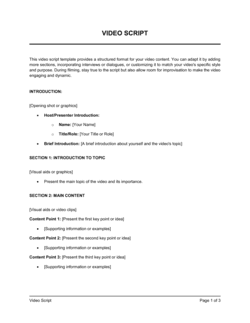
    Write the video script with scene directions and dialogue, then break it down into a shot list to guide the crew on set.

  5. 5

    Collect releases and agreements

    Get signed media release forms from all on-camera talent and execute a film production agreement with the client before the first shoot day.

  6. 6

    Establish on-set policies

    Circulate the production health and safety policy and any relevant conduct policies so every crew member knows their obligations.

  7. 7

    Deliver and distribute

    Once post-production is complete, confirm delivery format and platform rights in the production agreement before publishing or handing off the final file.

At a glance

What it is
Media production documents are the operational and legal paperwork that govern how content is planned, created, staffed, and distributed. They cover everything from pre-production budgets and shooting schedules to on-set safety policies, talent release forms, and social media publication rules.
When you need one
Any time you are producing video, film, or digital content — whether for a client, internal use, or public distribution — you need these documents to manage timelines, costs, rights, and team responsibilities.

Which Media Production do I need?

The right template depends on where you are in the production lifecycle and what function you need to fulfill — planning, compliance, rights management, or distribution.

Your situation
Recommended template

Planning and costing a film or video shoot from scratch

Captures all line items — crew, equipment, locations, post-production — in one structured sheet.

Building a day-by-day timeline for an upcoming production

Sequences scenes, crew calls, and milestones so nothing is missed on shoot days.

Securing rights to use footage or images of a person

Grants explicit written permission to use a subject's likeness in published content.

Getting consent before posting someone's image on social media

Specifically covers social platform use, sharing, and tagging rights.

Formalizing a production engagement with a client or studio

Sets out deliverables, fees, IP ownership, and usage rights between producer and client.

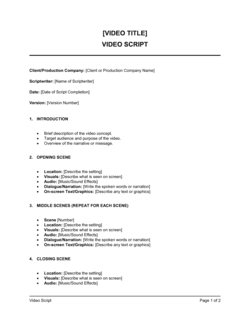
Scripting a corporate or promotional video before the shoot

Structures dialogue, scene direction, and visual cues in a broadcast-ready format.

Setting rules for how employees use social media on behalf of the company

Defines approved conduct, brand voice, and prohibited disclosures for staff accounts.

Hiring a social media manager to run external accounts

Governs scope, deliverables, fees, and content ownership with an external manager.

Glossary

Pre-production
The planning phase before filming begins, covering scripting, budgeting, scheduling, location scouting, and casting.
Post-production
The phase after filming, covering editing, color grading, sound mixing, visual effects, and final export.
Media release form
A signed document granting a producer the right to use a person's recorded likeness, voice, or performance in published content.
Media consent form
A document in which a person agrees to be recorded or photographed before filming takes place.
Production agreement
A contract between a producer and a client or studio defining deliverables, fees, timeline, IP ownership, and approval rights.
Shot list
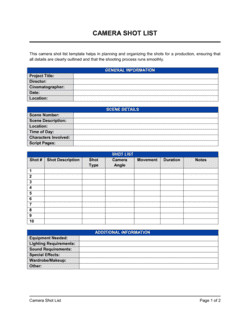
A scene-by-scene breakdown of every camera angle, setup, and take required to complete a production day.
Above-the-line costs
The creative and talent costs in a production budget — typically director, producer, writer, and principal cast fees.
Below-the-line costs
The technical and crew costs in a production budget — equipment, locations, crew wages, catering, and transport.
Likeness rights
A person's legal right to control commercial use of their image, voice, or performance.
Content calendar
A planning document that schedules what content will be published on which channels and dates over a defined period.
Media kit
A package of brand, audience, and contact information prepared for journalists, sponsors, or distribution partners.

What is a media production document?

A media production document is any template, contract, plan, or policy that supports the creation and distribution of video, film, photography, or digital content. These documents span the full production lifecycle — from the first budget estimate and shooting schedule through on-set safety policies, talent release forms, and the social media plans that govern how finished content reaches an audience.

Media production work involves a wide range of relationships — clients, directors, crew, on-camera talent, freelance editors, and social media managers — each generating its own paperwork requirements. A film production agreement governs the commercial relationship with a client. A media release form protects the producer's right to publish recorded content. A production health and safety policy protects the crew on set. A social media policy protects the brand after the content is live. Taken together, these documents transform a creative project into a professionally managed production.

Production documents also vary by scale. A two-person corporate video team needs a script, a schedule, and a release form. A full film crew needs a detailed budget, a health and safety policy, a production agreement, and consent forms for every person on camera. The templates in this folder cover both ends of that spectrum.

When you need a media production template

Any time you plan, shoot, edit, or publish content — for a client, for your own brand, or as part of a broader marketing campaign — you need production documents to manage responsibilities, protect rights, and keep the project on time and on budget.

Common triggers:

  • You are about to film a promotional video and need to budget all production costs before the client approves the project
  • You are scheduling a multi-day shoot and need every crew member working from the same timeline
  • You are recording interviews or testimonials and need signed consent before the camera rolls
  • You are publishing content featuring identifiable people and need written permission to use their likeness
  • You are contracting a social media manager and need to define scope, deliverables, and account ownership in writing
  • You are rolling out a company social media policy and need a document that covers employee conduct, brand voice, and prohibited disclosures
  • You are presenting your production company to a potential sponsor or distribution partner and need a professional media kit

Producing content without the right documents in place leaves you exposed on multiple fronts: a client can dispute deliverables without a production agreement, talent can demand content removal without a release form, and crew members can hold you liable for on-set incidents without a safety policy. The templates in this folder cover every stage of the production process so you can move from brief to delivery with the paperwork handled.

Award-winning platform

  • Great Place to Work 2025
  • BIG Award — Product of the Year 2025
  • Smartest Companies 2025
  • Global 100 Excellence 2026
  • Best of the Best 2025

Create your document in 3 simple steps.

From template to signed document — all inside one Business Operating System.
1
Download or open template

Access over 3,000+ business and legal templates for any business task, project or initiative.

2
Edit and fill in the blanks with AI

Customize your ready-made business document template and save it in the cloud.

3
Save, Share, Send, Sign

Share your files and folders with your team. Create a space of seamless collaboration.

Save time, save money, and create top-quality documents.

★★★★★

"Fantastic value! I'm not sure how I'd do without it. It's worth its weight in gold and paid back for itself many times."

Managing Director · Mall Farm
Robert Whalley
Managing Director, Mall Farm Proprietary Limited
★★★★★

"I have been using Business in a Box for years. It has been the most useful source of templates I have encountered. I recommend it to anyone."

Business Owner · 4+ years
Dr Michael John Freestone
Business Owner
★★★★★

"It has been a life saver so many times I have lost count. Business in a Box has saved me so much time and as you know, time is money."

Owner · Upstate Web
David G. Moore Jr.
Owner, Upstate Web

Run your business with a system — not scattered tools

Stop downloading documents. Start operating with clarity. Business in a Box gives you the Business Operating System used by over 250,000 companies worldwide to structure, run, and grow their business.

Free Forever Plan · No credit card required