Invoicing and Billing Templates
★★★★★4.7from 280+ reviews· Trusted by 20M+ businesses
Get paid faster with ready-to-use invoices, receipts, bills of sale, and billing policies built for every transaction type.
Word & ExcelEditable onlinePDF10+ invoicing and billing templates
Other Finance & Accounting categories
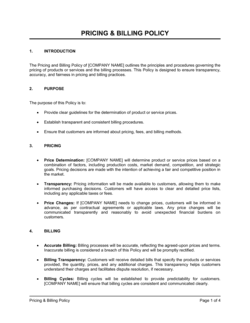
Billing policies and forms
Disputes and correspondence
250K+Clients
20M+Free users
20+Years
190+Countries
10,000+Law firms
50M+Downloads
Trusted across review platforms
- Capterra★★★★☆4.649 reviews
- G2★★★★☆4.713 reviews
- GetApp★★★★☆4.649 reviews
- Google Play★★★★☆4.6179 ratings
- Google Reviews★★★★☆4.567 reviews
Frequently asked questions
What should every invoice include?
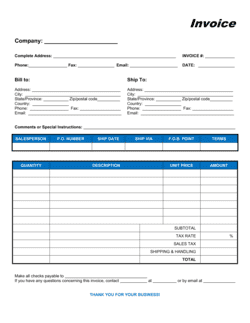
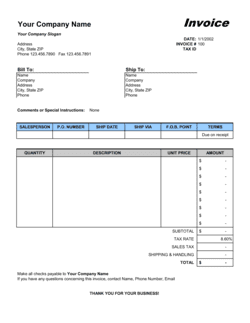
Every invoice should include the seller's and buyer's names and contact details, a unique invoice number, the date issued, an itemized list of goods or services with prices, the total amount due, and the payment due date and accepted methods. Missing any of these elements makes the invoice harder to enforce and creates unnecessary back-and-forth with customers.
What is the difference between an invoice and a receipt?
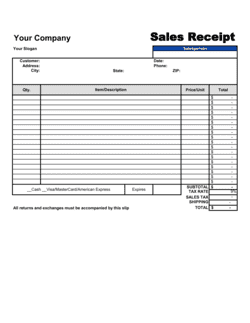
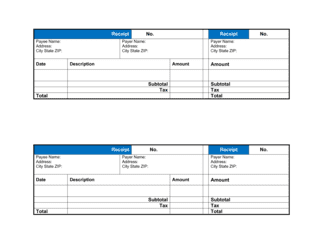
An invoice is a payment request — it tells the customer what they owe and when it is due. A receipt confirms that payment has already been made. Issuing both creates a clean paper trail: the invoice documents the obligation, the receipt documents its fulfillment.
When do I need a bill of sale instead of an invoice?
Use a bill of sale when transferring legal ownership of personal property — vehicles, equipment, land, or business assets. An invoice works for ongoing service or product billing where no formal ownership transfer occurs. For vehicle sales in particular, most jurisdictions require a bill of sale to register the change of title.
Do I need a billing policy if I already include payment terms on my invoices?
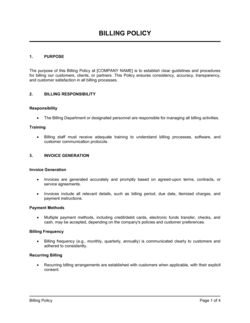
Payment terms on an invoice handle a single transaction. A billing policy governs the entire customer relationship — covering billing cycles, dispute processes, fee structures, and exceptions that apply across all invoices. Businesses with recurring clients, subscription services, or variable billing structures benefit significantly from a written billing policy to reduce disputes and set consistent expectations.
How do I handle a billing dispute with a customer?
Respond in writing as soon as possible — a template like Response to Improper Billing after Payment provides the right structure. Reference the original invoice number, state clearly what was charged and why, and attach any supporting documentation. Keep the tone factual and avoid escalating language; most billing disputes are clerical in nature and resolve quickly with clear documentation.
Can I use an Excel invoice template instead of a Word one?
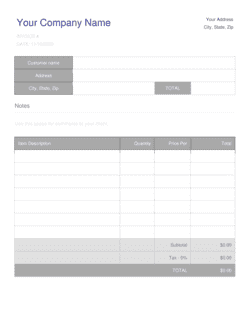
Yes. Excel invoice templates like the Sales Invoice - Excel template auto-calculate line totals, taxes, and the grand total as you enter data, which reduces arithmetic errors. Word templates offer more layout flexibility and are better suited for service-based invoices with narrative descriptions. Choose based on whether calculation automation or formatting control matters more for your workflow.
Is a price quotation legally binding?
A price quotation is generally not legally binding on its own — it is an offer to sell at a stated price, not a contract. It typically becomes binding only when the customer formally accepts it and both parties agree on the terms, at which point it can function as the basis for a purchase order or invoice. Adding an expiry date to your quotations protects you from being held to prices that are no longer current.
What makes a bill of sale legally valid?
A bill of sale is generally valid when it identifies both parties, describes the property being transferred, states the purchase price, and is signed by the seller. Some jurisdictions require a witness or notarization — particularly for real property and vehicles. Using a jurisdiction-appropriate template and retaining signed originals protects both parties if ownership is ever disputed.
Invoicing and Billing vs. related documents
An invoice is a payment request sent before or shortly after delivery, telling the customer what they owe and when. A receipt is a confirmation issued after payment is made, proving the transaction is complete. Use an invoice to request payment; issue a receipt once it's received.
An invoice requests payment for goods or services and may allow for deferred payment. A bill of sale documents the completed legal transfer of ownership of personal property from seller to buyer. Bills of sale are common for vehicles, equipment, and real property; invoices are standard for ongoing B2B and service billing.
A price quotation gives a prospective customer an estimate of costs before they commit — it is not a payment request. An invoice is issued after the customer has agreed to the deal and the work or delivery has occurred. Quotations become invoices once the sale is confirmed.
Payment terms are a short clause inside a contract or invoice specifying the due date and accepted methods. A billing policy is a standalone document that covers the full scope of how a business charges customers: billing cycles, late fees, dispute procedures, and exceptions. Use payment terms for individual transactions; use a billing policy to govern all customer relationships consistently.
Key clauses every Invoicing and Billing contains
Whether you're issuing an invoice, a bill of sale, or a billing policy, these core elements appear across virtually every invoicing and billing document.
- Parties and contact information. Full legal names, addresses, and contact details of both the seller/biller and the buyer/client.
- Description of goods or services. An itemized list of what was sold or provided, including quantities, unit prices, and any applicable SKUs.
- Total amount due. The final sum the customer owes, including subtotals, applicable taxes, discounts, and fees.
- Payment terms. The due date, accepted payment methods, and any early-payment discounts or late-payment penalties.
- Invoice or document number. A unique reference number that ties the document to your accounting records and makes disputes traceable.
- Date of transaction or issue. The date the document was created or the sale occurred, which establishes when payment obligations begin.
- Transfer of title or ownership (bills of sale). A statement confirming that ownership passes from seller to buyer at the point of sale or upon full payment.
- Dispute and correction procedures (billing policies). The process a customer must follow to dispute a charge, including timelines and contact information.
How to write an invoice or billing document
A clear, complete billing document reduces late payments, disputes, and follow-up work — here's how to put one together.
1
Choose the right document type
Decide whether you need an invoice, receipt, bill of sale, or billing policy based on the transaction stage and what you're selling.
2
Identify both parties fully
Enter the full legal names, business addresses, and contact details of both the seller and the buyer.
3
Assign a unique document number
Create a sequential reference number so the document can be linked to your accounting system and referenced in correspondence.
4
Describe goods or services in detail
List each item or service separately with a description, quantity, unit price, and line total to avoid ambiguity.
5
Calculate and display the total clearly
Show the subtotal, any taxes or fees, any discounts, and the final amount due in a clear summary section.
6
State the payment terms
Specify the due date, accepted payment methods, and any late-payment fees so the customer knows exactly what's expected.
7
Deliver and file the document
Send the document to the customer by your agreed method and retain a copy in your financial records for auditing and dispute resolution.
At a glance
- What it is
- Invoicing and billing documents are the formal records that request payment, confirm a completed sale, and establish the rules under which a business charges its customers. They range from a simple sales receipt to a detailed commercial invoice or a written billing policy that governs how and when clients are charged.
- When you need one
- Any time goods or services change hands — or before they do, when setting customer payment expectations — you need a billing or invoicing document to create a clear, enforceable paper trail.
Which Invoicing and Billing do I need?
The right document depends on what transaction you're recording, whether ownership is transferring, and whether you're requesting payment or confirming it has already been made.
Your situation
Recommended template
Requesting payment from a client for services or goods delivered
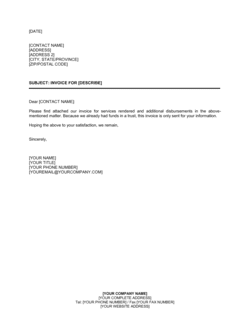
A standard invoice creates a formal payment request with due date and itemized charges.Billing a customer and attaching the invoice to a cover letter
Pairs a professional cover letter with the invoice for a complete billing communication.Issuing a commercial invoice for a B2B product sale
Formatted for commercial transactions with fields for taxes, terms, and buyer/seller details.Tracking a product sale with line items in a spreadsheet
Excel format auto-calculates totals and is easy to adapt for product-heavy invoicing.Confirming a customer has paid for goods or services
A receipt documents payment already made, serving as proof of purchase for both parties.Transferring ownership of personal property to a buyer
Records the legal transfer of personal property ownership from seller to buyer.Selling a motor vehicle privately
Includes vehicle-specific fields: VIN, make, model, odometer reading, and condition.Establishing written rules for how your business charges clients
Defines payment terms, late fees, and billing cycles to reduce disputes.Glossary
- Invoice
- A document sent by a seller to a buyer requesting payment for goods or services delivered, before or after delivery.
- Receipt
- A document confirming that payment has been received, serving as proof of purchase for the buyer.
- Bill of sale
- A legal document that records the transfer of ownership of personal property from a seller to a buyer.
- Billing policy
- A written document that defines how a business charges customers, including billing cycles, payment methods, late fees, and dispute procedures.
- Payment terms
- The conditions under which a buyer must pay an invoice, including the due date, accepted methods, and any penalties for late payment.
- Net 30 / Net 60
- Common payment term shorthand meaning the full invoice amount is due 30 or 60 days after the invoice date.
- Commercial invoice
- An invoice used in B2B transactions that includes detailed seller, buyer, and product information required for accounting and sometimes customs.
- Bill of lading
- A shipping document that serves as a receipt for goods in transit, a contract with the carrier, and evidence of title to the cargo.
- Price quotation
- A pre-sale document estimating the cost of goods or services for a prospective buyer before a purchase agreement is made.
- Credit card authorization form
- A signed form permitting a business to charge a customer's credit card for specified amounts, typically used for recurring billing.
- Encumbrance
- A claim, lien, or liability attached to a property being sold, disclosed in a bill of sale with encumbrances.
- Accounts receivable
- Money owed to a business by its customers for goods or services already delivered but not yet paid for.
What is an invoicing and billing document?
An invoicing and billing document is any formal record that requests payment, confirms a sale, transfers ownership of property, or establishes the rules under which a business charges its customers. The category covers a wide range of document types — from a one-page sales receipt to a detailed commercial invoice, a vehicle bill of sale, or a company-wide billing policy — but all share the same core function: creating a clear, written record of a financial transaction.
Invoices and billing documents serve both operational and legal purposes. Operationally, they tell customers what they owe, when it is due, and how to pay. Legally, they establish the terms of a transaction in writing, giving both parties a reference point if a dispute arises. A well-structured invoice or bill of sale also supports your accounting records, simplifies tax reporting, and signals professionalism to clients and customers.
The documents in this folder split into three practical groups: invoices and receipts (payment requests and payment confirmations), bills of sale (legal records of ownership transfer), and billing policies and forms (the governance layer that sets consistent payment expectations across your entire customer base).
When you need an invoicing or billing document
Billing and invoicing documents are needed at every stage of a commercial transaction — before the sale (quotation), during it (invoice, bill of sale), and after (receipt, billing dispute response). If money is changing hands or ownership is transferring, a written record should exist.
Common triggers:
- A freelancer or agency completes a project and needs to request payment from a client
- A business sells physical goods and must document the transaction for accounting and tax purposes
- A private seller transfers a vehicle, equipment, or real property to a buyer
- A company ships goods to a customer and needs a bill of lading for the carrier
- A business sets up recurring billing and wants a written policy to govern payment terms and dispute handling
- A customer disputes a charge and a formal written response is required
- A sales team needs to send a consistent, professional price quotation to a prospect
Skipping these documents creates real risk: missed payments become harder to pursue without a signed invoice, ownership disputes are difficult to resolve without a bill of sale, and inconsistent billing practices invite customer complaints that a written policy would prevent. A template gives you a legally sound starting point in minutes — no blank-page paralysis, no missing fields.
Award-winning platform
- Great Place to Work 2025
- BIG Award — Product of the Year 2025
- Smartest Companies 2025
- Global 100 Excellence 2026
- Best of the Best 2025