Forecasting and Projections Templates

4.7from 280+ reviews Trusted by 20M+ businesses

Plan revenue, spending, and cash flow with templates built for every business stage and model.

WordEditable onlinePDF14+ forecasting and projections templates

Other Finance & Accounting categories

250K+Clients
20M+Free users
20+Years
190+Countries
10,000+Law firms
50M+Downloads

Trusted across review platforms

  • Capterra★★★★☆4.649 reviews
  • G2★★★★☆4.713 reviews
  • GetApp★★★★☆4.649 reviews
  • Google Play★★★★☆4.6179 ratings
  • Google Reviews★★★★☆4.567 reviews

Related categories

Frequently asked questions

What is a financial projection?
A financial projection is a forward-looking estimate of a business's revenue, expenses, and cash position over a defined period, typically one to five years. Projections are built on documented assumptions about growth, pricing, costs, and market conditions. They are used for internal planning, investor presentations, loan applications, and board reporting.
What is the difference between a forecast and a projection?
In practice, the two terms are often used interchangeably. Technically, a forecast is based on expected conditions given current trends, while a projection is a hypothetical estimate based on a specific set of "what if" assumptions. For most small and mid-sized businesses, the distinction doesn't matter; use whichever term your audience prefers.
How many years of financial projections do investors typically want?
Most early-stage investors expect three to five years of projections. Three years is the standard minimum for a business plan or loan application. Earlier-stage pitches often pair a 12-month detailed monthly model with a 3-year summary. The further out the projection, the more important it is to show your assumptions clearly.
What's the difference between a 12-month and a 3-year projection?
A 12-month projection is a detailed monthly operating plan used for budgeting and near-term decision-making. A 3-year projection provides a strategic overview, typically modeled quarterly or annually, used for fundraising, long-range planning, and bank lending. Both are often prepared together — the 12-month feeds into the first year of the 3-year.
Do I need different templates for a SaaS business versus a traditional company?
Yes. SaaS businesses track metrics like monthly recurring revenue (MRR), annual recurring revenue (ARR), churn rate, and customer acquisition cost (CAC) that don't appear in a conventional income statement. A SaaS-specific template models these subscription dynamics correctly; using a generic template will understate key growth and retention metrics that investors expect to see.
What is a 13-week cash flow forecast used for?
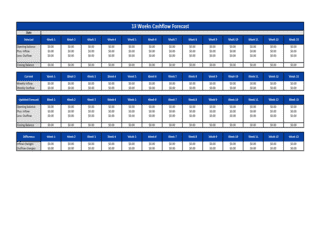
A 13-week cash flow forecast is a short-term tool used to monitor actual cash inflows and outflows on a weekly basis, covering approximately one quarter. It is the standard instrument used during financial stress, restructuring, or rapid growth to ensure the business never runs out of operating cash. Banks and turnaround advisors frequently require it as a condition of ongoing credit.
How do I forecast sales for a new product with no history?
Start with market sizing: estimate the total addressable market, then apply a realistic penetration rate based on your go-to-market plan. Use comparable product launches or industry benchmarks as a sanity check. Build a bottom-up model from pipeline, conversion rates, and average deal size rather than applying a growth percentage to zero. Document every assumption so the forecast can be revised as early sales data arrives.
Can I use a financial projections template for a bank loan application?
Yes. Most small business lenders require projections covering at least two to three years, including an income statement, cash flow statement, and balance sheet. A professionally formatted template that clearly labels assumptions and separates fixed from variable costs will satisfy the documentation requirements of most commercial lenders. For SBA loans or larger credit facilities, consider having an accountant review the final numbers.

Forecasting and Projection vs. related documents

Forecasting and Projection vs. Budget

A budget is a fixed spending and revenue plan approved for a period, usually a fiscal year. A forecast is a rolling estimate of where the business is actually headed based on current data. Budgets set the target; forecasts track whether you will hit it. Most finance teams maintain both and reconcile the gap between them regularly.

Forecasting and Projection vs. Cash flow statement

A cash flow statement records actual cash movements in the past; a cash flow forecast projects future inflows and outflows. Both use the same categories — operating, investing, and financing — but serve opposite purposes: the statement is for reporting, the forecast is for decision-making. Lenders and investors typically want to see both.

Forecasting and Projection vs. Business plan financial model

A business plan financial model is a broader document that combines projections with market analysis, competitive context, and strategic narrative. A standalone financial projection template is narrower — it focuses on the numbers and assumptions without the surrounding prose. Use the projection template to build the financial section of a business plan.

Forecasting and Projection vs. Pro forma financial statements

Pro forma statements are hypothetical financials that show what results would look like under a specific scenario — an acquisition, a new product line, or a financing round. Financial projections are the standard forward-looking forecast used in planning. Pro forma statements are a subset of projections prepared for a specific "what if" analysis.

Key clauses every Forecasting and Projection contains

Every financial forecast or projection, regardless of time horizon or business model, is built from the same core components.

  • Revenue assumptions. The documented basis for projected sales — unit volumes, pricing, growth rates, or market share — so readers can evaluate credibility.
  • Cost of goods sold (COGS). Direct costs tied to producing revenue: materials, labor, hosting costs, or commissions, depending on business type.
  • Operating expenses. Fixed and variable overhead not directly tied to production: salaries, rent, marketing, software, and general and administrative costs.
  • EBITDA or operating income. The earnings line that shows operational profitability before interest, taxes, depreciation, and amortization — the primary performance metric for most forecasts.
  • Cash flow projection. Converts accounting profit into actual cash timing by accounting for receivables, payables, inventory, and capital expenditures.
  • Balance sheet projection. A forward-looking snapshot of assets, liabilities, and equity that confirms the forecast is internally consistent.
  • Key assumptions log. A plain-language summary of the main inputs and their sources so that the forecast can be audited, challenged, or updated as conditions change.
  • Scenario or sensitivity analysis. Best-case, base-case, and worst-case variants that show how outcomes change when key assumptions shift.

How to write a financial forecast

A credible forecast is built from the bottom up, not by applying an arbitrary growth percentage to last year's numbers.

  1. 1

    Choose your time horizon and frequency

    Decide whether you need a 13-week cash forecast, a 12-month operating plan, or a 3-year strategic projection — and whether to model weekly, monthly, or quarterly.

  2. 2

    Gather your baseline data

    Pull historical revenue, cost, and cash data for at least the prior 12 months; for new products or companies, identify comparable market benchmarks.

  3. 3

    Build your revenue model first

    Start with units, prices, and conversion rates rather than a single top-line revenue number — bottom-up projections are far easier to defend to investors or lenders.

  4. 4

    Map costs to revenue drivers

    Separate fixed costs (rent, base salaries) from variable costs (commissions, fulfillment) so the model scales correctly when revenue assumptions change.

  5. 5

    Project cash separately from profit

    Account for the timing difference between when you recognize revenue and when cash actually arrives; a profitable business can still run out of cash.

  6. 6

    Document every key assumption

    Write a one-line note for each major input explaining why you chose that number — this is what investors and auditors will scrutinize first.

  7. 7

    Run at least three scenarios

    Build a base case, an upside case, and a downside case; show how cash and profitability change across each so stakeholders understand the risk range.

  8. 8

    Update the forecast monthly

    Replace projected figures with actuals as the period closes, recalibrate forward assumptions, and note the variance and its cause.

At a glance

What it is
A financial forecast or projection is a structured estimate of future revenue, expenses, and cash position based on historical data, assumptions, and business plans. Forecasts are used internally to guide decisions and externally to satisfy lenders, investors, and board members.
When you need one
Any time you are planning a budget cycle, raising capital, managing a cash shortfall, or launching a new product, you need a documented forecast to align stakeholders and track performance against targets.

Which Forecasting and Projection do I need?

The right forecasting template depends on your time horizon, business model, and primary audience — internal planning, investor reporting, or short-term cash management.

Your situation
Recommended template

Preparing a one-year financial plan for internal budgeting

Covers monthly revenue, expenses, and cash position across a full operating year.

Pitching to investors or applying for a bank loan

Multi-year outlook gives lenders and investors the long-range view they require.

Running a SaaS business and modeling MRR, churn, and ARR

Built around subscription metrics that don't fit a traditional P&L format.

Building projections for a conventional product or service company

Designed for standard revenue and cost structures without subscription logic.

Forecasting unit sales and revenue by product line or territory

Breaks revenue down by product, channel, or rep for granular sales planning.

Managing a liquidity crisis or monitoring weekly cash position

Week-by-week cash visibility is the standard tool for short-term cash management.

Learning how to build a sales forecast from scratch

Step-by-step guidance before committing numbers to a spreadsheet or template.

Forecasting sales for a brand-new product with no history

Addresses assumption-building and market-sizing when no baseline data exists.

Glossary

Revenue forecast
An estimate of future sales income broken down by product, service line, or period.
Cash flow forecast
A projection of actual cash inflows and outflows over a defined period, showing whether the business will have enough cash to operate.
MRR (Monthly Recurring Revenue)
The predictable monthly revenue from active subscriptions, a core metric for SaaS and subscription businesses.
ARR (Annual Recurring Revenue)
MRR multiplied by 12, used to express the annualized value of subscription revenue.
Churn rate
The percentage of customers or revenue lost in a given period, a key variable in SaaS financial projections.
COGS (Cost of Goods Sold)
Direct costs required to produce or deliver revenue — materials, direct labor, or hosting and infrastructure for software.
EBITDA
Earnings before interest, taxes, depreciation, and amortization — a widely used measure of operating profitability.
Run rate
The annualized value of a current metric, such as monthly revenue multiplied by 12, used to extrapolate short-term performance.
Burn rate
The rate at which a company spends its cash reserves each month, typically used for pre-revenue or early-stage businesses.
Sensitivity analysis
A test of how forecast outcomes change when a single key assumption — such as price or growth rate — is varied up or down.
Bottom-up forecast
A projection built from granular inputs such as units sold, headcount, and conversion rates, rather than from a top-line growth assumption.
Pro forma
Financial statements prepared under a hypothetical scenario — such as an acquisition or a new product launch — rather than actual or standard projected conditions.

What is a financial projection?

A financial projection is a forward-looking numerical model that estimates a business's revenue, expenses, and cash position over a defined future period. Projections translate strategy and assumptions into numbers — showing how many units need to be sold, what costs will be incurred, and whether the business will have enough cash to execute its plans. They are used equally for internal decision-making and for external audiences such as investors, lenders, and board members who need evidence that management understands the financial path ahead.

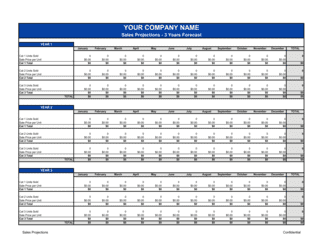
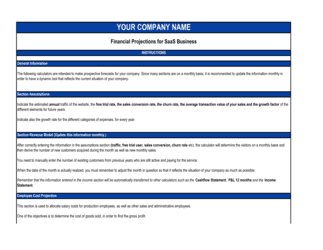
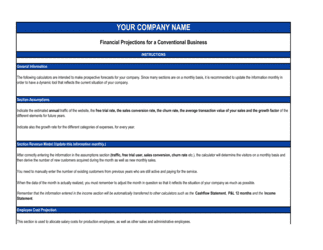
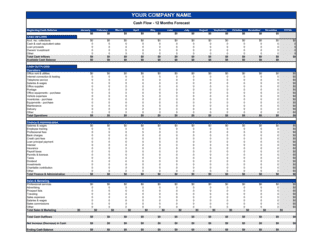
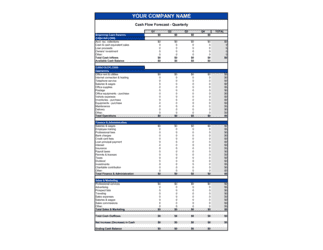
Forecasting and projection templates cover a spectrum of time horizons and business types. A 13-week cash flow forecast gives a week-by-week view of operating cash for immediate liquidity management. A 12-month projection supports annual budgeting and near-term planning. A 3-year projection provides the longer-range outlook that investors and banks require. SaaS businesses need purpose-built templates that model subscription metrics — MRR, ARR, churn — that don't fit a conventional income statement structure.

When you need a financial forecast

You need a documented financial forecast any time the numbers driving your business need to be visible, defensible, and shared with others. That includes routine planning cycles and high-stakes external events alike.

Common triggers:

  • Preparing an annual operating budget and communicating targets to department heads
  • Applying for a bank loan, line of credit, or SBA financing
  • Pitching to angel investors, venture capital firms, or strategic acquirers
  • Managing a cash shortfall and needing week-by-week visibility into the bank balance
  • Launching a new product and modeling when it will break even
  • Onboarding a new CFO, controller, or finance director who needs to understand the plan
  • Presenting quarterly results to a board alongside updated forward-looking estimates

Operating without a written forecast doesn't mean the future becomes less uncertain — it means decisions get made without a shared reference point for what success looks like. When actuals diverge from expectations, a documented forecast makes it possible to identify why, adjust assumptions, and course-correct. Without one, every surprise is just a surprise.

Award-winning platform

  • Great Place to Work 2025
  • BIG Award — Product of the Year 2025
  • Smartest Companies 2025
  • Global 100 Excellence 2026
  • Best of the Best 2025

Create your document in 3 simple steps.

From template to signed document — all inside one Business Operating System.
1
Download or open template

Access over 3,000+ business and legal templates for any business task, project or initiative.

2
Edit and fill in the blanks with AI

Customize your ready-made business document template and save it in the cloud.

3
Save, Share, Send, Sign

Share your files and folders with your team. Create a space of seamless collaboration.

Save time, save money, and create top-quality documents.

★★★★★

"Fantastic value! I'm not sure how I'd do without it. It's worth its weight in gold and paid back for itself many times."

Managing Director · Mall Farm
Robert Whalley
Managing Director, Mall Farm Proprietary Limited
★★★★★

"I have been using Business in a Box for years. It has been the most useful source of templates I have encountered. I recommend it to anyone."

Business Owner · 4+ years
Dr Michael John Freestone
Business Owner
★★★★★

"It has been a life saver so many times I have lost count. Business in a Box has saved me so much time and as you know, time is money."

Owner · Upstate Web
David G. Moore Jr.
Owner, Upstate Web

Run your business with a system — not scattered tools

Stop downloading documents. Start operating with clarity. Business in a Box gives you the Business Operating System used by over 250,000 companies worldwide to structure, run, and grow their business.

Free Forever Plan · No credit card required