Bids and Quotes Templates
★★★★★4.7from 280+ reviews· Trusted by 20M+ businesses
Win more business with professional bids, quotes, and proposals ready to send in minutes.
WordEditable onlinePDF10+ bid and quote templates
Other Sales & Marketing categories
Quotes and pricing documents
Proposal correspondence and follow-up
250K+Clients
20M+Free users
20+Years
190+Countries
10,000+Law firms
50M+Downloads
Trusted across review platforms
- Capterra★★★★☆4.649 reviews
- G2★★★★☆4.713 reviews
- GetApp★★★★☆4.649 reviews
- Google Play★★★★☆4.6179 ratings
- Google Reviews★★★★☆4.567 reviews
Frequently asked questions
What is the difference between a quote and an estimate?
A quote is a firm offer: if the buyer accepts it, you're committed to the stated price for the defined scope. An estimate is an approximation — useful for budgeting but not a binding commitment. Always clarify which one you're providing, because buyers sometimes treat estimates as fixed prices unless you say otherwise in writing.
Is a price quotation legally binding?
A quotation becomes binding when the buyer formally accepts it — by signing, issuing a purchase order, or confirming in writing. Before acceptance, it is an offer that can be withdrawn or amended. To be safe, include a validity period and an explicit acceptance step so there is no ambiguity about when a deal is struck.
How long should a quote be valid?
Most businesses set validity periods of 15 to 30 days for standard quotes, and 7 to 14 days for quotes involving volatile input costs such as raw materials or foreign currency. State the expiry date explicitly on the document — "This quote is valid until [date]" — rather than leaving it open-ended.
What should a bid proposal include?
A bid proposal typically includes an executive summary, your understanding of the buyer's requirements, your proposed approach or solution, a detailed pricing schedule, your qualifications and relevant experience, a project timeline, and your terms and conditions. For formal public tenders, follow the buyer's specified format exactly.
When should I use an RFP instead of just sending a quote?
Issue an RFP when you are the buyer and want multiple vendors to compete on a standardized basis — for large purchases, outsourced services, or any situation where comparing vendor responses fairly matters. A quote is issued by the seller; an RFP is issued by the buyer. If you're responding to someone else's RFP, use a proposal or bid template.
Can I send a proposal without being asked for one?
Yes. An unsolicited proposal can open doors if it is specific, relevant, and focused on a problem the prospect actually has. Keep it short — a one-page business proposal or a cover letter with a concise proposal attached works better than an unsolicited 20-page document. Tailor every section to the recipient's known priorities.
What is a scope of work and why does it belong in a quote?
A scope of work defines exactly what you will deliver, the boundaries of the engagement, and what is excluded. Including it in a quote prevents scope creep — the gradual expansion of deliverables without a corresponding price increase. When scope is agreed upfront, change orders are much easier to justify and price if the project expands.
How do I follow up on a quote the client hasn't responded to?
Send a short, polite reminder before the validity period expires, referencing the quote number and expiry date. Offer to answer questions or adjust scope. If the deadline passes, let the client know you can reissue the quote — at potentially updated pricing — if they're still interested. Document all follow-up communications in case of a later dispute.
Bids and Quote vs. related documents
A quote is a fixed-price document: it tells the buyer exactly what they will pay for a defined scope. A proposal is broader — it presents a solution, explains your methodology, and makes a case for why you should be chosen, with pricing as one component. Use a quote when the scope is clear and the buyer just needs a number; use a proposal when you need to persuade as well as price.
A bid is typically submitted in response to a formal procurement process (tender, RFP) where multiple vendors compete on price and qualifications. A quote is usually issued in a one-to-one context when a single prospect asks for pricing. Bids follow stricter formatting rules set by the buyer; quotes are largely at the seller's discretion.
An RFP (Request for Proposal) is issued by a buyer to solicit competing proposals from vendors. A proposal is the response submitted by a vendor. If you're the buyer standardizing what vendors send you, use an RFP template. If you're the vendor responding, use a proposal or bid template.
A quote is issued before work begins and represents an offer of price that the buyer can accept or reject. An invoice is issued after work is completed or milestones are reached, and it requests payment for work already done. Quotes are not legally binding payments requests; invoices typically are.
Key clauses every Bids and Quote contains
Regardless of whether you're submitting a quote, a bid, or a full proposal, the same core elements determine whether the document is clear, defensible, and commercially effective.
- Scope of work. Defines exactly what is included — and what is not — so there's no ambiguity about deliverables.
- Pricing and line items. Breaks down costs by product, service, labour, or phase so the buyer can see where every dollar goes.
- Validity period. States how long the quoted price is guaranteed, protecting you from cost increases if the buyer delays.
- Payment terms. Specifies when payment is due, whether a deposit is required, and what milestones trigger invoicing.
- Assumptions and exclusions. Lists the conditions under which the price holds — site access, client-supplied materials, regulatory approvals.
- Delivery or completion timeline. Sets realistic expectations for when work will be completed or goods will arrive.
- Acceptance mechanism. Explains how the buyer formally accepts the quote — signature, purchase order, or written confirmation.
- Revision and change-order process. Describes how scope changes are handled and priced after the original quote is accepted.
How to write a bid or quote
A well-structured quote or bid removes doubt, speeds up buyer decisions, and protects you if a dispute arises. Follow these steps each time.
1
Understand the buyer's actual need
Before pricing anything, confirm the full scope in writing — what the buyer wants delivered, by when, and to what standard.
2
Choose the right document type
Use a quote for straightforward pricing, a proposal when you need to justify your approach, and a bid when responding to a formal tender.
3
Itemize costs clearly
Break the price into line items — labour, materials, travel, licences — so the buyer can see the build-up and you can defend each number.
4
State your assumptions and exclusions
List every condition your price depends on: site readiness, client-supplied data, number of revision rounds, or third-party approvals.
5
Set a validity period
Prices for labour and materials change — specify how long the quote is valid (typically 15–30 days) to avoid being held to a stale number.
6
Include payment terms and milestones
State when the deposit is due, when progress payments are triggered, and when the final balance is payable.
7
Add a clear acceptance mechanism
Tell the buyer exactly how to say yes — a signature block, a reply email, or a purchase order reference — so acceptance is unambiguous.
8
Follow up before the validity period expires
Send a brief follow-up if you haven't heard back, referencing the expiry date and offering to adjust scope or terms if needed.
At a glance
- What it is
- A bid or quote template is a pre-structured document that lets a business present its pricing, scope, and terms to a prospective client in a clear, professional format. Quotes and bids establish the commercial basis for a deal before a contract is signed.
- When you need one
- Any time a prospect asks "how much does it cost?" or issues a formal request for proposal, you need a written quote, bid, or proposal on file before work begins.
Which Bids and Quote do I need?
The right document depends on who is initiating the request, how formal the process is, and whether you are quoting a price, proposing a solution, or responding to a formal tender. Pick the scenario that matches yours.
Your situation
Recommended template
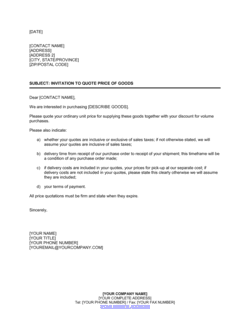
A prospect asks for a price breakdown for goods or services
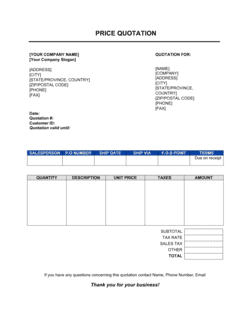
Itemized price quotation gives prospects the line-level detail they need to approve a purchase.A service business needs to quote labour, materials, and timeline
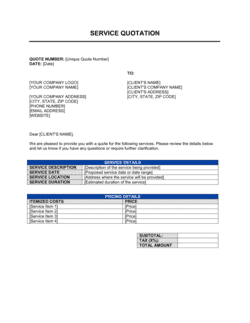
Purpose-built for service engagements with fields for scope, rate, and estimated hours.Responding to a formal tender or competitive bidding process
Structured to meet formal procurement requirements, including pricing and qualifications.Pitching a project or solution to a new client
Covers objectives, methodology, timeline, and budget in a single persuasive document.Selling a product or service through a structured written pitch
Combines value proposition, pricing, and next steps to move a prospect toward a decision.Issuing a formal request for vendors to submit their best price
Standardizes what vendors receive so you can compare responses fairly.Proposing digital marketing or SEO services to a client
Purpose-built for agency and consultant SEO engagements with deliverables and KPI sections.Securing a brand partner or funder for an event or program
Structured to present audience demographics, sponsorship tiers, and brand benefits.Glossary
- Quotation
- A formal offer stating the price at which a seller will supply goods or services under defined conditions.
- Bid
- A price offer submitted in response to a formal procurement process where multiple vendors compete.
- Request for Proposal (RFP)
- A document issued by a buyer inviting vendors to propose a solution and price for a defined need.
- Scope of work
- A written description of what will be delivered, the boundaries of the engagement, and what is excluded.
- Validity period
- The window of time during which a quoted price is guaranteed, after which the seller may revise terms.
- Line item
- An individual cost entry in a quote or proposal, typically including description, quantity, unit price, and total.
- Change order
- A written amendment to an accepted quote or contract that adjusts scope, timeline, or price.
- Purchase order (PO)
- A buyer-issued document that formally authorizes a purchase and often serves as acceptance of a quote.
- Work order
- An internal or external authorization document that initiates a specific piece of work, often issued after a quote is accepted.
- Unsolicited proposal
- A proposal sent to a prospect who did not issue a formal RFP, initiated by the seller to create a new opportunity.
- Executive summary
- A short opening section of a proposal that states the buyer's problem and your solution before any detail.
- Terms and conditions
- The legal provisions attached to a quote or proposal that govern payment, liability, cancellation, and dispute resolution.
What is a bid or quote template?
A bid or quote template is a pre-formatted document that enables a business to present its pricing, proposed scope, and commercial terms to a prospective client in a structured, professional way. Quotes and bids serve as the commercial bridge between a buyer's need and a signed contract: they make the seller's offer concrete, give the buyer a basis for comparison, and create a paper trail that protects both parties if a dispute arises later.
The category covers a spectrum from simple one-page price quotations — listing products, quantities, and unit costs — to multi-section proposals that present a full solution methodology, team qualifications, project timeline, and pricing schedule. What unites every document in this folder is the same commercial function: establishing what will be delivered, by whom, at what price, and under what conditions, before any work begins.
Bids and quotes differ from invoices and contracts. A quote is an offer; the buyer hasn't accepted yet. A contract is what comes after acceptance. Understanding that distinction keeps businesses from starting work — and incurring costs — before a buyer has formally committed.
When you need a bid or quote
The moment a prospect asks "what would this cost?" or a buyer issues a formal procurement notice, you need a written document on record. Informal verbal quotes are easy to misremember or dispute; a written quote or proposal removes ambiguity and signals professionalism.
Common triggers:
- A new client asks for pricing on a service or product you sell
- A business issues a formal RFP and invites vendors to respond competitively
- You want to pitch a solution to a prospect proactively, before they shop around
- A construction, IT, or events company needs to submit a bid for a project contract
- An agency is proposing a retainer or project to a new brand client
- A supplier asks for a purchase order before confirming a delivery date
- You're resubmitting or revising a proposal that didn't win the first time
Sending a well-structured quote or proposal is one of the highest-leverage things a sales team can do: it shows that you understand the buyer's need, sets price expectations clearly, and gives the buyer a reason to say yes. Skipping the written document — or sending a poorly formatted one — makes you look less credible than competitors who do it well and leaves you exposed if the buyer later disputes what was agreed. The templates in this folder cover every scenario, from a single-line price quote to a full competitive bid.
Award-winning platform
- Great Place to Work 2025
- BIG Award — Product of the Year 2025
- Smartest Companies 2025
- Global 100 Excellence 2026
- Best of the Best 2025