Term Of Use Template

Free Word download β€’ Edit online β€’ Save & share with Drive β€’ Export to PDF

3 pagesβ€’25–30 min to fillβ€’Difficulty: Standardβ€’Signature requiredβ€’Legal review recommended
Learn more ↓
FreeTerm Of Use Template

At a glance

What it is
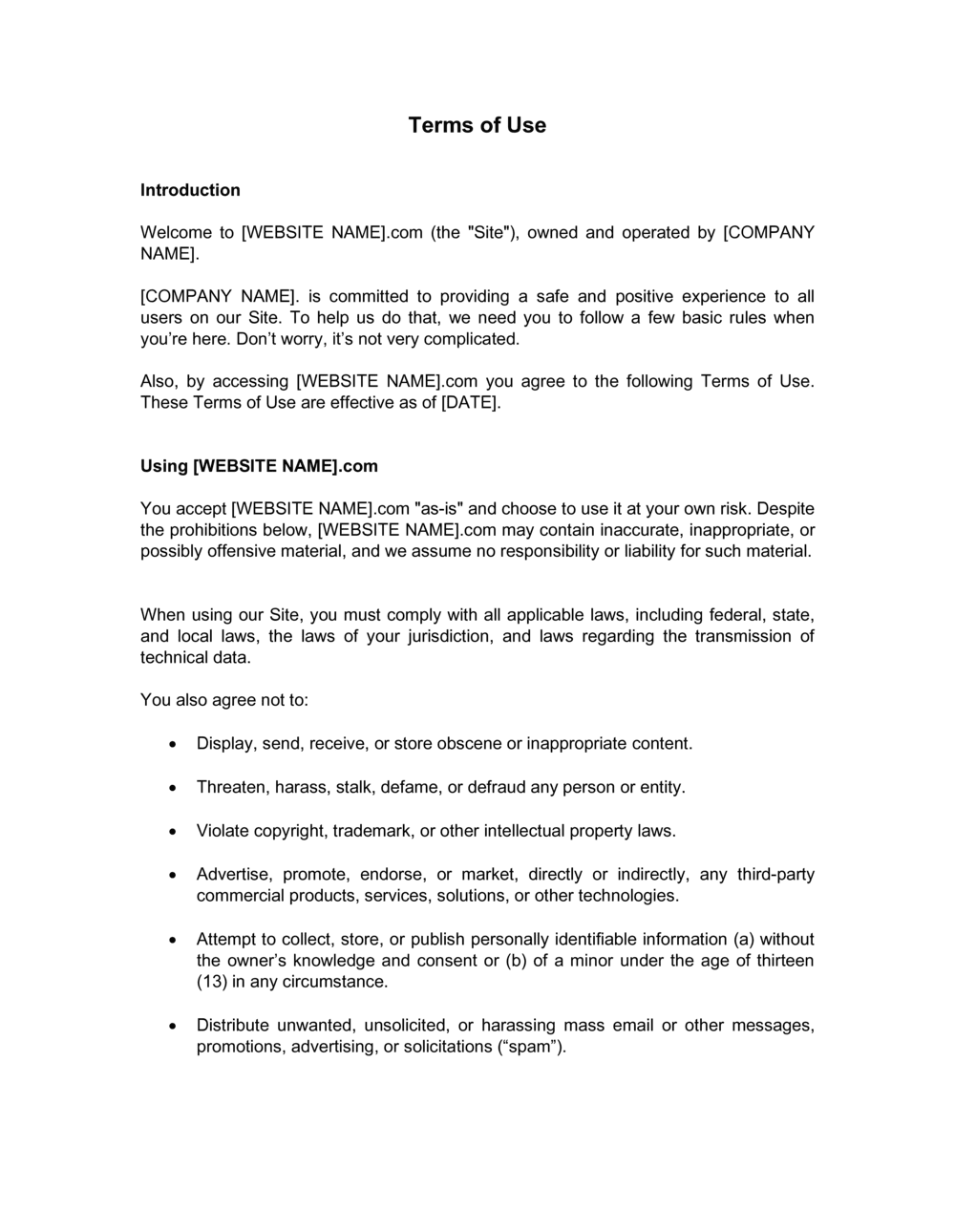
A Terms of Use is a legally binding agreement between a website owner, app developer, or SaaS provider and the users who access their platform. This free Word download covers user obligations, intellectual property rights, prohibited conduct, disclaimers of liability, and governing law in a single structured document you can edit online and publish directly to your site or app.
When you need it
Use it before launching any public-facing website, web application, mobile app, or SaaS product that allows users to create accounts, submit content, or access proprietary features. It is also required when you process user data, offer paid subscriptions, or host user-generated content.
What's inside
Acceptance mechanism, user eligibility and account responsibilities, intellectual property ownership, prohibited uses, content standards, limitation of liability, warranty disclaimer, termination rights, dispute resolution, and governing law and jurisdiction.

What is a Terms of Use?

A Terms of Use is a legally binding agreement between a platform operator β€” website owner, app developer, or SaaS provider β€” and every user who accesses the platform. It establishes the rules of the relationship: what users may and may not do, who owns the content and intellectual property on the platform, how liability is allocated when things go wrong, and which jurisdiction's laws govern any disputes. Unlike a negotiated contract, terms of use are a unilateral document presented to all users simultaneously, accepted either by clicking an agreement button or by continuing to use the platform. They function as the foundational legal layer beneath every user interaction on a digital product.

Why You Need This Document

Operating a website or app without terms of use leaves you legally exposed on every front simultaneously. Without an IP ownership clause, you have no documented basis to prevent users from reproducing or redistributing your content. Without a prohibited-conduct clause, you have no contractual ground to terminate accounts that abuse your platform or harm other users. Without a limitation of liability clause, a single user claim for service downtime or data loss has no contractual ceiling β€” your exposure is whatever a court determines. Regulators in the US, EU, and UK treat the absence of clear terms as evidence of unfair dealing, particularly when user data is involved. This template gives you a structured, enforceable starting point β€” covering all ten core provisions β€” that you can tailor to your platform and publish in under an hour, with legal review recommended before deployment on any product with meaningful user scale or paid subscriptions.

Which variant fits your situation?

If your situation is…Use this template
Operating a standard informational or marketing websiteWebsite Terms of Use
Running a SaaS product with paid subscription tiersSaaS Terms of Service
Operating a marketplace where third parties sell productsMarketplace Terms and Conditions
Collecting personal data from EU or UK residentsPrivacy Policy
Offering a free mobile app through an app storeMobile App Terms of Use
Running a membership or subscription communityMembership Agreement
Providing an API for third-party developer accessAPI Terms of Use

Common mistakes to avoid

❌ Using a browsewrap-only acceptance mechanism

Why it matters: Courts in the US and UK have repeatedly declined to enforce terms where there is no evidence the user was aware of them. A footer link alone does not constitute adequate notice for restrictive clauses.

Fix: Implement a clickwrap checkbox at account creation or checkout, log the acceptance timestamp and IP address, and link to the current terms version at the point of acceptance.

❌ Setting warranty disclaimers in sentence case

Why it matters: US courts apply a 'conspicuousness' standard to warranty disclaimers under the UCC. Disclaimers written in standard sentence case have been held unenforceable because they failed to stand out to a reasonable reader.

Fix: Present all disclaimer and limitation-of-liability language in all-caps or bold, large-font formatting as required by the template β€” do not reformat these sections into standard prose.

❌ Omitting a UGC license clause on platforms that accept user content

Why it matters: Without an explicit license grant, displaying or distributing content users upload technically infringes their copyright β€” exposing the platform to DMCA claims and civil liability.

Fix: Add a UGC license clause that grants the company a worldwide, royalty-free license to display and distribute submitted content in connection with operating the service.

❌ Failing to update terms and notify users after material changes

Why it matters: A court may apply the version of the terms in force when a dispute arose. If you silently updated terms to add arbitration or limit liability after a user signed up, those changes may not bind that user.

Fix: Send an email notice to all registered users at least 15–30 days before material changes take effect, provide a summary of what changed, and require re-acceptance for critical amendments.

❌ Using a single global terms document without jurisdiction-specific carve-outs

Why it matters: Consumer protection laws in California, the EU, and the UK override contractual terms that conflict with statutory rights. A one-size-fits-all document that ignores these rules exposes the company to regulatory enforcement.

Fix: Add jurisdiction-specific addenda or carve-out clauses that preserve statutory consumer rights in California (CCPA), the EU (GDPR, Consumer Rights Directive), and the UK (Consumer Rights Act 2015).

❌ No survival clause listing which sections persist after termination

Why it matters: Without a survival clause, IP ownership, liability caps, and indemnification obligations could theoretically lapse when an account is closed β€” removing protections the company relied on during the relationship.

Fix: Explicitly list every clause that survives termination β€” at minimum: IP ownership, disclaimers, limitation of liability, indemnification, and governing law.

The 10 key clauses, explained

Acceptance of Terms

In plain language: Explains how users agree to the terms β€” by clicking a button, creating an account, or continuing to use the site β€” and confirms they are bound by the current version.

Sample language
By accessing or using [PLATFORM NAME] ('Service'), you agree to be bound by these Terms of Use ('Terms'). If you do not agree to these Terms, do not access or use the Service.

Common mistake: Relying on a browsewrap-only notice buried in the footer. Courts increasingly require evidence of actual notice β€” a clickwrap checkbox at account creation provides far stronger enforceability.

User Eligibility and Account Registration

In plain language: Sets the minimum age requirement (typically 13 or 18), requires users to provide accurate information, and places responsibility for account security on the user.

Sample language
You must be at least [18] years old to use the Service. You agree to provide accurate, current, and complete information during registration and to update it as necessary. You are responsible for maintaining the confidentiality of your account credentials.

Common mistake: Setting the age minimum at 13 without a COPPA compliance mechanism. If you collect personal data from users under 13 in the US, you need verified parental consent β€” terms alone are insufficient.

Intellectual Property Ownership

In plain language: States that the platform, its content, trademarks, and code belong to the company, and grants users only a limited, non-exclusive license to access the service.

Sample language
All content, features, and functionality of the Service β€” including but not limited to text, graphics, logos, and software β€” are the exclusive property of [COMPANY NAME] and are protected by applicable intellectual property laws. You are granted a limited, non-exclusive, non-transferable license to access the Service solely for your personal or internal business use.

Common mistake: Granting an overly broad license that implies users can copy, redistribute, or create derivative works from the platform's content. The license should be limited to 'access and use' with all other rights reserved.

User-Generated Content License

In plain language: Grants the company a license to use, display, and distribute content that users submit to the platform, while confirming the user retains ownership of their content.

Sample language
By submitting content to the Service, you grant [COMPANY NAME] a worldwide, royalty-free, sublicensable license to use, reproduce, modify, publish, and distribute such content in connection with operating and promoting the Service. You represent that you own or have the right to grant this license.

Common mistake: Omitting the UGC license clause entirely when users can upload files, write reviews, or post comments. Without it, publishing user content technically infringes the user's copyright.

Prohibited Conduct

In plain language: Lists specific behaviors that are not permitted on the platform β€” scraping, hacking, impersonation, spam, and illegal activity β€” and makes violations grounds for immediate termination.

Sample language
You agree not to: (a) use automated tools to scrape or extract data from the Service; (b) attempt to gain unauthorized access to any part of the Service; (c) transmit spam, malware, or harmful code; (d) impersonate any person or entity; or (e) use the Service for any unlawful purpose.

Common mistake: Writing a generic prohibited-conduct list that does not address the platform's specific risk vectors. A SaaS product needs API abuse restrictions; a marketplace needs fraud and counterfeit-listing prohibitions specific to that context.

Disclaimer of Warranties

In plain language: States that the service is provided 'as is' with no guarantees of accuracy, availability, or fitness for a particular purpose, and that downtime or data loss does not trigger liability.

Sample language
THE SERVICE IS PROVIDED 'AS IS' AND 'AS AVAILABLE' WITHOUT WARRANTIES OF ANY KIND, EXPRESS OR IMPLIED, INCLUDING BUT NOT LIMITED TO WARRANTIES OF MERCHANTABILITY, FITNESS FOR A PARTICULAR PURPOSE, AND NON-INFRINGEMENT. [COMPANY NAME] DOES NOT WARRANT THAT THE SERVICE WILL BE UNINTERRUPTED, ERROR-FREE, OR SECURE.

Common mistake: Writing disclaimer language in sentence case rather than all-caps. US courts β€” and several other common-law jurisdictions β€” require warranty disclaimers to be 'conspicuous,' which courts have interpreted to mean all-caps or bold formatting in a written document.

Limitation of Liability

In plain language: Caps the total damages a user can recover from the company, typically at the amount paid in the prior 12 months or a fixed nominal sum, and excludes indirect and consequential damages.

Sample language
TO THE MAXIMUM EXTENT PERMITTED BY LAW, [COMPANY NAME]'S TOTAL LIABILITY FOR ANY CLAIM ARISING OUT OF OR RELATING TO THESE TERMS OR THE SERVICE SHALL NOT EXCEED THE GREATER OF (A) THE AMOUNTS PAID BY YOU IN THE 12 MONTHS PRIOR TO THE CLAIM, OR (B) $[100]. IN NO EVENT SHALL [COMPANY NAME] BE LIABLE FOR ANY INDIRECT, INCIDENTAL, SPECIAL, OR CONSEQUENTIAL DAMAGES.

Common mistake: Setting the liability cap at zero dollars for a paid service. Courts are more likely to uphold a cap that is tied to actual consideration paid β€” a nominal $0 cap on a $500/month subscription is often struck down as unconscionable.

Indemnification

In plain language: Requires users to defend and compensate the company for losses caused by the user's violation of the terms or applicable law.

Sample language
You agree to indemnify, defend, and hold harmless [COMPANY NAME] and its officers, directors, employees, and agents from any claims, liabilities, damages, and expenses (including reasonable attorneys' fees) arising from your use of the Service, your violation of these Terms, or your infringement of any third-party rights.

Common mistake: Including a mutual indemnification clause in consumer-facing terms. Consumer protection laws in the EU, UK, and several US states treat broad indemnities in consumer contracts as unfair terms β€” one-directional user-to-company indemnity is the standard approach for B2C platforms.

Termination and Suspension

In plain language: Gives the company the right to suspend or terminate any account at any time for any reason, with or without notice, and specifies which clauses survive after termination.

Sample language
[COMPANY NAME] may suspend or terminate your access to the Service at any time, with or without cause, with or without notice. Upon termination, your right to use the Service ceases immediately. Sections relating to IP ownership, disclaimer of warranties, limitation of liability, indemnification, and governing law shall survive termination.

Common mistake: Failing to list which clauses survive termination. Without a survival clause, core protections like liability caps and IP ownership could be argued to expire when the account is closed.

Governing Law and Dispute Resolution

In plain language: Specifies the jurisdiction whose laws govern the agreement and the mechanism β€” arbitration, mediation, or specific courts β€” for resolving disputes.

Sample language
These Terms are governed by the laws of the State of [STATE], without regard to its conflict-of-law provisions. Any dispute arising under these Terms shall be resolved by binding arbitration administered by [AAA / JAMS] in [CITY, STATE], except that either party may seek injunctive relief in a court of competent jurisdiction.

Common mistake: Choosing a governing law state with no connection to the company's operations or users. Some states β€” particularly Delaware for corporate law and California for consumer protection β€” apply their own standards regardless of what the contract specifies.

How to fill it out

  1. 1

    Identify your platform type and user base

    Determine whether your platform is a website, web app, mobile app, or SaaS product, and whether users are consumers (B2C), businesses (B2B), or both. This affects age thresholds, data obligations, and warranty language.

    πŸ’‘ If you serve both consumers and business users, consider separate terms for each β€” consumer protection laws impose obligations that are inappropriate in a B2B agreement.

  2. 2

    Set the acceptance mechanism

    Decide between clickwrap (checkbox at sign-up or checkout) and browsewrap (footer link). For any platform requiring an account or taking payment, implement clickwrap with a logged timestamp to maximize enforceability.

    πŸ’‘ Store a record of each user's acceptance β€” IP address, timestamp, and terms version β€” in your database. This evidence is critical if a user later claims they never agreed.

  3. 3

    Complete the company and platform identification fields

    Replace all [COMPANY NAME], [PLATFORM NAME], and [STATE] placeholders with your legal entity name, the product's public-facing name, and your chosen governing law state or country.

    πŸ’‘ Use your registered legal entity name, not your brand name, for the company identifier β€” this is the entity that will defend or enforce the agreement.

  4. 4

    Tailor the prohibited conduct list to your platform

    Review the template's prohibited-conduct clause and add any platform-specific restrictions β€” e.g., no scraping for a data-heavy product, no resale for a consumer SaaS, no competing use for a marketplace.

    πŸ’‘ Each item in the prohibited-conduct list should be specific enough to trigger termination rights without ambiguity. Vague terms like 'misuse' are hard to enforce.

  5. 5

    Configure the UGC license if users can submit content

    If users can post reviews, upload files, or submit any content, confirm the license grant is present and covers all formats (text, images, video). If your platform does not accept user content, remove this clause.

    πŸ’‘ For platforms that monetize user content β€” newsletters, aggregators, AI training data β€” consult a lawyer before finalizing the UGC license scope.

  6. 6

    Set the liability cap amount and currency

    Enter a liability cap that is proportionate to your subscription price or transaction value β€” typically 12 months of fees paid. For free services, a nominal flat amount ($100–$500) is standard practice.

    πŸ’‘ Courts are more likely to enforce caps tied to real consideration. A $0 cap on a paid service signals bad faith and is frequently struck down.

  7. 7

    Select the dispute resolution mechanism

    Choose binding arbitration for consumer-scale platforms (it prevents class actions), or court-based resolution for B2B products where negotiated disputes are more common. Name the arbitration body (AAA or JAMS) and seat city.

    πŸ’‘ A class action waiver is enforceable in most US states but is void in the EU and UK for consumer contracts β€” remove it from any version of the terms served to European users.

  8. 8

    Publish and version-control the document

    Post the final terms at a stable, crawlable URL (e.g., yoursite.com/terms). Add an 'effective date' and a 'last updated' date at the top. When you update the terms, notify existing users by email and increment the version date.

    πŸ’‘ Keep a historical archive of every version of your terms β€” courts may apply the version in force at the time of a disputed event, not the current version.

Frequently asked questions

What is a terms of use agreement?

A terms of use agreement is a legally binding contract between a platform operator and anyone who accesses the platform β€” website, app, or SaaS product. It sets the rules for acceptable use, establishes IP ownership, limits the company's liability, and specifies how disputes are resolved. Without one, a platform has no contractual basis to remove bad actors, enforce IP rights, or cap its exposure to user claims.

Are terms of use legally enforceable?

Terms of use are generally enforceable when properly presented and accepted, particularly when the user actively clicks an acceptance button (clickwrap) rather than passively browsing a site with a footer link (browsewrap). Specific clauses β€” such as liability caps, arbitration requirements, and class action waivers β€” are subject to additional scrutiny and may be unenforceable in certain jurisdictions or for consumer-facing platforms. Legal review is recommended before relying on these provisions in litigation.

What is the difference between terms of use and a privacy policy?

Terms of use govern the rules of the user relationship β€” what users can and cannot do, who owns the content, and how disputes are handled. A privacy policy discloses how personal data is collected, stored, and processed. Both are required for most websites and apps, and they serve different legal purposes. GDPR, CCPA, and most app store guidelines require a privacy policy as a separate document, not embedded in the terms.

Do I need terms of use for a free website?

Yes. A free website that collects email addresses, analytics data, or any user-submitted content needs terms of use to establish IP ownership, limit liability for inaccurate content, and define acceptable conduct. Without terms, you have no contractual right to remove content, ban abusive users, or disclaim responsibility for third-party links or user-submitted material.

What is the difference between terms of use and terms of service?

The two phrases are used interchangeably in practice. 'Terms of service' is more common for SaaS and subscription products, while 'terms of use' is more common for informational websites and apps. Legally, the label does not affect enforceability β€” the substance of the clauses determines what rights and obligations are created. Both should cover the same core elements: acceptance, IP, prohibited conduct, disclaimers, and governing law.

How often should I update my terms of use?

Review your terms annually as a minimum, and update them immediately when you add new features that affect user rights (payment processing, UGC, AI-generated outputs), expand into new jurisdictions, or experience a material change in your data practices. Each update should carry a new effective date, and material changes should be communicated to existing users by email with a summary of what changed.

Can I copy terms of use from another website?

Copying another company's terms verbatim is both a copyright infringement risk and a practical problem β€” the terms are likely tailored to their specific business model, jurisdiction, and legal exposure, not yours. A mismatched liability cap, an incorrect governing law, or a UGC clause that does not match your platform's actual functionality can all create gaps or contradictions that courts will resolve against you.

Is a class action waiver enforceable in my terms of use?

In most US states, a class action waiver embedded in an arbitration clause is enforceable following the Supreme Court's ruling in AT&T Mobility v. Concepcion. However, California has periodically challenged certain implementations, and the EU Consumer Rights Directive and UK Consumer Rights Act 2015 render class action waivers effectively void in consumer contracts governed by those regimes. Remove or limit this clause in any version served to European or UK consumers.

Do I need a lawyer to create terms of use?

For a standard informational website or simple mobile app, a high-quality template is generally sufficient. Engage a lawyer when your platform processes payments, handles sensitive user data, operates in regulated industries (healthcare, finance, children's services), serves users in multiple jurisdictions, or when your business model relies on UGC licensing or arbitration clauses. A 1–2 hour review typically costs $300–$800 and is worthwhile for any product with meaningful user scale.

How this compares to alternatives

vs Privacy Policy

A privacy policy discloses how personal data is collected, stored, shared, and deleted β€” it is a regulatory compliance document required by GDPR, CCPA, and most app store guidelines. Terms of use govern the user relationship and acceptable conduct. Both documents are required for any platform that collects user data; they address entirely different legal obligations and should not be combined.

vs End User License Agreement (EULA)

A EULA governs the license to use installed software β€” desktop applications, firmware, or enterprise software packages β€” and focuses on license scope, restrictions on reverse engineering, and IP ownership. Terms of use govern web-based and cloud-hosted platforms where the software is accessed rather than installed. SaaS products typically use terms of use; downloadable software uses a EULA.

vs Service Agreement

A service agreement is a bilaterally negotiated contract between a provider and a specific client, covering deliverables, fees, timelines, and liability on a one-to-one basis. Terms of use are a unilateral, take-it-or-leave-it contract presented to all users simultaneously. Service agreements are appropriate for professional services engagements; terms of use govern standardized platform access at scale.

vs Membership Agreement

A membership agreement governs a specific paid membership β€” dues, benefits, cancellation, and governance β€” typically for associations, clubs, or subscription communities. Terms of use set the baseline rules for platform access and apply to all users, including free-tier and trial users. For a paid community or subscription product, both documents may be needed: terms of use for platform rules and a membership agreement for the subscription relationship.

Industry-specific considerations

SaaS / Technology

Subscription tier restrictions, API rate limits, uptime disclaimer language, and data portability rights must all be addressed alongside standard terms.

E-commerce / Retail

Terms must cover product listing accuracy disclaimers, return policy integration, prohibited resale of digital goods, and payment processor pass-through obligations.

Media and Publishing

UGC license grants, DMCA takedown procedures, and content moderation standards are central to platforms that publish or aggregate user-submitted writing, video, or audio.

Healthcare / MedTech

Terms must disclaim that platform content does not constitute medical advice, address HIPAA compliance obligations for any patient data, and exclude liability for clinical decisions made on the basis of platform outputs.

Jurisdictional notes

United States

Enforceability varies by state. California courts scrutinize consumer-facing arbitration clauses and class action waivers under the CCPA and AB 51. Warranty disclaimers must be 'conspicuous' under the UCC β€” typically all-caps or bold formatting. COPPA requires verified parental consent for any data collection from users under 13. The FTC has authority to challenge deceptive or unfair terms under Section 5 of the FTC Act.

Canada

Canada's Anti-Spam Legislation (CASL) applies to any commercial electronic messages sent to Canadian users, even from foreign platforms. PIPEDA and provincial privacy laws (notably Quebec's Law 25, effective 2023) impose data handling obligations that should be reflected in both the terms and a separate privacy policy. Limitation-of-liability clauses are generally enforceable but must not conflict with provincial consumer protection legislation in Ontario, Quebec, or British Columbia.

United Kingdom

The Consumer Rights Act 2015 renders unfair contract terms β€” including broad liability exclusions and class action waivers β€” unenforceable in B2C agreements. The UK GDPR, retained post-Brexit, requires a lawful basis for processing personal data and must be addressed in a separate privacy policy. The Online Safety Act 2023 imposes additional obligations on platforms with user-generated content, including duty-of-care requirements for certain categories of harmful content.

European Union

The GDPR requires transparent disclosure of data processing practices in a separate privacy policy β€” embedding GDPR compliance language in terms of use is not sufficient. The EU Consumer Rights Directive limits the ability to exclude statutory consumer protections through contractual terms. The Digital Services Act (DSA), effective 2024, imposes additional transparency and content moderation obligations on platforms with significant EU user bases. Governing law clauses that deprive EU consumers of protections under their home country law are generally void.

Template vs lawyer β€” what fits your deal?

PathBest forCostTime
Use the templateStandard websites, informational apps, and simple SaaS products serving a domestic user baseFree30–60 minutes
Template + legal reviewSaaS products with paid subscriptions, platforms with UGC, or services expanding into EU or UK markets$300–$8002–5 days
Custom draftedMarketplaces, regulated industries (healthcare, fintech, edtech), AI-powered platforms, or multi-jurisdiction enterprise products$1,500–$5,000+1–3 weeks

Glossary

Terms of Use
A legally binding agreement that sets the rules and conditions under which users may access and use a website, app, or platform.
Clickwrap Agreement
An acceptance mechanism where a user actively clicks 'I Agree' or a similar button, creating a binding contract β€” generally more enforceable than a browsewrap notice.
Browsewrap Agreement
A passive acceptance mechanism where continued use of a site constitutes agreement to the terms, typically displayed via a footer link β€” less reliably enforced than clickwrap.
Limitation of Liability
A clause capping the maximum damages a company can be required to pay a user, typically at the amount the user paid in the past 12 months or a fixed dollar amount.
Warranty Disclaimer
A clause stating that the platform is provided 'as is' with no guarantees of uptime, accuracy, or fitness for a particular purpose.
Intellectual Property (IP) Assignment
Language clarifying that the platform owner retains all rights to the service, code, branding, and content β€” and what rights, if any, users grant back by submitting content.
User-Generated Content (UGC)
Any content β€” text, images, reviews, or files β€” that users submit to a platform, which must be governed by a license grant and content standards clause.
Indemnification
A clause requiring the user to compensate the platform owner for losses arising from the user's violation of the terms or applicable law.
Governing Law
The jurisdiction whose laws will be used to interpret and enforce the agreement, regardless of where the user is located.
Dispute Resolution
The mechanism β€” binding arbitration, mediation, or court β€” by which disagreements between the platform and its users will be resolved.
Termination Clause
Language giving the platform the right to suspend or permanently ban a user account for violating the terms, with or without advance notice.

Part of your Business Operating System

This document is one of 3,000+ business & legal templates included in Business in a Box.

  • Fill-in-the-blanks β€” ready in minutes
  • 100% customizable Word document
  • Compatible with all office suites
  • Export to PDF and share electronically

Create your document in 3 simple steps.

From template to signed document β€” all inside one Business Operating System.
1
Download or open template

Access over 3,000+ business and legal templates for any business task, project or initiative.

2
Edit and fill in the blanks with AI

Customize your ready-made business document template and save it in the cloud.

3
Save, Share, Send, Sign

Share your files and folders with your team. Create a space of seamless collaboration.

Save time, save money, and create top-quality documents.

β˜…β˜…β˜…β˜…β˜…

"Fantastic value! I'm not sure how I'd do without it. It's worth its weight in gold and paid back for itself many times."

Managing Director Β· Mall Farm
Robert Whalley
Managing Director, Mall Farm Proprietary Limited
β˜…β˜…β˜…β˜…β˜…

"I have been using Business in a Box for years. It has been the most useful source of templates I have encountered. I recommend it to anyone."

Business Owner Β· 4+ years
Dr Michael John Freestone
Business Owner
β˜…β˜…β˜…β˜…β˜…

"It has been a life saver so many times I have lost count. Business in a Box has saved me so much time and as you know, time is money."

Owner Β· Upstate Web
David G. Moore Jr.
Owner, Upstate Web

Run your business with a system β€” not scattered tools

Stop downloading documents. Start operating with clarity. Business in a Box gives you the Business Operating System used by over 250,000 companies worldwide to structure, run, and grow their business.

Start freeΒ Β·Β No credit card required