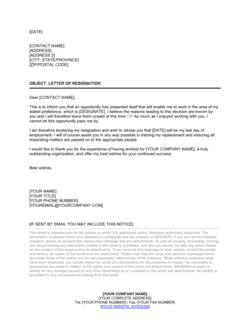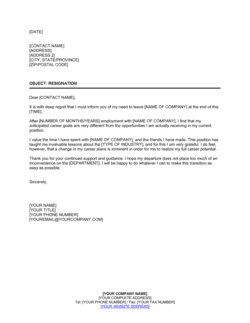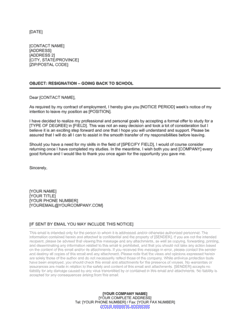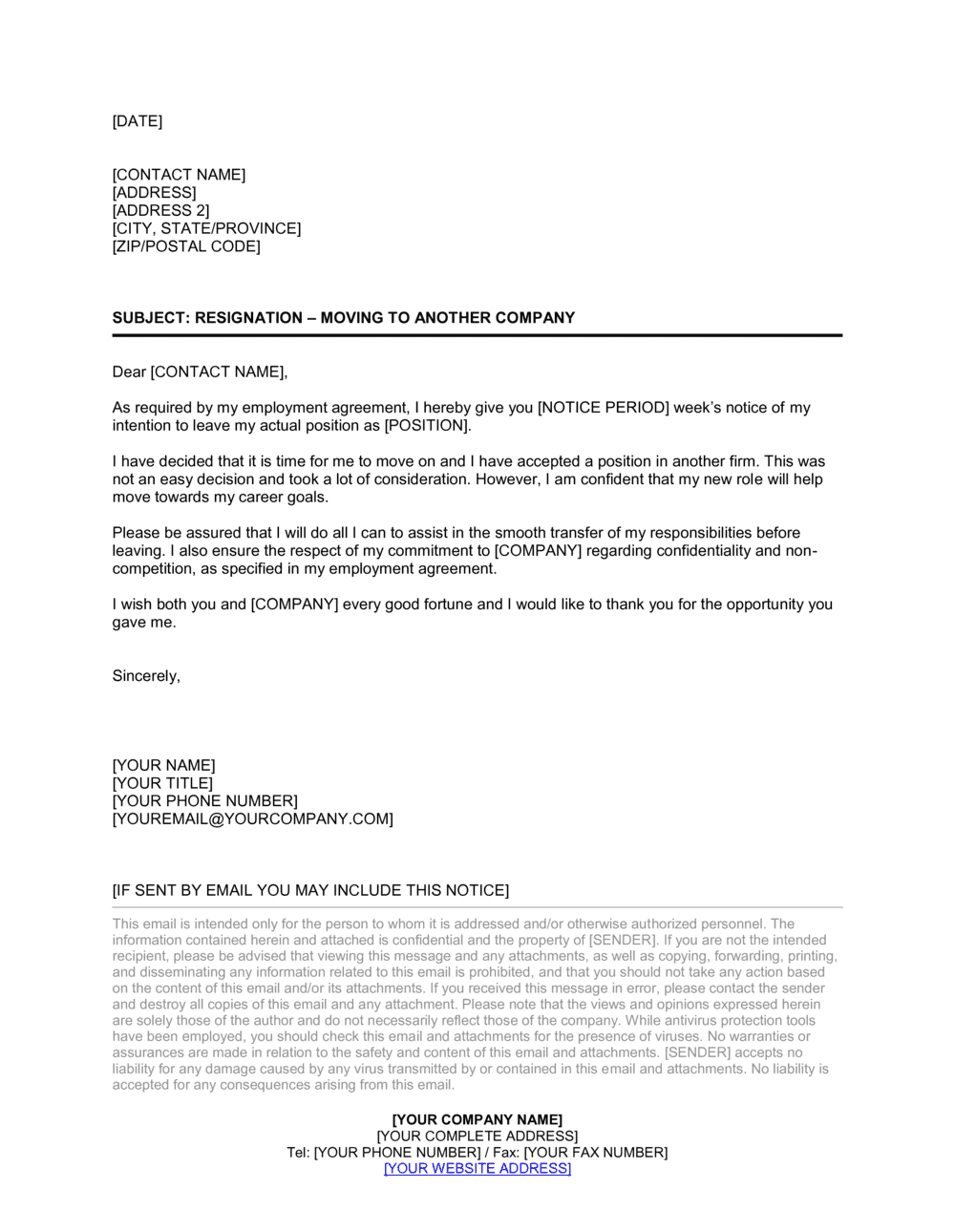
Resignation Letter_Moving to Another Company Template

Free Word download • Edit online • Save & share with Drive • Export to PDF

2 pages15–20 min to fillDifficulty: Standard
Learn more ↓
FreeResignation Letter_Moving to Another Company Template

At a glance

What it is
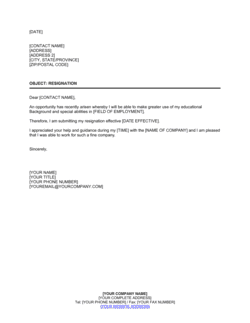
A Resignation Letter — Moving to Another Company is a formal written notice an employee submits when leaving their current role to accept a position elsewhere. This free Word download gives you a professionally worded, editable letter you can personalize in minutes and submit via email or print as a hard copy.
When you need it
Use it as soon as you have accepted and signed an offer from a new employer and are ready to formally notify your current manager. Submitting it promptly starts your notice period on the correct date and protects your professional standing.
What's inside
A clear statement of resignation with your last working day, a brief and positive reason for leaving, an expression of gratitude for the opportunity, and an offer to support the handover — all in a concise, single-page format.

What is a Resignation Letter — Moving to Another Company?

A Resignation Letter — Moving to Another Company is a formal written notice an employee submits to their employer when leaving a current role to accept a position elsewhere. It serves three practical purposes: it starts the official notice period on a documented date, it creates an HR record of the voluntary departure, and it preserves the professional relationship by leaving on explicitly positive terms. Unlike a verbal conversation, the letter is a permanent document that HR retains alongside your employment file — and that managers reference when future employers call for a reference check.

Why You Need This Document

Resigning verbally without a written letter leaves the notice period start date undefined, creates ambiguity about your final day, and gives HR nothing to file. A missing or poorly written resignation letter can delay your last paycheck, complicate benefit end dates, and — most consequentially — leave your manager with a negative last impression that colors every reference they give. Industries are far smaller than they appear: the manager you are leaving today may be a hiring decision-maker, a client, or a professional reference within five years. A short, professional resignation letter that gives clear notice, acknowledges genuine gratitude, and offers concrete transition support costs ten minutes to complete and pays dividends in professional reputation for years. This template gives you the right structure and tone so you can fill in your details and submit with confidence.

Which variant fits your situation?

If your situation is…Use this template
Leaving without having another job lined upResignation Letter (Personal Reasons)
Departing due to a hostile or unhealthy work environmentResignation Letter (Hostile Work Environment)
Resigning immediately without serving a notice periodImmediate Resignation Letter
Retiring rather than moving to a new employerRetirement Resignation Letter
Leaving a part-time or casual role for a full-time positionPart-Time Employee Resignation Letter
Resigning after a very short tenure of fewer than 90 daysResignation Letter (Short Tenure)

Common mistakes to avoid

❌ Not specifying a last working day

Why it matters: A resignation letter without an explicit final date creates ambiguity about when the notice period starts, which can delay your paycheck, affect benefit end dates, and complicate reference requests.

Fix: Calculate the exact date based on your contract or the standard two-week notice and state it clearly in the opening paragraph.
❌ Venting frustrations in the letter

Why it matters: Negative comments about management, culture, or pay become permanent records that HR retains and that former colleagues may share. Industries are smaller than they appear.

Fix: Keep the letter to three elements only: resignation with date, brief neutral reason, and gratitude. If you have feedback, share it privately in an exit interview.

❌ Copying in senior leaders before your manager

Why it matters: Your manager learning about your resignation from a CC email to their director destroys the professional relationship you are trying to preserve.

Fix: Send the letter to your direct manager first. Only add HR or other leaders to a CC after your manager has acknowledged receipt.

❌ Omitting any offer of transition support

Why it matters: A resignation letter that reads as pure announcement — with no acknowledgment of the burden it places on the team — signals indifference and reduces the likelihood of a positive reference.

Fix: Add one to two sentences naming specific transition actions you will complete before your last day.

The 8 key clauses, explained

Date and recipient address block

In plain language: Opens the letter with today's date, the manager's full name and title, and the company's address — establishing a formal record of when notice was given.

Sample language
[DATE] [MANAGER FULL NAME] [JOB TITLE] [COMPANY NAME] [COMPANY ADDRESS]

Common mistake: Omitting the date or using only the month and year. Without a precise date, the start of the notice period is ambiguous and can create payroll or HR disputes.

Opening statement of resignation

In plain language: States clearly that you are resigning from your position and names your last day of employment based on the required notice period.

Sample language
I am writing to formally notify you of my resignation from my position as [JOB TITLE] at [COMPANY NAME], effective [LAST DAY — typically two weeks from the date above].

Common mistake: Being vague about the final date — writing 'in approximately two weeks' rather than a specific date. This forces HR to follow up and delays the formal process.

Brief reason for leaving

In plain language: Mentions that you are moving to a new opportunity without naming the new employer or sharing salary details — enough context to be honest, brief enough to avoid complications.

Sample language
I have accepted a position at another organization that aligns closely with my long-term career goals.

Common mistake: Naming the new employer, salary, or role in the resignation letter. This information is not required and can create unnecessary tension or prompt a counter-offer conversation you are not prepared for.

Expression of gratitude

In plain language: Acknowledges specific positive experiences — skills developed, opportunities given, or team relationships built — to leave on a professionally warm note.

Sample language
I am genuinely grateful for the opportunities I have had at [COMPANY NAME] over the past [X years/months], particularly [SPECIFIC EXPERIENCE OR SKILL DEVELOPED].

Common mistake: Using generic phrases like 'it has been a great experience' with no specificity. A concrete detail reads as sincere; pure boilerplate reads as perfunctory.

Offer to support the transition

In plain language: Commits to assisting with knowledge transfer, documenting ongoing work, and training a replacement during the notice period.

Sample language
During my remaining time, I am committed to completing [CURRENT PROJECT/S] and will prepare handover documentation for my key responsibilities to ensure a smooth transition.

Common mistake: Offering to help 'in any way possible' without specifying what you can realistically do. Vague offers are often ignored; named deliverables show good faith and are more useful to your manager.

Closing salutation and signature

In plain language: Closes the letter professionally, leaves the door open for future contact, and includes a handwritten or digital signature.

Sample language
I hope to stay in touch and wish you and the team continued success. Thank you again for everything. Sincerely, [YOUR FULL NAME] [YOUR CONTACT EMAIL]

Common mistake: Ending abruptly with no closing sentiment. Even a single positive closing line significantly affects how the letter is remembered — departures are discussed long after they happen.

Subject line (for email delivery)

In plain language: When submitting by email, a clear subject line ensures the message is opened promptly and filed correctly by HR.

Sample language
Subject: Resignation — [YOUR FULL NAME] — [JOB TITLE]

Common mistake: Using a vague subject line like 'Important Notice' or 'Following Up.' HR inboxes are high-volume — a clear subject prevents the letter from being missed or delayed.

CC line (optional)

In plain language: Identifies any additional recipients — typically HR or a department head — who need a copy for record-keeping purposes.

Sample language
CC: [HR MANAGER NAME], Human Resources — [HR EMAIL ADDRESS]

Common mistake: Copying senior leadership above your direct manager without first telling your manager in person. The manager should hear about the resignation before anyone else in the organization.

How to fill it out

  1. 1

    Tell your manager in person before sending the letter

    Resigning verbally first — even briefly — before submitting the written letter is standard professional practice. The letter then functions as the formal record, not the announcement.

    💡 If your manager is remote, a video call achieves the same effect. Avoid resigning for the first time via email or message.

  2. 2

    Enter the date and calculate your last working day

    Add today's date at the top of the letter. Count forward from this date by the notice period in your contract — two weeks is standard in the US if no contract specifies otherwise.

    💡 Avoid setting your last day on a Monday. Fridays are cleaner handoff points and are easier for payroll processing.

  3. 3

    Fill in your name, title, and the recipient's details

    Use your legal name as it appears in your employment records. Use your manager's full name and correct title — double-check spelling before sending.

    💡 Including the company's physical address, even in an email, establishes a formal record that is useful if any dispute arises over the notice start date.

  4. 4

    Write your reason for leaving in one sentence

    Keep the explanation brief and neutral: 'I have accepted a position at another organization.' You are not obligated to share the employer's name, your new salary, or your role.

    💡 If you are on good terms and want to say more, add one sentence about the direction the new role takes you — e.g., 'it's an opportunity to move into [FIELD].' Do not compare the two employers.

  5. 5

    Add a specific detail to the gratitude section

    Replace generic appreciation with one specific thing — a skill you developed, a project you are proud of, or a mentor relationship. One concrete detail is more credible than two paragraphs of praise.

    💡 If you cannot think of a genuine specific, keep the section short and sincere rather than padding it with superlatives.

  6. 6

    Name the transition deliverables you will complete

    List one to three concrete actions — finishing a specific project, writing process documentation, or briefing your replacement — rather than a blanket offer to help.

    💡 Proposing a structured handover plan in the letter gives your manager something to work with immediately and sets you apart as a professional departure.

Frequently asked questions

Do I need to say where I am going in my resignation letter?

No. You are not obligated to name your new employer, disclose your new salary, or describe the role in your resignation letter. A brief statement — 'I have accepted a position at another organization' — is sufficient. Sharing more detail can prompt unwanted counter-offer conversations or create tension with a competitor employer.

How much notice should I give when resigning to join another company?

Two weeks is the standard notice period in the US for at-will employees without a contract specifying otherwise. If your employment contract states a longer period — four weeks is common for senior roles — you are contractually obligated to honor it unless your employer agrees to waive it. Your new employer's start date should be set after your current notice period ends.

Should I send my resignation letter by email or as a printed document?

Either is professionally acceptable. Email is faster, creates a timestamped record, and is the standard in most modern workplaces. A printed letter carries a more formal weight and is appropriate in conservative industries or when HR explicitly requires hard-copy documentation. In either case, have the verbal conversation with your manager first.

What should I not include in a resignation letter?

Avoid criticism of colleagues, management, or company culture; the name and details of your new employer; comparisons between your current and new salary or benefits; and any request for a counter-offer. A resignation letter is a permanent HR record — keep it factual, brief, and professional.

Can my employer reject my resignation or require me to stay longer?

In the US, under at-will employment, an employer cannot legally require you to stay beyond your contractual notice period, and they cannot reject a voluntary resignation. However, if your contract specifies a longer notice period, leaving before it ends could expose you to breach-of-contract claims in some circumstances. Check your employment agreement and consult an employment lawyer if you are unsure.

What is a counter-offer and should I accept one?

A counter-offer is a revised compensation or role proposal from your current employer made after you resign. Whether to accept depends on your reasons for leaving — if compensation was the only factor, a counter-offer may resolve it. Research consistently finds, however, that the majority of employees who accept counter-offers leave within 12 months regardless, because the underlying reasons for leaving rarely change.

How do I resign professionally if I have only been at the company a short time?

Use the same letter structure — resignation date, neutral reason, gratitude, transition offer. Keep the gratitude section brief and genuine rather than inflating a short tenure. If the tenure was under 90 days, acknowledge it simply: 'Although my time here has been brief, I appreciate the opportunity and the welcome I received from the team.' Short tenure resignations are common; how you handle the exit matters more than the length of stay.

Do I need to offer to train my replacement in the resignation letter?

You are not legally required to, but a brief offer to support the transition is standard professional practice and directly affects whether your manager will give you a positive reference. Name one or two specific things you can do — finish a current project, write documentation, or brief a colleague — rather than a vague offer to 'help in any way needed.'

How this compares to alternatives

vs Immediate Resignation Letter

An immediate resignation letter gives no notice period and ends employment on the same day it is submitted. This template gives standard notice — typically two weeks — and is the appropriate choice whenever the new employer's start date allows for it. Resigning immediately without cause can damage references and, in some contracts, trigger a breach-of-contract claim.

vs Resignation Letter (Personal Reasons)

A personal-reasons resignation letter is used when leaving without another job in place — the tone focuses on personal circumstances rather than a career opportunity. This template is specifically worded for employees who have already accepted a new offer and want to give a brief, honest reason without unnecessary detail.

vs Resignation Letter (Hostile Work Environment)

A hostile-environment resignation letter documents specific incidents and may be used as supporting evidence in a complaint or legal proceeding. This template deliberately avoids criticism and is designed for employees leaving on positive terms to join a better opportunity — not to create a record of grievances.

vs Retirement Resignation Letter

A retirement resignation letter announces the end of a career rather than a move to a new employer. The tone is more reflective and the transition offer often includes a longer wind-down period. This template is written for mid-career or early-career professionals accepting a new role, where the focus is a clean, professional handover.

Industry-specific considerations

Technology

High job-switching frequency means clear, dated resignation letters help HR process departures quickly without disrupting sprint cycles or on-call rotations.

Financial Services

Employers in finance often enforce contractual notice periods of 30–90 days and may place resigning employees on garden leave immediately — the written letter starts the clock.

Healthcare

Patient care continuity makes transition planning especially important; a detailed handover offer in the letter reduces scheduling disruption and protects licensure reputation.

Professional Services

Client relationships are tied to individuals — the letter's offer to support handover reassures management that active client files will be covered through the departure.

Template vs pro — what fits your needs?

PathBest forCostTime
Use the templateAny employee resigning from a standard role to join a new employerFree10 minutes
Template + professional reviewSenior executives or employees with complex non-compete or garden-leave clauses$150–$400 (employment lawyer review)1–2 days
Custom draftedC-suite departures with equity, deferred compensation, or contractual notice periods exceeding 60 days$500–$1,5002–5 days

Glossary

Notice Period
The amount of time between submitting a resignation and the last day of employment, typically two weeks in the US or as specified in an employment contract.
Last Day of Employment
The specific calendar date on which the employee's obligations to the employer formally end.
Transition Plan
A brief outline of how the departing employee will hand over ongoing work, document processes, and support the hiring or training of a replacement.
At-Will Employment
An employment arrangement in which either party may end the relationship at any time for any lawful reason — common across most US states.
Counter-Offer
A revised compensation or role offer made by the current employer in response to a resignation, intended to persuade the employee to stay.
Reference
A written or verbal account of an employee's performance and character provided by a former manager to a prospective employer.
Severance
Compensation paid by an employer when ending an employee's contract — not typically applicable when the employee resigns voluntarily.
Non-Solicitation Agreement
A post-employment restriction preventing a departing employee from recruiting the employer's staff or soliciting its clients for a defined period.

Part of your Business Operating System

This document is one of 3,000+ business & legal templates included in Business in a Box.

  • Fill-in-the-blanks — ready in minutes
  • 100% customizable Word document
  • Compatible with all office suites
  • Export to PDF and share electronically

Create your document in 3 simple steps.

From template to signed document — all inside one Business Operating System.
1
Download or open template

Access over 3,000+ business and legal templates for any business task, project or initiative.

2
Edit and fill in the blanks with AI

Customize your ready-made business document template and save it in the cloud.

3
Save, Share, Send, Sign

Share your files and folders with your team. Create a space of seamless collaboration.

Save time, save money, and create top-quality documents.

★★★★★

"Fantastic value! I'm not sure how I'd do without it. It's worth its weight in gold and paid back for itself many times."

Managing Director · Mall Farm
Robert Whalley
Managing Director, Mall Farm Proprietary Limited
★★★★★

"I have been using Business in a Box for years. It has been the most useful source of templates I have encountered. I recommend it to anyone."

Business Owner · 4+ years
Dr Michael John Freestone
Business Owner
★★★★★

"It has been a life saver so many times I have lost count. Business in a Box has saved me so much time and as you know, time is money."

Owner · Upstate Web
David G. Moore Jr.
Owner, Upstate Web

Run your business with a system — not scattered tools

Stop downloading documents. Start operating with clarity. Business in a Box gives you the Business Operating System used by over 250,000 companies worldwide to structure, run, and grow their business.

Free Forever Plan · No credit card required