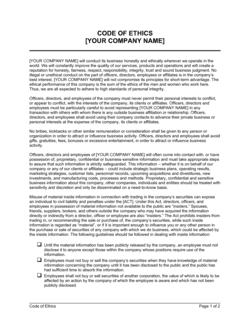
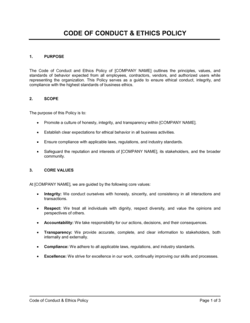
Real Estate Code Of Ethics Template

Free Word download • Edit online • Save & share with Drive • Export to PDF

3 pages25–30 min to fillDifficulty: StandardSignature requiredLegal review recommended
Learn more ↓
FreeReal Estate Code Of Ethics Template

At a glance

What it is
A Real Estate Code of Ethics is a binding policy document that establishes the professional conduct standards, fiduciary obligations, fair-dealing requirements, and disciplinary procedures that govern agents, brokers, and staff operating under a real estate brokerage or association. This free Word download gives you a structured, legally grounded starting point you can edit online and export as PDF for signatures and record-keeping.
When you need it
Use it when onboarding new agents, formalizing brokerage conduct standards, responding to a regulatory audit, or updating policies to reflect changes in licensing law or industry association requirements. It is also triggered when a misconduct complaint surfaces and the brokerage needs documented standards to reference.
What's inside
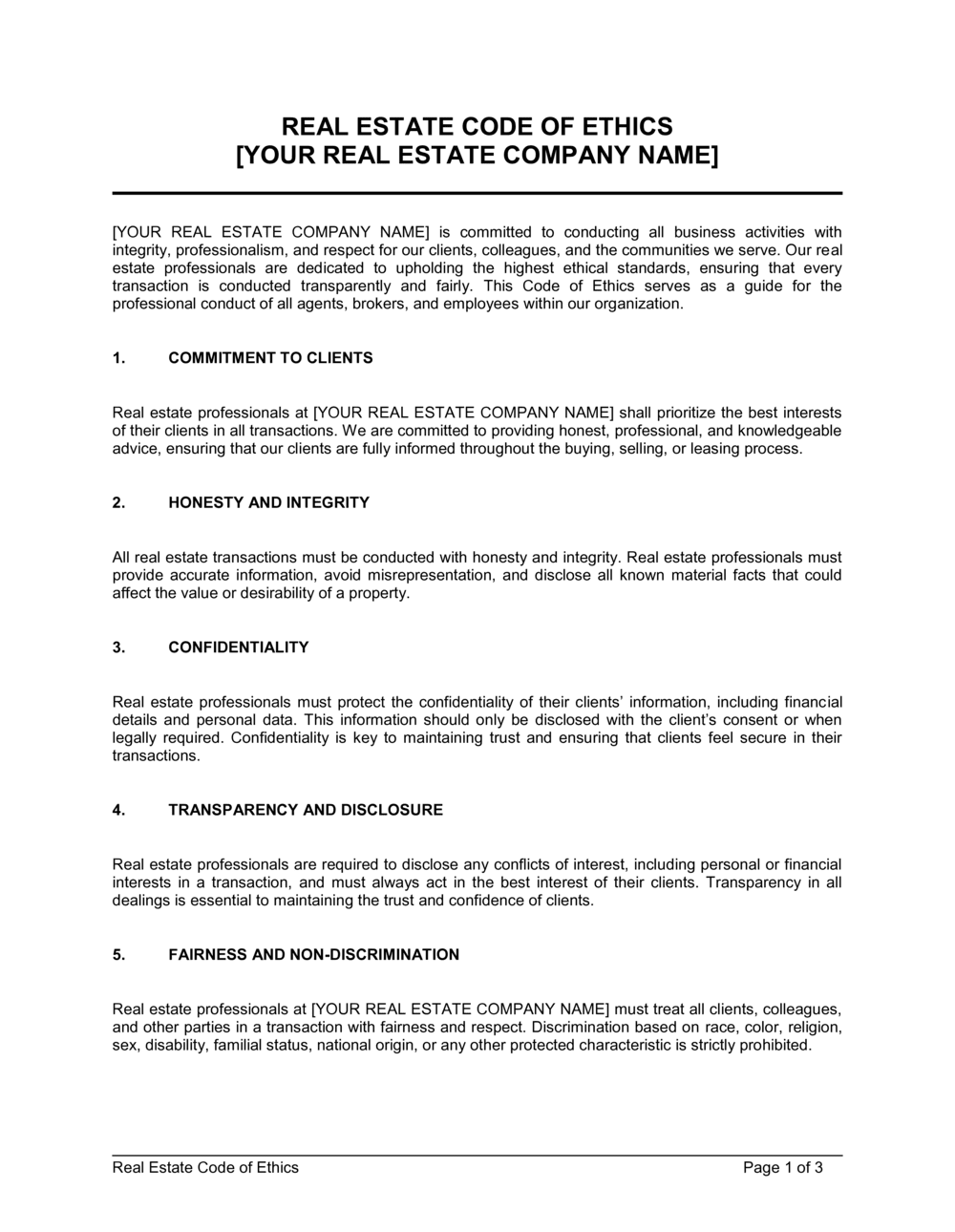
The document covers fiduciary duties to clients, confidentiality and disclosure obligations, fair-housing compliance, conflicts of interest, advertising and marketing standards, anti-discrimination commitments, professional courtesy obligations between practitioners, and a disciplinary and grievance procedure for violations.

What is a Real Estate Code of Ethics?

A Real Estate Code of Ethics is a binding policy document that establishes the professional conduct standards, fiduciary obligations, disclosure requirements, and disciplinary procedures governing every agent, broker, and covered staff member operating under a real estate brokerage or association. It defines what practitioners owe their clients — loyalty, confidentiality, honest dealing, and accurate accounting of funds — and sets the rules for interactions with counterparties, competing brokers, and the public. Unlike a general employee handbook, a real estate code of ethics is calibrated to the specific legal structure of the industry: independent contractor relationships, trust account obligations, agency disclosure requirements, and fair-housing law all require provisions that no generic conduct policy addresses.

Why You Need This Document

Operating a real estate brokerage without a written, signed code of ethics exposes you to four overlapping categories of risk simultaneously. First, without documented fiduciary standards, a client who suffers a loss — from an undisclosed conflict of interest, an improperly handled dual-agency situation, or a confidentiality breach — has no written standard to measure the agent's conduct against, but a court or licensing board will supply one anyway. Second, state licensing boards in virtually every US jurisdiction and every Canadian province treat the absence of a written trust account and advertising policy as a compliance failure on routine audit. Third, fair-housing violations — including steering, discriminatory marketing, and unequal service — expose the brokerage to federal civil rights liability regardless of whether a policy existed; a documented anti-discrimination commitment and training record are your primary mitigation evidence. Fourth, without a formal disciplinary procedure, a complaint against an agent forces you to improvise a response in front of the licensing board, creating the appearance of inconsistent or retaliatory enforcement. This template gives you a professionally structured, legally grounded starting point that closes all four gaps — and can be customized for your state's specific agency, advertising, and trust account rules in under two hours.

Which variant fits your situation?

If your situation is…Use this template
Residential brokerage with multiple licensed agentsReal Estate Code of Ethics (Brokerage)
Individual agent committing to personal professional standardsReal Estate Agent Code of Conduct
Property management company governing leasing staffProperty Management Code of Ethics
Commercial real estate firm with tenant and landlord representationCommercial Real Estate Ethics Policy
Real estate association issuing membership conduct requirementsAssociation Membership Ethics Agreement
Franchise brokerage supplementing national franchisor ethics standardsFranchise Real Estate Conduct Addendum
Real estate team documenting internal fair-housing and anti-bias commitmentsFair Housing Compliance Policy

Common mistakes to avoid

❌ Listing only federal fair-housing protected classes

Why it matters: State and municipal laws add protected categories — source of income, sexual orientation, immigration status, and others — that vary by location. Omitting them exposes the brokerage to complaints it is not equipped to defend.

Fix: Research your state licensing board's fair-housing bulletin and your municipality's human rights ordinance before finalizing the clause. Update the list whenever local law changes.

❌ No specified earnest money deposit timeline

Why it matters: Vague language like 'promptly' or 'without delay' fails most state licensing board audits and leaves the brokerage unable to demonstrate compliance when a client complaint is filed.

Fix: Insert a specific number of business days that meets or exceeds your state board's minimum requirement. Include the governing statutory citation in a footnote.

❌ Omitting dual agency limitations

Why it matters: A dual-agency clause that permits the practice without specifying what the agent can and cannot do creates an expectation of full advocacy that cannot be fulfilled — leading to complaints and potential lawsuits.

Fix: State explicitly that a dual agent may not disclose either party's confidential information, may not advocate for price movement in either direction, and must treat both parties impartially.

❌ Relying on verbal conflict-of-interest disclosures

Why it matters: Oral disclosures cannot be verified after a dispute and do not satisfy the written disclosure requirements of most state licensing boards and NAR's Code of Ethics.

Fix: Require all conflict disclosures to be made on a signed form before the agent provides any service in the affected transaction. File the completed form in the transaction record.

❌ Covering licensed agents only and excluding unlicensed staff

Why it matters: Unlicensed assistants who answer phones, prepare documents, or interact with clients can create brokerage liability for conduct that the code does not address.

Fix: Extend the scope clause to all personnel under the brokerage's supervision, including unlicensed assistants, transaction coordinators, and administrative staff.

❌ No written record of disciplinary investigations and outcomes

Why it matters: If a licensing board or court reviews a complaint, the brokerage must demonstrate it took the allegation seriously and followed its own documented procedure. Undocumented investigations are treated as no investigation at all.

Fix: Create a standard investigation summary form that captures the complaint date, parties involved, findings, sanctions imposed, and the date the matter was closed. Retain it for at least 5 years.

The 10 key clauses, explained

Purpose and Scope

In plain language: States the objectives of the code, identifies who is bound by it (all licensed agents, unlicensed assistants, and administrative staff), and references any governing association standards it supplements.

Sample language
This Code of Ethics applies to [BROKERAGE NAME] ('Firm') and all licensed and unlicensed personnel operating under the Firm's supervision. It supplements the standards of [ASSOCIATION NAME, e.g., National Association of REALTORS®] and applicable licensing law in [STATE / PROVINCE].

Common mistake: Scoping the code to licensed agents only. Unlicensed assistants who interact with clients can create liability if their conduct is not covered.

Fiduciary Duties to Clients

In plain language: Enumerates the core duties owed to represented clients — loyalty, confidentiality, disclosure, obedience, reasonable care, and accounting — and distinguishes obligations owed to unrepresented customers.

Sample language
When representing a client, each Agent owes the duties of loyalty, confidentiality, disclosure of material facts, obedience to lawful instructions, and reasonable care. When dealing with unrepresented customers, Agents shall treat all parties honestly and shall not provide services requiring a license without disclosure.

Common mistake: Conflating duties owed to clients with those owed to customers. Misidentifying the relationship level creates both disclosure failures and professional liability.

Confidentiality and Information Handling

In plain language: Prohibits agents from disclosing a client's financial position, motivation to buy or sell, or negotiating limits to any third party, including counterparties and cooperating brokers.

Sample language
Agents shall not disclose any Confidential Client Information — including financial capacity, seller motivation, purchase price limits, or negotiating strategy — to any person outside the representation relationship without the client's prior written consent.

Common mistake: No definition of what constitutes confidential information. Without specifics, agents inadvertently disclose motivation or financial details in casual counterparty conversations.

Disclosure of Conflicts of Interest

In plain language: Requires agents to promptly disclose any personal interest in a transaction — ownership stake, family relationship, or financial benefit — and to obtain informed written consent before proceeding.

Sample language
Any Agent with a personal, financial, or familial interest in a property or transaction must disclose that interest in writing to all represented parties and to the Firm's designated broker before performing any services related to the transaction.

Common mistake: Treating verbal disclosure as sufficient. Oral conflict disclosures are nearly impossible to prove after a dispute arises and do not satisfy most licensing board requirements.

Dual Agency and Designated Agency

In plain language: Sets the rules for when and how the brokerage may represent both buyer and seller, including the required written consent, the limitations on agent conduct, and whether designated agency is permitted as an alternative.

Sample language
Dual Agency — representing both Buyer and Seller in the same transaction — is permitted only with the prior informed written consent of both parties on the form prescribed by [STATE LICENSING AUTHORITY]. Where permitted, Designated Agency shall be offered as an alternative whenever practicable.

Common mistake: Omitting the limitation on what a dual agent may do. Without a limitations clause, clients expect full advocacy — and when they don't receive it, complaints and lawsuits follow.

Fair Housing and Anti-Discrimination

In plain language: Commits the brokerage and all agents to full compliance with federal, state, and local fair-housing laws, prohibits steering and discriminatory marketing, and requires equal professional service to all clients regardless of protected characteristics.

Sample language
No Agent shall discriminate against any person in the provision of real estate services on the basis of race, color, religion, sex, national origin, disability, familial status, or any other characteristic protected by applicable law. Agents shall not engage in steering, redlining, or any marketing practice that results in unequal service.

Common mistake: Listing only federal protected classes. Many states and municipalities add protected categories — sexual orientation, source of income, immigration status — that the code must also address.

Advertising and Marketing Standards

In plain language: Requires all advertising to be truthful, to identify the brokerage, and to comply with licensing board advertising rules, including social media and online listing platforms.

Sample language
All advertising and marketing materials — including online listings, social media posts, email campaigns, and signage — must clearly identify [BROKERAGE NAME] and comply with [STATE] advertising regulations. Agents shall not make false, misleading, or unsubstantiated claims about properties, services, or market conditions.

Common mistake: Treating social media posts as personal content exempt from brokerage advertising rules. Licensing boards in most jurisdictions require brokerage identification on all public-facing agent communications.

Trust Account and Financial Integrity

In plain language: Prohibits commingling of client funds, requires prompt deposit of earnest money and rents into the designated trust account, and mandates accurate record-keeping of all client funds.

Sample language
All client funds — including earnest money deposits, security deposits, and rental proceeds — shall be deposited into the Firm's designated trust account within [NUMBER] business days of receipt. Agents shall not commingle client funds with personal or business operating funds under any circumstances.

Common mistake: No specified deposit timeline. Vague instructions like 'promptly' are routinely cited in licensing audits as insufficient; most state boards require a specific number of business days.

Professional Courtesy and Cooperation

In plain language: Establishes conduct standards for interactions with other real estate professionals, including cooperating brokers, competing agents, and multiple listing service (MLS) members.

Sample language
Agents shall treat all real estate professionals, cooperating brokers, and MLS members with honesty and respect. Agents shall not solicit clients under exclusive representation by another broker, make false statements about competitors, or attempt to interfere with existing agency relationships.

Common mistake: No clause on interfering with existing agency relationships. Soliciting another broker's listed client is one of the most common ethics complaints and one of the most overlooked omissions in brokerage codes.

Disciplinary Procedure and Enforcement

In plain language: Defines how complaints are submitted, who investigates them, what sanctions are available (warning, suspension, termination, referral to the licensing board), and how findings are documented.

Sample language
Any complaint alleging a violation of this Code shall be submitted in writing to the Designated Broker within [NUMBER] days of the alleged violation. The Firm shall investigate within [NUMBER] business days and may impose sanctions including written warning, mandatory retraining, suspension, termination of association, or referral to [STATE LICENSING BOARD].

Common mistake: No written record of investigation outcomes. Without documented findings, the brokerage cannot demonstrate due diligence if a licensing board or court later reviews the complaint.

How to fill it out

  1. 1

    Identify all parties bound by the code

    Enter the brokerage's full legal name and specify every category of personnel covered — licensed agents, unlicensed assistants, property managers, and administrative staff. Reference the governing state or provincial licensing authority by name.

    💡 If your brokerage operates in multiple states, list each licensing authority separately rather than using a blanket reference.

  2. 2

    Reference the applicable association standards

    If your agents are members of NAR, CREA, or a state or provincial association, cite the association's code by name and confirm whether this document supplements or replaces it. Most brokerages supplement rather than replace.

    💡 NAR's Code of Ethics is updated annually — confirm you are referencing the current edition year to avoid a stale citation.

  3. 3

    Define fiduciary duties and agency relationship types

    Specify which agency relationships the brokerage offers — buyer representation, seller representation, dual agency, and designated agency — and define the duties attached to each. Confirm these match your state's agency disclosure requirements.

    💡 Some states — including Texas and Florida — use 'intermediary' rather than 'dual agency.' Use the statutory term for your jurisdiction.

  4. 4

    Complete the fair housing and anti-discrimination clause

    List every protected class under federal law plus any additional categories protected by your state or municipality. Review your local human rights ordinances — many cities have expanded protections beyond federal minimums.

    💡 Run a side-by-side comparison of federal, state, and municipal protected classes before finalizing this clause. Missing a local category is a common and costly oversight.

  5. 5

    Set trust account deposit timelines

    Enter the specific number of business days within which agents must deposit earnest money and other client funds into the trust account. Confirm this matches your state licensing board's mandatory timeline.

    💡 Most state boards require deposit within 1–3 business days. If your board specifies a different period, use that number — stricter internal rules are permissible, looser ones are not.

  6. 6

    Tailor the advertising standards clause

    List the specific platforms and media covered — MLS, Zillow, social media, email, print, signage — and confirm the brokerage identification requirement matches your state's advertising rules.

    💡 Several state boards have issued guidance specifically addressing social media. Include a reference to those rules or link to the board's published guidance in a footnote.

  7. 7

    Define the disciplinary procedure with specific timelines

    Enter the number of days within which complaints must be submitted and investigated, name the designated broker as the responsible investigator, and list all available sanctions in order of severity.

    💡 Build a parallel complaints log template — even a simple spreadsheet — so every complaint received is date-stamped at intake. The log is your first exhibit if the case reaches a licensing board.

  8. 8

    Obtain signatures before the agent's first active transaction

    Both the brokerage's designated broker and each covered agent must sign and date the code before the agent conducts any client-facing activity. File the executed copy in the agent's personnel record.

    💡 Use a separate acknowledgment page that the agent signs independently of the main document. This makes it easier to update the code without re-executing the entire agreement.

Frequently asked questions

What is a real estate code of ethics?

A real estate code of ethics is a binding policy document that defines the professional conduct standards, fiduciary duties, disclosure obligations, and disciplinary procedures governing agents and brokers operating under a brokerage or real estate association. It establishes what agents owe their clients, how they must treat counterparties and competitors, and what happens when those standards are violated. Most major associations — including the National Association of REALTORS® — maintain their own code, which individual brokerages typically supplement with a brokerage-specific policy.

Is a real estate code of ethics legally binding?

Yes, when properly executed. A signed code of ethics creates contractual obligations between the brokerage and each agent, and its terms can be enforced through disciplinary action, termination of association, or referral to the state licensing board. Association codes — such as the NAR Code of Ethics — are binding on members as a condition of membership. Violations can also constitute a breach of fiduciary duty actionable by clients in civil litigation.

Who is required to follow a real estate code of ethics?

At minimum, all licensed agents and brokers operating under a brokerage's license are bound. A well-drafted code extends to unlicensed assistants, transaction coordinators, property managers, and administrative staff who interact with clients or handle transaction documents. Association membership codes typically bind all members regardless of their specific role or brokerage affiliation.

What is the difference between a real estate code of ethics and a brokerage policy manual?

A code of ethics focuses specifically on professional conduct standards, fiduciary obligations, client relationships, fair-housing compliance, and disciplinary procedures. A brokerage policy manual is broader — covering office procedures, commission structures, MLS participation rules, transaction file requirements, and administrative policies. The code of ethics is typically a standalone signed document; the policy manual is a reference guide. Both should exist and cross-reference each other.

Do I need a real estate code of ethics if my agents are already NAR members?

Yes, for two reasons. First, the NAR Code of Ethics sets minimum standards for all members but does not address brokerage-specific practices — trust account timelines, dual-agency procedures, social media advertising rules, and internal disciplinary processes all require a brokerage-level document. Second, a signed brokerage code creates an independent contractual record that the brokerage can enforce directly, without relying on the association's grievance process.

How often should a real estate code of ethics be updated?

Review the code annually, at minimum. The NAR Code of Ethics is updated each January and state fair-housing regulations change without a fixed schedule. Trigger an immediate review when a new protected class is added by state or municipal law, when your state licensing board issues new guidance on advertising or agency disclosure, or when a complaint reveals a gap in the existing policy.

What happens if an agent violates the code of ethics?

The disciplinary procedure outlined in the code governs the response. Sanctions typically escalate from a written warning and mandatory retraining to suspension of association rights, termination of the independent contractor or employment relationship, and referral to the state licensing board. Serious violations — fraud, commingling of funds, or fair-housing discrimination — may also result in license suspension or revocation by the state authority and civil or criminal liability.

Does a real estate code of ethics need to be signed by agents?

Yes. An unsigned code is an unenforceable policy document. Every agent and covered staff member should sign an acknowledgment — ideally a separate page that can be updated independently of the main document — confirming they have read, understood, and agreed to be bound by the code. Execute the acknowledgment before the agent conducts any client-facing activity, and retain a copy in the agent's personnel file.

Can a brokerage's code of ethics be stricter than the NAR Code of Ethics?

Yes, and this is common practice. A brokerage may impose higher standards than the association minimum — shorter trust account deposit timelines, mandatory written disclosures in situations where the association only recommends them, or broader anti-discrimination protections. A brokerage code cannot, however, give agents permission to do something the association code or state law prohibits.

How this compares to alternatives

vs Brokerage Policy Manual

A brokerage policy manual governs day-to-day operational procedures — commission splits, MLS participation, transaction file requirements, and office conduct. A code of ethics focuses specifically on professional and fiduciary standards, client obligations, and disciplinary procedures. Both documents are necessary; the code of ethics is the binding conduct standard, and the policy manual is the operational reference. Reference each in the other document to avoid gaps.

vs Independent Contractor Agreement (Real Estate)

An independent contractor agreement defines the commercial terms of the agent-brokerage relationship — commission structure, expenses, exclusivity, and termination. A code of ethics defines the conduct standards the agent must meet while operating under that relationship. The two documents work together; the contractor agreement should reference the code of ethics as an incorporated exhibit and binding condition.

vs Real Estate Agency Disclosure Form

An agency disclosure form is a client-facing document that explains the agency relationship offered in a specific transaction — buyer's agent, seller's agent, dual agent. A code of ethics is an internal governance document that establishes the standards agents must follow across all transactions. The disclosure form fulfills a statutory client-notification requirement; the code of ethics governs agent conduct between transactions and within the brokerage.

vs Employee Handbook

An employee handbook covers workplace policies for W-2 employees — hours, benefits, leave, and general conduct. Most real estate agents are independent contractors, not employees, making a standard employee handbook inapplicable to their relationship with the brokerage. A real estate code of ethics is specifically designed for the independent contractor structure and references licensing law, association standards, and fiduciary obligations that a general employee handbook does not address.

Industry-specific considerations

Residential Real Estate

Dual-agency consent forms, fair-housing steering prohibitions, and earnest money trust account rules are the most heavily used provisions in residential brokerage codes.

Commercial Real Estate

Tenant and landlord representation conflicts, broker cooperation on off-market deals, and confidentiality of financial underwriting data require more detailed conflict-of-interest and confidentiality clauses than residential codes typically contain.

Property Management

Rental security deposit handling, anti-discrimination in tenant screening, and maintenance contractor referral disclosure are the conduct areas most relevant to property management firms.

Real Estate Associations and Franchises

Associations and franchise systems use the code as a membership condition, requiring agents to sign at onboarding and re-sign annually when the code is updated to reflect regulatory changes.

Jurisdictional notes

United States

Real estate licensing and agency law is state-regulated; there is no single federal standard governing brokerage codes of ethics beyond fair-housing requirements under the Fair Housing Act. The NAR Code of Ethics — updated annually — is the most widely recognized baseline for member brokerages. State licensing boards in California, Texas, Florida, and New York have issued specific guidance on dual agency, trust account handling, and advertising that must be reflected in brokerage-level codes. Non-NAR member brokerages are not bound by NAR standards but remain subject to state licensing law.

Canada

Real estate regulation in Canada is provincial. CREA (Canadian Real Estate Association) members are bound by the CREA Code of Ethics and Standards of Business Practice. Provincial regulatory bodies — including RECO in Ontario, RECBC in British Columbia, and RECA in Alberta — each maintain their own conduct standards and trust account rules that must be incorporated by reference. Quebec operates under the Organisme d'autoréglementation du courtage immobilier du Québec (OACIQ), with separate French-language requirements.

United Kingdom

The Property Ombudsman (TPO) Code of Practice and the National Association of Estate Agents (NAEA Propertymark) Code of Practice are the primary voluntary conduct standards in England and Wales. Compliance with these codes is required for TPO membership and provides important consumer protection credentials. The Estate Agents Act 1979 imposes statutory duties on all agents, including conflict of interest disclosure and accurate property description requirements. Scotland operates under additional regulations including the Housing (Scotland) Act 2006.

European Union

Real estate regulation varies significantly by EU member state — there is no single pan-EU licensing or ethics framework. France, Germany, and Spain each operate national licensing systems with their own conduct standards. GDPR applies to all EU real estate professionals handling client personal data, requiring specific data handling, retention, and consent provisions in any code of ethics or brokerage policy. The European Association of Real Estate Professions (CEPI) publishes voluntary European professional standards that member associations reference.

Template vs lawyer — what fits your deal?

PathBest forCostTime
Use the templateIndividual agents or small brokerages in a single state supplementing an existing association codeFree1–2 hours to customize and execute
Template + legal reviewMulti-agent brokerages, brokerages operating in more than one state, or firms adding dual-agency or designated-agency provisions$400–$900 for a real estate attorney review3–7 days
Custom draftedLarge brokerages, franchise systems, or firms operating across multiple states with complex agency, trust account, and advertising compliance requirements$1,500–$4,000+2–4 weeks

Glossary

Fiduciary Duty
A legal obligation to act in the best interests of a client, placing their interests above the agent's own financial or personal gain.
Dual Agency
A situation in which a single agent or brokerage represents both the buyer and the seller in the same transaction, creating a potential conflict of interest.
Disclosure Obligation
The duty to proactively inform clients and counterparties of material facts — including conflicts of interest, known defects, and agency relationships — that could affect a transaction decision.
Fair Housing Act
US federal law prohibiting discrimination in housing transactions on the basis of race, color, national origin, religion, sex, familial status, or disability.
Steering
The illegal practice of directing buyers or renters toward or away from certain neighborhoods based on protected characteristics such as race or national origin.
Material Fact
Any information that a reasonable person would consider significant in deciding whether to buy, sell, lease, or finance a property.
Client Confidentiality
The obligation to protect non-public information shared by a client — including financial position, motivation to sell or buy, and negotiating limits — from disclosure to third parties.
Grievance Procedure
A formal, documented process for receiving, investigating, and resolving complaints alleging violations of a code of ethics or professional standards.
Earnest Money
A deposit made by a buyer to demonstrate serious intent to purchase; its handling and accounting are typically governed by brokerage ethics and trust-account rules.
Trust Account
A segregated bank account in which a broker holds client funds — deposits, earnest money, rents — separate from the brokerage's own operating funds.
Commingling
The prohibited practice of mixing client funds held in trust with the broker's personal or business operating funds.
Anti-Discrimination Policy
A written brokerage commitment to treat all clients, customers, and counterparties equally, without regard to protected characteristics under applicable fair-housing and human-rights laws.

Part of your Business Operating System

This document is one of 3,000+ business & legal templates included in Business in a Box.

  • Fill-in-the-blanks — ready in minutes
  • 100% customizable Word document
  • Compatible with all office suites
  • Export to PDF and share electronically

Create your document in 3 simple steps.

From template to signed document — all inside one Business Operating System.
1
Download or open template

Access over 3,000+ business and legal templates for any business task, project or initiative.

2
Edit and fill in the blanks with AI

Customize your ready-made business document template and save it in the cloud.

3
Save, Share, Send, Sign

Share your files and folders with your team. Create a space of seamless collaboration.

Save time, save money, and create top-quality documents.

★★★★★

"Fantastic value! I'm not sure how I'd do without it. It's worth its weight in gold and paid back for itself many times."

Managing Director · Mall Farm
Robert Whalley
Managing Director, Mall Farm Proprietary Limited
★★★★★

"I have been using Business in a Box for years. It has been the most useful source of templates I have encountered. I recommend it to anyone."

Business Owner · 4+ years
Dr Michael John Freestone
Business Owner
★★★★★

"It has been a life saver so many times I have lost count. Business in a Box has saved me so much time and as you know, time is money."

Owner · Upstate Web
David G. Moore Jr.
Owner, Upstate Web

Run your business with a system — not scattered tools

Stop downloading documents. Start operating with clarity. Business in a Box gives you the Business Operating System used by over 250,000 companies worldwide to structure, run, and grow their business.

Start free · No credit card required