No Cancellation Policy Template

Free Word download β€’ Edit online β€’ Save & share with Drive β€’ Export to PDF

2 pagesβ€’20–25 min to fillβ€’Difficulty: Standard
Learn more ↓
FreeNo Cancellation Policy Template

At a glance

What it is
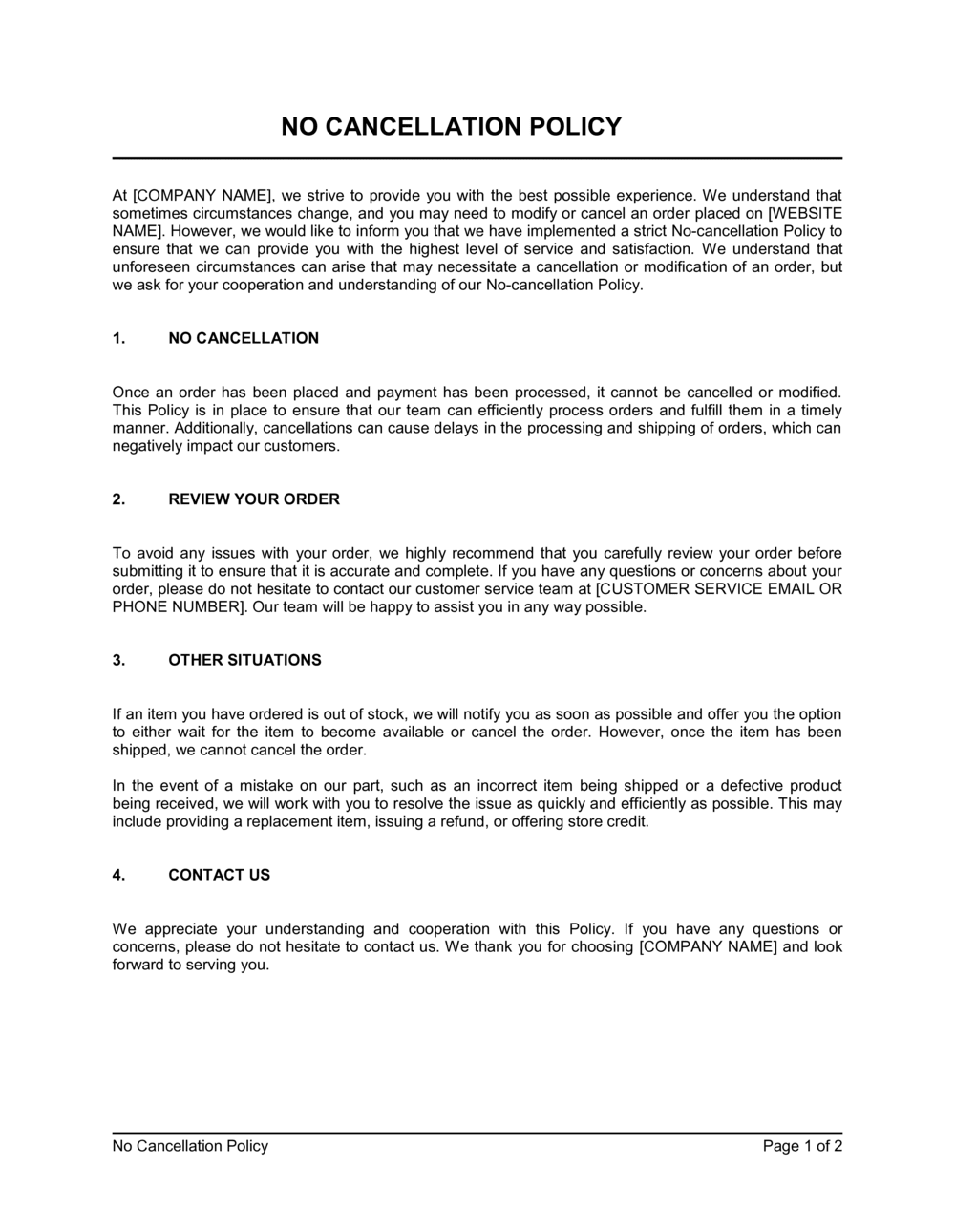
A No Cancellation Policy is a written operational document that states clients or customers cannot cancel a booked service, appointment, or order after a defined cutoff point β€” and that all fees paid are non-refundable past that point. This free Word download gives service businesses a professionally worded, editable policy you can publish on your website, include in booking confirmations, and reference in client agreements.
When you need it
Use it any time your business holds time slots, allocates staff, or reserves materials for a specific client and cannot recover that cost if the booking is cancelled. It is most critical when late cancellations represent a direct revenue loss you cannot offset by rebooking.
What's inside
A purpose statement, scope defining which services and clients are covered, the specific cutoff window and fee terms, acknowledged exceptions, the enforcement and refund procedure, and the client acknowledgment requirement.

What is a No Cancellation Policy?

A No Cancellation Policy is a written operational document that establishes that confirmed bookings, appointments, or orders cannot be cancelled after a specified cutoff point β€” and that all fees paid at or after that cutoff are non-refundable. It defines the exact window, payment terms, accepted exceptions, and enforcement procedure in clear language that the client acknowledges before the booking is finalized. Unlike a general refund policy, a no cancellation policy focuses specifically on the act of cancellation itself and the business's right to retain payment as compensation for reserved capacity that cannot be recovered.

Why You Need This Document

Every time a client cancels a confirmed booking at short notice, the business absorbs a real cost: a time slot that cannot be resold, staff who were scheduled and cannot be redeployed, and materials or vendors that were committed in advance. Without a written, acknowledged policy, your only recourse is an awkward conversation β€” and if the client disputes the charge with their bank, you have no documentation to present. A clearly worded no cancellation policy, placed in front of the client at the point of booking and captured with a timestamped acknowledgment, converts a verbal understanding into a documented agreement. It reduces no-shows, simplifies fee enforcement, and provides the paper trail that wins chargeback disputes before they escalate. This template gives you a professionally structured starting point you can customize to your booking window, deposit structure, and service type in under 30 minutes.

Which variant fits your situation?

If your situation is…Use this template
Service business with a 24–48 hour notice windowNo Cancellation Policy (Short Notice)
Event or venue booking with a non-refundable deposit structureEvent Cancellation and Refund Policy
Subscription or membership that bills monthly in advanceSubscription Cancellation Policy
Product sale with no returns acceptedNo Refund Policy
Service business that allows rescheduling but not cancellationRescheduling Policy
Healthcare practice with a strict no-show fee structureMedical Appointment Cancellation Policy
Client contract that includes cancellation terms as a clauseService Agreement

Common mistakes to avoid

❌ Vague cancellation window

Why it matters: Terms like 'short notice' or 'last minute' are not enforceable because they are open to interpretation. Clients will always argue their cancellation did not qualify.

Fix: State the exact cutoff in hours or days β€” '48 hours before the scheduled start time' β€” and define whether that means calendar hours or business hours.

❌ Not capturing written acknowledgment at booking

Why it matters: Without documented proof the client agreed to the policy, card issuers routinely side with the cardholder in chargeback disputes, reversing your fee.

Fix: Require a checkbox, digital signature, or confirmation email reply before the booking is finalized, and retain a timestamped copy for at least 18 months.

❌ Omitting exceptions entirely

Why it matters: A policy with zero exceptions signals inflexibility to clients and increases the likelihood they escalate to a chargeback rather than accepting the charge.

Fix: Include a narrow, documented exceptions clause covering genuine emergencies and your own-initiated cancellations, with the 'sole discretion' carve-out preserved.

❌ Applying the policy retroactively after an update

Why it matters: Charging a fee under updated terms that did not exist when the client booked is a contract breach, and clients who pursue chargebacks on this basis generally win.

Fix: Include a policy-updates clause stating that changes take effect only for bookings made after the new effective date, and communicate updates at least 14 days in advance.

❌ Burying the policy in fine print

Why it matters: If the policy is not clearly visible before or at the time of booking, courts and card processors often find it was not properly disclosed, making it unenforceable.

Fix: Display the policy summary β€” or a direct link to the full policy β€” on the booking confirmation page, in the booking confirmation email, and in any intake form.

❌ Using identical terms for all service types

Why it matters: A 24-hour window that works for a 45-minute massage is grossly inadequate for a multi-day event where vendor deposits are due 30 days out.

Fix: Segment your policy by service category and set cutoff windows that reflect the actual financial exposure and rebooking feasibility for each.

The 9 key sections, explained

Policy purpose and objective

Scope and covered services

Cancellation cutoff and non-refundable terms

Deposit and payment terms

Accepted exceptions

No-show terms

Client acknowledgment and consent

Enforcement and fee collection procedure

Policy updates and communication

How to fill it out

  1. 1

    Insert your business name and service list

    Replace all [BUSINESS NAME] placeholders with your registered trading name. List every service type the policy covers in the scope section so there is no ambiguity at enforcement.

    πŸ’‘ If you offer services with different risk profiles β€” e.g., a 30-minute consultation versus a full-day event β€” consider defining separate cutoff windows for each within the same policy.

  2. 2

    Set a specific cancellation cutoff window

    Choose a number of hours or days that gives you enough lead time to attempt a rebook β€” typically 24 hours for appointment-based services, 7–14 days for events requiring vendor commitments.

    πŸ’‘ Match the window to your actual rebooking lead time, not an arbitrary standard. A hair salon can often rebook in 4 hours; a photographer with equipment booked cannot.

  3. 3

    Define deposit and payment amounts

    Enter the deposit percentage or fixed amount, confirm it is explicitly non-refundable, and state when the remaining balance is due.

    πŸ’‘ A deposit of 25–50% is the standard range for service businesses. Higher-cost services with large upfront material costs often require 50–100% at booking.

  4. 4

    Write the exceptions list carefully

    Limit exceptions to circumstances you are genuinely willing to honor and that involve documented evidence β€” medical emergencies, government restrictions, or your own cancellations. Do not list exceptions you will argue over.

    πŸ’‘ The phrase 'at the sole discretion of [BUSINESS NAME]' is important β€” it preserves your right to apply exceptions without creating an obligation to do so.

  5. 5

    Add no-show terms and a grace period

    State how many minutes past the scheduled start time constitute a no-show, and confirm the full fee applies. A 10–15 minute grace period is standard and reduces disputes.

    πŸ’‘ Send an automated reminder 24 hours before the appointment β€” businesses that do this report significantly lower no-show rates and fewer policy enforcement disputes.

  6. 6

    Place the acknowledgment at point of payment

    Integrate the acknowledgment clause into your booking confirmation, intake form, or payment page so the client confirms agreement before the booking is complete.

    πŸ’‘ A checkbox at checkout or a required signature on a digital form creates a timestamped record that is your primary defense in a chargeback dispute.

  7. 7

    Publish the policy and link to it everywhere

    Post the completed policy on your website, include a link in every booking confirmation email, and reference it in any client service agreement or contract.

    πŸ’‘ If you use a third-party booking platform, paste the policy text directly into the platform's cancellation policy field β€” do not rely on a link that may not be clicked.

  8. 8

    Review the policy annually

    Revisit the cutoff window, deposit amounts, and exceptions list each year and after any significant business model change.

    πŸ’‘ Log every dispute or chargeback loss for 12 months β€” patterns in dispute reasons are the most reliable signal that a policy clause needs clarification.

Frequently asked questions

What is a no cancellation policy?

A no cancellation policy is a written business rule stating that once a booking is confirmed, the client cannot cancel and all fees paid are non-refundable after a specified cutoff point. It is used by service businesses that incur direct costs β€” reserved time, allocated staff, or pre-ordered materials β€” when a booking is made, and cannot recover those costs if the booking is cancelled at short notice.

Is a no cancellation policy legally enforceable?

A no cancellation policy is generally enforceable when it is clearly communicated to the client before or at the time of booking, and when the client has provided documented acknowledgment of the terms. Policies buried in fine print, applied retroactively, or never shown to the client before payment are frequently challenged successfully. Including the policy in your booking confirmation and obtaining a checkbox or signature significantly strengthens enforceability.

How do I handle chargebacks against a no cancellation policy?

Your primary defense against a chargeback is documentation: a copy of the signed or acknowledged policy, the booking confirmation showing the policy was referenced, and any communication records with the client. Card processors require evidence that the client was clearly informed of the non-refundable terms before payment. Businesses with a timestamped acknowledgment at checkout win the majority of no-cancellation chargeback disputes.

Should I include exceptions in a no cancellation policy?

Yes β€” a narrow exceptions clause covering documented emergencies and force majeure events strengthens rather than weakens the policy. It signals fairness to clients and reduces the likelihood they escalate to a chargeback when genuine hardship occurs. The key is to preserve discretion β€” state that exceptions are considered at the sole discretion of the business and require supporting documentation, rather than creating a list of loopholes clients will exploit.

What cancellation window should I use?

Match the window to your actual financial exposure and rebooking feasibility. Appointment-based services β€” hair, massage, personal training β€” typically use 24–48 hours. Event or venue bookings with vendor commitments often require 7–30 days. The question to ask is: how much notice do I realistically need to rebook this slot or cancel my own costs? That answer is your minimum window.

What is the difference between a no cancellation policy and a no refund policy?

A no cancellation policy prevents the client from cancelling the service after a specified point and retains the fees as compensation for the reserved capacity. A no refund policy states that payments already made will not be returned regardless of circumstances, and may apply even if the service is cancelled by the business. The two are related but distinct β€” many businesses use both in conjunction.

Do I need a lawyer to draft a no cancellation policy?

For most service businesses, a high-quality template is sufficient. A lawyer's input is worth considering if your average transaction value is high (above $1,000 per booking), if you operate in a regulated industry such as healthcare or financial services, or if you have experienced repeated chargeback losses. A one-hour legal review typically costs $150–$400 and is worthwhile for businesses with significant cancellation exposure.

How should I communicate the policy to clients?

The policy should appear in at least three places: on your website or booking page before payment, in the booking confirmation email with a direct link or full text, and in any client intake form or service agreement. For high-value bookings, have the client sign a copy or check a box confirming acknowledgment. The more touchpoints before service delivery, the stronger your position in any dispute.

Can I apply a no cancellation policy to existing clients?

You can introduce or update a no cancellation policy for existing clients, but it should apply only to bookings made after the effective date of the policy, not retroactively to bookings already confirmed under different terms. Notify existing clients in writing at least 14 days before the new policy takes effect and include the updated terms in their next booking confirmation so there is no ambiguity.

How this compares to alternatives

vs No Refund Policy

A no refund policy states that money paid will not be returned under any circumstances, regardless of who initiates the cancellation. A no cancellation policy focuses specifically on preventing the client from cancelling after a cutoff point and retaining fees as a result. Both may apply to the same transaction, but they address different scenarios β€” use a no cancellation policy when your primary risk is client-initiated cancellations, and a no refund policy when you need to protect against refund requests after delivery.

vs Cancellation and Rescheduling Policy

A cancellation and rescheduling policy permits the client to reschedule within a defined window and reserves the no-cancellation terms for outright cancellations. A no cancellation policy takes a stricter position β€” no cancellation is permitted after the cutoff, though it may or may not allow rescheduling. Use the combined version when your business can absorb a rebooked slot; use the no-cancellation-only version when your capacity is fixed and a rescheduled booking provides no guaranteed revenue.

vs Service Agreement

A service agreement is a comprehensive contract governing the full scope of work, deliverables, payment, and liabilities between a provider and client. A no cancellation policy is a standalone operational document focused solely on booking and cancellation terms. For high-value engagements, embed the no cancellation terms as a clause within the service agreement; for appointment-based businesses, a standalone policy communicated at booking is more practical.

vs Refund Policy

A refund policy defines the conditions under which a client can request and receive a refund β€” it presupposes that some refunds are permitted. A no cancellation policy is its opposite: it establishes that no cancellation and no refund will be granted past a specific point. If your business offers refunds under certain conditions but not others, a tiered refund policy is the right document; if your business cannot absorb any post-cutoff cancellations, a no cancellation policy is the appropriate instrument.

Industry-specific considerations

Health and wellness

Appointment slots are the core revenue unit β€” a single no-show in a solo practice can eliminate 20–30% of that day's income, making a documented no-show and cancellation policy essential.

Events and hospitality

Venue and catering bookings trigger third-party vendor commitments days or weeks in advance, requiring longer cancellation windows β€” typically 14–30 days β€” and full non-refundable deposit structures.

Professional services

Consultants and advisors who bill by the hour need a no cancellation policy to protect calendar blocks that cannot be resold on short notice, especially for retained-client engagements.

Creative and marketing agencies

Project kickoffs, photo shoots, and production days involve pre-booked crew, equipment, and studio time β€” cancellation costs are immediate and largely non-recoverable without a documented policy.

Template vs pro β€” what fits your needs?

PathBest forCostTime
Use the templateAppointment-based service businesses, independent practitioners, and small studios with standard booking structuresFree20–30 minutes
Template + professional reviewHigh-transaction-value services, healthcare or regulated industries, or businesses with repeated chargeback exposure$150–$400 for a one-hour legal or business advisor review2–5 days
Custom draftedEvent venues, multi-location businesses, or operators whose standard booking terms include complex deposit waterfalls or third-party vendor cost structures$500–$1,5001–2 weeks

Glossary

No Cancellation Policy
A business rule stating that confirmed bookings or orders cannot be cancelled after a specified point, and that all associated fees are non-refundable.
Cancellation Window
The period before a scheduled service during which a client may cancel without penalty β€” once this window closes, the no-cancellation terms apply.
Non-Refundable Deposit
An upfront payment the client forfeits if they cancel, intended to compensate the provider for reserving time, materials, or capacity.
No-Show
When a client fails to appear for a confirmed appointment or booking without providing any prior notice.
Force Majeure
An unforeseeable event β€” such as a natural disaster, government mandate, or medical emergency β€” that may constitute an accepted exception to a strict cancellation policy.
Acknowledgment Clause
The section of a policy where the client confirms they have read, understood, and agreed to the cancellation terms, typically captured at booking.
Rebooking Fee
A charge applied when a client reschedules rather than cancels, compensating the provider for administrative time and any resulting scheduling gaps.
Chargeback
A payment reversal initiated by a client through their bank or card issuer β€” a documented no-cancellation policy is a primary defense against a chargeback dispute.
Scope of Policy
The definition of which services, booking types, clients, and circumstances the policy applies to, ensuring it is not applied inconsistently.
Enforcement Procedure
The documented process the business follows to apply the policy β€” including how the client is notified and how the fee is charged or retained.

Part of your Business Operating System

This document is one of 3,000+ business & legal templates included in Business in a Box.

  • Fill-in-the-blanks β€” ready in minutes
  • 100% customizable Word document
  • Compatible with all office suites
  • Export to PDF and share electronically

Create your document in 3 simple steps.

From template to signed document β€” all inside one Business Operating System.
1
Download or open template

Access over 3,000+ business and legal templates for any business task, project or initiative.

2
Edit and fill in the blanks with AI

Customize your ready-made business document template and save it in the cloud.

3
Save, Share, Send, Sign

Share your files and folders with your team. Create a space of seamless collaboration.

Save time, save money, and create top-quality documents.

β˜…β˜…β˜…β˜…β˜…

"Fantastic value! I'm not sure how I'd do without it. It's worth its weight in gold and paid back for itself many times."

Managing Director Β· Mall Farm
Robert Whalley
Managing Director, Mall Farm Proprietary Limited
β˜…β˜…β˜…β˜…β˜…

"I have been using Business in a Box for years. It has been the most useful source of templates I have encountered. I recommend it to anyone."

Business Owner Β· 4+ years
Dr Michael John Freestone
Business Owner
β˜…β˜…β˜…β˜…β˜…

"It has been a life saver so many times I have lost count. Business in a Box has saved me so much time and as you know, time is money."

Owner Β· Upstate Web
David G. Moore Jr.
Owner, Upstate Web

Run your business with a system β€” not scattered tools

Stop downloading documents. Start operating with clarity. Business in a Box gives you the Business Operating System used by over 250,000 companies worldwide to structure, run, and grow their business.

Start freeΒ Β·Β No credit card required