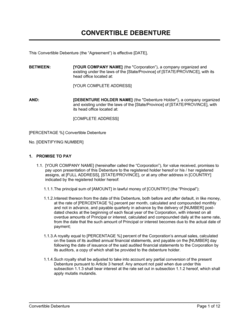
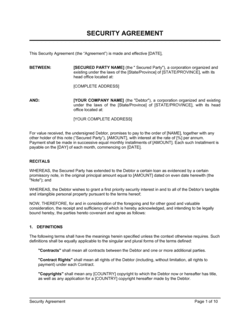
Debentureholders Instrument Cancelation Template

Free Word download • Edit online • Save & share with Drive • Export to PDF

1 page20–30 min to fillDifficulty: StandardSignature requiredLegal review recommended
Learn more ↓
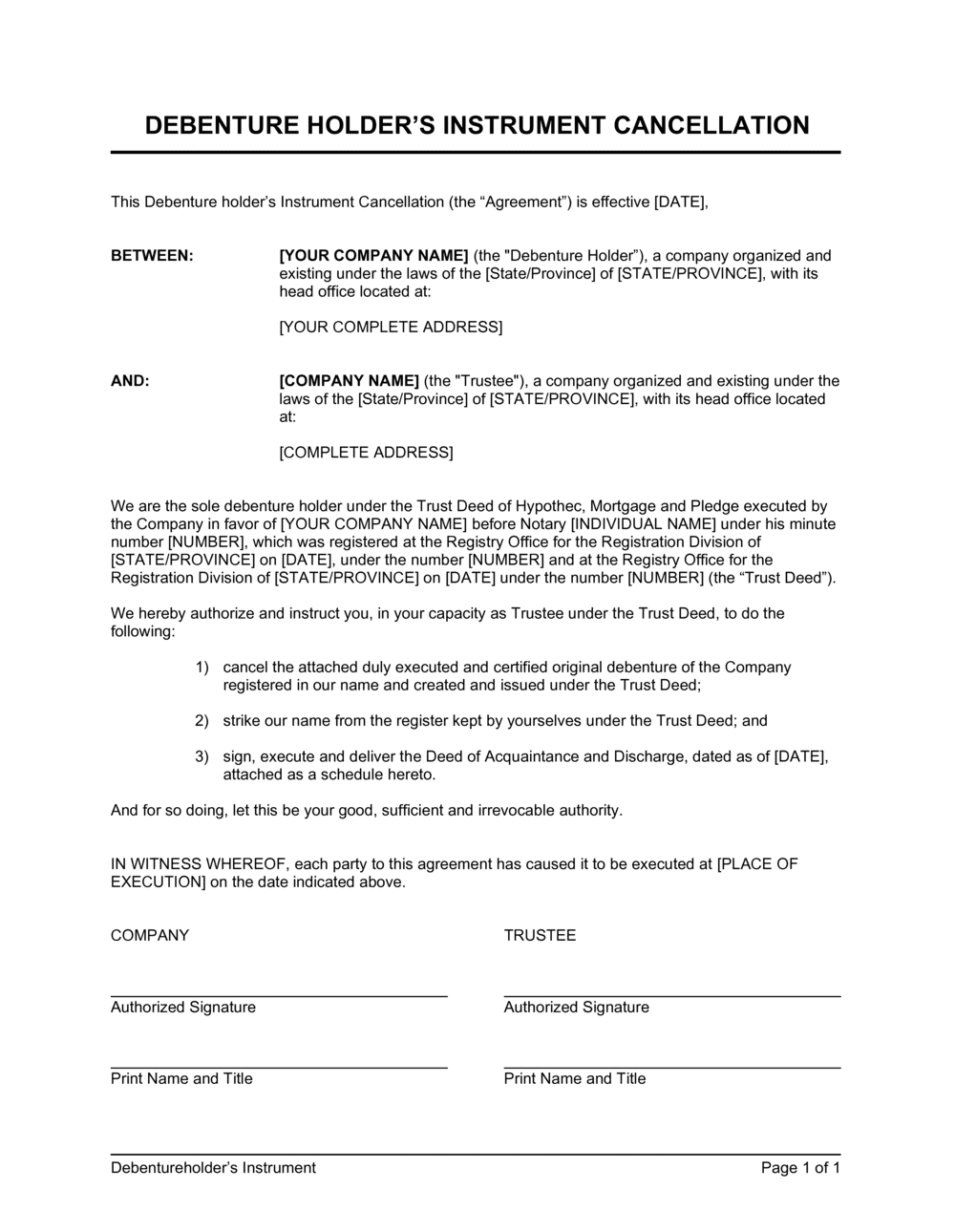
FreeDebentureholders Instrument Cancelation Template

At a glance

What it is
A Debentureholders Instrument Cancelation is a formal legal document executed by a company and its debenture holders to confirm that all obligations under a debenture instrument have been satisfied and that the debenture is discharged with full effect. This free Word download gives you a structured, attorney-ready template you can edit online and export as PDF for signing by all relevant parties and filing with the appropriate corporate registry.
When you need it
Use it when a company has repaid all principal and interest owed under a debenture, when a lender agrees to release its security interest before full repayment as part of a restructuring, or when a debenture is being canceled as part of a corporate reorganization or asset sale. It is also required before a company can cleanly refinance or grant fresh security to a new lender.
What's inside
Identification of the original debenture instrument and parties, a confirmation of debt satisfaction or agreed discharge, a release of all security interests and charges registered against the company's assets, an instruction to update the company's register of charges, and execution blocks for all debenture holders and authorized company officers.

What is a Debentureholders Instrument Cancelation?

A Debentureholders Instrument Cancelation is a formal legal document executed by a company and its debenture holders to confirm that all obligations secured by a debenture — including principal, interest, fees, and any other agreed sums — have been fully satisfied and that the debenture instrument, together with every fixed and floating charge created under it, is discharged and extinguished. It functions as the legal mirror image of the original debenture: where the debenture creates the security interest and records the lender's rights over the company's assets, the cancelation terminates those rights, releases the encumbrances, and authorizes the company to file with the applicable corporate registry to remove the charge from the public record. The document is typically executed as a deed to meet the formal requirements of jurisdictions where a simple contract signature is insufficient to release a registered security interest.

Why You Need This Document

Without a formally executed instrument cancelation, a satisfied debenture continues to appear as an active charge on your company's public registry record — and that has concrete consequences. Future lenders will see the encumbrance and either decline to advance funds or require costly and time-consuming indemnity arrangements before proceeding. Buyers in an acquisition will flag the outstanding charge as a condition precedent to closing, adding legal fees and delay to the transaction. In some jurisdictions, a debenture holder that has been repaid but has not formally released its security retains the technical right to enforce the charge against specific assets — a risk that becomes acute if the holder becomes insolvent or is acquired by a party hostile to the company. A properly executed cancelation, filed promptly with the relevant registry, eliminates all of these risks for the cost of a template and a focused legal review where the complexity warrants it.

Which variant fits your situation?

If your situation is…Use this template
Canceling a fixed and floating charge debenture after full loan repaymentDebentureholders Instrument Cancelation
Releasing a specific fixed charge only while a floating charge remainsPartial Debenture Release Agreement
Discharging a mortgage or property-specific security interestMortgage Discharge Agreement
Canceling a promissory note after repaymentPromissory Note Cancelation
Confirming debt satisfaction and closing out a loan facilityLoan Payoff and Release Letter
Restructuring outstanding debentures rather than canceling themDebt Restructuring Agreement
Documenting the original security interest being dischargedDebenture Agreement

Common mistakes to avoid

❌ Releasing only one charge type

Why it matters: A debenture typically creates both fixed and floating charges. Releasing only the floating charge leaves registered fixed charges on the public record, blocking asset sales and future lending against specific property.

Fix: Expressly identify and release every fixed charge by asset description and the floating charge in the body of the release clause, and confirm all are removed from the registry filing.

❌ Executing as a simple contract rather than a deed

Why it matters: In the UK and Commonwealth jurisdictions, a release of a debenture must be executed as a deed to be legally effective. A document signed without deed formalities — witness attestation, 'signed as a deed' language — may not discharge the security.

Fix: Include 'executed as a deed' execution language, obtain independent witness signatures with addresses, and ensure corporate signatories meet the dual-authorizer requirements applicable in the governing jurisdiction.

❌ Omitting the warranty that the debenture has not been assigned

Why it matters: If the original holder has assigned or charged the debenture to a third party without the company's knowledge, a release from the original holder is ineffective — and the company may face a claim from the undisclosed assignee.

Fix: Include an express representation from the holder that the debenture has not been assigned, transferred, or encumbered, and require the holder to indemnify the company against any third-party claims arising from a breach of that warranty.

❌ Failing to file the discharge with the corporate registry

Why it matters: Execution of the cancelation instrument discharges the obligation between the parties, but the charge remains on the public register until a formal filing is made. Future lenders and buyers will see an active charge and may assume the debt is still outstanding.

Fix: File the required discharge form with the corporate registry immediately after execution — within 21 days in the UK — and retain the registry confirmation as part of the transaction record.

❌ Using vague payoff confirmation language

Why it matters: Phrases like 'substantially all amounts' or 'all known obligations' leave open the possibility that undisclosed fees or accrued interest remain outstanding, exposing the company to a future claim.

Fix: State the exact final payment amount, the payment date, and confirm there are no further sums whatsoever owed under the debenture, including fees, default interest, and indemnities.

❌ Not addressing a lost original debenture instrument

Why it matters: Without the original instrument or an express provision dealing with its absence, the legal effectiveness of the cancelation may be questioned — particularly if a third party later claims to hold the original.

Fix: Include a clause confirming the instrument is void whether or not the original is returned, and obtain a statutory declaration or lost instrument indemnity from the holder if the original cannot be produced.

The 10 key clauses, explained

Recitals and background

In plain language: Identifies the original debenture instrument, its date, the parties, and the factual background establishing why the cancelation is being executed.

Sample language
WHEREAS, on [DATE], [COMPANY NAME] (the 'Company') granted a Debenture in favor of [DEBENTUREHOLDER NAME] (the 'Holder') dated [ORIGINAL DEBENTURE DATE] (the 'Debenture'), a copy of which is attached hereto as Schedule A; AND WHEREAS, the Company has [repaid in full / satisfied all obligations] secured by the Debenture as of [DATE].

Common mistake: Failing to reference the original debenture by its exact title and date. A mismatch between the cancelation instrument and the registered charge record can delay removal from the company's charge register and block a pending transaction.

Confirmation of debt satisfaction

In plain language: A clear statement by the debenture holder that all amounts owed under the debenture — principal, interest, fees, and other charges — have been paid in full or that the holder agrees to release the obligation.

Sample language
The Holder hereby confirms that, as of [DATE], all principal, interest, fees, and other sums secured by or payable under the Debenture have been fully paid and discharged to the Holder's complete satisfaction, and that no further amounts are owed by the Company to the Holder thereunder.

Common mistake: Using vague language such as 'substantially paid' or 'most obligations met.' Any residual ambiguity about outstanding amounts can invalidate the discharge or leave the company exposed to future claims.

Release of security interests and charges

In plain language: The operative clause by which the debenture holder formally releases all fixed and floating charges, liens, and encumbrances created by the debenture over the company's assets.

Sample language
With effect from the date hereof, the Holder hereby releases and discharges the Company from all fixed charges, floating charges, liens, and encumbrances created under or by virtue of the Debenture over all present and future assets and undertakings of the Company, including but not limited to [SPECIFIC ASSETS IF ANY].

Common mistake: Releasing only the floating charge while leaving the fixed charge on specific assets unreleased. Both charge types must be expressly discharged to clear the register completely.

Instruction to update the register of charges

In plain language: Authorizes the company to file with the relevant corporate registry to remove the charge from the public record, and confirms the holder will cooperate with any required filings.

Sample language
The Holder hereby authorizes the Company to file all necessary forms and documents with [Companies House / the applicable corporate registry] to record the satisfaction and cancellation of the Debenture and the release of all associated charges registered therein, and agrees to execute any further documents reasonably required to give effect to such filings.

Common mistake: Omitting the holder's cooperation obligation. In some jurisdictions, the registry will not remove a charge without a signed statement from the charge holder — if this commitment is not in the instrument, the company may be unable to complete the filing.

Surrender and cancelation of the original instrument

In plain language: Requires the debenture holder to return or confirm destruction of the original debenture document and any associated certificates, confirming the instrument is void and of no further effect.

Sample language
The Holder hereby surrenders to the Company the original Debenture instrument together with all related certificates, together with confirmation that the Debenture is void and of no further force or effect as of the date hereof.

Common mistake: Skipping this clause when the original instrument cannot be located. Without an express provision covering a lost instrument, the holder's obligations and the release mechanism are unclear, potentially allowing a claim to be revived.

Representations and warranties

In plain language: Each party warrants that it has the authority to execute the instrument, that the Debenture details are accurate, and that the holder has not assigned or transferred the debenture to a third party.

Sample language
Each party represents and warrants that: (a) it has full power and authority to enter into and perform this Instrument; (b) the Debenture has not been assigned, transferred, charged, or otherwise encumbered in favor of any third party; and (c) no other person has any claim or interest in the Debenture.

Common mistake: Omitting the warranty that the debenture has not been assigned. If the holder has secretly transferred the debenture to another party, a cancelation signed by the original holder is ineffective — and the company may discover this only when the assignee asserts its rights.

Indemnity for filing costs

In plain language: Allocates responsibility for the costs of filing the cancelation with the corporate registry and related professional fees between the parties.

Sample language
The Company shall bear all filing fees, stamp duties, and reasonable professional costs associated with the registration of this Instrument Cancelation with the applicable corporate registry. The Holder shall execute all further documents reasonably required at no cost to the Company.

Common mistake: Leaving cost allocation silent. Disputes over who pays registry fees and legal costs can hold up execution for weeks, particularly where multiple debenture holders are involved.

Entire agreement and supersession

In plain language: Confirms that this instrument, together with the original debenture (now discharged), represents the complete agreement of the parties and supersedes all prior negotiations or communications regarding the discharge.

Sample language
This Instrument constitutes the entire agreement of the parties with respect to the cancellation and discharge of the Debenture and supersedes all prior negotiations, representations, and understandings relating thereto. No amendment shall be effective unless in writing and signed by all parties.

Common mistake: Omitting this clause when side letters or email exchanges contain informal agreements about the discharge conditions. Without an entire-agreement clause, those communications may be introduced as contractual terms.

Governing law and jurisdiction

In plain language: Specifies which jurisdiction's law governs the instrument and where disputes will be resolved — critical when the company and debenture holder are in different countries.

Sample language
This Instrument shall be governed by and construed in accordance with the laws of [JURISDICTION]. Each party irrevocably submits to the exclusive jurisdiction of the courts of [JURISDICTION] for the resolution of any dispute arising out of or in connection with this Instrument.

Common mistake: Choosing a governing law that differs from the jurisdiction where the charge is registered. A mismatch can create conflicts about which registry rules and filing procedures apply to the discharge.

Execution blocks

In plain language: Formal signature blocks for each debenture holder and authorized company signatories, with date fields, witness requirements, and, where applicable, company seal provisions.

Sample language
EXECUTED as a deed by [COMPANY NAME] acting by [DIRECTOR NAME], Director, and [DIRECTOR / SECRETARY NAME], Director / Secretary: _________________________ | Witnessed by: _________________________ | Date: [DATE]. SIGNED by [DEBENTUREHOLDER NAME]: _________________________ | Witnessed by: _________________________ | Date: [DATE].

Common mistake: Using a simple signature block instead of deed execution formalities. In the UK and many Commonwealth jurisdictions, a debenture release must be executed as a deed — a standard signature without witness attestation is insufficient to effect a legal release.

How to fill it out

  1. 1

    Locate and verify the original debenture details

    Obtain the original debenture instrument and confirm the exact document title, date, registered charge number, and all parties. Cross-check against the company's register of charges and the relevant public registry record.

    💡 Pull the live registry filing — not just the internal copy — to confirm the charge description matches exactly. Discrepancies between the two are the most common cause of rejected discharge filings.

  2. 2

    Confirm full satisfaction of all obligations

    Obtain a written statement from the debenture holder confirming the total amount paid, the final payment date, and that no further sums are outstanding. Attach this as a schedule if a separate payoff letter exists.

    💡 Request a formal payoff letter stating a per-diem interest accrual amount and an expiry date for the payoff figure — this protects the company if the closing date shifts by a day or two.

  3. 3

    Identify all charges to be released

    List every fixed charge and the floating charge created under the debenture in the release clause. Include specific asset descriptions for fixed charges (e.g., land title numbers, equipment serial numbers).

    💡 If the debenture covers after-acquired property, include broad release language covering both current and future assets to avoid leaving residual encumbrances.

  4. 4

    Complete the parties and execution blocks

    Enter the full legal names of the company (registered name and number) and each debenture holder. Confirm the authorized signatories for each party and whether deed execution with witnesses is required.

    💡 In UK and Commonwealth jurisdictions, check whether the debenture itself specifies how the release must be executed — some contain express requirements for deed formality or two-director signatures.

  5. 5

    Attach the original debenture as a schedule

    Annex a copy of the original debenture instrument to the cancelation. This avoids any dispute about which instrument is being discharged and provides a clear audit trail for the registry filing.

    💡 If the original is lost, include a statutory declaration from the holder confirming the instrument details and its loss — most registries accept this in lieu of the original.

  6. 6

    Execute as a deed with proper witnesses

    Have all parties sign in the presence of independent witnesses who also sign and print their name and address. For corporate parties, ensure the signatories hold the required authority (typically two directors, or a director and company secretary).

    💡 Never use the same witness for both the company and the debenture holder signatures — a witness with an interest in the transaction may invalidate the deed in some jurisdictions.

  7. 7

    File with the relevant corporate registry

    Submit the required discharge forms and a certified copy of the executed instrument to Companies House (UK), the provincial registry (Canada), or the applicable state authority (US). Pay any applicable filing fees.

    💡 In the UK, file Form MR04 (satisfaction of charge) within 21 days of execution to maintain a clean registry record — late filing does not invalidate the discharge but creates gaps in the public record.

  8. 8

    Update internal registers and notify relevant parties

    Record the cancelation in the company's internal register of charges, update the company's accounting records to remove the related liability, and notify any party that relied on the existence of the charge (e.g., a subsequent lender).

    💡 Obtain a copy of the registry's acknowledgment of the discharge filing and retain it with the executed instrument — you will need it if a future buyer or lender runs a charge search.

Frequently asked questions

What is a debentureholders instrument cancelation?

A debentureholders instrument cancelation is a formal legal document executed by a company and its debenture holders to confirm that the obligations secured by a debenture have been fully satisfied and that the debenture — along with all fixed and floating charges created under it — is discharged and of no further effect. It is the final step in closing out a secured debt arrangement and clearing the company's charge register.

When should a debentureholders instrument cancelation be used?

It is used when a company has repaid all principal and interest owed under a debenture, when a lender agrees to release security as part of a debt restructuring, or when a debenture is being canceled in connection with a corporate reorganization or asset sale. It is also required before refinancing — a new lender will typically require proof that prior charges are discharged before advancing funds.

What is the difference between a debenture cancelation and a debenture release?

The terms are often used interchangeably, but a cancelation typically refers to the extinguishment of the entire debenture instrument and all obligations under it, while a release may refer to the discharge of a specific charge or asset from a continuing debenture. A full instrument cancelation is appropriate when all obligations are satisfied and the debenture relationship is ending entirely.

Does a debentureholders instrument cancelation need to be executed as a deed?

In the UK, Australia, and most Commonwealth jurisdictions, the release of a debenture security interest must typically be executed as a deed to be legally effective. This requires witness attestation, specific execution language, and in the case of corporate parties, execution by two authorized signatories. In the US, deed formality requirements vary by state and by the nature of the underlying security. Legal advice is recommended to confirm the execution requirements in the applicable jurisdiction.

What filings are required after a debenture is canceled?

In the UK, the company must file Form MR04 (memorandum of satisfaction of charge) with Companies House, ideally within 21 days of execution. In Canada, a discharge must be registered with the applicable provincial personal property securities registry. In the US, UCC-3 termination statements are filed to extinguish registered financing statements. Failure to file does not necessarily invalidate the discharge between the parties, but leaves an active charge on the public record that can complicate future transactions.

Can a debenture be canceled if the original instrument has been lost?

Yes, in most jurisdictions a debenture can still be canceled even if the original instrument cannot be produced. The cancelation document should include an express clause confirming the instrument is void regardless of whether the original is returned. The debenture holder should also provide a statutory declaration or a lost instrument indemnity to protect the company against any third-party claim based on the original instrument.

What happens to registered charges after a debenture is canceled?

Execution of the cancelation instrument discharges the obligation between the parties with immediate effect, but registered charges remain visible on the public register until a formal discharge or satisfaction filing is made with the relevant registry. Companies should file promptly after execution to ensure the public record reflects the clean position — this is essential for any pending refinancing, acquisition, or asset sale.

Can part of a debenture be canceled while the rest remains in force?

Yes. A partial release can discharge a specific fixed charge over a named asset while leaving the remainder of the debenture — including other fixed charges and the floating charge — intact. This is common when a company sells a specific secured asset and needs to deliver clean title to the buyer. A partial release instrument should be used in this scenario rather than a full instrument cancelation.

Do all debenture holders need to sign the cancelation?

Yes, generally. Each registered debenture holder must execute the cancelation instrument to release their respective security interest. If there are multiple holders — for example, a trustee holding on behalf of a class of bondholders — the trustee typically executes on behalf of all holders under the terms of the trust deed. Obtaining all required signatures before filing is essential to ensure the discharge is complete.

How this compares to alternatives

vs Debenture Agreement

A debenture agreement creates the security interest — it grants the lender a fixed and floating charge over the company's assets in exchange for advancing funds. A debentureholders instrument cancelation is the document that terminates that relationship once all obligations are met. You need the debenture agreement to create the charge and this cancelation to extinguish it.

vs Loan Payoff Letter

A loan payoff letter is a lender's statement of the exact amount needed to close out a loan on a given date, including outstanding principal, accrued interest, and fees. It is a precondition to executing a debenture cancelation, not a substitute for it. The payoff letter confirms the numbers; the cancelation instrument formally discharges the security and authorizes registry filings.

vs Promissory Note Cancelation

A promissory note cancelation discharges an unsecured promise to repay a specific sum. A debenture cancelation is more complex because it also releases registered security interests — fixed and floating charges — over company assets. Where a promissory note has no registered charge attached, a simple note cancelation is sufficient; where a debenture is involved, this instrument is required.

vs Debt Settlement Agreement

A debt settlement agreement records a compromise under which the creditor accepts less than the full amount owed in full satisfaction of the debt. A debenture cancelation is appropriate when the full debt has been repaid or when the holder agrees to release the security regardless of the payment outcome. If the debenture is being released as part of a negotiated partial settlement, a debt settlement agreement should be executed first, with the cancelation instrument following to discharge the security.

Industry-specific considerations

Banking and financial services

Commercial banks regularly issue debenture cancelations as part of loan close-out procedures, triggering internal credit file updates and PPSR or Companies House discharge filings as standard post-repayment steps.

Private equity and venture capital

Debenture cancelation is a standard pre-exit step in portfolio company disposals, required to deliver unencumbered assets to a buyer and satisfy the conditions precedent in acquisition agreements.

Real estate and property development

Fixed charges over land and buildings created under development finance debentures must be formally canceled before titles can be transferred to buyers or mortgaged to new lenders.

Manufacturing and asset-heavy businesses

Equipment and plant subject to fixed charges under debentures require express asset-level release language in the cancelation to allow machinery to be sold or refinanced without lender consent.

Technology and SaaS

IP assets and receivables pledged under debentures to early-stage lenders or revenue-based finance providers must be discharged before a company can grant fresh security to a new growth-stage lender.

Professional services

Partnership or corporate practices that used debenture financing to fund fit-out or working capital need clean charge registers to satisfy professional body requirements and facilitate partner buyouts.

Jurisdictional notes

United States

In the US, debentures are typically governed by state law, and security interests in personal property are perfected by filing a UCC-1 financing statement. Upon satisfaction, the secured party must file a UCC-3 termination statement within 20 days of a written demand from the debtor, or face liability for costs and damages. Real property security interests require a separate deed of release or reconveyance filed with the county recorder. Requirements vary significantly by state.

Canada

In Canada, personal property security interests are registered under each province's Personal Property Security Act (PPSA). Upon discharge, the secured party must register a financing change statement to terminate the registration. Quebec operates under the Civil Code of Quebec, which governs hypothecs rather than common-law charges — discharge requires a release of hypothec registered at the Registre des droits personnels et réels mobiliers (RDPRM). Corporate debentures in federally incorporated companies may also require filings under the Canada Business Corporations Act.

United Kingdom

In the UK, debenture charges must be registered at Companies House within 21 days of creation. Upon satisfaction, the company must file Form MR04 (memorandum of satisfaction of charge) or Form MR05 (part satisfaction). The release document must be executed as a deed, signed by two directors or a director and company secretary, and witnessed. Scottish law treats floating charges differently from English law — specific Scottish law advice is recommended for charges over Scottish assets.

European Union

The EU has no unified debenture law; requirements vary by member state. In Germany, securities over movable assets are discharged under the BGB (Civil Code) through a written release and return of possession or control. In France, sûretés (security interests) require a mainlevée (discharge notice) filed with the relevant registry. GDPR considerations apply where the debenture documentation contains personal data — data relating to individual guarantors or directors should be handled in line with applicable retention policies.

Template vs lawyer — what fits your deal?

PathBest forCostTime
Use the templateStandard single-holder debenture cancelations following full repayment, where the governing jurisdiction and charge details are straightforwardFree30–60 minutes to complete, plus filing time
Template + legal reviewMulti-holder debentures, cross-border arrangements, or cancelations connected to an asset sale or refinancing with a new lender$500–$1,500 for a solicitor or corporate counsel review2–5 business days
Custom draftedComplex syndicated debentures, trustee-held instruments, regulated financial institutions, or debentures involving material IP or real property in multiple jurisdictions$2,000–$8,000+1–3 weeks

Glossary

Debenture
A long-term debt instrument issued by a company to a lender or investor, typically secured against the company's assets and governed by a formal deed.
Fixed Charge
A security interest attached to a specific identified asset — such as real property or major equipment — that prevents the company from disposing of that asset without the lender's consent.
Floating Charge
A security interest over a class of assets that changes from time to time (such as inventory or receivables), which crystallizes into a fixed charge upon a defined event of default.
Crystallization
The point at which a floating charge converts to a fixed charge, typically triggered by insolvency, receivership appointment, or a specified default event.
Register of Charges
A statutory register maintained by a company and the national corporate registry listing all security interests and charges granted over the company's assets.
Satisfaction of Debt
The full discharge of a financial obligation through payment of all principal, interest, fees, and any other agreed sums — the trigger event for debenture cancelation.
Deed of Release
A formal legal instrument by which a secured party relinquishes its rights and interests under a security agreement, effective upon execution and delivery.
Charge Holder
The party — typically a lender or investor — in whose favor a charge or security interest is registered against a company's assets under a debenture.
Companies House / PPSR / UCC Filing
Jurisdiction-specific public registers where security interests are recorded: Companies House in the UK, the Personal Property Securities Register in Australia and New Zealand, and UCC filings in the United States.
Encumbrance
Any legal claim, lien, charge, or liability attached to an asset that restricts its free transfer or use — discharged by this cancelation instrument.
Consideration
The value exchanged between parties to make a contract binding — in a debenture cancelation, typically the repayment of the full debt or an agreed settlement sum.

Part of your Business Operating System

This document is one of 3,000+ business & legal templates included in Business in a Box.

  • Fill-in-the-blanks — ready in minutes
  • 100% customizable Word document
  • Compatible with all office suites
  • Export to PDF and share electronically

Create your document in 3 simple steps.

From template to signed document — all inside one Business Operating System.
1
Download or open template

Access over 3,000+ business and legal templates for any business task, project or initiative.

2
Edit and fill in the blanks with AI

Customize your ready-made business document template and save it in the cloud.

3
Save, Share, Send, Sign

Share your files and folders with your team. Create a space of seamless collaboration.

Save time, save money, and create top-quality documents.

★★★★★

"Fantastic value! I'm not sure how I'd do without it. It's worth its weight in gold and paid back for itself many times."

Managing Director · Mall Farm
Robert Whalley
Managing Director, Mall Farm Proprietary Limited
★★★★★

"I have been using Business in a Box for years. It has been the most useful source of templates I have encountered. I recommend it to anyone."

Business Owner · 4+ years
Dr Michael John Freestone
Business Owner
★★★★★

"It has been a life saver so many times I have lost count. Business in a Box has saved me so much time and as you know, time is money."

Owner · Upstate Web
David G. Moore Jr.
Owner, Upstate Web

Run your business with a system — not scattered tools

Stop downloading documents. Start operating with clarity. Business in a Box gives you the Business Operating System used by over 250,000 companies worldwide to structure, run, and grow their business.

Free Forever Plan · No credit card required