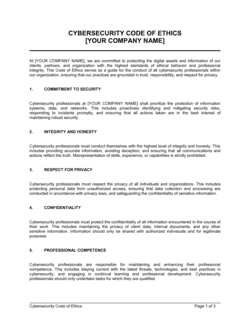
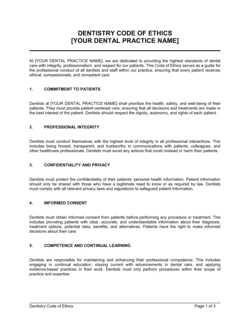
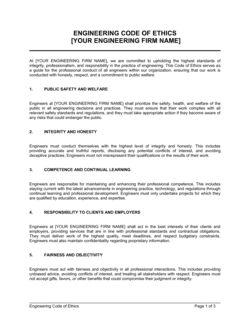
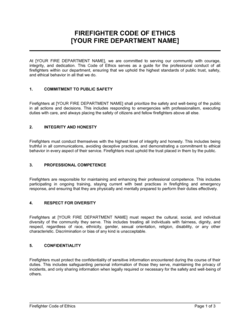
Councelor Code Of Ethics Template

Free Word download • Edit online • Save & share with Drive • Export to PDF

3 pages25–30 min to fillDifficulty: StandardSignature requiredLegal review recommended
Learn more ↓
FreeCouncelor Code Of Ethics Template

At a glance

What it is
A Counselor Code of Ethics is a binding professional conduct document that establishes the ethical standards, duties, and behavioral expectations governing a counselor's practice. This free Word download covers confidentiality, informed consent, professional boundaries, dual relationships, and disciplinary procedures in a single structured document you can edit online and export as PDF.
When you need it
Use it when establishing a counseling practice, onboarding new counseling staff, applying for professional licensure, or when a clinic or agency needs a written ethics policy to satisfy accreditation requirements.
What's inside
Core ethical principles, client confidentiality obligations, informed consent requirements, professional boundary rules, dual-relationship prohibitions, mandatory reporting duties, documentation standards, supervision requirements, and disciplinary and grievance procedures.

What is a Counselor Code of Ethics?

A Counselor Code of Ethics is a binding professional conduct document that establishes the ethical standards, duties, and behavioral expectations governing a counselor's practice. It defines how counselors must handle client confidentiality, obtain informed consent, maintain professional boundaries, manage mandatory reporting obligations, document clinical work, and respond to grievances. Unlike a general workplace code of conduct, a counselor code of ethics is calibrated to the specific clinical, legal, and relational obligations of the mental health profession — drawing on the standards published by bodies such as the American Counseling Association (ACA), the National Association of Social Workers (NASW), and provincial and national equivalents in Canada and the UK. When signed by counseling staff, it creates enforceable commitments that licensing boards, accreditation bodies, and courts treat as evidence of professional standards in force at the practice.

Why You Need This Document

Operating a counseling practice without a written, signed code of ethics creates serious and compounding exposure. In a licensing board investigation, the board will ask whether the counselor was on notice of the applicable ethical standard — a signed code is your primary evidence that they were. Without documented mandatory reporting procedures, a counselor who misses a reporting deadline cannot point to a written protocol, and the practice bears institutional liability for the oversight. Practices that fail to specify dual-relationship prohibitions, record retention periods, and termination procedures expose themselves to civil claims that a written code would have foreclosed. Beyond liability, most accreditation bodies — including CACREP and CARF — and many government and foundation funders require a documented ethics policy as a condition of certification or contract. This template gives solo practitioners, group practices, and clinics a structured, profession-specific starting point that covers every material obligation in a single document, formatted for immediate use.

Which variant fits your situation?

If your situation is…Use this template
School-based counselor employed by a K–12 districtSchool Counselor Code of Ethics
Substance abuse and addiction counseling practiceSubstance Abuse Counselor Code of Ethics
Career or life coaching practice (non-clinical)Life Coach Code of Ethics
Telehealth or online therapy platformTelehealth Counseling Ethics Policy
Employee Assistance Program (EAP) counseling providerEAP Counselor Code of Ethics
Group counseling practice with multiple licensed practitionersGroup Practice Counseling Ethics Policy
Counseling intern or trainee under supervised hoursCounseling Intern Ethics Agreement

Common mistakes to avoid

❌ Jurisdiction-agnostic mandatory reporting language

Why it matters: Mandatory reporting thresholds, timelines, and designated authorities differ by state and province. A clause that says 'as required by law' without specifics provides no operational guidance and can result in a missed or late report.

Fix: Insert the specific statute name, the reporting timeline in hours, and the name and phone number of the reporting authority for each jurisdiction where counselors are licensed.

❌ Limiting dual-relationship prohibitions to current clients only

Why it matters: Most professional association standards (ACA, NASW) prohibit romantic or sexual relationships with former clients for at least two years post-termination, and often indefinitely. A clause that expires at termination is non-compliant and leaves the practice exposed.

Fix: Extend dual-relationship prohibitions to cover former clients for the period required by your professional association's current ethics code, typically no less than two years.

❌ No signed acknowledgment by counseling staff

Why it matters: A code of ethics that is not signed by staff is advisory, not binding. In a licensing board investigation or civil suit, the practice cannot demonstrate that individual counselors were aware of and committed to the standards.

Fix: Require every counselor, intern, and trainee to sign a dated acknowledgment before their first client contact and retain a signed copy in their personnel file.

❌ Using a single record retention period for all clients

Why it matters: Setting a uniform 7-year retention period fails minor clients whose records may need to be retained until the client is 25 or older depending on the jurisdiction. A licensing complaint or subpoena for records after premature destruction carries serious consequences.

Fix: Create separate retention rules for adult and minor client records, and for records related to any client who has filed a complaint or initiated litigation, which must be retained until all proceedings are concluded.

❌ Informed consent treated as a one-time form rather than an ongoing process

Why it matters: When a counselor changes treatment approach, fee structure, or supervisor, the original consent no longer covers the new arrangement. Proceeding without renewed consent violates both the code and client rights.

Fix: Add a clause requiring counselors to obtain fresh written consent whenever there is a material change to services, fees, or the supervisory relationship.

❌ No designated alternate contact in the grievance procedure

Why it matters: When the primary complaints officer is the subject of a complaint, a single-contact grievance procedure creates a conflict of interest that most accreditation bodies will cite as a deficiency.

Fix: Name a secondary complaints officer or an external ombudsperson as the escalation contact when the primary officer is the subject of or a witness to the alleged violation.

The 10 key clauses, explained

Statement of purpose and governing ethical principles

In plain language: Establishes the foundational ethical values — autonomy, beneficence, non-maleficence, justice, and fidelity — that guide all conduct covered by the code.

Sample language
This Code of Ethics governs the professional conduct of [COUNSELOR NAME / PRACTICE NAME] and all counseling staff. All counselors shall adhere to the principles of client autonomy, beneficence, non-maleficence, justice, and fidelity in every aspect of their practice.

Common mistake: Using generic corporate ethics language instead of mental health-specific principles. Courts and licensing boards evaluate conduct against the standard of the counseling profession, not general business ethics.

Scope of practice and competence

In plain language: Defines the specific modalities, populations, and conditions the counselor is qualified to treat and prohibits practice outside those boundaries.

Sample language
[COUNSELOR NAME] is licensed to practice [MODALITY / SPECIALTY] in [STATE / PROVINCE / COUNTRY]. Services shall be limited to [TARGET POPULATION / CONDITIONS]. Any expansion of scope requires completion of [TRAINING REQUIREMENTS] and written approval from [SUPERVISOR / LICENSING BOARD].

Common mistake: Failing to specify the limitations of competence. A vague scope-of-practice clause does not protect the counselor from liability when treating conditions outside their training.

Informed consent and disclosure

In plain language: Requires the counselor to explain the nature of counseling, fees, session structure, confidentiality limits, and the client's right to withdraw before treatment begins.

Sample language
Prior to commencing counseling, [COUNSELOR NAME] shall provide each client with a written Informed Consent Form covering: (a) the nature and goals of counseling; (b) session fees and cancellation policy; (c) confidentiality obligations and legally required exceptions; (d) the client's right to withdraw consent at any time without penalty.

Common mistake: Treating informed consent as a one-time form rather than an ongoing process. Significant changes in treatment approach, fees, or counselor supervision status require renewed consent.

Confidentiality and privileged communication

In plain language: Obligates the counselor to protect all client communications and records and specifies the narrow legal exceptions — mandatory reporting, court orders, and imminent danger — that override confidentiality.

Sample language
All client communications and records are strictly confidential. [COUNSELOR NAME] shall not disclose client information without written authorization except where required by law, including: (a) mandatory reporting of suspected child or elder abuse; (b) imminent danger to the client or an identifiable third party; (c) a valid court order or subpoena.

Common mistake: Listing mandatory reporting obligations without specifying the applicable jurisdiction's reporting thresholds. The duty to warn and the duty to report vary significantly by state and province.

Professional boundaries and dual relationships

In plain language: Prohibits sexual, romantic, financial, and other exploitative relationships with current clients and sets limits on social, business, and personal contact.

Sample language
No counselor shall engage in sexual, romantic, or intimate contact with any current client. Counselors shall avoid dual relationships that impair professional judgment or create a risk of exploitation. Business relationships, social media connections, and significant personal contact with clients shall not occur during the counseling relationship.

Common mistake: Limiting dual-relationship prohibitions to current clients only. Post-termination relationships — particularly romantic ones — remain ethically prohibited for at least two years under most professional association standards.

Mandatory reporting and duty to warn

In plain language: Specifies the counselor's legal obligations to report suspected abuse or neglect and to take protective action when a client presents an imminent threat of harm to themselves or others.

Sample language
When [COUNSELOR NAME] has reasonable suspicion of child abuse, elder abuse, or dependent adult abuse, a report shall be made to [APPLICABLE AUTHORITY] within [X] hours. When a client presents a credible, imminent threat of harm to an identifiable third party, [COUNSELOR NAME] shall take reasonable protective action, which may include notifying the potential victim, law enforcement, or seeking emergency hospitalization.

Common mistake: Using a single duty-to-warn clause without reference to the specific statutory standard in the counselor's jurisdiction. Tarasoff and its state-level equivalents have different triggers and obligations.

Documentation and record-keeping

In plain language: Sets minimum standards for session notes, treatment plans, and client records — including retention periods and secure storage requirements.

Sample language
Counselors shall maintain a contemporaneous record of each session including the date, duration, presenting issues, interventions used, and client response. Client records shall be retained for a minimum of [7] years from the date of last service, or [3] years after a minor client reaches the age of majority. Records shall be stored in a [HIPAA-compliant / encrypted] system accessible only to authorized personnel.

Common mistake: Setting a single retention period without accounting for minor clients. Records for minors must typically be retained until the client reaches the age of majority plus the standard retention window.

Supervision and continuing education

In plain language: Establishes the supervision structure for trainees and interns and sets ongoing professional development requirements for licensed counselors.

Sample language
All unlicensed counselors and interns shall receive a minimum of [1 hour] individual supervision per [X] hours of direct client contact with a licensed supervisor approved by [LICENSING BOARD]. Licensed counselors shall complete a minimum of [X] continuing education hours per licensure renewal period, including [X] hours in ethics.

Common mistake: Setting continuing education requirements that fall below the licensing board's mandatory minimum. Contractual obligations must meet or exceed statutory requirements in every jurisdiction where the counselor is licensed.

Termination, referral, and non-abandonment

In plain language: Defines appropriate grounds for ending a counseling relationship, requires a transition plan, and prohibits abrupt termination that leaves a client without care.

Sample language
Counseling shall not be terminated abruptly. When termination is initiated by [COUNSELOR NAME], the counselor shall provide the client with reasonable notice of [X] sessions, a clinical rationale, and written referrals to at least [TWO] appropriate alternative providers. Emergency termination due to a threat to counselor safety shall be documented and supported by a referral plan.

Common mistake: No non-abandonment clause at all. Abruptly ending services without a referral plan exposes the counselor to licensing complaints and professional liability claims, particularly when the client is in acute distress.

Grievance and disciplinary procedure

In plain language: Establishes a documented process for clients and colleagues to raise ethics concerns and the steps for investigating and resolving complaints internally.

Sample language
Any client or colleague who believes a counselor has violated this Code of Ethics may submit a written complaint to [PRACTICE DIRECTOR / ETHICS COMMITTEE] at [CONTACT INFORMATION]. Complaints shall be acknowledged within [5] business days and resolved within [30] business days. Counselors found to have committed a violation may be subject to remediation, suspension, or termination of practice privileges.

Common mistake: Failing to include a timeline for complaint resolution. A grievance procedure without defined response windows is unenforceable and fails accreditation reviews that require demonstrable procedural accountability.

How to fill it out

  1. 1

    Identify the governing professional association and licensing board

    Before customizing the template, confirm which professional body's ethics code applies — ACA, NASW, AMHCA, or a state-level board. The code of ethics must align with the standards your license requires.

    💡 Download the current version of your professional association's ethics code and keep it open as a reference while filling in the template.

  2. 2

    Define the scope of practice and applicable modalities

    Enter the specific counseling modalities, target populations, and conditions the practice is qualified to address. Be precise — a scope-of-practice clause that is too broad creates liability exposure for work outside your training.

    💡 If any counselor on staff holds a different or narrower license, create a practice-specific addendum for that individual rather than broadening the main code.

  3. 3

    Customize the confidentiality and mandatory reporting provisions

    Replace the placeholder jurisdiction references with the specific statutes and reporting thresholds applicable in each state or province where counselors are licensed. Include the name and contact information for the applicable reporting authority.

    💡 Consult your state licensing board's most recent guidance on the duty-to-warn standard — several states updated their Tarasoff-equivalent statutes between 2020 and 2025.

  4. 4

    Set supervision ratios and continuing education minimums

    Enter the supervision hours required per your licensing board's regulations, the name of the approved supervisor, and the continuing education credit requirements for each license type on staff.

    💡 Build in a 10% buffer above the licensing minimum — setting contractual requirements slightly higher than the legal floor reduces the risk of inadvertent non-compliance during a busy period.

  5. 5

    Specify record retention periods for all client types

    Enter the retention period for adult client records (typically 7 years from last service) and separately for minor client records (typically until the client turns 18 plus 7 years). Reference the applicable HIPAA or provincial health records legislation.

    💡 If your practice uses an EHR system, confirm the system's default retention settings match the periods stated in this document.

  6. 6

    Define the termination and referral process

    Specify the notice period for planned terminations (number of sessions), the minimum number of referrals to be provided, and the documentation required for emergency terminations.

    💡 Include language confirming that the referral obligation applies even when the client has not paid outstanding balances — non-abandonment overrides fee disputes under most professional association standards.

  7. 7

    Complete the grievance procedure with named contacts and timelines

    Replace placeholders with the name or role of the person who receives complaints, the acknowledgment window (typically 5 business days), and the resolution timeline (typically 30 business days).

    💡 Designate an alternate contact in case the primary complaints officer is the subject of the complaint — grievance procedures without a neutral escalation path fail accreditation reviews.

  8. 8

    Obtain signatures from all counseling staff before services begin

    Have every licensed counselor, intern, and trainee sign the code prior to their first client contact. For new hires, signature must precede onboarding.

    💡 Use a signature log that captures the name, credential, license number, and date of signature for each signatory — this is the evidence file if a licensing board requests proof of ethics training.

Frequently asked questions

What is a counselor code of ethics?

A counselor code of ethics is a binding professional conduct document that defines the ethical standards, obligations, and behavioral expectations for counselors in their practice. It covers confidentiality, informed consent, professional boundaries, mandatory reporting duties, documentation standards, and disciplinary procedures. It functions as both an internal policy document and, when signed, a binding commitment by each counselor to practice within defined ethical limits.

Is a counselor code of ethics legally required?

In most US states and Canadian provinces, licensed counselors are required to adhere to their licensing board's or professional association's code of ethics as a condition of licensure — but a separately signed practice-level code is typically not mandated by statute. However, accreditation bodies (CACREP, CARF), insurers, and many school districts and government funders require a written, signed code as a condition of contract or certification. Clinics and agencies that employ multiple counselors should treat a written code as a practical necessity rather than an optional formality.

What professional association's ethics code should I reference?

The applicable code depends on your credential. Licensed Professional Counselors (LPCs) typically follow the American Counseling Association (ACA) Code of Ethics. Clinical social workers follow the NASW Code of Ethics. Marriage and family therapists reference the AAMFT Code. School counselors follow the American School Counselor Association (ASCA) standards. Substance abuse counselors reference NAADAC. Your practice's code of ethics should explicitly name the governing code and be reviewed against the most current version — the ACA Code was last revised in 2014 and is periodically updated.

What is the difference between confidentiality and privileged communication?

Confidentiality is an ethical obligation — the counselor's duty to protect client disclosures from unauthorized disclosure in day-to-day practice. Privileged communication is a legal right held by the client that prevents a counselor from being compelled to testify about confidential communications in court proceedings. Both concepts should be addressed in the code. Privilege is jurisdiction-specific and may not apply in all states or in all types of proceedings.

When can a counselor break confidentiality?

Confidentiality is not absolute. Counselors are typically required or permitted to disclose client information in three narrow circumstances: mandatory reporting of suspected child or elder abuse; imminent danger to the client or an identifiable third party (duty to warn or protect); and compliance with a valid court order or subpoena. Some jurisdictions also permit disclosure when the client provides written authorization. The specific thresholds and procedures for each exception vary by state and province and must be reflected accurately in the code.

What are dual relationships and why are they prohibited?

A dual relationship exists when a counselor has both a professional therapeutic role and another significant relationship with the same person — financial, social, supervisory, romantic, or familial. They are generally prohibited because they impair the counselor's objectivity, create a power imbalance, and expose the client to exploitation. Most professional association codes prohibit sexual or romantic relationships with current and former clients (typically for at least two years post- termination), business partnerships, and close personal friendships that developed during the counseling relationship.

Does the code of ethics need to be signed by the client?

Clients do not typically sign the code of ethics itself. Instead, the informed consent form — which summarizes the client's rights and the counselor's key obligations — is signed by the client before treatment begins. The code of ethics is an internal professional standards document signed by counseling staff. Clients should, however, be informed that a code exists, how to access it, and how to submit a grievance if they believe it has been violated.

How often should a counselor code of ethics be updated?

Review the code at minimum annually and whenever a professional association issues a revised ethics code, the licensing board updates its regulations, or the practice adds a new service modality or population. Mandatory reporting statutes and duty-to-warn standards have seen significant legislative activity in recent years — a code that is more than two years old should be audited against current statutory requirements in every jurisdiction where counselors are licensed.

What happens if a counselor violates the code of ethics?

A violation can trigger multiple concurrent consequences. At the practice level, the grievance and disciplinary procedure in the code governs investigation and potential remediation or termination of practice privileges. At the licensing board level, a complaint can result in suspension, probation, or revocation of the counselor's license. At the professional association level, membership may be terminated. In cases involving harm to a client, civil liability and, in extreme cases involving abuse or fraud, criminal charges are also possible. A documented, signed code demonstrates that the practice set clear standards and took reasonable steps to enforce them.

How this compares to alternatives

vs Employee code of conduct

An employee code of conduct governs general workplace behavior — attendance, harassment, and use of company resources — for any employee in any industry. A counselor code of ethics is a profession-specific document addressing clinical obligations such as confidentiality, mandatory reporting, dual relationships, and scope of practice that an employment code of conduct does not cover. Counseling practices typically need both.

vs Client informed consent form

An informed consent form is a client-facing document signed by the client before treatment begins. It summarizes the counselor's key obligations and the client's rights in plain language. A code of ethics is an internal professional standards document signed by counseling staff. The informed consent form is derived from and must be consistent with the code of ethics, but the two documents serve different legal and clinical functions.

vs Non-disclosure agreement

An NDA is a contract that prohibits one or both parties from disclosing specified confidential information. A counselor code of ethics addresses confidentiality as one component of a much broader professional obligations framework. The confidentiality provisions in a code of ethics are governed by professional licensing law and ethics standards, not solely by contract law, and include legally mandated exceptions that an NDA cannot override.

vs Professional services agreement

A professional services agreement defines the commercial terms of a counselor's engagement — fees, session schedule, cancellation policy, and billing. A code of ethics defines the professional and ethical standards that govern how services are delivered. Both are typically used together: the services agreement establishes the business relationship while the code of ethics establishes the professional conduct standards.

Industry-specific considerations

Healthcare and mental health clinics

HIPAA-compliant record-keeping requirements, telehealth ethics provisions, and multi-disciplinary team confidentiality protocols are all addressed in a clinic-level code.

Education and school districts

School counselors must align with ASCA ethical standards, mandatory reporting to child protective services, and parental notification rules that differ from adult clinical settings.

Nonprofit and social services

Government and foundation funders increasingly require a signed ethics policy as a grant condition, and NASW-aligned codes satisfy most social services accreditation requirements.

Employee Assistance Programs (EAPs)

EAP counselors navigate dual reporting obligations to both the employer client and the individual employee-client, requiring explicit confidentiality language that addresses the organizational context.

Jurisdictional notes

United States

Counselor licensing and ethics requirements vary by state. The ACA Code of Ethics governs most licensed professional counselors, but each state licensing board establishes its own disciplinary standards. Mandatory reporting obligations and duty-to-warn thresholds differ significantly — California, Texas, Florida, and New York each have distinct statutes. HIPAA applies to covered counseling practices and sets federal minimum standards for records and confidentiality.

Canada

Counseling regulation in Canada is provincial. Ontario, British Columbia, and Quebec have regulated the profession under their respective health professions acts; other provinces rely on voluntary association membership. The Canadian Counselling and Psychotherapy Association (CCPA) publishes the primary national ethics code. Quebec requires service delivery and documentation in French for provincially regulated providers. PIPEDA and provincial privacy legislation govern client record handling.

United Kingdom

Counselling and psychotherapy are not statutorily regulated in the UK as of 2025 — practitioners are not required to hold a license. However, the British Association for Counselling and Psychotherapy (BACP) Ethical Framework for the Counselling Professions is the dominant voluntary standard, and most employers and insurers require BACP membership. The UK GDPR governs client records, and the Children Act 1989 and Safeguarding legislation impose mandatory reporting obligations for child protection concerns.

European Union

Counseling regulation in the EU varies widely by member state. Germany, Austria, and the Netherlands have statutory frameworks; most other member states rely on professional association standards. The European Association for Counselling (EAC) publishes a cross-border ethics framework, but its application is advisory. EU GDPR imposes strict requirements on the handling of health-related client data, including data minimization, consent documentation, and the right to erasure — all of which must be reflected in the confidentiality and records provisions of the code.

Template vs lawyer — what fits your deal?

PathBest forCostTime
Use the templateSolo practitioners and small counseling practices in a single jurisdiction with straightforward licensure requirementsFree2–4 hours
Template + legal reviewMulti-counselor practices, practices serving minors or high-risk populations, or those operating across multiple states or provinces$400–$900 for a healthcare attorney or licensed professional counselor ethics consultant3–7 business days
Custom draftedHospital-affiliated counseling programs, accredited training clinics, or practices under licensing board scrutiny or prior ethics complaints$1,500–$4,000+2–4 weeks

Glossary

Informed Consent
A process by which a client voluntarily agrees to participate in counseling after being fully informed of the nature, risks, benefits, and alternatives to treatment.
Confidentiality
The ethical and legal obligation of a counselor to protect client disclosures from unauthorized disclosure to third parties.
Privileged Communication
A legal protection that prevents a counselor from disclosing client communications in legal proceedings without the client's explicit consent.
Dual Relationship
A situation in which a counselor holds a professional role and simultaneously has another significant relationship with the same client, such as a personal, financial, or supervisory connection.
Mandatory Reporting
A legal obligation requiring counselors to report known or suspected abuse, neglect, or imminent harm to authorities regardless of client confidentiality.
Competence
The counselor's obligation to practice only within the boundaries of their education, training, supervised experience, and licensure.
Transference
A psychological phenomenon in which a client unconsciously redirects feelings about a significant person in their life onto the counselor.
Supervision
A formal oversight relationship in which a licensed senior counselor reviews and guides the clinical work of a less-experienced or trainee counselor.
Grievance Procedure
A documented process by which a client or colleague can formally raise concerns about a counselor's ethical conduct and have them reviewed.
Non-Abandonment
The ethical obligation to provide adequate transition support and referrals when terminating a counseling relationship, rather than ending services abruptly.
Cultural Competence
A counselor's ability to understand, respect, and effectively work with clients from diverse cultural, ethnic, and social backgrounds.

Part of your Business Operating System

This document is one of 3,000+ business & legal templates included in Business in a Box.

  • Fill-in-the-blanks — ready in minutes
  • 100% customizable Word document
  • Compatible with all office suites
  • Export to PDF and share electronically

Create your document in 3 simple steps.

From template to signed document — all inside one Business Operating System.
1
Download or open template

Access over 3,000+ business and legal templates for any business task, project or initiative.

2
Edit and fill in the blanks with AI

Customize your ready-made business document template and save it in the cloud.

3
Save, Share, Send, Sign

Share your files and folders with your team. Create a space of seamless collaboration.

Save time, save money, and create top-quality documents.

★★★★★

"Fantastic value! I'm not sure how I'd do without it. It's worth its weight in gold and paid back for itself many times."

Managing Director · Mall Farm
Robert Whalley
Managing Director, Mall Farm Proprietary Limited
★★★★★

"I have been using Business in a Box for years. It has been the most useful source of templates I have encountered. I recommend it to anyone."

Business Owner · 4+ years
Dr Michael John Freestone
Business Owner
★★★★★

"It has been a life saver so many times I have lost count. Business in a Box has saved me so much time and as you know, time is money."

Owner · Upstate Web
David G. Moore Jr.
Owner, Upstate Web

Run your business with a system — not scattered tools

Stop downloading documents. Start operating with clarity. Business in a Box gives you the Business Operating System used by over 250,000 companies worldwide to structure, run, and grow their business.

Free Forever Plan · No credit card required