1
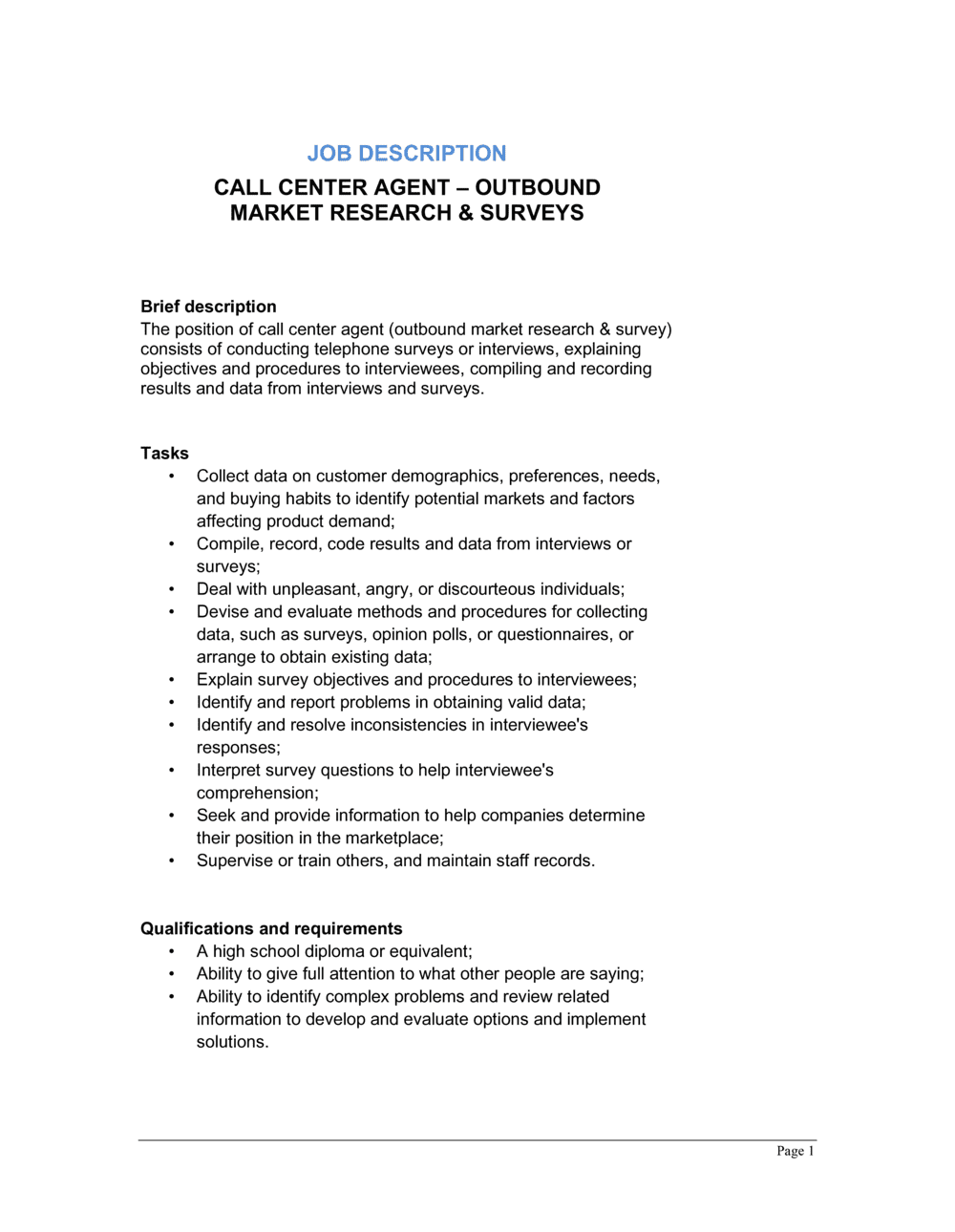
Enter the position details and reporting line
Fill in the official job title, employment type (full-time, part-time, or contract), the name and title of the direct supervisor, and the work location or remote designation. These fields anchor every other section.
💡 Confirm the employment type before filling this in — misclassifying a contractor as an employee or vice versa triggers tax and benefits liability that far exceeds any administrative convenience.
2
Write a focused position summary
In 2–4 sentences, describe what the agent does, for whom, and to what end. Emphasize outbound calling for market research and survey data collection — not sales or lead generation.
💡 Avoid the word 'telemarketing' in a pure research role. The TCPA treats research calls and commercial solicitation calls differently, and conflating them in the job description can create regulatory exposure.
3
List essential duties with specific, measurable language
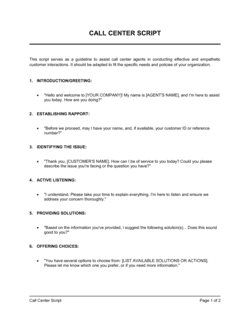
Write each duty as an action the agent takes — 'places outbound calls,' 'records responses in [SYSTEM],' 'flags DNC requests.' Avoid vague phrases like 'handles calls' or 'supports the team.'
💡 Include the verbatim-script requirement explicitly in the duties list. This is the single most important behavioral standard for survey data integrity and it is frequently omitted.
4
Set numeric KPI targets
Enter concrete benchmarks: minimum completed interviews per shift, minimum QA monitoring score percentage, maximum average handle time, and data accuracy rate. Leave placeholders only if values are project-dependent — note that in the document.
💡 Benchmark your KPIs against your current top-quartile agent performance, not your aspirational target. Unachievable standards are ignored or gamed.
5
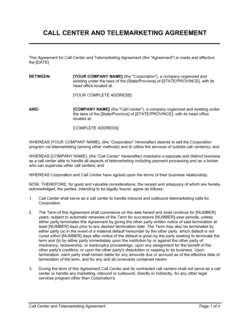
Complete the regulatory compliance clause
Confirm which laws apply based on where the agent and respondents are located — TCPA and state DNC laws for US operations, PIPEDA for Canada, and GDPR for EU respondents. Enter the required compliance training hours and completion deadline.
💡 If your sample lists include respondents in multiple jurisdictions, apply the strictest standard across all of them as the baseline for this clause.
6
Tailor the data privacy obligations to your jurisdiction
Reference the applicable privacy statutes by name — CCPA for California respondents, GDPR for EU contacts, PIPEDA for Canadian contacts. Specify which systems are authorized for data entry and storage.
💡 A research firm conducting surveys for multiple clients may be a 'service provider' under CCPA or a 'data processor' under GDPR — your agent-level obligations differ slightly under each designation. Confirm with legal counsel before finalizing.
7
Enter compensation, schedule, and incentive details
Fill in the hourly rate, weekly hours, shift schedule, overtime policy, and any per-interview bonus. If the incentive is tied to both quota and QA score, document both thresholds explicitly.
💡 State the overtime policy even if you don't expect overtime — agents who work extra hours and find no written policy create wage-and-hour liability in most jurisdictions.
8
Obtain signatures before the first shift
Have both the employee and their supervisor sign and date the acknowledgment block before the agent places their first call. File the signed copy in the employee's HR record.
💡 For remote agents, use an e-signature platform with timestamp and audit trail — this is the record you will need if a TCPA compliance inquiry identifies calls made by this agent.