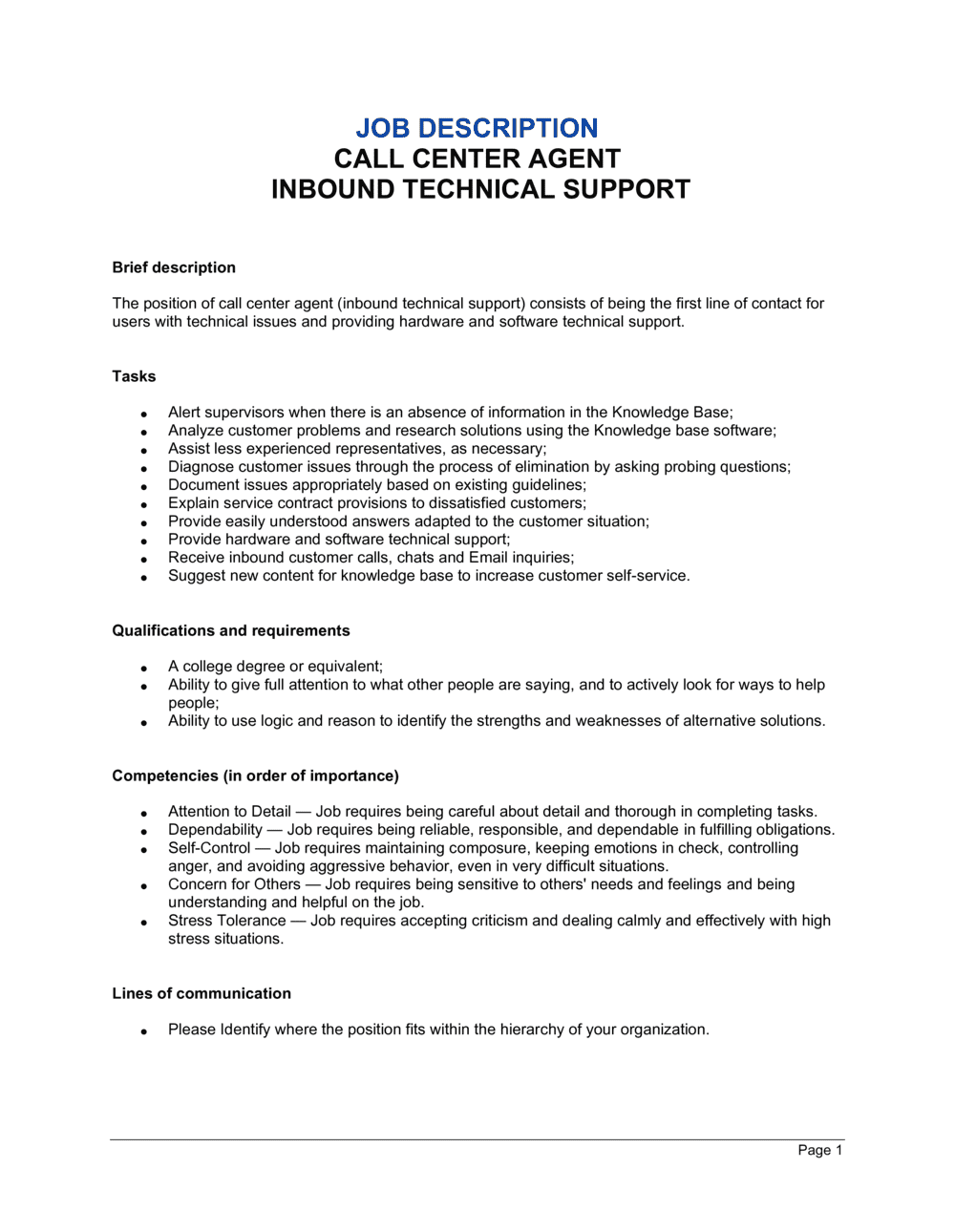
Call Center Agent_Inbound_Technical Support Job Description Template

Free Word download • Edit online • Save & share with Drive • Export to PDF

2 pages20–30 min to fillDifficulty: StandardSignature requiredLegal review recommended
Learn more ↓
FreeCall Center Agent_Inbound_Technical Support Job Description Template

At a glance

What it is
A Call Center Agent Inbound Technical Support Job Description is a formal employment document that defines the scope, responsibilities, qualifications, performance expectations, and reporting structure for an agent handling inbound technical support calls. This free Word download gives employers a legally grounded starting point they can edit online and export as PDF for use in recruitment, onboarding, and performance management.
When you need it
Use it when posting a new inbound technical support role, restructuring an existing call center team, or standardizing role definitions across a support department. It is also essential during onboarding to align new hires with performance expectations from day one.
What's inside
Role summary and reporting structure, core duties and daily responsibilities, required and preferred qualifications, technical skills and tool proficiencies, key performance indicators, compensation framework, and acknowledgment and signature block for employer and employee.

What is a Call Center Agent Inbound Technical Support Job Description?

A Call Center Agent Inbound Technical Support Job Description is a formal employment document that defines the role scope, daily duties, required qualifications, technical skill requirements, KPIs, compensation framework, and data-handling obligations for an agent responsible for receiving and resolving inbound technical support calls. Unlike a general job posting, this document is designed to be signed by both the employer and the employee, making it a referenced standard for performance management, disciplinary action, and role-boundary disputes throughout the employment relationship. It covers everything from ticketing system proficiencies and first-call resolution targets to confidentiality obligations that govern how agents handle sensitive customer data.

Why You Need This Document

Without a specific, signed job description, employers have no objective baseline for measuring performance, managing underperformance, or defending a termination decision in an employment dispute. A call center environment magnifies this risk: agents handle high call volumes, access customer personal data, and operate against measurable KPIs — and every one of those elements needs to be documented before the first shift begins. Vague or unsigned job descriptions are routinely cited in wrongful dismissal claims as evidence that the employer failed to communicate expectations clearly. Beyond legal protection, a well-structured job description accelerates onboarding by giving new agents an unambiguous picture of what success looks like on day 30, 60, and 90. This template gives HR managers and small business owners a legally grounded, editable starting point that covers every material clause — saving hours of drafting time and reducing the risk of costly omissions.

Which variant fits your situation?

If your situation is…Use this template
Hiring an agent focused on outbound sales or follow-up callsCall Center Agent Outbound Sales Job Description
Defining a senior or team lead technical support roleTechnical Support Team Lead Job Description
Recruiting a general customer service representativeCustomer Service Representative Job Description
Staffing a live chat or email-only support roleCustomer Support Specialist (Chat/Email) Job Description
Hiring a Level 2 or escalation support technicianTechnical Support Specialist Level 2 Job Description
Onboarding a full-time employee with compensation and benefits termsEmployment Contract
Engaging a contractor for short-term call center coverageIndependent Contractor Agreement

Common mistakes to avoid

❌ No signature block on the job description

Why it matters: Without a signed acknowledgment, the employer cannot treat the job description as an agreed document during a performance dispute or disciplinary action — the agent can claim they were unaware of the expectations.

Fix: Always include a signature block and obtain execution before or on the first day. File the signed copy with the employment contract.

❌ Vague KPIs with no numeric targets

Why it matters: A KPI section that says 'maintain high CSAT' or 'resolve calls efficiently' provides no enforceable standard and makes performance improvement plans legally vulnerable.

Fix: State specific numeric thresholds — 'FCR rate of 75% or above, AHT of 6 minutes or less' — and reference them in the employment contract's performance review clause.

❌ Omitting data confidentiality and privacy obligations

Why it matters: Call center agents routinely access names, account numbers, and payment data. Without an explicit confidentiality clause, enforcing data-handling obligations after a breach is significantly harder.

Fix: Include a confidentiality clause and reference applicable privacy laws (HIPAA, PIPEDA, GDPR) where relevant. Have the agent sign the document acknowledging these obligations.

❌ Listing salary as 'competitive' without a range

Why it matters: Multiple US states and EU member states now require pay ranges in job postings. Non-compliance exposes employers to regulatory complaints and disadvantages them in attracting candidates who screen on compensation.

Fix: Enter a specific hourly rate or salary band and review applicable pay transparency laws in every jurisdiction where the role will be posted or filled.

❌ Failing to distinguish required from preferred qualifications

Why it matters: Bundling all qualifications together makes it harder to justify screening decisions under equal-opportunity laws — a rejected candidate can challenge that an unlisted preference was applied.

Fix: Create two explicit sections — 'Required Qualifications' and 'Preferred Qualifications' — and apply the distinction consistently in the screening process.

❌ Generic duties list that applies to any support role

Why it matters: A non-specific duties section fails to screen candidates, creates ambiguity during performance reviews, and cannot support a termination for-cause decision based on role failure.

Fix: Reference the specific product, platform, shift, and escalation protocol the agent will work with — replacing 'handle customer inquiries' with 'diagnose and resolve [PRODUCT] connectivity issues using [TOOL] per Level 1 protocol.'

The 10 key clauses, explained

Job Title, Department, and Reporting Structure

In plain language: Identifies the exact role title, the department it belongs to, and who the agent reports to directly.

Sample language
Job Title: Call Center Agent — Inbound Technical Support | Department: Customer Support | Reports to: [SUPERVISOR TITLE] | Location: [OFFICE ADDRESS / REMOTE]

Common mistake: Using a generic title like 'Support Agent' without specifying inbound or technical scope — this creates mismatched expectations during recruitment and complicates performance reviews.

Role Summary

In plain language: A 2–4 sentence overview of the position's primary purpose, the type of customers or accounts served, and the general work environment.

Sample language
The Call Center Agent — Inbound Technical Support is responsible for receiving and resolving inbound technical inquiries from [TARGET CUSTOMER SEGMENT] via phone, and where applicable, chat and email. The agent operates within a [SHIFT SCHEDULE] environment and is the first point of contact for [PRODUCT/SERVICE] troubleshooting.

Common mistake: Writing a role summary so broad it could apply to any support role — omitting 'inbound' and 'technical' specifics means the document fails to screen out mismatched candidates.

Core Duties and Responsibilities

In plain language: An itemized list of the agent's day-to-day tasks — answering calls, diagnosing issues, logging tickets, and escalating as needed.

Sample language
- Answer inbound technical support calls within SLA targets. - Diagnose and resolve [PRODUCT/SERVICE] issues using the knowledge base and approved troubleshooting scripts. - Log all interactions in [TICKETING SYSTEM]. - Escalate unresolved issues to Level 2 support within [X] minutes per protocol.

Common mistake: Listing tasks without indicating frequency or priority — agents cannot self-organize effectively when all duties appear equally weighted.

Required Qualifications

In plain language: Minimum education, experience, certifications, and language requirements the candidate must meet to be considered.

Sample language
- High school diploma or equivalent required; associate degree in a technology-related field preferred. - [X]+ years of call center or technical support experience. - Proficiency in [OPERATING SYSTEM / SOFTWARE PLATFORM]. - Fluency in [LANGUAGE(S)] required.

Common mistake: Setting qualification thresholds that are either too high (narrowing the candidate pool without justification) or too vague (e.g., 'some technical experience') to support a defensible hiring decision.

Technical Skills and Tool Proficiencies

In plain language: Specific software, hardware, and technical knowledge the agent must demonstrate — including ticketing platforms, remote desktop tools, and product-specific systems.

Sample language
Required: Proficiency in [TICKETING SYSTEM], [REMOTE SUPPORT TOOL], and [CRM PLATFORM]. Familiarity with [OPERATING SYSTEM] troubleshooting and [NETWORK PROTOCOL] basics. Experience with [COMPANY PRODUCT/SERVICE] or comparable technology preferred.

Common mistake: Omitting tool-specific requirements entirely and relying on 'general computer proficiency' — this leads to costly onboarding gaps when agents cannot use core systems on day one.

Key Performance Indicators (KPIs)

In plain language: The measurable performance targets the agent is held to — FCR rate, AHT, CSAT score, call volume, and schedule adherence.

Sample language
Agent performance will be evaluated against: First Call Resolution rate of [X]% or above; Average Handle Time of [X] minutes or less; CSAT score of [X]/5 or above; Schedule adherence of [X]% or above.

Common mistake: Including KPIs in the job description but not referencing them in the employment contract or performance review process — this creates an expectation without an enforceable accountability mechanism.

Work Schedule, Shift Requirements, and Physical Demands

In plain language: States the agent's expected schedule, shift rotation, overtime eligibility, and any physical or environmental requirements.

Sample language
This position requires availability for [SHIFT HOURS, e.g., Monday–Friday, 8:00 AM–6:00 PM] on a rotating schedule. Occasional weekend or holiday coverage may be required. The role involves prolonged periods of sitting and continuous use of a telephone headset and computer workstation.

Common mistake: Failing to disclose shift rotation or weekend requirements upfront — agents who discover these terms after accepting an offer are more likely to resign within the probationary period, increasing turnover cost.

Compensation, Benefits, and Incentives

In plain language: States the hourly rate or salary range, bonus or incentive structure, and the benefits the employee is eligible for.

Sample language
Hourly rate: $[X]–$[X] per hour, commensurate with experience. Eligible for performance-based bonus of up to [X]% of annual earnings based on CSAT and FCR targets. Benefits include [HEALTH/DENTAL/VISION], [PTO DAYS] days PTO, and [401K / RRSP] with [X]% employer match.

Common mistake: Omitting the pay range or listing only 'competitive compensation' — several US states and the EU now require salary ranges in job postings, and omitting them can expose employers to compliance risk.

Confidentiality and Data Handling Obligations

In plain language: Requires the agent to protect customer data, proprietary scripts, and internal systems — particularly important in call centers handling sensitive personal or financial information.

Sample language
Agent agrees to maintain the confidentiality of all customer information, call recordings, internal scripts, and proprietary systems accessed during employment. Unauthorized disclosure of customer data may result in immediate termination and civil or criminal liability under applicable privacy laws.

Common mistake: Treating data confidentiality as implicit rather than explicit — without a signed acknowledgment, enforcing data-handling obligations against a departing agent is significantly harder.

Acknowledgment and Signature Block

In plain language: Confirms that both the employer and the employee have reviewed, understood, and agreed to the terms of the job description.

Sample language
I acknowledge that I have received, read, and understand the requirements and expectations described in this job description. | Employee Signature: _______________ Date: ________ | Employer Representative: _______________ Date: ________

Common mistake: Skipping the signature block entirely and treating the document as an informational handout — without a signed acknowledgment, the employer cannot enforce performance standards or the confidentiality clause as agreed terms.

How to fill it out

  1. 1

    Enter the job title, department, and reporting line

    Fill in the exact job title as it will appear in the HRIS, the department name, and the direct supervisor's title. Include the work location or remote-work status.

    💡 Use the same job title across the job posting, offer letter, and employment contract — inconsistencies create classification issues in payroll and compliance records.

  2. 2

    Write a specific role summary

    Describe what the agent does, which customer segment they serve, and what product or platform they support. Limit this to 3–4 sentences and keep it free of marketing language.

    💡 Include the word 'inbound' and the specific product or service category in the role summary — this cuts unqualified applications by narrowing candidate self-selection.

  3. 3

    List core duties in priority order

    Itemize day-to-day tasks starting with the most frequent and highest-impact. Use action verbs — 'diagnose,' 'log,' 'escalate,' 'resolve' — and reference the specific tools or protocols involved.

    💡 Limit the duties list to 8–10 items. A list of 20 tasks signals poor role design and makes performance management harder.

  4. 4

    Define required versus preferred qualifications separately

    Separate must-have qualifications (minimum experience, required certifications, mandatory language fluency) from preferred ones (product-specific experience, advanced certifications). This distinction matters for equal-opportunity compliance.

    💡 Review qualification thresholds against your existing team's profile — if your current high performers don't meet the stated minimums, recalibrate before posting.

  5. 5

    Specify tools and technical proficiencies by name

    List every platform the agent will use on day one by its actual product name — ticketing system, remote desktop tool, CRM, and internal knowledge base — rather than generic categories.

    💡 Contact the IT or ops team to get the current tool stack before finalizing — outdated tool references in a job description create confusion during onboarding.

  6. 6

    Set measurable KPI targets

    Enter specific numeric targets for FCR rate, AHT, CSAT score, and schedule adherence. These should reflect the team's actual current benchmarks, not aspirational targets.

    💡 If the targets are new or above current team averages, flag them explicitly in the onboarding conversation — surprising agents with unachievable KPIs in the first 30 days drives early attrition.

  7. 7

    Complete the compensation block with a salary range

    Enter the hourly rate range, any performance bonus structure, and benefits eligibility. Check applicable state or country pay transparency laws before publishing externally.

    💡 In jurisdictions requiring pay transparency (California, Colorado, New York, EU), failing to include a salary range is a compliance violation — not just a best practice.

  8. 8

    Obtain signatures before the first day

    Have both the employee and an authorized employer representative sign and date the document before the start date. Retain a copy in the employee's personnel file.

    💡 Use an eSign tool to timestamp execution and store the fully executed copy alongside the employment contract — matching signatures across both documents supports enforcement if disputes arise.

Frequently asked questions

What is a call center agent inbound technical support job description?

A call center agent inbound technical support job description is a formal document that defines the duties, qualifications, KPIs, compensation, and behavioral expectations for an agent who receives incoming calls from customers seeking help with a technical product or service. It serves as both a recruitment tool and a legally referenced document during onboarding, performance reviews, and disciplinary procedures.

Is a job description a legally binding document?

A job description is generally not a standalone contract, but it becomes legally significant when signed by both parties and incorporated by reference into an employment contract. In most jurisdictions, a signed job description can be used as evidence of agreed performance expectations and role scope in employment disputes. Including a signature block and filing it with the employment contract is strongly recommended.

What KPIs should be included in a technical support agent job description?

The four core KPIs for inbound technical support roles are First Call Resolution (FCR) rate, Average Handle Time (AHT), Customer Satisfaction Score (CSAT), and schedule adherence. Some employers also include call volume targets and escalation rate thresholds. KPIs should be expressed as specific numeric targets — such as FCR of 75% or above and AHT of 6 minutes or less — rather than qualitative descriptors.

What qualifications are typically required for an inbound technical support agent?

Most employers require a high school diploma or equivalent, one to two years of call center or help desk experience, and proficiency in the specific ticketing and CRM platforms used by the team. Preferred qualifications often include an associate degree in a technology-related field, product-specific certifications, and experience with remote desktop tools. Language requirements depend on the customer base served.

Do I need to include a salary range in the job description?

In several US states — including California, Colorado, New York, and Washington — and across EU member states under the EU Pay Transparency Directive, employers are required by law to disclose a salary or hourly pay range in job postings. Even where not legally required, including a range reduces unqualified applications and shortens time-to-offer by filtering candidates whose expectations don't align with the budget.

How does a job description differ from an employment contract?

A job description defines what the employee is expected to do — duties, qualifications, KPIs, and tools. An employment contract creates the binding legal relationship — compensation, benefits, IP ownership, confidentiality, termination terms, and governing law. Both documents are needed: the job description sets performance expectations, and the employment contract governs the legal terms of the relationship. They should be executed together on or before the first day of work.

Can I use the same job description template across multiple jurisdictions?

A core template can be reused, but jurisdiction-specific adjustments are necessary. Pay transparency requirements, at-will versus notice-period language, and data privacy references (GDPR in the EU, PIPEDA in Canada, HIPAA in US healthcare) all vary by location. Review the template against local employment standards before posting in each jurisdiction and consult an employment lawyer for multi-country deployments.

Should the job description reference the company's data privacy obligations?

Yes. Inbound technical support agents regularly access customer names, account numbers, device information, and sometimes payment data. The job description should explicitly state the agent's obligation to handle this data in accordance with company policy and applicable privacy law. This reference, combined with a signature block, supports enforcement in the event of a data-handling breach.

How often should a call center agent job description be updated?

Review and update the job description whenever the tool stack changes, KPI targets are revised, the product scope shifts, or the reporting structure is reorganized. At minimum, an annual review aligned with performance cycle planning is recommended. An outdated job description with obsolete tools or superseded KPIs weakens its value as a performance management document.

How this compares to alternatives

vs Employment Contract

A job description defines what the employee does — duties, qualifications, KPIs, and tools. An employment contract creates the binding legal relationship covering compensation, IP, confidentiality, termination, and governing law. Both are needed for every hire: the job description sets performance expectations, while the contract governs legal obligations. Execute them together before day one.

vs Offer Letter

An offer letter confirms the role and compensation package to trigger acceptance. It is not a performance document and typically lacks KPIs, detailed duties, and data-handling obligations. A signed job description supplements the offer letter by establishing the specific standards the employee is accountable to throughout the employment relationship.

vs Independent Contractor Agreement

An independent contractor agreement engages a self-employed individual for project-based or temporary support work without employment entitlements. A job description is used for employees who are subject to direct supervision, shift schedules, and performance management. Misclassifying a regularly supervised call center agent as a contractor triggers back taxes, penalties, and benefit liability.

vs Employee Performance Review Template

A performance review evaluates how well the employee has met the expectations defined in the job description. The job description is the input; the performance review is the output. Without a specific, signed job description to reference, performance reviews lack an objective baseline and are harder to defend in a wrongful termination dispute.

Industry-specific considerations

SaaS / Technology

Agents support subscription software products via phone, requiring proficiency in remote desktop tools, bug logging platforms, and tiered escalation to engineering.

Telecommunications

Agents handle high-volume inbound calls for internet, cable, and mobile service issues, with strict AHT and FCR targets tied to regulatory service-level commitments.

Healthcare / MedTech

HIPAA compliance obligations and patient data handling requirements must be explicitly referenced in the duties and confidentiality clauses.

Financial Services

Agents accessing account data must meet PCI-DSS and FINRA or FCA compliance standards, with confidentiality and data-handling clauses tailored accordingly.

Jurisdictional notes

United States

At-will employment is the default in 49 states, but the job description must avoid language implying job security or guaranteed tenure. California, Colorado, New York, and Washington require salary or pay range disclosure in job postings. HIPAA applies where agents handle protected health information. The FTC's proposed non-compete rule (status: contested as of 2025) may affect any restrictive covenants referenced in or attached to the job description.

Canada

Employers must comply with provincial employment standards on minimum wage, overtime, and termination notice — terms referenced in the job description must not fall below statutory minimums. PIPEDA (or provincial equivalents in Alberta, BC, and Quebec) governs the handling of customer personal data accessed by agents. Quebec requires French-language documentation for provincially regulated employers. Pay transparency requirements are emerging in BC and Ontario.

United Kingdom

A job description does not replace the written statement of employment particulars required on or before day one under the Employment Rights Act 1996, but it can be attached as a schedule. UK data protection law (UK GDPR and the Data Protection Act 2018) requires agents handling customer data to receive explicit training and acknowledgment — the confidentiality clause should reference these obligations. The Equality Act 2010 prohibits qualification thresholds that indirectly discriminate on protected characteristics.

European Union

The EU Pay Transparency Directive (effective 2026 for large employers) requires pay range disclosure before interviews. GDPR imposes strict obligations on employees who access personal data; the job description's data-handling clause should explicitly reference GDPR compliance and Article 5 processing principles. The EU Transparent and Predictable Working Conditions Directive requires that core job terms be provided in writing within 7 days of hire — a signed job description supports this requirement when attached to the employment contract.

Template vs lawyer — what fits your deal?

PathBest forCostTime
Use the templateHR managers and small business owners hiring standard inbound technical support agents in a single domestic jurisdictionFree15–30 minutes
Template + legal reviewCompanies hiring in multiple US states, across Canadian provinces, or with HIPAA, GDPR, or PCI-DSS data-handling obligations$200–$500 for an employment counsel review1–3 days
Custom draftedEnterprise call centers operating across multiple countries, heavily regulated industries, or where non-compete or IP clauses are embedded in the job description$500–$2,000+1–2 weeks

Glossary

Inbound Call
A call initiated by a customer and received by the support center, as opposed to an outbound call placed by an agent.
First Call Resolution (FCR)
A KPI measuring the percentage of customer issues resolved during the initial call without requiring escalation or a callback.
Average Handle Time (AHT)
The average total time an agent spends on a call, including talk time, hold time, and after-call work — typically expressed in seconds or minutes.
Escalation
The process of transferring an unresolved customer issue to a higher-tier agent, supervisor, or specialist with greater authority or technical knowledge.
Ticketing System
Software used to log, track, and resolve customer support requests, such as Zendesk, Freshdesk, or ServiceNow.
Service Level Agreement (SLA)
A commitment between a service provider and customer defining response time, resolution time, and quality standards for support interactions.
CSAT (Customer Satisfaction Score)
A survey-based metric collected after a support interaction, measuring the customer's satisfaction on a defined scale — typically 1 to 5.
Knowledge Base
A searchable internal or external repository of articles, FAQs, and troubleshooting guides that agents use to resolve issues consistently.
At-Will Employment
Employment that either party may end at any time for any lawful reason, without advance notice — the default in most US states.
KPI (Key Performance Indicator)
A measurable target used to evaluate an employee's performance — in a call center context, typically FCR rate, AHT, CSAT score, and call volume.

Part of your Business Operating System

This document is one of 3,000+ business & legal templates included in Business in a Box.

  • Fill-in-the-blanks — ready in minutes
  • 100% customizable Word document
  • Compatible with all office suites
  • Export to PDF and share electronically

Create your document in 3 simple steps.

From template to signed document — all inside one Business Operating System.
1
Download or open template

Access over 3,000+ business and legal templates for any business task, project or initiative.

2
Edit and fill in the blanks with AI

Customize your ready-made business document template and save it in the cloud.

3
Save, Share, Send, Sign

Share your files and folders with your team. Create a space of seamless collaboration.

Save time, save money, and create top-quality documents.

★★★★★

"Fantastic value! I'm not sure how I'd do without it. It's worth its weight in gold and paid back for itself many times."

Managing Director · Mall Farm
Robert Whalley
Managing Director, Mall Farm Proprietary Limited
★★★★★

"I have been using Business in a Box for years. It has been the most useful source of templates I have encountered. I recommend it to anyone."

Business Owner · 4+ years
Dr Michael John Freestone
Business Owner
★★★★★

"It has been a life saver so many times I have lost count. Business in a Box has saved me so much time and as you know, time is money."

Owner · Upstate Web
David G. Moore Jr.
Owner, Upstate Web

Run your business with a system — not scattered tools

Stop downloading documents. Start operating with clarity. Business in a Box gives you the Business Operating System used by over 250,000 companies worldwide to structure, run, and grow their business.

Free Forever Plan · No credit card required