Business Ethics Guide

Free Word download β€’ Edit online β€’ Save & share with Drive β€’ Export to PDF

11 pagesβ€’25–35 min to fillβ€’Difficulty: Complex
Learn more ↓
FreeBusiness Ethics Guide Template

At a glance

What it is
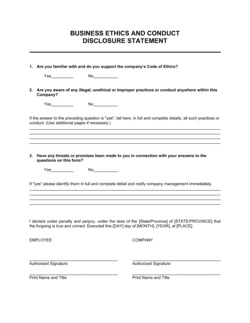
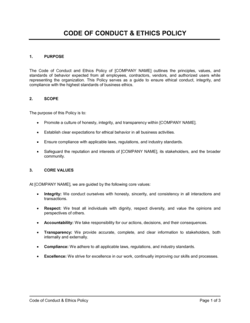
A Business Ethics Guide is a structured policy document that defines the values, behavioral expectations, and decision-making standards your organization holds employees, managers, and leadership accountable to. This free Word download gives you a ready-to-edit framework covering conduct, conflicts of interest, confidentiality, anti-corruption, and reporting channels β€” exportable as PDF for distribution across your team.
When you need it
Use it when onboarding new employees, responding to a compliance audit, applying for government contracts that require a written ethics policy, or formalizing cultural standards as your team grows beyond a founding circle.
What's inside
Core values statement, employee conduct standards, conflict-of-interest policy, anti-bribery and anti-corruption rules, confidentiality obligations, social media and public communications guidelines, reporting procedures and whistleblower protections, and enforcement and disciplinary framework.

What is a Business Ethics Guide?

A Business Ethics Guide is a policy document that defines the values, behavioral standards, and decision-making principles an organization expects from every employee, manager, contractor, and board member who acts on its behalf. It covers the full spectrum of ethical conduct β€” from everyday professional behavior and conflict-of-interest disclosures to anti-bribery rules, confidentiality obligations, and the procedures for reporting misconduct. Unlike a legal contract, a business ethics guide operates as an internal governance instrument, but its existence, distribution, and enforcement carry real weight in regulatory audits, employment disputes, and investor due-diligence reviews.

Why You Need This Document

Without a written ethics guide, your organization has no documented standard to enforce β€” making it nearly impossible to discipline an employee for misconduct, defend against a compliance investigation, or demonstrate to a regulator that you took reasonable preventive steps. US federal contractors over $5 million are required by FAR 52.203-13 to maintain a written code of ethics; financial services and healthcare firms face their own overlay obligations. Beyond regulatory exposure, an undocumented ethics framework means that as your team grows, conduct expectations are transmitted informally and inconsistently β€” creating the conditions for the exact conflicts and misconduct a guide is designed to prevent. This template gives you a structured, customizable starting point that you can tailor to your industry's specific risks, distribute to your entire workforce, and update annually as your business and its obligations evolve.

Which variant fits your situation?

If your situation is…Use this template
Establishing a concise values and conduct policy for a small teamCode of Ethics
Creating a detailed employee handbook with conduct as one chapterEmployee Handbook
Addressing conflicts of interest for board members and executivesConflict of Interest Policy
Documenting anti-bribery compliance for government contract eligibilityAnti-Bribery and Corruption Policy
Setting up a formal channel for reporting misconductWhistleblower Policy
Communicating company values and culture to new hiresCompany Culture and Values Document
Formalizing social media conduct rules for staffSocial Media Policy

Common mistakes to avoid

❌ Copying a generic template without tailoring it to your industry

Why it matters: A guide that references risks your business doesn't face β€” and omits the ones it does β€” signals to regulators and employees that ethics compliance is performative, not operational.

Fix: Identify the two or three highest-risk ethical exposure areas specific to your industry (e.g., kickbacks in construction, insider information in finance) and build those scenarios explicitly into the guide.

❌ Setting a gift threshold without a gift log requirement

Why it matters: A written threshold is unverifiable without a corresponding record. During a Foreign Corrupt Practices Act or UK Bribery Act audit, undocumented gifts are treated as violations regardless of value.

Fix: Require a simple gift log β€” recipient name, date, value, business justification β€” for any gift or entertainment above a low tracking threshold, such as $25.

❌ Listing a single reporting contact with no backup

Why it matters: When the named contact is the subject of a complaint, employees have no credible path to report β€” the policy effectively fails at the moment it is most needed.

Fix: Name at least two escalation options: a direct contact (HR or compliance officer) and an independent alternative (board audit committee chair or a third-party ethics hotline).

❌ Publishing the guide without collecting signed acknowledgments

Why it matters: An unacknowledged policy is difficult to enforce in disciplinary proceedings and provides weak protection in employment litigation β€” employees can credibly claim they were never informed.

Fix: Distribute the guide with a one-page acknowledgment form that employees sign and date. Store signed copies in personnel files and track completion as an HR metric.

❌ Never updating the guide after initial publication

Why it matters: Laws change, thresholds become outdated, reporting contacts leave the company, and new risk areas emerge β€” a static guide quietly becomes inaccurate and unenforceable.

Fix: Conduct a formal annual review aligned to your fiscal year. Assign a named owner (compliance officer or HR director) responsible for initiating the review and distributing the updated version.

❌ Writing enforcement language too vaguely to be actionable

Why it matters: Phrases like 'appropriate corrective action may be taken' give employees and managers no guidance on proportionality and invite inconsistent application that creates discrimination exposure.

Fix: Describe a tiered disciplinary framework β€” verbal warning, written warning, suspension, termination β€” with examples of which violations trigger which tier.

The 9 key sections, explained

Introduction and Purpose

Core Values Statement

Employee Conduct Standards

Conflict of Interest Policy

Anti-Bribery and Anti-Corruption Standards

Confidentiality and Information Security

Social Media and Public Communications

Reporting Procedures and Whistleblower Protections

Enforcement and Disciplinary Framework

How to fill it out

  1. 1

    Insert your company name and scope

    Replace [COMPANY NAME] throughout the document and confirm the scope β€” whether it covers employees only, or also contractors, board members, and agents.

    πŸ’‘ Contractors and third-party vendors who act on the company's behalf should be explicitly included, especially for anti-bribery compliance.

  2. 2

    Define your core values with behavioral descriptions

    Choose three to six values that reflect how your organization actually operates. For each, write one sentence describing what it looks like in practice.

    πŸ’‘ Test each value statement against a real scenario that happened in your company β€” if it doesn't help resolve the scenario, rewrite it.

  3. 3

    Set your conflict-of-interest disclosure process

    Name the specific role (HR director, compliance officer, or legal counsel) who receives conflict disclosures and describe the review and approval process.

    πŸ’‘ Build a simple disclosure form β€” even a one-page template β€” and reference it in this section so the process is concrete, not aspirational.

  4. 4

    Set thresholds for gifts and entertainment

    Enter a specific dollar threshold for acceptable gifts and entertainment per recipient per year β€” a common range is $50–$200 for most industries. Require a gift log for anything above a lower tracking threshold.

    πŸ’‘ Check industry-specific rules before setting thresholds: regulated sectors like financial services, healthcare, and government contracting have statutory limits that override your internal policy.

  5. 5

    Configure reporting channels and backup contacts

    Enter the name and contact information for the primary reporting recipient. Add at least one alternative β€” typically the board chair or an external ethics hotline β€” for cases where the primary contact is the subject of the complaint.

    πŸ’‘ Anonymous reporting channels increase the volume of credible reports by 40–60% compared to named-only channels, according to ethics program benchmarks.

  6. 6

    Define the investigation and response timeline

    Enter a specific number of business days for initial acknowledgment (typically 2–3 days) and for investigation completion (typically 30–45 days). Name the role responsible for each step.

    πŸ’‘ A written timeline creates accountability and protects the organization from claims that complaints were ignored.

  7. 7

    Tailor the social media and communications section

    Adjust the social media section to reflect your industry's specific risks β€” MNPI restrictions for publicly traded companies, patient privacy for healthcare, or attorney-client privilege for legal firms.

    πŸ’‘ Have an employment attorney in your jurisdiction review the social media section before publishing β€” overly broad restrictions can violate protected concerted activity rules.

  8. 8

    Distribute, acknowledge, and schedule annual review

    Distribute the finalized guide to all covered parties and collect signed acknowledgment forms. Set a calendar reminder for an annual review β€” typically aligned with your fiscal year β€” to update thresholds, contacts, and any regulatory changes.

    πŸ’‘ Store signed acknowledgments in each employee's personnel file. During an audit or litigation, proof of distribution and acknowledgment is as important as the document itself.

Frequently asked questions

What is a business ethics guide?

A business ethics guide is a policy document that defines an organization's core values, behavioral expectations, and decision-making standards for employees, managers, and leadership. It typically covers conduct standards, conflict-of-interest rules, anti-bribery requirements, confidentiality obligations, and reporting procedures. Unlike a legal contract, it is an internal governance document β€” but its contents can carry significant weight in regulatory audits, employment disputes, and due-diligence reviews.

What is the difference between a business ethics guide and a code of conduct?

A code of conduct is typically a shorter, more prescriptive list of rules β€” what employees must and must not do. A business ethics guide is broader and more explanatory, framing behavior within the company's values and providing reasoning and context for each standard. In practice, many organizations use the terms interchangeably, but a guide tends to include more narrative guidance and scenario-based examples than a rulebook.

Who needs a business ethics guide?

Any organization with employees, contractors, or agents who make decisions on its behalf benefits from a written ethics guide. It is particularly important for companies seeking government contracts (which often require a written ethics policy), businesses in regulated industries, nonprofits with board governance obligations, and any company undergoing investor due diligence or preparing for an audit. Even small teams benefit from setting written norms before an ethical issue arises.

Is a business ethics guide legally required?

For most private businesses, a written ethics guide is not legally mandated. However, certain contexts create near-requirements: US federal contractors over $5 million are required under FAR 52.203-13 to have a written code of ethics and a compliance program. Publicly traded companies face SEC and stock-exchange listing standards requiring codes of ethics for senior officers. Regulated industries β€” financial services, healthcare, and government contracting β€” carry their own ethics documentation requirements.

How often should a business ethics guide be updated?

An annual review is the standard practice, typically aligned to the fiscal year. Updates are also triggered by changes in applicable law, a significant compliance incident, a leadership change, or a new business line that introduces new risk areas. A guide that has not been reviewed in more than 18 months should be treated as potentially outdated, particularly its reporting contacts, gift thresholds, and regulatory references.

How do you enforce a business ethics guide?

Enforcement requires four elements: a documented distribution and acknowledgment process so employees cannot claim ignorance, a clear reporting channel for violations, a defined investigation procedure with named ownership and timelines, and a tiered disciplinary framework that specifies consequences proportionate to the severity of the violation. Without all four, the guide is aspirational rather than operational.

What is the difference between a business ethics guide and a compliance program?

A business ethics guide documents standards and expectations β€” what the organization values and what behavior it requires. A compliance program is the broader operational system that enforces those standards β€” training cycles, internal audits, reporting systems, risk assessments, and disciplinary mechanisms. The ethics guide is typically a key component of a compliance program, but the program is significantly larger in scope.

Should a business ethics guide apply to contractors and vendors?

Yes, for any contractor or vendor who acts on your behalf, has access to confidential information, or interacts with your clients. Anti-bribery laws in particular β€” including the US Foreign Corrupt Practices Act and the UK Bribery Act β€” can hold a company liable for the actions of third parties acting on its behalf. Including contractors and key vendors in the scope of your ethics guide is one of the primary defenses against third-party compliance exposure.

Can a business ethics guide protect the company in litigation?

A well-implemented ethics guide can support a company's defense in several ways: it demonstrates that the organization took reasonable steps to prevent misconduct, it establishes the standard of conduct against which an employee's behavior is measured, and it provides evidence that reporting channels were available. However, the guide must be accompanied by proof of distribution, acknowledgment, and actual enforcement β€” a document that exists on paper but is never applied provides limited protection.

How this compares to alternatives

vs Employee Handbook

An employee handbook is a comprehensive HR reference covering policies on leave, benefits, performance management, and conduct. A business ethics guide focuses specifically on values, ethical decision-making, anti-corruption, and reporting. The ethics guide is typically one chapter of a full handbook, but organizations in regulated industries often publish it as a standalone document for easier distribution and annual acknowledgment.

vs Code of Conduct

A code of conduct is a shorter, rule-based document that lists specific dos and don'ts for employee behavior. A business ethics guide is broader β€” it contextualizes those rules within the company's values, explains the reasoning behind each standard, and includes procedures for reporting and enforcement. A code of conduct tells employees what to do; an ethics guide also explains why and what happens when rules are breached.

vs Whistleblower Policy

A whistleblower policy is a single-purpose document focused exclusively on the reporting channel, investigation procedure, and retaliation protections for employees who report misconduct. A business ethics guide incorporates whistleblower provisions as one section within a broader conduct and values framework. Organizations that face high compliance risk often maintain both β€” using the ethics guide for culture-setting and the whistleblower policy as the operational procedure document.

vs Non-Disclosure Agreement

An NDA is a legally binding contract that creates enforceable confidentiality obligations between named parties. A business ethics guide's confidentiality section establishes the internal behavioral standard but is not a contract β€” it does not create rights against third parties. For sensitive IP and client relationships, both documents are needed: the NDA for legal enforcement, the ethics guide for internal conduct standards.

Industry-specific considerations

Financial Services

FINRA and SEC requirements for written supervisory procedures mean ethics guides in financial services must explicitly address insider trading, customer fair-dealing, and anti-money-laundering conduct standards.

Healthcare

HIPAA obligations, anti-kickback statute compliance, and patient dignity standards must be integrated into conduct expectations, with specific guidance on interactions with pharmaceutical and device vendors.

Construction and Government Contracting

Federal Acquisition Regulation (FAR) 52.203-13 mandates a written code of ethics for contractors on federal contracts over $5 million, making a documented ethics guide a contract eligibility requirement.

Professional Services

Client confidentiality, fee disclosure, and conflict-of-interest management are the dominant ethics risks, with bar association rules for law firms and AICPA standards for accounting firms creating overlay obligations.

Template vs pro β€” what fits your needs?

PathBest forCostTime
Use the templateSmall to mid-size businesses establishing a first written ethics policy for internal use or standard onboardingFree2–4 hours
Template + professional reviewCompanies in regulated industries, government contractors, or any business undergoing investor due diligence or an external audit$300–$800 for a compliance consultant or employment attorney review3–5 business days
Custom draftedPublicly traded companies, large enterprises with multi-jurisdiction operations, or businesses subject to a formal compliance program mandate$2,000–$10,000+ for a compliance program specialist2–6 weeks

Glossary

Code of Ethics
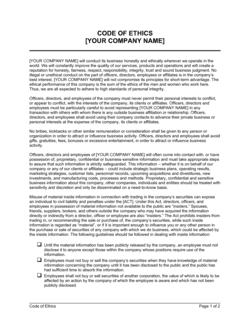
A concise statement of the core values and principles that guide an organization's decisions and conduct β€” typically shorter and more values-focused than a full ethics guide.
Conflict of Interest
A situation in which a person's private interests β€” financial, personal, or professional β€” could improperly influence their decisions or actions on behalf of the organization.
Whistleblower
An employee or insider who reports suspected misconduct, fraud, or policy violations, typically through an internal or external reporting channel.
Anti-Bribery Policy
A written rule prohibiting employees from offering, accepting, or facilitating payments or gifts intended to improperly influence a business or government decision.
Duty of Confidentiality
An obligation to protect non-public information belonging to the organization, its clients, or its partners from unauthorized disclosure.
Retaliation
Any adverse action taken against an employee for reporting a concern in good faith β€” prohibited under most whistleblower protection laws and internal ethics policies.
Ethics Hotline
An anonymous reporting channel β€” typically a phone line or online portal β€” through which employees can report suspected misconduct without fear of identification.
Due Diligence
A process of investigating a business partner, vendor, or transaction to confirm it meets the organization's legal and ethical standards before committing resources.
Material Non-Public Information (MNPI)
Confidential information about a company that has not been disclosed to the public and that could influence an investor's decision to buy or sell securities.
Tone at the Top
The ethical culture and behavioral standards modeled by senior leadership, widely regarded as the single strongest predictor of organizational ethics in practice.

Part of your Business Operating System

This document is one of 3,000+ business & legal templates included in Business in a Box.

  • Fill-in-the-blanks β€” ready in minutes
  • 100% customizable Word document
  • Compatible with all office suites
  • Export to PDF and share electronically

Create your document in 3 simple steps.

From template to signed document β€” all inside one Business Operating System.
1
Download or open template

Access over 3,000+ business and legal templates for any business task, project or initiative.

2
Edit and fill in the blanks with AI

Customize your ready-made business document template and save it in the cloud.

3
Save, Share, Send, Sign

Share your files and folders with your team. Create a space of seamless collaboration.

Save time, save money, and create top-quality documents.

β˜…β˜…β˜…β˜…β˜…

"Fantastic value! I'm not sure how I'd do without it. It's worth its weight in gold and paid back for itself many times."

Managing Director Β· Mall Farm
Robert Whalley
Managing Director, Mall Farm Proprietary Limited
β˜…β˜…β˜…β˜…β˜…

"I have been using Business in a Box for years. It has been the most useful source of templates I have encountered. I recommend it to anyone."

Business Owner Β· 4+ years
Dr Michael John Freestone
Business Owner
β˜…β˜…β˜…β˜…β˜…

"It has been a life saver so many times I have lost count. Business in a Box has saved me so much time and as you know, time is money."

Owner Β· Upstate Web
David G. Moore Jr.
Owner, Upstate Web

Run your business with a system β€” not scattered tools

Stop downloading documents. Start operating with clarity. Business in a Box gives you the Business Operating System used by over 250,000 companies worldwide to structure, run, and grow their business.

Start freeΒ Β·Β No credit card required