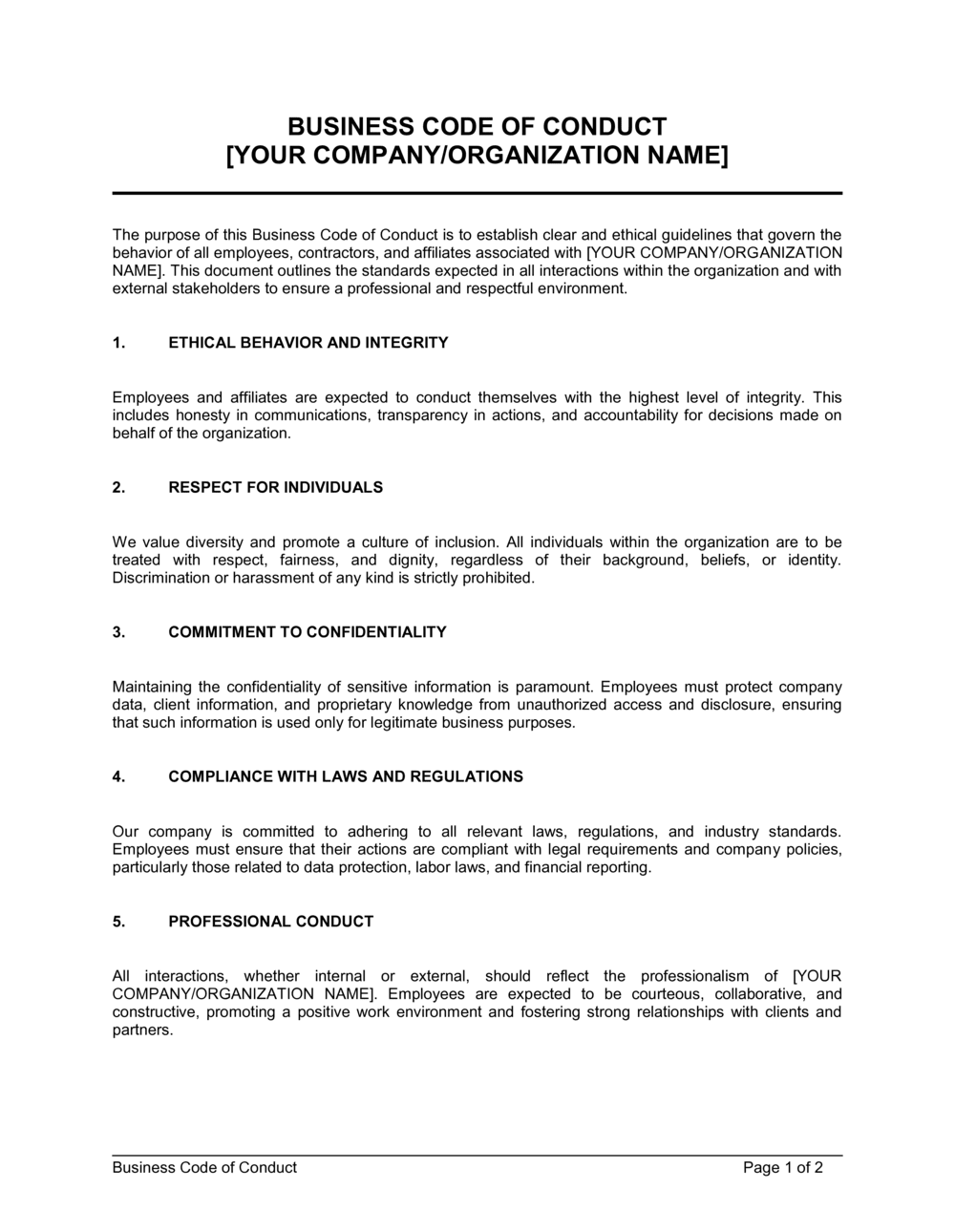
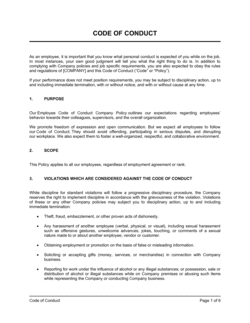
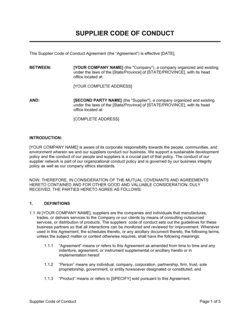
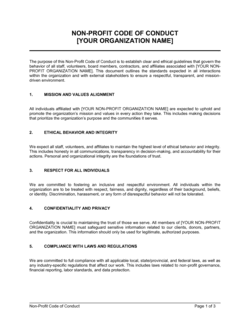
Business Code Of Conduct Template

Free Word download β€’ Edit online β€’ Save & share with Drive β€’ Export to PDF

Learn more ↓
FreeBusiness Code Of Conduct Template

At a glance

What it is
A Business Code of Conduct is a formal policy document that defines the ethical standards, behavioral expectations, and compliance obligations employees and stakeholders must follow. This free Word download gives you a structured, ready-to-customize template you can edit online and export as PDF to distribute to your team during onboarding or policy reviews.
When you need it
Use it when onboarding new employees, responding to a compliance audit, formalizing company values after a period of rapid growth, or meeting the governance requirements of an investor, partner, or public tender.
What's inside
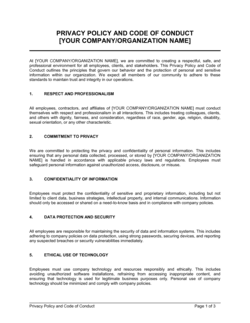
Core values and purpose statement, workplace behavior standards, conflict of interest policy, confidentiality and data-handling rules, anti-bribery and gift policy, social media and communications guidelines, reporting procedures for violations, and disciplinary consequences.

What is a Business Code of Conduct?

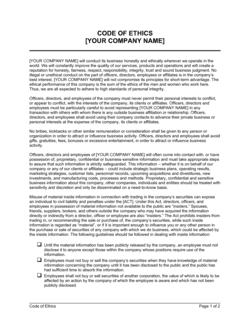
A Business Code of Conduct is a formal policy document that sets out the ethical standards, behavioral expectations, and compliance obligations an organization requires of its employees, contractors, board members, and agents. It translates the company's core values β€” integrity, respect, accountability, fairness β€” into specific rules governing areas such as conflicts of interest, confidentiality, gifts and anti-bribery, use of company assets, workplace behavior, and how to report potential violations. Unlike an employee handbook, which covers the full operational scope of employment, a code of conduct is a focused governance document that functions equally as an internal guide for daily decision-making and an external signal of the company's ethical commitments to investors, regulators, and customers.

Why You Need This Document

Operating without a written, distributed code of conduct leaves the company exposed on multiple fronts simultaneously. In a disciplinary proceeding, courts and employment tribunals look first for evidence that the behavioral standard was communicated in writing β€” its absence weakens every conduct-related termination or suspension. Regulators auditing for anti-bribery or data-privacy compliance expect to see a documented policy with evidence of employee acknowledgment; an oral culture of "we just do the right thing" does not satisfy that standard. Investors and enterprise procurement teams increasingly require a signed code as part of vendor due diligence, and the absence of one can stall or kill a deal. At the operational level, a clear code reduces the volume of conduct disputes that reach HR by giving managers a concrete document to point to rather than relying on judgment calls. This template gives you a professionally structured starting point you can customize, distribute, and update annually β€” closing the governance gap in a single afternoon.

Which variant fits your situation?

If your situation is…Use this template
Policy for a publicly traded or regulated company with strict governance requirementsCorporate Code of Ethics
Conduct rules specifically for board members and executivesBoard of Directors Code of Conduct
Standards applying to third-party suppliers and vendorsSupplier Code of Conduct
Specific anti-harassment and anti-discrimination policy for the workplaceAnti-Harassment Policy
Standalone social media use policy for employeesSocial Media Policy
Conflict of interest policy for a nonprofit board or funded organizationConflict of Interest Policy
Short internal document summarizing core behavioral expectations onlyEmployee Conduct Policy

Common mistakes to avoid

❌ Distributing the code without collecting signed acknowledgments

Why it matters: Without evidence that employees received and read the policy, the company cannot rely on it in a disciplinary hearing or employment tribunal.

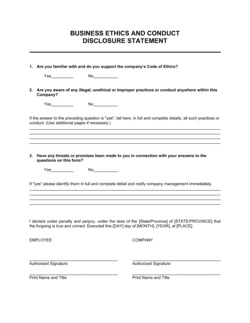
Fix: Attach an acknowledgment form to every distribution and store signed copies in personnel files or your HRIS. Require re-acknowledgment after each material update.

❌ Writing values without behavioral examples

Why it matters: Abstract principles like 'act with integrity' give employees no guidance on what to do in a real conflict β€” and give managers no basis for a disciplinary conversation.

Fix: Follow every stated value with at least one specific scenario illustrating compliant and non-compliant behavior.

❌ Naming only one reporting channel

Why it matters: Employees with concerns about their direct manager or HR have no safe escalation path, so they stay silent β€” allowing misconduct to continue and the company's legal exposure to grow.

Fix: Provide at least two channels, one of which allows anonymous reporting. For organizations with 50+ employees, consider a third-party ethics hotline.

❌ Never updating the code after initial publication

Why it matters: Laws, regulations, and business practices change β€” a code that references outdated privacy regulations or omits a newly relevant risk area (e.g., AI use) loses credibility and may create compliance gaps.

Fix: Assign a named owner responsible for an annual review. Track regulatory changes in your industry and update the relevant sections within 60 days of a material change.

The 10 key sections, explained

Purpose and scope

Core values and ethical principles

Workplace behavior and respect

Conflict of interest

Confidentiality and data protection

Anti-bribery, gifts, and entertainment

Use of company assets and systems

Social media and external communications

Reporting violations and whistleblower protection

Enforcement and consequences

How to fill it out

  1. 1

    Define the scope and covered parties

    Insert your company's legal name and list every category of person bound by the code β€” full-time employees, part-time staff, contractors, board members, and agents.

    πŸ’‘ Add a line extending the code to wholly-owned subsidiaries if you have them β€” a gap in scope at a subsidiary is still your liability.

  2. 2

    State your core values with behavioral examples

    Write 3–5 values that reflect how your company actually operates, then add one concrete behavioral example for each so the values are actionable rather than decorative.

    πŸ’‘ Pull examples from real situations your team has encountered β€” they resonate far more than hypothetical scenarios.

  3. 3

    Customize the conflict-of-interest disclosure process

    Name the specific person or team to whom conflicts must be disclosed (typically HR or a compliance officer), set a disclosure deadline, and describe how disclosed conflicts are reviewed and resolved.

    πŸ’‘ A simple Google Form or email alias works for small organizations β€” the important thing is that the process is documented and consistently followed.

  4. 4

    Set your gift and hospitality thresholds

    Choose a per-occurrence and annual threshold appropriate for your industry. Sectors with government clients or in regulated industries should set these low β€” $25–$50 per occurrence is common.

    πŸ’‘ Check whether your industry has a published regulatory guidance on acceptable gift amounts before setting your threshold.

  5. 5

    Name your reporting channels explicitly

    Insert the email address, hotline number, or form URL for each reporting channel. Provide at least two options so employees with concerns about their manager or HR have an alternative.

    πŸ’‘ An anonymous reporting option β€” even a simple anonymous email alias β€” meaningfully increases the rate at which employees report concerns early.

  6. 6

    Define the disciplinary range and appeals process

    List the full spectrum of consequences from written warning to termination, and name the appeals body and timeframe for challenging a disciplinary decision.

    πŸ’‘ Specifying a timeframe for investigation completion (e.g., 30 business days) sets expectations and protects against claims of indefinite suspension.

  7. 7

    Have legal or HR review before distribution

    A 1–2 hour review by an employment lawyer or senior HR professional catches jurisdiction-specific gaps β€” particularly in the harassment, social media, and data privacy sections β€” before the document is distributed.

    πŸ’‘ Even if you skip a full legal review, cross-check the data privacy section against the applicable law for every jurisdiction where you have employees.

  8. 8

    Distribute, collect acknowledgments, and set a review cadence

    Send the code to all covered parties with an acknowledgment form confirming they have read and understood it. Schedule an annual review date and assign an owner responsible for keeping it current.

    πŸ’‘ Store signed acknowledgments in each employee's personnel file β€” they are your primary evidence that the policy was communicated if a dispute arises.

Frequently asked questions

What is a business code of conduct?

A business code of conduct is a formal policy document that defines the ethical standards and behavioral expectations an organization holds for its employees, contractors, and representatives. It covers areas such as workplace behavior, conflict of interest, confidentiality, gifts and anti-bribery, use of company assets, and how to report potential violations. It functions as both a governance tool and a practical guide for day-to-day decision-making.

Is a code of conduct legally required?

In most jurisdictions, private businesses are not legally required to have a written code of conduct. However, publicly listed companies in the US must comply with NYSE and Nasdaq listing standards that require a code of ethics for directors, officers, and employees. Government contractors, companies subject to SOX, and organizations pursuing ISO certification also face specific code-of-conduct requirements. Even where not mandated, a written code significantly reduces legal exposure in employment and compliance disputes.

What is the difference between a code of conduct and a code of ethics?

A code of ethics focuses on high-level values and moral principles β€” integrity, honesty, fairness β€” that guide an organization's culture. A code of conduct translates those principles into specific behavioral rules and procedures. In practice, many organizations use the terms interchangeably, and a well-drafted document typically incorporates both: a values statement followed by concrete behavioral standards and enforcement procedures.

Who should be covered by a business code of conduct?

The code should apply to all full-time and part-time employees, officers, board members, and contractors who act on behalf of the company. Many organizations extend it to agents and key vendors through a supplier code of conduct. The broader the scope, the more consistently the company can enforce its ethical standards and demonstrate a culture of compliance to regulators and investors.

How often should a code of conduct be updated?

A full review once per year is the standard practice. Triggered updates should happen within 60 days whenever a relevant law changes β€” such as a new data privacy regulation β€” or when the business enters a new industry or geography. Each material update should be redistributed to all covered parties with a new acknowledgment requirement.

What should employees do if they witness a code of conduct violation?

Employees should report the concern promptly through one of the designated reporting channels β€” typically an ethics email, HR contact, or anonymous hotline β€” described in the code itself. A well-drafted code includes explicit non-retaliation language guaranteeing that good-faith reporters will not face disciplinary or career consequences for coming forward. Employees uncertain whether an action constitutes a violation are generally encouraged to ask rather than assume.

Can a code of conduct be used in a disciplinary proceeding?

Yes β€” a signed acknowledgment confirming an employee received and understood the code is typically admissible evidence in employment tribunal, arbitration, and civil litigation. Courts and regulators regularly look for evidence that the company communicated its policies clearly and consistently. The absence of a written, distributed code β€” or missing acknowledgments β€” weakens the company's position in any conduct-related dispute.

How is a code of conduct different from an employee handbook?

An employee handbook is a comprehensive operational guide covering employment policies, benefits, time-off procedures, performance management, and conduct expectations in a single document. A code of conduct is a focused ethics and compliance document β€” narrower in scope and typically distributed as a standalone policy that employees sign separately. Many companies include the code of conduct as a chapter within the employee handbook and also publish it as a standalone document for external stakeholders.

Should contractors and vendors sign the code of conduct?

Contractors and vendors who regularly interact with customers, handle confidential data, or represent your brand should acknowledge the code or a comparable supplier code of conduct. For high-risk or long-term vendor relationships, requiring written acknowledgment at contract renewal is a defensible compliance practice. At minimum, the main services agreement with these parties should reference the code and make compliance a contractual obligation.

How this compares to alternatives

vs Employee Handbook

An employee handbook is a comprehensive operational guide covering benefits, time-off, performance management, and workplace policies across every dimension of employment. A code of conduct is a focused ethics and compliance document β€” narrower in scope, typically signed separately, and often published externally. Many companies include the code as a chapter in the handbook and also distribute it as a standalone document.

vs Anti-Harassment Policy

An anti-harassment policy addresses one specific conduct risk β€” harassment and discrimination in the workplace β€” in granular detail, including investigation procedures and legal definitions. A code of conduct covers the full spectrum of ethical obligations, of which harassment is one section. Organizations should maintain both: the code as the overarching framework and the anti-harassment policy as the detailed procedural document for that specific risk.

vs Conflict of Interest Policy

A standalone conflict of interest policy goes deeper on disclosure procedures, recusal rules, and review mechanisms than a code of conduct can within a single section. Organizations in regulated industries or those with active board governance requirements often maintain both β€” the code sets the standard, and the standalone policy provides the operational detail for managing and documenting conflicts.

vs Supplier Code of Conduct

A supplier code of conduct extends ethical standards to third-party vendors, manufacturers, and service providers β€” covering labor practices, environmental standards, anti-bribery, and data security in the supply chain. A business code of conduct governs internal employees and representatives. Companies with significant supply chain exposure need both documents operating in tandem.

Industry-specific considerations

Technology / SaaS

Data handling, MNPI controls, open-source contribution policies, and AI use guidelines are critical additions for technology companies managing sensitive customer and proprietary data.

Financial Services

Strict anti-bribery thresholds, personal account dealing rules, MNPI controls, and regulator-mandated ethics training requirements make the code a core compliance document rather than a general HR policy.

Healthcare

HIPAA confidentiality obligations, patient interaction standards, pharmaceutical gift rules, and mandatory reporting requirements for healthcare fraud and abuse must be addressed explicitly.

Professional Services

Client confidentiality, conflict-of-interest checks before accepting new engagements, and independence requirements for audit and advisory firms make the code central to professional licensing compliance.

Manufacturing

Supplier due diligence, workplace safety conduct standards, environmental compliance obligations, and anti-corruption rules for international procurement are typically covered in detail.

Retail / E-commerce

Customer data handling, employee discount policies, loss-prevention conduct rules, and social media guidelines for customer-facing staff are the most commonly customized sections.

Template vs pro β€” what fits your needs?

PathBest forCostTime
Use the templateSmall and mid-size businesses establishing a written ethics policy for the first timeFree2–4 hours
Template + professional reviewCompanies in regulated industries, those with international employees, or those preparing for a compliance audit$300–$800 for an employment lawyer or HR consultant review3–5 days
Custom draftedPublicly listed companies, government contractors, or organizations subject to SOX, FCPA, or sector-specific ethics mandates$2,000–$8,000+2–6 weeks

Glossary

Code of Conduct
A written policy that sets out the ethical standards and behavioral rules an organization expects from its employees and representatives.
Conflict of Interest
A situation where an employee's personal interests β€” financial, relational, or otherwise β€” could improperly influence their professional decisions or actions.
Whistleblower Protection
A policy guarantee that employees who report misconduct in good faith will not face retaliation, demotion, or termination as a result.
Anti-Bribery Policy
Rules prohibiting employees from offering, accepting, or facilitating payments, gifts, or benefits intended to improperly influence a business decision.
Confidential Information
Non-public business data β€” including financials, trade secrets, customer lists, and product plans β€” that employees are obligated to protect from unauthorized disclosure.
Due Diligence
The process of verifying that employees, partners, or vendors meet the ethical and compliance standards required before entering a business relationship.
Disciplinary Action
A formal response to a conduct violation, ranging from a written warning to suspension or termination depending on the severity and frequency of the breach.
Material Non-Public Information (MNPI)
Information about a company that has not been publicly released and that could affect an investor's decision to buy or sell its securities β€” sharing or trading on it is typically illegal.
Reporting Channel
A designated, confidential mechanism β€” such as an ethics hotline or email alias β€” through which employees can raise concerns about potential misconduct.
Scope of Application
The defined group of individuals β€” employees, contractors, board members, vendors β€” to whom a code of conduct applies.
Part of your Business Operating System

This document is one of 3,000+ business & legal templates included in Business in a Box.

  • Fill-in-the-blanks β€” ready in minutes
  • 100% customizable Word document
  • Compatible with all office suites
  • Export to PDF and share electronically

Create your document in 3 simple steps.

From template to signed document β€” all inside one Business Operating System.
1
Download or open template

Access over 3,000+ business and legal templates for any business task, project or initiative.

2
Edit and fill in the blanks with AI

Customize your ready-made business document template and save it in the cloud.

3
Save, Share, Send, Sign

Share your files and folders with your team. Create a space of seamless collaboration.

Save time, save money, and create top-quality documents.

β˜…β˜…β˜…β˜…β˜…

"Fantastic value! I'm not sure how I'd do without it. It's worth its weight in gold and paid back for itself many times."

Managing Director Β· Mall Farm
Robert Whalley
Managing Director, Mall Farm Proprietary Limited
β˜…β˜…β˜…β˜…β˜…

"I have been using Business in a Box for years. It has been the most useful source of templates I have encountered. I recommend it to anyone."

Business Owner Β· 4+ years
Dr Michael John Freestone
Business Owner
β˜…β˜…β˜…β˜…β˜…

"It has been a life saver so many times I have lost count. Business in a Box has saved me so much time and as you know, time is money."

Owner Β· Upstate Web
David G. Moore Jr.
Owner, Upstate Web

Run your business with a system β€” not scattered tools

Stop downloading documents. Start operating with clarity. Business in a Box gives you the Business Operating System used by over 250,000 companies worldwide to structure, run, and grow their business.

Start freeΒ Β·Β No credit card required