Research and Development Templates
★★★★★4.7from 280+ reviews· Trusted by 20M+ businesses
Structure every stage of R&D — from market research and strategy to development agreements and product launch plans.
WordEditable onlinePDF10+ R&D templates
Other Product Management categories
Most popular R&D templates
250K+Clients
20M+Free users
20+Years
190+Countries
10,000+Law firms
50M+Downloads
Trusted across review platforms
- Capterra★★★★☆4.649 reviews
- G2★★★★☆4.713 reviews
- GetApp★★★★☆4.649 reviews
- Google Play★★★★☆4.6179 ratings
- Google Reviews★★★★☆4.567 reviews
Frequently asked questions
What documents do I need to start an R&D project?
At minimum, you need a research or development agreement with any external parties, an internal research policy to govern how the work is conducted, and a product or project development plan to track milestones. For projects involving joint IP creation, a joint development agreement should be signed before any work begins. For software-specific projects, add a software development agreement with defined acceptance criteria.
Who owns intellectual property created during an R&D engagement?
Ownership depends entirely on what the contract says. Without a written agreement, the default rules vary by jurisdiction and engagement type — employees' work often belongs to the employer, but contractors' work may not. A well-drafted development agreement specifies who owns background IP (pre-existing), foreground IP (created during the project), and jointly developed IP. Always address this clause before work starts.
What is a joint development agreement and when do I need one?
A joint development agreement is a contract between two or more parties who are co-creating a product, technology, or piece of software together. It allocates ownership of the resulting IP, sets cost-sharing arrangements, and defines decision-making rights. You need one any time two organizations are contributing resources — money, technology, or people — to a shared development effort.
How is a research agreement different from a consulting agreement?
A research agreement is specifically designed for projects where the output is knowledge — data, findings, a study, or a prototype. It typically includes provisions for IP assignment of discoveries and rights over published results. A consulting agreement is broader, covering advisory services, recommendations, and deliverables that may not involve original research. If the engagement produces patentable discoveries or novel data, use a research agreement.
Do I need a development agreement for internal software projects?
Internal projects built entirely by employees typically do not require a formal development agreement, since employee IP assignment is usually covered in employment contracts. However, if you bring in contractors, freelancers, or external agencies for any part of the build, a development agreement is essential to ensure IP transfers to your company.
What should a new product development plan include?
A solid new product development plan typically includes the product concept and target market, development phases with milestones and owners, a resource and budget plan, technical specifications or design requirements, a testing and validation approach, and a go-to-market timeline. The plan should be reviewed at each phase gate before moving to the next stage.
How do I control costs when outsourcing software development?
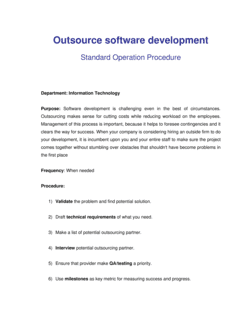
Tie payment milestones to accepted deliverables rather than elapsed time, include a detailed specification document as an exhibit to the agreement, set a change-control process for any scope additions, and define acceptance criteria clearly so disputes about "done" don't stall payment. The "How to Outsource Software Development" template in this folder provides a structured checklist for this process.
Can a research policy protect my company from IP loss?
A research policy is a governance tool, not a contract — it establishes internal rules but does not bind external parties. To protect IP from loss to outside researchers or partners, you need a signed research agreement or development agreement with explicit IP assignment clauses. The policy and the contract work together: the policy sets the standard, the contract enforces it.
Research and Development vs. related documents
A research agreement engages one party — typically an academic institution, consultant, or specialist — to conduct a defined study and deliver findings. A joint development agreement involves two or more parties actively building something together, sharing costs, risks, and IP. Use a research agreement when you're buying research output; use a joint development agreement when you're co-creating a product or technology.
A custom software development agreement covers bespoke application builds — desktop, mobile, or web apps — with detailed acceptance testing and IP assignment provisions. A website development agreement is scoped specifically to website design and build projects, with provisions around CMS, hosting, and content ownership. If your project is a fully functional web application rather than a marketing site, lean toward the software development agreement.
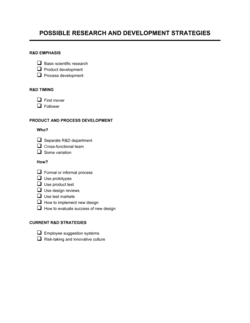
An R&D strategy document — like "Possible Research and Development Strategies" — is a high-level planning tool that evaluates directions before committing to a path. A product development plan is an execution document: it schedules milestones, assigns resources, and tracks progress for a specific product already approved for development. You typically produce the strategy first, then the plan.
A research policy is an internal governance document that sets the rules for how R&D is conducted across the organization — who can approve projects, what ethical standards apply, how IP is handled. A research agreement is an external contract with a specific researcher or institution for a defined engagement. The policy governs all research activity; the agreement governs one specific project.
Key clauses every Research and Development contains
Most R&D and development documents — regardless of type — share a core set of clauses that define ownership, scope, and accountability.
- Scope of work. Defines exactly what research or development activities are covered, preventing scope creep and disputes over deliverables.
- Intellectual property ownership. Specifies who owns discoveries, inventions, source code, and other outputs created during the engagement.
- Confidentiality. Prevents either party from disclosing proprietary methods, data, or findings to third parties.
- Milestones and deliverables. Sets measurable checkpoints so both parties can track progress and trigger payment or review stages.
- Payment and cost-sharing. Outlines fees, reimbursement structures, or how shared R&D costs are allocated between parties.
- Acceptance criteria. Defines the standards a deliverable must meet before it is formally accepted and payment is released.
- Representations and warranties. Each party confirms it has the authority, expertise, and rights needed to perform its obligations.
- Termination. Explains what triggers termination, how work-in-progress is handled, and what obligations survive the agreement's end.
How to write a research and development agreement or plan
Whether you're drafting a formal development contract or an internal R&D plan, these steps apply across most documents in this category.
1
Define the research or development objective
State clearly what you are trying to discover, build, or validate — vague objectives produce unenforceable contracts and undeliverable plans.
2
Identify all parties and their roles
Name every person, company, or institution involved and specify whether each is a commissioner, developer, researcher, or licensor.
3
Describe the scope of work in detail
List specific tasks, methods, technologies, and exclusions so both parties agree on what is and is not covered.
4
Set milestones, timelines, and deliverables
Break the work into measurable phases with due dates and defined outputs that can be reviewed and approved.
5
Address intellectual property ownership upfront
Decide before work begins who owns background IP, foreground IP (created during the project), and any jointly developed IP.
6
Specify payment terms or budget allocation
Tie payment milestones to deliverable acceptance rather than calendar dates to align incentives with output quality.
7
Add confidentiality, compliance, and termination provisions
Protect sensitive data, reference any regulatory requirements applicable to your industry, and define the exit process if the project is cancelled.
At a glance
- What it is
- Research and development (R&D) templates are structured documents that help organizations plan, govern, and execute the full lifecycle of product and technology development — from initial market research through formal development agreements and launch planning.
- When you need one
- Any time your team is investigating a new product idea, contracting with a development partner, or formalizing an R&D program, you need documents that define scope, ownership, and process before work begins.
Which Research and Development do I need?
The right R&D template depends on what stage you're in — researching a market, contracting with a development partner, or planning a product rollout. Match your current situation below.
Your situation
Recommended template
Defining your company's formal approach to R&D activities
Establishes governance rules, approval workflows, and ethical boundaries for all R&D work.Partnering with an external party to jointly develop a product or technology
Allocates IP ownership, cost-sharing, and decision rights between development partners.Commissioning a custom software build from an outside vendor
Covers specifications, milestones, IP assignment, and acceptance criteria for bespoke software.Planning the full lifecycle of a new product from concept to launch
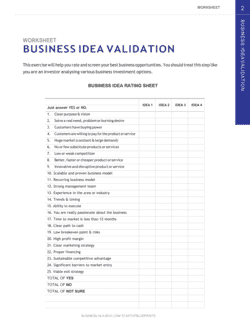
Provides a structured template for phased development milestones and resource allocation.Conducting market research to validate a product or business opportunity
Step-by-step guide covering research design, data collection, and findings synthesis.Contracting with an individual researcher or institution for a defined study
Formalizes scope, deliverables, IP rights, and payment terms for a discrete research engagement.Building or redesigning a company website with an external developer
Defines deliverables, timelines, acceptance criteria, and IP ownership for web builds.Exploring potential R&D strategic directions before committing resources
Structured framework for evaluating and prioritizing competing R&D investment options.Glossary
- R&D
- Short for Research and Development — the systematic process of investigating new knowledge and applying it to create or improve products, services, or processes.
- Foreground IP
- Intellectual property created during a development project, as distinguished from background IP that existed before the engagement.
- Background IP
- Pre-existing intellectual property that a party brings into a project; typically retained by the original owner unless the contract says otherwise.
- Joint development agreement
- A contract between two or more parties who are co-creating a product or technology, specifying how IP, costs, and decisions are shared.
- Acceptance criteria
- The specific, measurable conditions a deliverable must meet before the commissioning party formally accepts it and releases payment.
- Milestone
- A defined checkpoint in a development project at which specific deliverables must be completed and reviewed before work continues.
- Scope of work
- A written description of the specific tasks, outputs, and boundaries of a development engagement.
- Phase gate
- A formal review point between development phases at which a project is evaluated before proceeding to the next stage.
- Technology transfer
- The process of formally assigning or licensing technology or IP from one party — often a researcher or developer — to another.
- Source code escrow
- An arrangement where a neutral third party holds the source code of a software product, releasing it to the customer if the developer fails to meet contractual obligations.
- Market research
- The systematic collection and analysis of data about target customers, competitors, and market conditions to inform product and business decisions.
What is a research and development template?
A research and development (R&D) template is a structured document that helps organizations plan, contract, govern, and execute activities across the full R&D lifecycle — from early-stage market research and strategic planning through formal development agreements, product development plans, and post-launch evaluation. These templates translate complex, often legally and technically sensitive processes into organized frameworks that reduce risk and keep projects on track.
R&D documentation spans two broad categories. Planning and strategy documents — such as new product development plans, R&D strategy frameworks, and market research guides — help teams align on objectives, validate opportunities, and allocate resources before committing to a build. Formal agreements — research agreements, joint development agreements, software development contracts, and website development agreements — govern the legal and commercial relationship between a company and the external parties it works with during development, defining IP ownership, deliverables, milestones, and payment terms.
Whether you are a startup validating a product concept, a mid-size company commissioning a custom software build, or an established business formalizing its internal R&D governance, having the right documentation in place is the single most important step you can take to protect your investment.
When you need an R&D template
R&D projects fail for many reasons, but the preventable ones almost always trace back to unclear objectives, undefined IP ownership, or poorly scoped contracts. The right document — drafted before work begins — eliminates most of these problems.
Common triggers:
- A product team is ready to move a concept from ideation into structured development and needs a phased plan with milestones
- Your company is commissioning custom software or a new website from an external developer
- Two organizations are co-developing a technology or product and need to formalize IP ownership and cost-sharing
- A research institution or independent researcher is being engaged to conduct a study, clinical trial, or technical investigation
- Leadership wants to formalize the company's R&D governance with a written policy covering approvals, ethics, and IP rules
- A marketing or product team needs to conduct and document market research before a product launch
- An employee or contractor with access to proprietary development work needs to have their obligations documented alongside their employment or services agreement
Skipping these documents doesn't eliminate the risks — it just leaves them unresolved until a dispute forces the issue. With the right R&D templates in place, your team can focus on building rather than arguing about who owns what they built.
Award-winning platform
- Great Place to Work 2025
- BIG Award — Product of the Year 2025
- Smartest Companies 2025
- Global 100 Excellence 2026
- Best of the Best 2025