Equipment and Facilities Templates
★★★★★4.7from 280+ reviews· Trusted by 20M+ businesses
Cover every stage of equipment acquisition, use, maintenance, and disposal with ready-to-edit documents.
WordEditable onlinePDF10+ equipment and facilities templates
Other Production & Operations categories
Most popular equipment templates
Equipment lease agreements
Policies, checklists, and operational records
Facilities, warehousing, and specialized agreements
250K+Clients
20M+Free users
20+Years
190+Countries
10,000+Law firms
50M+Downloads
Trusted across review platforms
- Capterra★★★★☆4.649 reviews
- G2★★★★☆4.713 reviews
- GetApp★★★★☆4.649 reviews
- Google Play★★★★☆4.6179 ratings
- Google Reviews★★★★☆4.567 reviews
Frequently asked questions
What is an equipment lease agreement?
An equipment lease agreement is a contract in which one party (the lessor) allows another (the lessee) to use specific equipment for a defined period in exchange for periodic payments, while the lessor retains ownership. It covers payment terms, permitted use, maintenance responsibilities, and what happens at the end of the lease — including return, renewal, or purchase options. It is generally enforceable when properly executed by authorized representatives.
Should I lease or buy equipment?
Leasing preserves capital, keeps equipment current, and may offer tax advantages as an operating expense, but you do not build equity and total payments often exceed purchase price over time. Buying is better when you need the asset long-term, want to depreciate it, or plan to modify it. The Checklist Leasing vs Purchasing template in this folder walks through the key financial and operational factors to consider before deciding.
What is the difference between an operating lease and a finance lease?
An operating lease is a short-term arrangement where the lessor keeps the asset on its balance sheet and assumes residual value risk — the lessee effectively rents the equipment. A finance (or capital) lease transfers substantially all the risks and rewards of ownership to the lessee and is treated as a purchase on the lessee's balance sheet. The distinction affects accounting treatment and tax deductibility, so confirm which applies with your accountant.
What should an equipment maintenance agreement include?
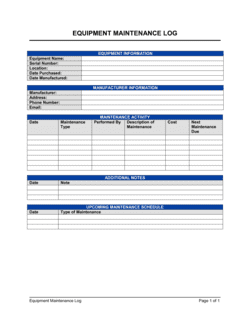
A maintenance agreement should identify the equipment covered, the scope of services (preventive maintenance, emergency repairs, parts replacement), response-time commitments, payment terms, and liability limits. It should also address who provides replacement equipment during downtime and how disputes over service quality are resolved. A maintenance log used alongside the agreement creates an auditable service record.
Can I lend equipment to another business without a formal agreement?
You can, but doing so without a written equipment loan agreement creates significant risk. Without documentation, disputes over the equipment's condition at return, liability for damage or loss, and the return timeline are difficult to resolve. A short equipment loan agreement takes minutes to complete and provides clear evidence of the terms both parties accepted.
What does a PPE policy need to cover?
A personal protective equipment policy should identify the roles or tasks requiring PPE, specify which PPE items are required for each, explain how equipment is issued and replaced, set employee obligations for inspection and care, and state the consequences of non-compliance. It should align with applicable occupational health and safety regulations in your jurisdiction and be reviewed whenever processes or regulations change.
What is an equipment placement agreement used for?
An equipment placement agreement is used when one party installs or places equipment on another party's premises — for example, a vending machine operator placing machines in an office building, or a supplier placing demonstration units at a retailer. It records ownership of the equipment, the host's obligations, revenue sharing (if any), and the owner's right to remove the equipment.
Do equipment agreements need to be notarized?
Notarization is generally not required for standard equipment leases, purchase agreements, or use agreements — signatures from authorized representatives are sufficient in most jurisdictions. Exceptions include certain secured transactions (such as a commercial pledge or movable hypothec), high-value asset transfers, or situations involving cross-border parties. Consult local counsel if the transaction is complex or high-value.
What is a net equipment lease?
In a net lease, the lessee bears some or all of the costs that a lessor would normally cover — taxes, insurance, and/or maintenance — in addition to base rent. A single-net lease passes property taxes to the lessee; a triple-net (NNN) lease passes taxes, insurance, and maintenance. Net leases are common in commercial real estate but also appear in long-term equipment arrangements where the lessee effectively assumes ownership-like responsibilities.
Equipment and Facilitie vs. related documents
Equipment and Facilitie vs. Equipment Purchase Agreement
An equipment lease agreement gives the lessee the right to use equipment for a defined period in exchange for regular payments, while title stays with the lessor. An equipment purchase agreement transfers ownership permanently at the time of sale. Use a lease when capital preservation or flexibility matters; use a purchase agreement when long-term ownership and full control are the goal. A lease-with-option-to-purchase agreement lets you start with a lease and convert to ownership at a pre-agreed price.
Equipment and Facilitie vs. Equipment Loan Agreement
An equipment lease generates recurring payments and is typically a commercial arrangement with a defined term. An equipment loan agreement is usually interest-free or short-term, used when one party lends equipment to another as a courtesy or operational necessity — a contractor borrowing a tool, for instance. The key difference is compensation: leases always involve payment; loans may not.
Equipment and Facilitie vs. Equipment Use Agreement
An equipment use agreement governs an employee's or contractor's right to use company-owned equipment, not an external party's equipment. It sets care standards, permitted uses, and liability for damage. An equipment lease, by contrast, is a formal commercial contract between two entities that may involve tax treatment, depreciation, and title. Use an equipment use agreement for internal asset management; use a lease for external commercial transactions.
Equipment and Facilitie vs. Equipment Maintenance Agreement
An equipment maintenance agreement is a service contract — it covers who performs upkeep and at what standard, but does not transfer use or ownership. Equipment lease and purchase agreements govern acquisition and use. Businesses often sign all three: a lease to obtain the asset, a use agreement for employees accessing it, and a maintenance agreement to keep it operational.
Key clauses every Equipment and Facilitie contains
Equipment and facilities documents share a common set of core clauses that define rights, responsibilities, and remedies regardless of the specific transaction type.
- Description of equipment. Identifies the asset precisely — make, model, serial number, and condition — so there is no ambiguity about what the agreement covers.
- Term and renewal. States when the agreement begins and ends, and whether it renews automatically or requires written notice to extend.
- Payment or consideration. Sets the amount, frequency, and method of payment, including any deposit, late-payment penalty, or escalation clause.
- Permitted use. Limits how and where the equipment may be used, preventing misuse that could affect the asset's condition or the owner's liability.
- Maintenance and repairs. Allocates responsibility for routine maintenance and repairs between the owner and the user or lessee.
- Insurance and risk of loss. Specifies which party must insure the equipment and bears the financial risk if it is damaged, stolen, or destroyed.
- Return conditions. Describes the expected condition of the equipment at return and the process for inspecting it and resolving disputes over damage.
- Default and remedies. Defines what constitutes a breach, the notice required before action, and the remedies available — including repossession or liquidated damages.
- Governing law. Names the jurisdiction whose laws govern the agreement and where disputes will be resolved.
How to write an equipment and facilities agreement
The core structure is the same whether you are drafting a lease, a purchase agreement, or a maintenance contract — identify the asset, define the relationship, and allocate risk clearly.
1
Identify the parties and asset
Record the full legal names of both parties and describe the equipment precisely: make, model, serial number, current condition, and location.
2
Choose the right agreement type
Decide whether you are leasing, selling, lending, placing, or authorizing use — each situation requires a different template and carries different legal and tax implications.
3
Set the term and payment terms
State start and end dates, renewal provisions, payment amounts, due dates, and consequences for late or missed payments.
4
Allocate maintenance and repair responsibility
Specify who handles routine servicing, who pays for unexpected repairs, and what standards the equipment must be returned in.
5
Address insurance and risk of loss
Require the appropriate party to carry insurance and state clearly who bears the financial risk if the equipment is damaged or destroyed.
6
Define permitted use and restrictions
List where and how the equipment may be used, any prohibited activities, and whether subletting or further lending is allowed.
7
Include default, remedies, and governing law
State what triggers a default, the cure period, and the remedies available — then name the governing jurisdiction.
8
Execute and store the agreement
Have authorized signatories sign dated copies, retain originals in a secure location, and set a calendar reminder for renewal or return deadlines.
At a glance
- What it is
- Equipment and facilities documents are the contracts, policies, and checklists that govern how a business acquires, operates, maintains, and disposes of physical assets — from machinery and vehicles to office hardware and warehouse space. They protect both parties in a transaction and create an auditable record of asset responsibility.
- When you need one
- Any time physical assets change hands, are leased, placed on-site, or require formal maintenance arrangements, a written agreement prevents costly disputes over ownership, condition, and liability.
Which Equipment and Facilitie do I need?
The right document depends on whether you are acquiring, lending, maintaining, or setting policy for equipment. Match your situation below.
Your situation
Recommended template
Leasing equipment to or from another business for a set term
Standard lease covering payment terms, condition, and return obligations.Equipment Lease Agreement
Buying equipment outright from a vendor or private seller
Documents price, warranties, and transfer of title at the point of sale.Equipment Purchase Agreement
Leasing equipment with the option to buy at term end
Combines lease terms with a defined purchase price if you exercise the option.Equipment Lease Agreement With Option to Purchase
Temporarily lending equipment to another party without transferring title
Keeps title with the lender while setting return conditions and liability.Equipment Loan Agreement
Authorizing employees or contractors to use company equipment
Defines permitted use, care obligations, and consequences for damage or loss.Equipment Use Agreement
Arranging scheduled servicing or repairs by a third-party provider
Sets service scope, response times, and liability for maintenance work.Equipment Maintenance Agreement
Installing equipment at a client or partner's premises
Records ownership, placement terms, and removal rights for on-site equipment.Formalizing workers' safety gear obligations and inventory
Establishes PPE requirements, issue procedures, and employee responsibilities.Personal Protective Equipment Policy
Glossary
- Lessor
- The party who owns the equipment and grants another party the right to use it under a lease.
- Lessee
- The party who pays for and uses equipment owned by the lessor under a lease agreement.
- Operating lease
- A short-term lease where the lessor retains the asset on its balance sheet and the lessee treats payments as an operating expense.
- Finance lease
- A lease that transfers substantially all risks and rewards of ownership to the lessee and is recorded as an asset on the lessee's balance sheet.
- Equipment placement
- An arrangement where equipment is installed at a third party's premises while remaining owned by the installing party.
- Residual value
- The estimated market value of equipment at the end of a lease term, which determines the buyout price if a purchase option exists.
- Bill of sale
- A legal document that records the transfer of ownership of an asset from seller to buyer, including price and condition at the time of sale.
- Movable hypothec
- A security interest granted over movable property (such as equipment) without the creditor taking physical possession of it.
- Subordination
- An agreement in which a creditor with a lower-priority claim accepts that a higher-priority creditor will be paid first in the event of default.
- PPE (Personal Protective Equipment)
- Protective gear — helmets, gloves, eyewear, high-visibility clothing, and similar items — worn to reduce exposure to workplace hazards.
- Repurchase agreement
- A contract in which the seller of an asset agrees to buy it back at a specified price and time, often used to provide short-term financing.
- Material requirement planning (MRP)
- A production planning process that calculates the materials and equipment quantities needed to meet a manufacturing schedule.
What are equipment and facilities documents?
Equipment and facilities documents are the contracts, policies, checklists, and operational records that govern how a business acquires, deploys, maintains, and disposes of physical assets. They cover the full asset lifecycle — from the initial decision to lease or buy, through day-to-day use and maintenance, to final return, sale, or disposal. Without these documents, responsibility for damage, liability for accidents, and the terms of ownership or use exist only as verbal understandings that are difficult and expensive to enforce.
The category spans a wide range of document types. Lease and purchase agreements transfer rights to use or own specific assets. Maintenance and use agreements define who keeps equipment in working order and on what terms. Policies such as PPE or IT equipment policies set internal standards for how employees interact with company assets. Checklists support the due-diligence decisions — whether to lease or buy, how to inspect a used vehicle, what to verify before signing a lease — that determine whether an asset acquisition is sound.
When you need equipment and facilities documents
The need for formal equipment documentation arises any time a physical asset changes hands, is deployed in a new context, or is the subject of a financial or service arrangement. Even routine internal transactions — issuing a laptop to a remote worker or assigning a company vehicle — benefit from written records that establish condition, responsibility, and expectations at the outset.
Common triggers:
- A business leases machinery, vehicles, or technology hardware from a vendor or lessor
- A company purchases equipment outright and needs to document title transfer and warranties
- An employee or contractor is authorized to use company-owned equipment off-site
- Equipment is installed at a client's or partner's premises under a placement arrangement
- A third-party service provider takes on scheduled maintenance or emergency repair obligations
- A company lends equipment temporarily to another business or site
- Employees work in environments requiring personal protective equipment under safety regulations
- Management needs a board resolution to approve a significant capital equipment purchase
- A business stores goods or materials in a third-party warehouse under a formal agreement
Skipping formal documentation on equipment transactions rarely saves time — it shifts risk entirely onto the party without paperwork. When a dispute arises over the condition of returned equipment, liability for an on-site accident, or the ownership of assets after a relationship ends, the party that documented the arrangement clearly is the one with a path to resolution.
Award-winning platform
- Great Place to Work 2025
- BIG Award — Product of the Year 2025
- Smartest Companies 2025
- Global 100 Excellence 2026
- Best of the Best 2025
Create your document in 3 simple steps.
From template to signed document — all inside one Business Operating System.
1
Download or open template
Access over 3,000+ business and legal templates for any business task, project or initiative.
2
Edit and fill in the blanks with AI
Customize your ready-made business document template and save it in the cloud.
Share your files and folders with your team. Create a space of seamless collaboration.
Save time, save money, and create top-quality documents.
★★★★★
"Fantastic value! I'm not sure how I'd do without it. It's worth its weight in gold and paid back for itself many times."
Managing Director · Mall Farm
RW
Robert Whalley
Managing Director, Mall Farm Proprietary Limited
★★★★★
"I have been using Business in a Box for years. It has been the most useful source of templates I have encountered. I recommend it to anyone."
Business Owner · 4+ years
MF
Dr Michael John Freestone
Business Owner
★★★★★
"It has been a life saver so many times I have lost count. Business in a Box has saved me so much time and as you know, time is money."
Owner · Upstate Web
DM
David G. Moore Jr.
Owner, Upstate Web