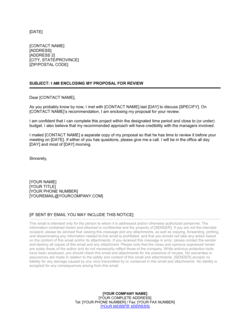
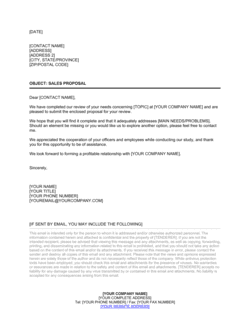
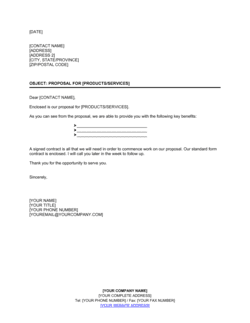
Sales Proposal Templates

4.7from 280+ reviews Trusted by 20M+ businesses

Win more deals with professionally structured proposals tailored to every sales situation.

WordEditable onlinePDF17+ sales proposal templates

Other Sales & Marketing categories

Guides and supporting materials

250K+Clients
20M+Free users
20+Years
190+Countries
10,000+Law firms
50M+Downloads

Trusted across review platforms

  • Capterra★★★★☆4.649 reviews
  • G2★★★★☆4.713 reviews
  • GetApp★★★★☆4.649 reviews
  • Google Play★★★★☆4.6179 ratings
  • Google Reviews★★★★☆4.567 reviews

Related categories

Frequently asked questions

What should a sales proposal include?
A sales proposal should include an executive summary, a problem or needs statement, a proposed solution, a detailed scope of work, pricing, a timeline, credentials or case studies, and acceptance terms. The depth of each section scales with the size and complexity of the deal — a short proposal for a small engagement may combine several sections, while a large-contract proposal may have each section spanning multiple pages.
How long should a sales proposal be?
For most B2B deals, a sales proposal runs 3–8 pages. Short-form proposals for straightforward services can be as brief as 1–2 pages. Complex enterprise or government proposals responding to formal RFPs may run 20–50 pages or more. Let the buyer's evaluation process guide the length — match the formality and depth they expect, not the length that impresses you.
What is the difference between a solicited and unsolicited proposal?
A solicited proposal is written in response to a buyer's explicit request — such as an RFP or a verbal ask after a meeting. An unsolicited proposal is sent to a prospect who has not asked for one, typically to introduce a new solution or opportunity. Unsolicited proposals require a stronger needs-identification section because you cannot assume the reader recognizes the problem you are solving.
How do I respond to an RFP?
Start by reading the RFP in full and noting every requirement, evaluation criterion, and submission instruction. Use a checklist (such as the Checklist Sample Format for Responding to RFP template) to track compliance. Structure your response to mirror the RFP's own section order, address every requirement explicitly, and submit before the deadline — late submissions are almost always disqualified without review.
Should a proposal include a contract or terms?
A proposal can include a short terms section covering pricing validity, confidentiality, and basic engagement conditions, but it is not a substitute for a signed contract. Once a proposal is accepted, follow up with a formal services agreement or statement of work that contains the full legal terms. Some short-form proposals combine acceptance signature with a basic contract, which works for smaller engagements.
How long should a proposal be valid?
Most proposals are valid for 30 days from the date of issue. Shorter windows (14 days) create more urgency; longer windows (60–90 days) are common for large or complex deals where the buyer's approval cycle is lengthy. Always state the expiry date explicitly — proposals with no expiry can create pricing disputes months later.
What makes a proposal win over a competitor's?
Proposals that win consistently do three things better: they demonstrate deeper understanding of the buyer's specific problem, they present a clearer and more credible solution, and they make the path to yes obvious with simple pricing and a clear call to action. Presentation quality, relevant case studies, and fast turnaround time are secondary factors that tip close decisions.
Can I use a proposal template for a grant application?
General proposal templates provide a useful starting structure, but grant proposals follow conventions set by each funder — including specific sections like needs assessment, logic model, evaluation plan, and detailed budget justification. Use the dedicated Grant Proposal or Writing the Grant Proposal templates, and always review the funder's own submission guidelines before writing.

Sales Proposal vs. related documents

Sales Proposal vs. Quotation

A quotation states a price for a defined scope of work; a sales proposal explains why that work matters, how it will be done, and what the buyer gains. Quotations are transactional and short; proposals are persuasive and detailed. Use a quotation when the scope is already agreed and the buyer just needs a number; use a proposal when you still need to win the business.

Sales Proposal vs. Statement of Work

A statement of work (SOW) is a contractual document agreed after the sale that defines deliverables, timelines, and responsibilities in binding terms. A proposal comes before the sale and is designed to persuade. Once a proposal is accepted, an SOW typically replaces or supplements it as the operative document.

Sales Proposal vs. Business plan

A business plan is an internal strategic document outlining how a company intends to operate and grow. A sales proposal is an external document directed at a specific client or funder to win a specific piece of business. Business plans inform proposals, but they serve different audiences and different decisions.

Sales Proposal vs. Pitch deck

A pitch deck is a visual presentation — usually 10–15 slides — designed for a live meeting. A sales proposal is a written document designed for async review, signature, and record-keeping. Many deals use both: the deck opens the conversation; the proposal closes it.

Key clauses every Sales Proposal contains

Every effective sales proposal, regardless of type, is built from the same core sections — the wording and emphasis shift by audience, but the structure does not.

  • Executive summary. A 1–3 paragraph overview written for decision-makers who may not read the full document; it should state the problem, your solution, and the expected outcome.
  • Problem or needs statement. Articulates the specific challenge or opportunity the prospect faces, demonstrating that you understand their situation before presenting your solution.
  • Proposed solution. Describes what you are offering — the service, product, project, or approach — and explains why it is the right fit for this particular client.
  • Scope of work. Lists the specific deliverables, tasks, and exclusions so both parties have a shared understanding of what is and is not included.
  • Pricing and investment. Presents fees, payment terms, and any pricing options or tiers; should be framed as an investment relative to the value delivered.
  • Timeline and milestones. Shows when work starts, when key deliverables are due, and when the engagement ends — giving the buyer a clear picture of commitment.
  • Credentials and social proof. Summarizes relevant experience, case studies, or testimonials that establish credibility with this particular buyer.
  • Terms and conditions. Covers acceptance terms, expiry date of the offer, confidentiality expectations, and any governing-law provisions applicable to the engagement.

How to write a sales proposal

A winning proposal is built around the buyer's situation, not your company's capabilities. Follow these steps to structure a document that advances the deal.

  1. 1

    Research the buyer before you write a word

    Identify the decision-maker, their pain points, their evaluation criteria, and any competitors you are up against.

  2. 2

    Open with an executive summary

    Write 1–3 paragraphs that state the problem, your solution, and the key outcome — designed for a reader who has two minutes.

  3. 3

    Define the problem in the buyer's language

    Mirror back the specific challenge or goal they described; buyers trust proposals that demonstrate genuine understanding of their situation.

  4. 4

    Present your solution with specifics

    Describe exactly what you will deliver, how it addresses the stated problem, and why your approach is the right one.

  5. 5

    Include a detailed scope of work

    List every deliverable, clarify what is excluded, and state any assumptions to prevent scope disputes after acceptance.

  6. 6

    Present pricing as an investment

    Frame the cost relative to the value and outcome — provide tiered options if appropriate to give the buyer a sense of control.

  7. 7

    Add a clear call to action and expiry date

    Tell the buyer exactly what to do next — sign, reply, or schedule a call — and state how long the pricing is valid to create urgency.

  8. 8

    Proofread, brand, and send in PDF format

    A proposal with typos or inconsistent formatting signals low attention to detail; export to PDF to lock your layout before sending.

At a glance

What it is
A sales proposal is a formal document that outlines a solution, its scope, pricing, and value to a prospective client or decision-maker. It moves a sales conversation from verbal discussion to a written commitment that both sides can review, approve, and sign.
When you need one
Any time you are competing for a contract, responding to an RFP, or pitching a new service to a client who needs to see the details in writing before saying yes.

Which Sales Proposal do I need?

The right proposal template depends on who your audience is and what you are asking them to approve — a purchase, a project, a budget, or a bid. Match your situation below.

Your situation
Recommended template

Pitching a product or service to a new commercial client

Structured specifically to present a solution, pricing, and next steps to a buyer.

Responding to a formal request for proposal from a buyer

Provides the structured format buyers expect when issuing or responding to an RFP.

Competing for a contract with a formal competitive bid

Designed for competitive bidding environments with clear scope and pricing sections.

Proposing a defined project with deliverables and timeline

Covers objectives, milestones, budget, and success criteria in a structured format.

Offering professional or consulting services to a client

Tailored for service-based engagements with scope, fees, and terms sections.

Approaching a company about a sponsorship opportunity

Presents sponsorship tiers, audience data, and brand benefits in one document.

Applying for grant funding from an organization or government body

Follows the structured format funders expect: need statement, objectives, and budget.

Seeking investment from an investor or fund

Addresses financials, market opportunity, and return potential for investor audiences.

Glossary

Request for Proposal (RFP)
A formal document issued by a buyer that invites suppliers to submit proposals against a defined set of requirements and evaluation criteria.
Solicited proposal
A proposal written in direct response to a buyer's explicit request, such as an RFP or a follow-up ask after a sales meeting.
Unsolicited proposal
A proposal sent to a prospect who has not asked for one, intended to introduce a solution or opportunity the buyer may not have considered.
Scope of work
The section of a proposal that defines exactly what is included, what is excluded, and what assumptions the pricing is based on.
Executive summary
A short overview at the start of a proposal — typically 1–3 paragraphs — written for senior decision-makers who may not read the full document.
Bid
A competitive offer submitted in response to a tender or RFP, typically evaluated alongside bids from other suppliers on price and criteria.
Proposal validity period
The window of time during which the pricing and terms in a proposal are guaranteed — usually 30 days from the issue date.
Statement of work (SOW)
A binding contractual document that defines deliverables, timelines, and responsibilities after a proposal has been accepted.
Value proposition
The clear statement in a proposal of what the buyer gains, why it matters to them specifically, and why your solution is the right choice.
Resubmission
A revised proposal sent after an initial submission was declined or returned with feedback, addressing the buyer's specific objections.
Grant proposal
A structured application submitted to a funding body — government agency, foundation, or corporation — requesting financial support for a project or program.

What is a sales proposal?

A sales proposal is a formal written document that presents a solution, defines its scope, outlines the investment required, and makes the case for why a specific buyer should say yes. Unlike a quotation — which states a price — a proposal persuades. It demonstrates that you understand the buyer's problem, explains how your product or service addresses it, and provides enough structured detail for the reader to make a confident decision.

Sales proposals range from a single-page letter proposal for a straightforward service engagement to a multi-section document of 20 or more pages for a competitive government tender. What they share is a common architecture: an opening that hooks the reader, a middle that builds the case, and a close that makes the next step obvious. Templates in this folder cover the full spectrum — from a short-form Sales Proposal Short Version for fast-moving deals to a full Business Proposal for complex, high-value opportunities.

When you need a sales proposal

A sales proposal becomes necessary the moment a prospect moves from general interest to "show me the details in writing." That transition happens at different points depending on the deal size, the buyer's procurement process, and the complexity of what you are selling.

Common triggers:

  • A prospect asks for a written summary of your pricing and scope after an initial meeting
  • A potential client issues a formal RFP and expects a structured written response
  • You are bidding competitively against other suppliers for a contract
  • A client wants to see a defined project plan with milestones and deliverables before approving budget
  • You are pitching a sponsorship, advertising package, or media partnership to an external partner
  • A nonprofit or research team is applying to a foundation or government body for grant funding
  • A founder is seeking investment and needs a document that covers market opportunity and financials
  • You want to proactively approach a prospect with a solution they have not yet asked for

Skipping the proposal — or sending an informal email in its place — leaves money on the table and creates ambiguity that delays decisions. A well-structured proposal signals professionalism, builds trust, and gives the buyer a clear document to take to internal stakeholders for sign-off. The templates in this folder give you a production-ready starting point for every scenario so you spend your time on the argument, not the formatting.

Award-winning platform

  • Great Place to Work 2025
  • BIG Award — Product of the Year 2025
  • Smartest Companies 2025
  • Global 100 Excellence 2026
  • Best of the Best 2025

Create your document in 3 simple steps.

From template to signed document — all inside one Business Operating System.
1
Download or open template

Access over 3,000+ business and legal templates for any business task, project or initiative.

2
Edit and fill in the blanks with AI

Customize your ready-made business document template and save it in the cloud.

3
Save, Share, Send, Sign

Share your files and folders with your team. Create a space of seamless collaboration.

Save time, save money, and create top-quality documents.

★★★★★

"Fantastic value! I'm not sure how I'd do without it. It's worth its weight in gold and paid back for itself many times."

Managing Director · Mall Farm
Robert Whalley
Managing Director, Mall Farm Proprietary Limited
★★★★★

"I have been using Business in a Box for years. It has been the most useful source of templates I have encountered. I recommend it to anyone."

Business Owner · 4+ years
Dr Michael John Freestone
Business Owner
★★★★★

"It has been a life saver so many times I have lost count. Business in a Box has saved me so much time and as you know, time is money."

Owner · Upstate Web
David G. Moore Jr.
Owner, Upstate Web

Run your business with a system — not scattered tools

Stop downloading documents. Start operating with clarity. Business in a Box gives you the Business Operating System used by over 250,000 companies worldwide to structure, run, and grow their business.

Free Forever Plan · No credit card required