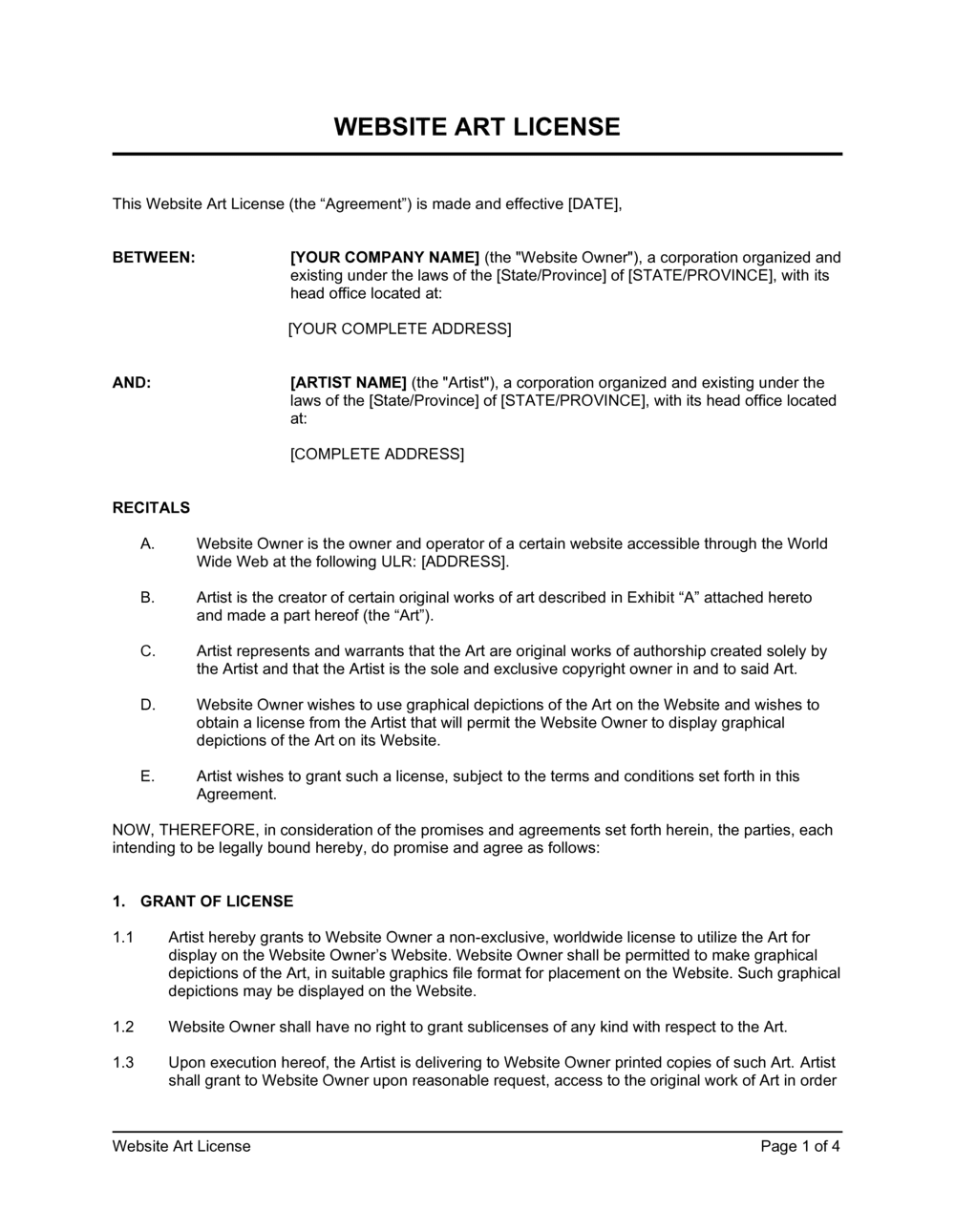
Website Art License Template

Free Word download β€’ Edit online β€’ Save & share with Drive β€’ Export to PDF

4 pagesβ€’25–30 min to fillβ€’Difficulty: Complexβ€’Signature requiredβ€’Legal review recommended
Learn more ↓
FreeWebsite Art License Template

At a glance

What it is
A Website Art License is a legally binding agreement between a copyright owner (licensor) and a website operator or business (licensee) that grants specific, defined rights to display, reproduce, or embed artwork on a designated website. This free Word download covers scope of use, attribution requirements, licensing fees, exclusivity, and termination in a single ready-to-sign document you can edit online and export as PDF.
When you need it
Use it whenever a business or individual needs written permission to feature an artist's work on a website β€” whether for editorial display, product pages, background imagery, or decorative use. It is equally necessary when an artist grants permission and wants to control exactly how, where, and for how long their work appears online.
What's inside
Parties and grant of license, permitted website and permitted uses, exclusivity terms, attribution requirements, licensing fees and payment schedule, moral rights acknowledgment, representations and warranties, termination conditions, and governing law.

What is a Website Art License?

A Website Art License is a legally binding agreement in which a copyright owner β€” typically an artist, illustrator, or photographer β€” grants a website operator or business the right to display, reproduce, or embed a specific work of art on a defined website. The license does not transfer copyright: the artist retains full ownership of the work and grants only the narrowly defined permissions set out in the document. The agreement specifies which artwork is covered, on which URL it may appear, for how long, whether the license is exclusive, what attribution must accompany the work, and how the licensee compensates the artist.

Why You Need This Document

Displaying artwork on a website without a written license is copyright infringement, regardless of whether the artist informally agreed, the work was purchased as a print, or no money changed hands. A verbal arrangement provides no proof of permitted use, no definition of exclusivity, and no recourse if either party later changes their position. For artists, an unsigned agreement means no enforceable control over how the work is cropped, reused across other domains, or displayed after the relationship ends. For website operators, it means no contractual protection if the licensor's ownership claim turns out to be disputed by a third party. This template gives both sides a clear, signed record of exactly what was agreed β€” scope, duration, fee structure, attribution, and termination β€” so the working relationship can proceed without ambiguity, and disputes that do arise can be resolved against the written terms rather than competing recollections.

Which variant fits your situation?

If your situation is…Use this template
Licensing art for a single campaign page with a fixed end dateWebsite Art License (Fixed Term)
Commissioning entirely new artwork owned by the website operatorGraphic Design Contract
Licensing a photograph rather than an illustration or paintingPhoto License Agreement
Granting rights across multiple websites or digital channelsDigital Art License Agreement
Licensing artwork for print merchandise sold through an online storeArt Licensing Agreement
Authorizing a third party to sublicense the art to downstream sitesSublicense Agreement
Transferring full copyright in the artwork to the website operatorCopyright Assignment Agreement

Common mistakes to avoid

❌ No Schedule A or artwork exhibit

Why it matters: Without a clear image reference or file description, both parties can later disagree about which work was licensed β€” opening the door to infringement claims if the wrong version is used.

Fix: Attach a high-resolution image of the artwork and its metadata as Schedule A, referenced explicitly in the grant-of-license clause.

❌ Granting rights to 'the website' without specifying the URL

Why it matters: A licensee operating a network of domains can interpret a vague website reference to cover all properties, putting the artist's work on sites they never approved.

Fix: List the exact URL β€” including relevant subdomains β€” as the Permitted Website, and state that any other domain requires a separate written amendment.

❌ Omitting a post-termination removal deadline

Why it matters: When the license expires or is terminated, a licensee who faces no deadline to remove the artwork may leave it online indefinitely, creating ongoing infringement with no clear enforcement trigger.

Fix: Include a clause requiring removal within 10 business days of termination and written confirmation of removal within 5 additional business days.

❌ Confusing a license with a copyright assignment

Why it matters: A licensor who does not understand the distinction may sign a broadly drafted license believing they retain copyright, only to discover the language effectively transferred all ownership rights.

Fix: Include an express statement that the licensor retains full copyright ownership and that no assignment of copyright is intended or effected by the agreement.

❌ No audit right for royalty-based fees

Why it matters: Without an audit right, a licensor accepting a revenue-based royalty has no way to verify whether the licensee's reported revenue figures are accurate.

Fix: Add a clause granting the licensor the right to audit relevant financial records once per calendar year on 30 days' written notice, at the licensor's expense unless a discrepancy of more than 5% is found.

❌ Skipping the representations and indemnification clause

Why it matters: If the artwork infringes a third-party copyright β€” for example, if it incorporates a stock element without a sublicensable license β€” the licensee faces infringement liability with no contractual right to recover costs from the licensor.

Fix: Include a warranty from the licensor that the artwork is original, owned by them, and free of third-party claims, backed by an indemnification obligation covering breach of that warranty.

The 10 key clauses, explained

Parties and recitals

In plain language: Identifies the licensor and licensee by their full legal names and establishes the background purpose of the agreement.

Sample language
This Website Art License Agreement ('Agreement') is entered into as of [DATE] between [ARTIST FULL NAME / ENTITY] ('Licensor') and [BUSINESS NAME / ENTITY] ('Licensee'). Licensor is the sole author and copyright owner of the artwork described in Schedule A ('Artwork').

Common mistake: Using a personal name when the copyright is held by the artist's LLC or corporation. If the licensor entity doesn't match the actual copyright holder, the license may not convey valid rights.

Description and identification of the artwork

In plain language: Precisely identifies the specific work being licensed β€” title, medium, dimensions, and a file reference or image attachment β€” so there is no ambiguity about what is covered.

Sample language
The Artwork licensed hereunder is: '[TITLE],' [MEDIUM], [DIMENSIONS], created in [YEAR], as further depicted in Schedule A attached hereto and incorporated by reference.

Common mistake: Describing the artwork only by title without attaching an image or file reference. Titles can be duplicated or misremembered; an attached exhibit eliminates disputes about which work is licensed.

Grant of license and scope

In plain language: States exactly what the licensee may do with the artwork β€” display, reproduce as part of a web page, embed β€” and what is expressly excluded.

Sample language
Licensor grants Licensee a [non-exclusive / exclusive], non-transferable, non-sublicensable license to display and reproduce the Artwork solely on the Permitted Website located at [URL] for the purpose of [PURPOSE]. All other rights are reserved by Licensor.

Common mistake: Omitting an express reservation of rights clause. Without it, courts may infer broader permissions than the licensor intended, including social media sharing or third-party sublicensing.

Permitted website and territory

In plain language: Locks the license to a specific domain and, where relevant, a geographic territory, preventing the licensee from extending use to sister sites, apps, or foreign storefronts.

Sample language
The Artwork may only be displayed on the website located at [URL] ('Permitted Website'). Use on any other domain, subdomain, mobile application, or digital property requires a separate written agreement.

Common mistake: Specifying only the root domain when the licensee operates multiple subdomains or a mobile app. Each unlisted property becomes an infringement the moment the artwork appears on it.

Exclusivity

In plain language: States whether the license is exclusive β€” meaning the licensor cannot license the same artwork to anyone else β€” or non-exclusive, allowing the licensor to license the work freely to others.

Sample language
This license is [non-exclusive / exclusive within [CATEGORY/INDUSTRY] for the Territory]. If exclusive, Licensor agrees not to grant any third party the right to display the Artwork [in the Territory / in the same category] during the License Term.

Common mistake: Agreeing to exclusivity without a premium fee or time limit. Exclusivity has real market value to the licensor β€” granting it without compensation or a defined term cap is a common and costly oversight.

License term

In plain language: Sets the start date and either a fixed end date or an evergreen term with renewal and termination provisions.

Sample language
This Agreement commences on [START DATE] and continues for an initial term of [X] months / years ('Initial Term'), unless earlier terminated. Upon expiration, this Agreement shall [renew automatically for successive [X]-month periods / terminate].

Common mistake: Using an open-ended 'perpetual' term without a termination-for-convenience clause. An artist who grants a perpetual license with no exit mechanism loses all future leverage if the relationship deteriorates.

Fees, royalties, and payment

In plain language: States the licensing fee structure β€” flat fee, annual royalty, or revenue-based royalty β€” the payment schedule, and the consequences of late payment.

Sample language
Licensee shall pay Licensor a licensing fee of $[AMOUNT] [upon execution / annually on [DATE]], plus a royalty of [X]% of net revenue directly attributable to pages featuring the Artwork. Payments overdue by more than [15] days accrue interest at [X]% per month.

Common mistake: Agreeing to a 'revenue-based royalty' without defining what counts as 'net revenue.' Disputed deductions and vague attribution methodology are the single most common source of licensing payment disputes.

Attribution requirements

In plain language: Specifies the exact credit line the licensee must display adjacent to or near the artwork and the acceptable placement formats.

Sample language
Licensee shall display the following attribution in a legible font no smaller than [X]pt adjacent to the Artwork: 'Β© [YEAR] [ARTIST NAME]. All rights reserved. Licensed for display at [URL].'

Common mistake: Failing to specify font size, placement, or whether a hyperlink to the artist's website is required. Vague attribution terms lead to credit that is technically present but practically invisible.

Representations, warranties, and indemnification

In plain language: Each party confirms they have the authority to enter the agreement; the licensor confirms they own the copyright and the artwork does not infringe third-party rights; the licensee confirms it will use the artwork only as permitted.

Sample language
Licensor represents and warrants that Licensor is the sole author and copyright owner of the Artwork, that the Artwork does not infringe any third-party intellectual property rights, and that Licensor has full authority to grant the rights set out herein. Licensor shall indemnify Licensee against claims arising from a breach of this warranty.

Common mistake: No indemnification clause at all. If the artwork turns out to infringe a third party's copyright β€” a stock image embedded in the artwork without a sublicensable license, for example β€” the licensee bears the defense cost alone.

Termination and post-termination obligations

In plain language: States what triggers termination (breach, insolvency, convenience), how much notice is required, and what the licensee must do after termination β€” typically remove the artwork within a defined period and confirm removal in writing.

Sample language
Either party may terminate this Agreement upon [30] days' written notice. Either party may terminate immediately for cause upon written notice if the other party materially breaches this Agreement and fails to cure within [15] days of notice. Upon termination, Licensee shall remove the Artwork from the Permitted Website within [10] business days and provide written confirmation of removal.

Common mistake: No post-termination removal obligation or cure period. Without one, a terminated licensee may continue displaying the artwork indefinitely while disputing whether a breach actually occurred.

How to fill it out

  1. 1

    Identify the parties and confirm copyright ownership

    Enter the full legal names of the licensor and licensee. If the artist holds copyright through an LLC or corporation, use that entity's registered name β€” not the artist's personal name.

    πŸ’‘ Request a copy of the copyright registration certificate or the artist's portfolio URL as a quick ownership check before executing.

  2. 2

    Attach a clear description and image of the artwork

    Complete Schedule A with the artwork title, medium, year of creation, dimensions, and a high-resolution image or file reference. This becomes the definitive record of exactly what is licensed.

    πŸ’‘ Use the artwork's filename or a SHA-256 hash in the exhibit for digital files β€” this proves which version was licensed if a dispute arises later.

  3. 3

    Define the permitted website and scope of use

    Enter the exact URL of the permitted website, including subdomains if applicable. Specify the permitted purpose β€” decorative display, product page background, editorial illustration β€” and list any expressly excluded uses.

    πŸ’‘ If the licensee operates a staging or development site that will temporarily display the artwork, add those URLs to the permitted website definition or include a carve-out clause.

  4. 4

    Decide on exclusivity and document it clearly

    Choose between non-exclusive and exclusive. If exclusive, define the scope β€” exclusive within a specific industry vertical, territory, or use category β€” and set a premium fee to compensate the licensor for forgoing other deals.

    πŸ’‘ Narrow exclusivity (e.g., exclusive in the home-goods retail sector only) is far easier to negotiate and price than blanket exclusivity.

  5. 5

    Set the license term and renewal mechanics

    Enter the start date and either a fixed end date or an initial term with auto-renewal language. Include a termination-for-convenience notice period so neither party is locked in indefinitely.

    πŸ’‘ For evergreen licenses, set a 60-day non-renewal notice window β€” shorter windows create operational risk when the licensee needs time to replace the artwork on the site.

  6. 6

    Complete the fees and payment schedule

    Enter the flat fee, annual royalty rate, or revenue-royalty percentage. Define 'net revenue' with specific permitted deductions and set a payment due date and late-interest rate.

    πŸ’‘ For royalty-based arrangements, add an audit right allowing the licensor to inspect relevant financial records once per year on 30 days' notice.

  7. 7

    Specify attribution requirements in full

    Write out the exact credit line, including copyright symbol, year, and artist name. State where on the page the credit must appear and whether a hyperlink is required.

    πŸ’‘ If the artwork is displayed in a slider or gallery where attribution would be disruptive, negotiate a footer credit with a link rather than inline attribution.

  8. 8

    Execute before the artwork goes live

    Both parties sign and date the agreement before the artwork is uploaded to the website. Retain the fully-executed copy in a shared document archive accessible to both parties.

    πŸ’‘ Use a timestamped e-signature service so the execution date is independently verifiable β€” especially important for exclusive licenses where timing determines competitive rights.

Frequently asked questions

What is a website art license?

A website art license is a written agreement in which a copyright owner grants a website operator specific rights to display, reproduce, or embed artwork on a defined website. It does not transfer copyright β€” the artist retains ownership β€” but it gives the licensee legally documented permission to use the work under the terms and conditions set out in the agreement. Without it, displaying someone else's artwork online is copyright infringement regardless of whether any money changed hands.

Do I need a website art license if the artist gave me verbal permission?

Verbal permission is generally not enforceable for copyright licenses in most jurisdictions. In the United States, an exclusive license must be in writing to be valid under 17 U.S.C. Β§ 204. Even for non-exclusive licenses, where no writing is strictly required, a verbal agreement provides no proof of scope, duration, or permitted uses if the relationship sours. A written license protects both the artist and the website operator.

What is the difference between an exclusive and a non-exclusive website art license?

A non-exclusive license means the artist can grant the same or similar display rights to as many other websites as they choose. An exclusive license means the artist commits not to license the same artwork to any other party β€” at least within the defined scope, territory, or industry. Exclusive licenses command higher fees because they have real market value to the licensee. Always define the scope of exclusivity precisely β€” blanket exclusivity with no limits is rarely what either party intends.

Can the licensee edit or modify the artwork under a website art license?

Not unless the agreement expressly permits it. A standard website art license covers display as-is. Creating a derivative work β€” cropping, colorizing, remixing, or overlaying text β€” requires explicit permission in the grant-of-license clause. In jurisdictions that recognize moral rights (Canada, UK, EU), even a licensee with broad editing rights may still be prohibited from derogatory treatment of the work.

What happens to the artwork when the license terminates?

Upon termination, the licensee's right to display the artwork ends immediately or at the close of a notice period, depending on the agreement. The licensee is typically required to remove the artwork from all pages of the permitted website within a specified number of business days and confirm removal in writing. Failure to remove constitutes copyright infringement from the moment the license term expires.

Does a website art license cover social media sharing of the website page?

It depends entirely on how the grant of license clause is drafted. A license limited to display on a specific URL generally does not cover social media embeds, shares, or reposts β€” even if the sharing is automated by the platform. If the licensee intends to promote pages featuring the artwork on social channels, this use should be explicitly included in the permitted uses.

Who owns the artwork after signing a website art license?

The licensor β€” the artist β€” retains full copyright ownership. A license grants permission to use, not ownership. To transfer copyright, the parties would need a copyright assignment agreement signed in writing. A well-drafted website art license should include an express statement confirming that no copyright assignment is intended, to avoid any ambiguity.

Is a website art license enforceable internationally?

Copyright is a territorial right, but the Berne Convention means copyright is recognized in most countries without registration formalities. The license itself is governed by the law chosen in the governing-law clause, typically the licensor's or licensee's home jurisdiction. For websites accessible globally, the agreement should address whether the license is limited to a specific territory or worldwide, and which country's courts have jurisdiction over disputes.

How much does a website art license typically cost?

Fees vary widely based on exclusivity, artwork prominence, website traffic, and commercial purpose. Non-exclusive licenses for decorative display on a small business website may run $50–$500 per year. Exclusive licenses for prominent placement on a high-traffic e-commerce site can reach $2,000–$10,000 or more annually. Revenue-based royalties of 5–15% of directly attributable revenue are common when the artwork is central to the site's commercial proposition.

How this compares to alternatives

vs Copyright Assignment Agreement

A copyright assignment permanently transfers ownership of the artwork from the artist to the buyer β€” the artist loses all future rights. A website art license leaves copyright with the artist and grants only the defined display rights for the agreed term. Artists should use an assignment only when they intend a complete, permanent transfer of ownership for appropriate compensation.

vs Graphic Design Contract

A graphic design contract governs the creation of new artwork on commission β€” defining deliverables, revision rounds, and payment milestones. A website art license applies to existing artwork and defines the terms of display rather than creation. If the client wants to own the newly created work, the design contract needs an IP assignment clause; if they want only display rights, a license is appropriate.

vs Stock Photo License Agreement

A stock photo license is a standardized, often click-wrap agreement for high-volume, low-negotiation use of pre-existing image libraries. A website art license is a negotiated, bespoke agreement between an artist and a specific licensee for a specific work. The website art license offers far more control over exclusivity, attribution, and permitted uses but requires direct negotiation.

vs Digital Art License Agreement

A digital art license covers display and reproduction rights across multiple digital channels β€” websites, apps, digital advertising, and email campaigns. A website art license is intentionally narrower, restricting use to a single named URL. Use the digital art license when multi-channel rights are needed; use the website art license when the goal is precise, limited permission for a single web property.

Industry-specific considerations

E-commerce and Retail

Artwork licensed for storefront backgrounds, product page imagery, and promotional banners requires clear exclusivity terms and revenue-royalty provisions tied to pages featuring the work.

Publishing and Media

Editorial illustration licenses for online articles typically require attribution adjacent to the image and may include a right to archive the article page indefinitely after publication.

Technology and SaaS

Software and app companies licensing UI artwork or mascot illustrations need the permitted website definition to cover their web app domain, marketing site, and any CDN or subdomain serving the assets.

Nonprofit and Arts Organizations

Nonprofits often receive donated or reduced-fee licenses and must ensure the agreement permits use on fundraising campaign pages and grant reporting sites without triggering commercial-use restrictions.

Jurisdictional notes

United States

Under 17 U.S.C. Β§ 204, an exclusive copyright license must be in writing and signed to be valid. Non-exclusive licenses may be oral but are difficult to enforce without written evidence. Moral rights under the Visual Artists Rights Act (VARA) apply only to works of visual art as defined by statute β€” primarily fine-art originals and limited editions β€” not to digital reproductions. California courts may apply different implied-license doctrines from courts in other states.

Canada

The Copyright Act of Canada grants moral rights to authors independently of copyright ownership. An artist can waive moral rights in writing but cannot assign them. Exclusive licenses should reference the specific rights granted under the Act (reproduction, communication to the public by telecommunication) to avoid ambiguity. Quebec's Civil Code may impose additional formality requirements for contracts involving Quebec-resident licensors.

United Kingdom

UK copyright law under the Copyright, Designs and Patents Act 1988 protects moral rights, including the right of integrity and the right of attribution β€” the latter must be asserted in writing by the author to be enforceable. Exclusive licenses must be in writing and signed by or on behalf of the copyright owner. Post-Brexit, UK and EU copyright regimes diverge, so licenses covering both territories should specify each jurisdiction's rights separately.

European Union

EU member states implement the Berne Convention and the InfoSoc Directive, both recognizing strong moral rights that generally cannot be waived β€” unlike common-law jurisdictions. The EU Digital Single Market Directive (2019/790) introduced additional online rights relevant to content-sharing platforms. Royalty terms for online display may be subject to mandatory remuneration rights in some member states (notably Germany and France), which cannot be contracted away.

Template vs lawyer β€” what fits your deal?

PathBest forCostTime
Use the templateNon-exclusive display licenses for small business or personal websites with flat-fee arrangementsFree30–45 minutes
Template + legal reviewExclusive licenses, royalty-based fees, high-traffic commercial websites, or artwork central to the site's brand$300–$700 for a 1–2 hour IP attorney review2–5 days
Custom draftedComplex multi-artwork portfolios, international exclusivity, revenue-share structures, or fine-art works with significant commercial value$1,000–$3,500+1–3 weeks

Glossary

Licensor
The copyright owner β€” typically the artist β€” who grants permission for the artwork to be used under the terms of the agreement.
Licensee
The party β€” typically a website owner or business β€” who receives the right to display the artwork under the conditions set out in the license.
Grant of License
The specific clause that defines what rights are transferred: to display, reproduce, embed, or otherwise use the artwork, within stated limits.
Exclusive License
A license in which the licensor promises not to grant the same rights to any other party for the duration of the agreement.
Non-Exclusive License
A license that allows the licensor to simultaneously grant the same or similar rights to multiple licensees.
Permitted Website
The specific URL or domain identified in the agreement as the only location where the licensed artwork may appear.
Moral Rights
Rights recognized in many jurisdictions that protect an artist's right to attribution and to object to derogatory treatment of their work, separate from copyright ownership.
Attribution
A credit line or notice identifying the artist as the creator of the work, required by many licenses to appear adjacent to or near the displayed artwork.
Royalty
A periodic payment calculated as a percentage of revenue or a flat fee, paid by the licensee to the licensor in exchange for ongoing use rights.
Termination for Cause
A clause allowing either party to end the agreement immediately if the other party materially breaches its terms and fails to cure within a defined notice period.
Derivative Work
Any artwork based on or adapted from the licensed work β€” such as a cropped, colorized, or remixed version β€” which typically requires explicit permission beyond the base license.

Part of your Business Operating System

This document is one of 3,000+ business & legal templates included in Business in a Box.

  • Fill-in-the-blanks β€” ready in minutes
  • 100% customizable Word document
  • Compatible with all office suites
  • Export to PDF and share electronically

Create your document in 3 simple steps.

From template to signed document β€” all inside one Business Operating System.
1
Download or open template

Access over 3,000+ business and legal templates for any business task, project or initiative.

2
Edit and fill in the blanks with AI

Customize your ready-made business document template and save it in the cloud.

3
Save, Share, Send, Sign

Share your files and folders with your team. Create a space of seamless collaboration.

Save time, save money, and create top-quality documents.

β˜…β˜…β˜…β˜…β˜…

"Fantastic value! I'm not sure how I'd do without it. It's worth its weight in gold and paid back for itself many times."

Managing Director Β· Mall Farm
Robert Whalley
Managing Director, Mall Farm Proprietary Limited
β˜…β˜…β˜…β˜…β˜…

"I have been using Business in a Box for years. It has been the most useful source of templates I have encountered. I recommend it to anyone."

Business Owner Β· 4+ years
Dr Michael John Freestone
Business Owner
β˜…β˜…β˜…β˜…β˜…

"It has been a life saver so many times I have lost count. Business in a Box has saved me so much time and as you know, time is money."

Owner Β· Upstate Web
David G. Moore Jr.
Owner, Upstate Web

Run your business with a system β€” not scattered tools

Stop downloading documents. Start operating with clarity. Business in a Box gives you the Business Operating System used by over 250,000 companies worldwide to structure, run, and grow their business.

Start freeΒ Β·Β No credit card required