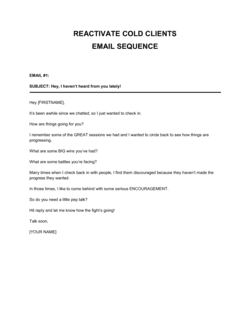
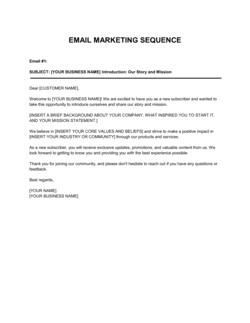
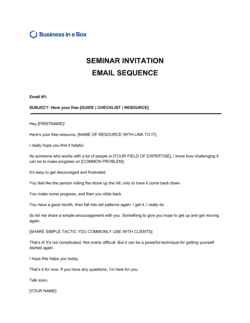
Get New Clients Email Sequence Template

Free Word download β€’ Edit online β€’ Save & share with Drive β€’ Export to PDF

6 pagesβ€’25–35 min to fillβ€’Difficulty: Complexβ€’Signature requiredβ€’Legal review recommended
Learn more ↓
FreeGet New Clients Email Sequence Template

At a glance

What it is
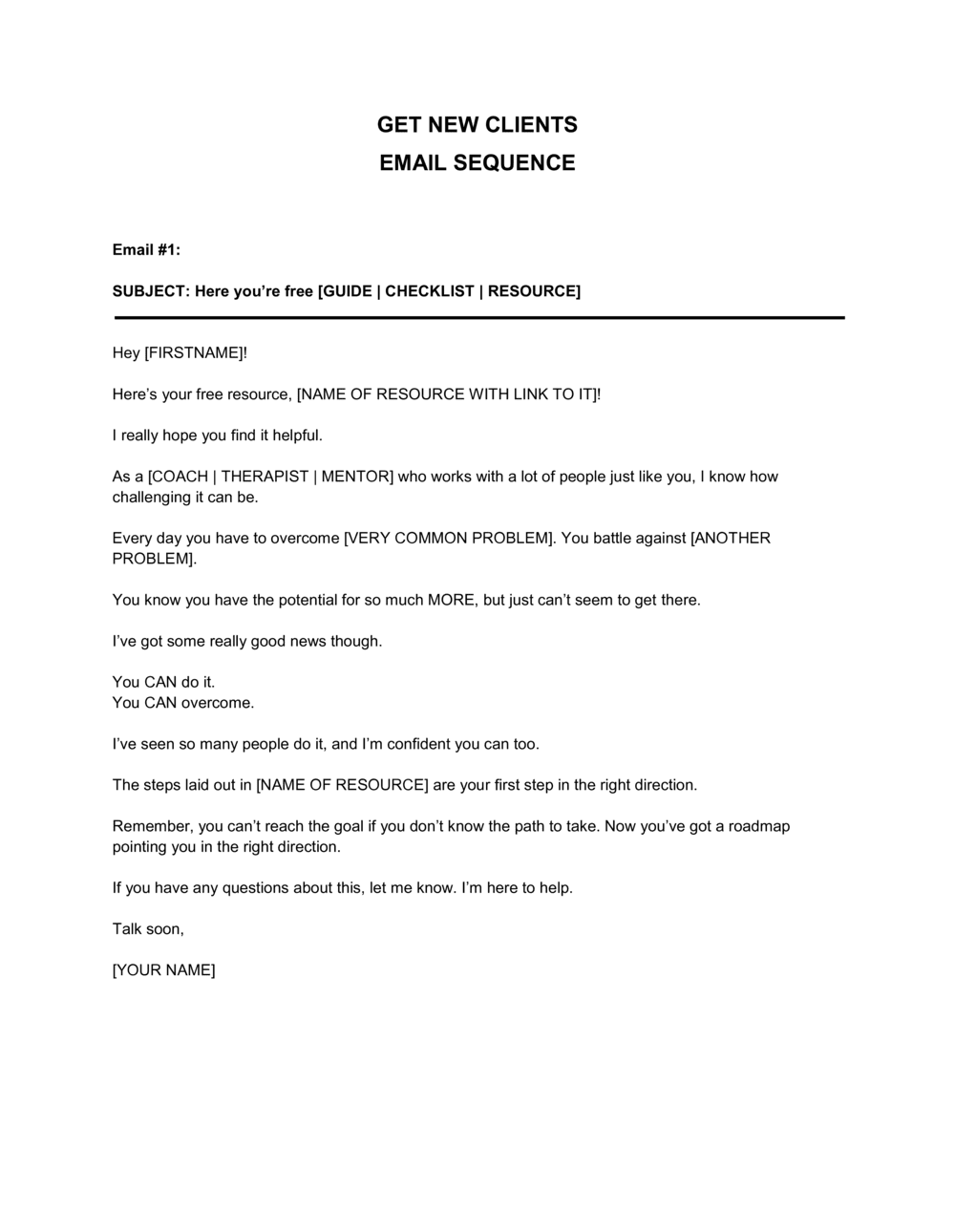
A Get New Clients Email Sequence is a structured, multi-touch outreach framework that guides a business through a series of professionally written emails designed to introduce services, establish credibility, handle objections, and convert cold prospects into paying clients. This free Word download gives you a ready-to-edit sequence you can personalize with your brand, value proposition, and call-to-action, then export as PDF or send directly.
When you need it
Use it when launching a new service line, entering a new market, or building a repeatable pipeline from scratch. It is particularly valuable when your team lacks a consistent outreach process and conversion rates on first-touch emails are low or unpredictable.
What's inside
An introduction email, a value-proposition follow-up, a social-proof touchpoint, an objection-handling message, a direct ask for a meeting or call, and a final breakup email β€” each with placeholder text, subject-line options, and timing guidance between sends.

What is a Get New Clients Email Sequence?

A Get New Clients Email Sequence is a structured, multi-touch outreach framework consisting of six to eight professionally drafted emails sent at defined intervals to a list of target prospects, with the objective of converting them into paying clients. Each email in the sequence performs a specific function β€” introducing the sender and their value proposition, delivering social proof, handling common objections, and making progressively direct requests for a meeting or engagement β€” before closing with a breakup message that maximizes final-touch reply rates. Unlike a one-off cold email, a sequence sustains presence across a 30-day window and accounts for the reality that most prospects who eventually convert do not respond until the third, fourth, or fifth touchpoint.

Why You Need This Document

Without a documented, repeatable email sequence, client acquisition depends entirely on individual memory, inconsistent timing, and ad hoc wording β€” meaning your outreach quality varies with whoever wrote the last email and how much time they had. The cost of an undocumented process is measurable: most first-touch cold emails go unanswered not because the prospect is uninterested, but because there was no follow-up cadence in place to catch them at the right moment. Beyond conversion rate, an undocumented sequence creates compliance exposure β€” sending commercial email without a physical address, functional opt-out, or lawful processing basis can trigger CAN-SPAM enforcement actions, CASL penalties of up to CAD $10M, or GDPR investigations depending on where your recipients are located. This template gives you a legally structured, field-tested six-email framework you can customize in under four hours and deploy immediately with confidence.

Which variant fits your situation?

If your situation is…Use this template
Reaching a completely cold list with no prior relationshipCold Outreach Email Sequence
Following up on a trade show or networking event connectionPost-Event Follow-Up Email Sequence
Re-engaging lapsed or dormant clientsWin-Back Email Sequence
Onboarding a newly signed client after the deal closesClient Onboarding Email Sequence
Nurturing a warm lead who has downloaded content or attended a webinarLead Nurture Email Sequence
Requesting a referral from an existing satisfied clientClient Referral Request Email
Pitching a specific service to a list segmented by industryIndustry-Specific Prospecting Email Sequence

Common mistakes to avoid

❌ Sending to a list that has not been verified for compliance

Why it matters: CAN-SPAM, CASL, and GDPR all impose fines for sending commercial email to recipients without a lawful basis. CASL penalties alone can reach CAD $10M per violation for organizations.

Fix: Before launching any sequence, confirm the legal basis for contacting each recipient in each jurisdiction β€” consent for CASL, legitimate interest documentation for GDPR, and physical address plus opt-out for CAN-SPAM.

❌ Using the same sequence for every segment without customization

Why it matters: A generic sequence that does not reference a specific pain point, industry context, or measurable outcome reads as mass spam and achieves sub-1% reply rates.

Fix: Create a separate sequence for each ICP segment, changing at minimum the value proposition statement, the social proof example, and the objection-handling paragraph.

❌ Including multiple calls to action in a single email

Why it matters: Asking a prospect to reply, book a call, review a PDF, and follow your LinkedIn profile in one email creates decision paralysis and reduces the likelihood of any action being taken.

Fix: Limit every email to one CTA. Rotate the type of CTA across the sequence β€” a reply ask in email two, a calendar link in email three β€” to test which format your segment responds to.

❌ Failing to suppress replied or converted prospects from the automated sequence

Why it matters: Sending a scheduled follow-up to a prospect who has already agreed to a meeting β€” or already become a client β€” is one of the fastest ways to destroy a new relationship before it starts.

Fix: Configure your CRM or email automation tool to immediately pause the sequence for any contact who replies, clicks a booking link, or is tagged as a customer.

❌ Skipping the breakup email to avoid seeming presumptuous

Why it matters: The breakup email is statistically the highest-performing touchpoint in the sequence. Removing it leaves the single most likely reply moment on the table.

Fix: Always include a breakup email as the final touchpoint. Frame it as a respectful close, not a guilt trip, and include a clear re-engagement path for when timing improves.

❌ Omitting the compliance footer from any email in the sequence

Why it matters: CAN-SPAM requires every commercial email to include the sender's physical mailing address and a functional opt-out mechanism β€” the law applies to every individual email, not just the first one.

Fix: Embed the compliance footer as a locked template element in your email tool so it cannot be accidentally deleted from any variant in the sequence.

The 10 key clauses, explained

Subject line and preview text

In plain language: The subject line and the first sentence visible in the inbox before the email is opened β€” together they determine whether the email is read.

Sample language
Subject: Quick question about [PROSPECT COMPANY]'s [PAIN POINT AREA] | Preview: I noticed [SPECIFIC OBSERVATION] and wanted to share one idea.

Common mistake: Using a generic subject line like 'Following up' or 'Checking in' with no context β€” these are the most filtered and ignored phrases in cold outreach.

Personalized opening line

In plain language: A one-to-two sentence hook that references something specific to the prospect β€” a recent hire, a published article, a funding announcement β€” to signal the email is not mass-blasted.

Sample language
I saw that [PROSPECT COMPANY] recently [SPECIFIC TRIGGER β€” e.g., expanded into the [MARKET] market / published a report on [TOPIC]] β€” congratulations on [MILESTONE].

Common mistake: Fabricating personalization or using outdated information. Prospects notice immediately and it destroys credibility before you have made your point.

Value proposition statement

In plain language: A two-to-three sentence explanation of what you do, for whom, and what measurable outcome you deliver β€” written in terms of the prospect's world, not your service features.

Sample language
We help [TARGET CLIENT TYPE] achieve [SPECIFIC OUTCOME] in [TIMEFRAME] without [COMMON PAIN OR SACRIFICE]. On average, our clients see [METRIC] within [X] days of working with us.

Common mistake: Leading with a list of services instead of a client outcome. 'We offer strategy, design, and development' tells the prospect nothing about what changes for them.

Social proof insert

In plain language: A brief reference to a named client, case study metric, or recognizable brand that validates your claim and reduces perceived risk.

Sample language
We recently helped [CLIENT NAME OR DESCRIPTION β€” e.g., a [INDUSTRY] company similar to yours] achieve [RESULT] in [TIMEFRAME]. I can share the full case study if useful.

Common mistake: Using vague proof like 'many clients' or 'several Fortune 500 companies' without specifics. Vague proof reads as unverifiable and undermines the sequence's credibility.

Objection-handling paragraph

In plain language: A short paragraph β€” typically in the third or fourth email β€” that directly addresses the most common reasons a prospect delays or declines.

Sample language
I know [COMMON OBJECTION β€” e.g., timing is often the challenge / budget is tight until Q[X] / you may already be working with someone]. Here is why clients in exactly that situation still found it worth 20 minutes: [SPECIFIC REASON].

Common mistake: Waiting for the prospect to raise objections rather than addressing the top one or two preemptively. Prospects who do not reply have often already dismissed the email based on an unspoken objection.

Call to action (CTA)

In plain language: A single, specific, low-friction request that closes every email β€” one action only, never multiple asks in the same message.

Sample language
Are you open to a 20-minute call [DAY] or [DAY] this week? Here is my calendar link: [LINK]. If the timing does not work, just let me know a better window.

Common mistake: Including more than one CTA in a single email β€” for example, asking the prospect to reply, book a call, and review a case study simultaneously. Multiple asks reduce total response rate.

Timing and send-interval guidance

In plain language: Notes embedded in the template that specify how many days to wait between each email, ensuring the sequence is persistent without being aggressive.

Sample language
Email 1: Day 1 | Email 2: Day 4 | Email 3: Day 8 | Email 4: Day 14 | Email 5: Day 21 | Email 6 (Breakup): Day 30

Common mistake: Sending every email within two or three days of the last. A prospect who has not responded in 48 hours has not necessarily dismissed you β€” compressing the cadence signals desperation and accelerates unsubscribes.

Compliance and opt-out notice

In plain language: A brief footer or inline statement that satisfies CAN-SPAM, CASL, and GDPR requirements β€” including a clear way for recipients to opt out of further contact.

Sample language
You are receiving this email because [REASON FOR CONTACT β€” e.g., you match the profile of clients we work with in [INDUSTRY]]. To opt out of future messages from [COMPANY NAME], reply 'Unsubscribe' or click [LINK].

Common mistake: Omitting opt-out language from cold outreach emails on the assumption that the sequence is small or personal. CAN-SPAM and CASL apply to commercial emails regardless of list size or whether the sender considers the message 'personal.'

Breakup email

In plain language: The final email in the sequence that explicitly states you will not follow up again unless invited β€” often phrased as a question that makes it easy for the prospect to say no or yes.

Sample language
I will take your silence as a signal that the timing is not right β€” no hard feelings at all. If things change and [PAIN POINT] becomes a priority for [PROSPECT COMPANY], I would be glad to reconnect. Is it safe to close your file for now, or is there a better time to follow up?

Common mistake: Skipping the breakup email to avoid seeming final. The breakup email consistently generates the highest reply rate in the sequence β€” prospects who had no intention of replying often respond when they believe the outreach will stop.

Sender signature and contact block

In plain language: A professional closing that includes the sender's full name, title, company, phone number, website, and any relevant social proof such as a LinkedIn URL or trust badge.

Sample language
[FULL NAME] | [TITLE] | [COMPANY NAME] | [PHONE] | [WEBSITE] | [LINKEDIN URL] | [OPTIONAL: TRUST BADGE β€” e.g., As seen in [PUBLICATION] / [X] clients served]

Common mistake: Using an oversized HTML signature with logos, banners, and multiple links. Heavy signatures trigger spam filters, push content below the fold on mobile, and reduce deliverability.

How to fill it out

  1. 1

    Define your ideal customer profile before writing a single word

    Fill in [TARGET CLIENT TYPE], [INDUSTRY], and [PAIN POINT] placeholders with specific attributes of the segment you are targeting β€” company size, role, and the problem they experience most acutely. Every email in the sequence should be written as if it were sent to one person, not a list.

    πŸ’‘ If your ICP covers more than two distinct segments, create a separate sequence for each rather than trying to write one that addresses all of them.

  2. 2

    Craft your value proposition around a measurable outcome

    Replace the [SPECIFIC OUTCOME] and [METRIC] placeholders with a real result you have delivered β€” a dollar figure, a percentage improvement, or a time saved. If you do not yet have client results, use a range or a conservative estimate with a clear caveat.

    πŸ’‘ The more specific the outcome, the higher the reply rate. '27% reduction in onboarding time' outperforms 'we streamline onboarding' in every A/B test.

  3. 3

    Insert at least one named or described social proof reference

    Fill in the [CLIENT NAME OR DESCRIPTION] and [RESULT] fields in the social proof email. If you cannot use a client's name, describe them by industry and company size β€” 'a mid-market SaaS company with 120 employees' is credible without being a breach of confidentiality.

    πŸ’‘ Ask existing clients for a one-sentence quote you can use in outreach. Most clients agree when asked directly, especially if the sequence has already generated results for them.

  4. 4

    Set the send-interval timing in your email tool

    Map the six emails to the recommended cadence (Days 1, 4, 8, 14, 21, and 30) in your CRM or email automation tool. Confirm that automated sends will pause if a prospect replies at any point β€” sending a scheduled email after a positive reply is a common and damaging error.

    πŸ’‘ Day 14 and Day 21 emails generate disproportionately high replies from prospects who were interested but distracted during the first three touchpoints.

  5. 5

    Add personalization tokens for the opening line of each email

    Replace the [SPECIFIC TRIGGER] placeholder with one piece of publicly available information about each prospect β€” a LinkedIn post, a press release, a job listing, or a recent company announcement. Even one genuine personalization line per email significantly improves open-to-reply conversion.

    πŸ’‘ Set up a Google Alert for each target account before launching the sequence so new triggers surface automatically.

  6. 6

    Add the compliance footer to every email in the sequence

    Insert your company name, physical mailing address, and opt-out mechanism into the [COMPLIANCE FOOTER] block. Confirm the language meets the requirements of the jurisdiction you are sending from β€” CAN-SPAM for the US, CASL for Canada, and GDPR for EU recipients.

    πŸ’‘ If you are sending to EU recipients for the first time, verify you have a lawful basis for processing their contact data before launching β€” legitimate interest is the most common basis for B2B prospecting but requires a documented assessment.

  7. 7

    Write and test the breakup email last

    Customize the breakup email's closing question to make it easy for the prospect to say no cleanly or flag a better time. Test the subject line β€” 'Closing your file' and 'Should I close your file?' are two of the highest-performing subject lines for final-touch emails.

    πŸ’‘ Send the breakup email manually rather than automating it for your highest-value prospects. A slight variation in the opening line dramatically increases the sense that it is personal.

  8. 8

    Review and update the sequence every 90 days

    Pull open rate and reply rate data from your email tool and identify which email in the sequence is underperforming. Update the subject line, first line, or CTA of that email before the next 90-day cycle.

    πŸ’‘ A reply rate below 2% on the first email usually signals an ICP mismatch, not a copywriting problem. Revisit the target list before rewriting the sequence.

Frequently asked questions

What is a get new clients email sequence?

A get new clients email sequence is a series of pre-written, timed emails sent to a list of target prospects with the goal of converting them into paying clients. Each email in the sequence builds on the previous one β€” introducing the sender, delivering value, handling objections, and making progressively more direct asks for a meeting or engagement. A well-structured sequence typically runs six to eight emails over 30 days.

How many emails should a client acquisition sequence include?

Six emails over 30 days is the most widely validated structure for B2B client outreach: an introduction on Day 1, a value-proposition follow-up on Day 4, a social-proof touchpoint on Day 8, an objection-handling email on Day 14, a direct meeting ask on Day 21, and a breakup email on Day 30. Sequences shorter than four emails leave significant reply potential unrealized; sequences longer than eight become intrusive for most segments.

Is a client outreach email sequence legally binding?

The emails themselves are not contracts, but they can create implied representations or commitments that a court may treat as binding if a prospect relies on them. Pricing, service scope, and delivery timelines stated in outreach emails have been cited in contract disputes. Keep outreach language as an invitation to discuss, not a firm offer, until a formal proposal or agreement is executed.

What laws apply to cold email outreach?

In the United States, the CAN-SPAM Act governs commercial email and requires an accurate sender identity, a physical mailing address, and a functional opt-out mechanism in every message. In Canada, CASL requires express or implied consent before sending most commercial electronic messages and imposes penalties up to CAD $10M per violation. In the EU and UK, GDPR requires a lawful basis for processing contact data, and the Privacy and Electronic Communications Regulations (PECR) in the UK add specific requirements for direct marketing.

What is the typical reply rate for a cold client email sequence?

For well-targeted, personalized B2B sequences, a combined reply rate of 5–15% across all six emails is achievable. The first email typically generates a 1–3% reply rate; the breakup email often matches or exceeds the first email's performance. Sequences sent to poorly defined lists, with no personalization, or with generic value propositions typically see reply rates below 1%.

Can I automate the entire sequence using an email tool?

Yes β€” tools such as HubSpot Sequences, Outreach, Salesloft, and Apollo allow full automation with reply detection and automatic suppression. Automation is appropriate for sequences sent to more than 20 prospects at a time. For fewer than 20 high-value targets, sending manually and personalizing each email individually typically produces a meaningfully higher conversion rate than automation.

What subject lines perform best in client acquisition emails?

Subject lines that perform best in B2B outreach share three traits: they are short (four to seven words), they reference something specific to the prospect or their company, and they signal a question rather than a pitch. Examples: 'Quick question about [COMPANY],' '[MUTUAL CONNECTION] suggested I reach out,' and 'Idea for [SPECIFIC GOAL].' Avoid subject lines containing the words 'free,' 'guaranteed,' or 'opportunity' β€” these reliably trigger spam filters.

Do I need a lawyer to review an email sequence template?

Legal review is recommended when you are sending to recipients in Canada or the EU, when the emails contain specific pricing or service commitments, or when you are operating in a regulated industry such as financial services, healthcare, or legal services. For standard domestic B2B outreach in the US, a well-structured template with a compliant footer is typically sufficient without a full legal review.

What should I do when a prospect replies but does not commit?

A non-committal reply β€” 'send me more information' or 'let's reconnect next quarter' β€” should trigger a manual follow-up outside the automated sequence. Pause the original sequence immediately, respond personally within 24 hours, and set a calendar reminder to follow up on the specific date the prospect mentioned. Non-committal replies have a significantly higher close rate than cold sequences when handled with a tailored personal response rather than a re-enrollment in the same template.

How this compares to alternatives

vs Sales Proposal

A sales proposal is a formal document presenting scope, pricing, and terms to a prospect who has already expressed interest. An email sequence is the upstream activity that generates the conversation leading to a proposal. The sequence opens the door; the proposal closes it. Sending a full proposal as the first outreach touchpoint is a common and costly misstep.

vs Business Introduction Letter

A business introduction letter is a single formal document introducing your company to a new contact or organization. An email sequence is a multi-touch cadence designed to sustain engagement over 30 days regardless of whether the first message receives a reply. Introduction letters suit formal or high-stakes first contact; sequences suit scalable pipeline building.

vs Cold Calling Script

A cold calling script governs a real-time phone conversation and depends on live objection handling and tone of voice. An email sequence is asynchronous β€” the prospect reads and responds on their own schedule, which typically produces a lower volume but higher quality of engagement per contact. Many outreach programs use both in parallel, with calls referencing emails sent in the same cadence.

vs Newsletter Template

A newsletter template is designed for a warm, opted-in audience that has already expressed interest in your content. A client acquisition sequence is directed at cold or warm prospects who have not yet opted in and requires explicit compliance handling. Sending acquisition content through a newsletter format to non-subscribers is a CASL and GDPR violation in most jurisdictions.

Industry-specific considerations

Professional Services

Outreach sequences referencing specific regulatory changes, compliance deadlines, or recent case outcomes relevant to the prospect's industry drive significantly higher engagement than generic service pitches.

SaaS / Technology

Sequences tied to product-led growth motions typically reference a free trial, a benchmark report, or a usage data insight as the value-delivery touchpoint rather than a traditional case study.

Marketing and Creative Agencies

Agencies achieve the highest reply rates when the social proof email includes a before-and-after metric from a recognizable brand in the prospect's sector β€” revenue lift, CPL reduction, or organic traffic growth.

Financial Services

Heavily regulated in most jurisdictions β€” outreach emails in financial services must avoid any language that constitutes investment advice or a securities solicitation, and compliance review of every touchpoint is standard practice.

Healthcare and Life Sciences

HIPAA restricts the use of patient-related data in prospecting; outreach must be directed to administrative and procurement contacts rather than clinical staff, and value propositions focused on operational efficiency rather than clinical outcomes.

Consulting and Coaching

Sequences for coaching and advisory services perform best when the social proof touchpoint features a transformation story with a named or specifically described client and a quantified outcome rather than a generic testimonial.

Jurisdictional notes

United States

The CAN-SPAM Act governs all commercial email in the US. Every email must include an accurate 'From' name and subject line, the sender's physical mailing address, and a functional opt-out mechanism honored within 10 business days. CAN-SPAM does not require prior consent for B2B cold email, but the FTC actively enforces deceptive subject lines and failure to honor opt-out requests. State laws β€” particularly California's CCPA β€” add data privacy considerations for large lists.

Canada

Canada's Anti-Spam Legislation (CASL) is among the strictest commercial email laws in the world. It requires either express or implied consent before sending a commercial electronic message to a Canadian recipient. Implied consent exists when the recipient has a prior business relationship with the sender within the past two years. Penalties reach CAD $1M per violation for individuals and CAD $10M for organizations. Every email must include sender identification, a mailing address, and a functional unsubscribe mechanism.

United Kingdom

Post-Brexit, the UK operates under UK GDPR and the Privacy and Electronic Communications Regulations (PECR). B2B cold email to corporate addresses is permitted where there is a legitimate interest basis, but the sender must be identifiable and an opt-out must be provided in every message. Outreach to sole traders and partnerships is treated as consumer outreach under PECR and requires prior consent. The ICO actively investigates complaints and can issue fines up to Β£500,000 under PECR.

European Union

GDPR requires a documented lawful basis for processing personal data used in outreach β€” legitimate interest is the most common basis for B2B email, but requires a balancing test and records before the sequence launches. Individual EU member states also apply national ePrivacy laws on top of GDPR; Germany and France impose stricter consent requirements for direct marketing emails. Every email must include an easy opt-out, and suppression lists must be maintained to prevent re-contacting opted-out recipients.

Template vs lawyer β€” what fits your deal?

PathBest forCostTime
Use the templateFreelancers and small businesses running domestic US outreach to clearly defined B2B segmentsFree2–4 hours to customize and configure
Template + legal reviewBusinesses sending to Canadian or EU recipients, regulated industries, or sequences containing specific pricing or service commitments$300–$800 for a compliance and communications attorney review2–5 business days
Custom draftedEnterprises running high-volume cross-border sequences in financial services, healthcare, or legal sectors where regulatory risk is material$1,500–$5,000+ for full legal and compliance drafting1–3 weeks

Glossary

Email Sequence
A pre-written series of emails sent at defined intervals to move a prospect through a defined objective β€” in this case, becoming a client.
Ideal Customer Profile (ICP)
A detailed description of the type of company or individual most likely to buy, retain, and derive value from your service.
Cadence
The timing and spacing of touchpoints in an outreach sequence β€” for example, Day 1, Day 4, Day 8, Day 14.
Call to Action (CTA)
A specific, low-friction request at the end of an email β€” such as booking a 20-minute call β€” that tells the prospect exactly what to do next.
Social Proof
Evidence that other clients have achieved results using your service, including testimonials, case study metrics, or named client references.
Breakup Email
The final message in a sequence that signals you will stop reaching out unless the prospect responds β€” often the highest-reply-rate email in the cadence.
Open Rate
The percentage of recipients who open a given email, used as a proxy for subject-line effectiveness and list quality.
Reply Rate
The percentage of recipients who respond to an email, which is the primary conversion metric for a client-acquisition sequence.
Personalization Token
A variable field β€” such as [FIRST NAME] or [COMPANY NAME] β€” that is replaced with prospect-specific data before sending.
Objection Handling
Proactively addressing the most common reasons a prospect might decline β€” price, timing, or fit β€” within the body of a follow-up email.
Value Proposition
A clear statement of the specific outcome your service delivers, for whom, and why you deliver it better or differently than alternatives.

Part of your Business Operating System

This document is one of 3,000+ business & legal templates included in Business in a Box.

  • Fill-in-the-blanks β€” ready in minutes
  • 100% customizable Word document
  • Compatible with all office suites
  • Export to PDF and share electronically

Create your document in 3 simple steps.

From template to signed document β€” all inside one Business Operating System.
1
Download or open template

Access over 3,000+ business and legal templates for any business task, project or initiative.

2
Edit and fill in the blanks with AI

Customize your ready-made business document template and save it in the cloud.

3
Save, Share, Send, Sign

Share your files and folders with your team. Create a space of seamless collaboration.

Save time, save money, and create top-quality documents.

β˜…β˜…β˜…β˜…β˜…

"Fantastic value! I'm not sure how I'd do without it. It's worth its weight in gold and paid back for itself many times."

Managing Director Β· Mall Farm
Robert Whalley
Managing Director, Mall Farm Proprietary Limited
β˜…β˜…β˜…β˜…β˜…

"I have been using Business in a Box for years. It has been the most useful source of templates I have encountered. I recommend it to anyone."

Business Owner Β· 4+ years
Dr Michael John Freestone
Business Owner
β˜…β˜…β˜…β˜…β˜…

"It has been a life saver so many times I have lost count. Business in a Box has saved me so much time and as you know, time is money."

Owner Β· Upstate Web
David G. Moore Jr.
Owner, Upstate Web

Run your business with a system β€” not scattered tools

Stop downloading documents. Start operating with clarity. Business in a Box gives you the Business Operating System used by over 250,000 companies worldwide to structure, run, and grow their business.

Free Forever PlanΒ Β·Β No credit card required