Employee Demotion Letter Template

Free Word download β€’ Edit online β€’ Save & share with Drive β€’ Export to PDF

1 pageβ€’15–20 min to fillβ€’Difficulty: Standard
Learn more ↓
FreeEmployee Demotion Letter Template

At a glance

What it is
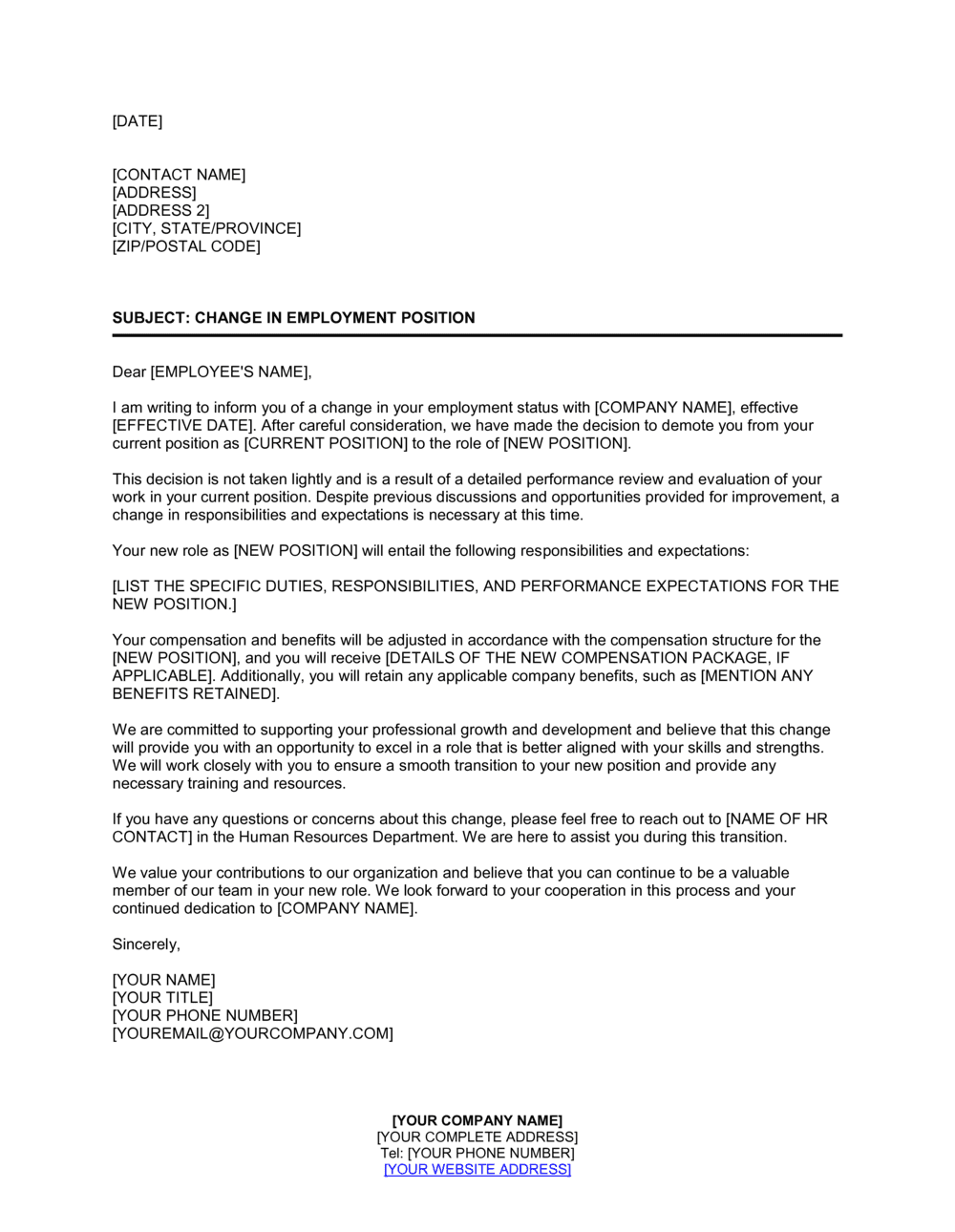
An Employee Demotion Letter is a formal HR document notifying an employee that their role, title, and compensation are being reduced, effective a stated date. This free Word download gives you a structured, professional starting point you can edit online and export as PDF β€” covering the new position, salary change, reasons for the demotion, and any attached performance expectations.
When you need it
Use it whenever you need to formally communicate a role reduction β€” whether driven by documented performance issues, an organizational restructuring, or a disciplinary outcome β€” to create a clear written record and reduce the risk of miscommunication or legal challenge.
What's inside
Header with employee and employer details, a direct statement of the demotion and effective date, the new job title and revised compensation, the stated reason for the action, any expectations or improvement plan reference, and a closing acknowledgment block.

What is an Employee Demotion Letter?

An Employee Demotion Letter is a formal HR document that notifies an employee in writing of a reduction in their job title, responsibilities, and compensation, effective a specified date. It states the reason for the action β€” whether rooted in documented underperformance, an organizational restructuring, or a disciplinary outcome β€” describes the new role and revised pay, and sets out any expectations the employee must meet going forward. Unlike a verbal conversation, a written demotion letter creates a clear, dated record of exactly what was communicated and on what basis, forming a critical part of the employer's documentation trail.

Why You Need This Document

Delivering a demotion verbally without a written record leaves the employer exposed on multiple fronts: the employee may dispute the terms of the new role, contest the stated pay, or later claim the change was discriminatory or arbitrary. In jurisdictions where a significant unilateral change to employment conditions can constitute constructive dismissal, the absence of documentation makes it nearly impossible to defend the decision. A properly issued demotion letter β€” anchored to prior written warnings or a PIP, and signed for receipt β€” closes those gaps. It also gives the employee an unambiguous picture of what their new role requires, reducing the confusion and conflict that often follow poorly managed role changes. This template gives HR teams and managers a structured, professional starting point that covers every required element in under 30 minutes.

Which variant fits your situation?

If your situation is…Use this template
Demotion due to sustained underperformance with a documented PIP historyEmployee Demotion Letter (Performance)
Role reduction as part of a company-wide restructuring or layoff avoidanceEmployee Demotion Letter (Restructuring)
Demotion as a disciplinary sanction following a formal investigationEmployee Demotion Letter (Disciplinary)
Ending a promotion trial period and returning the employee to their prior roleReturn to Previous Role Letter
Voluntary demotion requested by the employee for work-life balance reasonsVoluntary Demotion Agreement Letter
Formal termination following a failed demotion or improvement planEmployee Termination Letter

Common mistakes to avoid

❌ Using vague language to soften the message

Why it matters: Phrases like 'role realignment' or 'scope adjustment' obscure the fact that a demotion occurred. Employees who claim they were never clearly notified can challenge the validity of subsequent actions.

Fix: State the demotion plainly in the opening paragraph β€” 'your position is being changed from X to Y, effective [DATE]' β€” and reserve softening language for the forward-looking expectations section.

❌ Issuing the letter without prior documented warnings

Why it matters: A demotion letter that arrives without a preceding paper trail β€” no performance reviews, no PIP, no verbal or written warnings β€” appears arbitrary and significantly increases legal exposure.

Fix: Ensure at least one prior written document (PIP, written warning, or formal performance review) is on file before issuing the demotion letter, and reference it explicitly.

❌ Omitting the revised salary amount

Why it matters: Leaving out the new compensation figure or stating only a percentage reduction creates immediate disputes between the employee, payroll, and HR over what was actually agreed.

Fix: State the exact new base salary or hourly rate and the date it takes effect. Confirm this figure with payroll before the letter is delivered.

❌ Framing the acknowledgment line as agreement

Why it matters: Employees routinely refuse to sign letters that ask them to 'agree' with a demotion, turning a routine HR step into a confrontation and leaving no signed record.

Fix: Change the signature line to 'I confirm receipt of this letter' and add a note that signature does not constitute agreement with its contents.

The 8 key clauses, explained

Header and parties

In plain language: Identifies the employer, the employee's full name and current job title, the date the letter is issued, and the subject line.

Sample language
[DATE] | To: [EMPLOYEE FULL NAME], [CURRENT JOB TITLE] | From: [MANAGER/HR NAME], [TITLE] | Re: Notice of Role Change

Common mistake: Addressing the letter to a nickname or informal name rather than the employee's legal name β€” creating a mismatch with payroll records that complicates any downstream HR or legal process.

Opening statement of demotion

In plain language: States clearly and directly that the employee is being demoted, names the new role, and gives the effective date β€” no ambiguous language.

Sample language
This letter confirms that, effective [DATE], your position will change from [CURRENT TITLE] to [NEW TITLE] in the [DEPARTMENT] department.

Common mistake: Burying the demotion in vague language like 'role adjustment' or 'position realignment' β€” employees and employment tribunals treat ambiguity as a sign the employer lacked confidence in the decision.

Reason for the demotion

In plain language: States the specific grounds β€” performance, restructuring, or disciplinary β€” with a brief factual summary that ties to prior documented conversations or decisions.

Sample language
This decision follows a documented performance review process in which [EMPLOYEE NAME] did not meet the targets outlined in the Performance Improvement Plan issued on [DATE], specifically [METRIC OR BEHAVIOR].

Common mistake: Including inflammatory or subjective language like 'attitude problems' or 'not a team player' without specific, documented examples β€” increasing legal exposure and making the letter harder to defend.

New role and responsibilities

In plain language: Describes the new job title, reporting line, and any key changes to duties so the employee has a clear picture of what their role looks like going forward.

Sample language
In your new role as [NEW TITLE], you will report to [MANAGER NAME/TITLE] and be responsible for [KEY DUTIES]. A revised job description is attached as Schedule A.

Common mistake: Omitting a description of the new role, leaving the employee uncertain about their duties β€” which often leads to performance confusion and further issues within the first 30 days.

Revised compensation and benefits

In plain language: States the new base salary or hourly rate, the date it takes effect, and confirms whether benefits change or remain the same.

Sample language
Your base salary will be revised to $[AMOUNT] per [year/hour], effective [DATE]. All other benefits remain unchanged as outlined in your current benefits summary.

Common mistake: Stating only the percentage reduction without the new absolute figure β€” employees and payroll need the exact dollar amount to avoid disputes about what was agreed.

Expectations going forward

In plain language: Outlines what the employer expects the employee to achieve or demonstrate in the new role, and references any attached improvement plan or support resources.

Sample language
In this role, you are expected to [SPECIFIC EXPECTATION] by [DATE]. A 60-day check-in has been scheduled for [DATE] to review your progress. [MANAGER NAME] will provide ongoing support.

Common mistake: Setting no forward expectations at all β€” a demotion without clear expectations gives the employee no path to succeed and the employer no basis for further action if performance continues to decline.

Consequences of further non-compliance

In plain language: States plainly what will happen if the employee does not meet expectations in the new role, typically referencing further disciplinary action up to and including termination.

Sample language
Failure to meet the expectations outlined above may result in further disciplinary action, up to and including termination of employment, in accordance with [COMPANY NAME]'s disciplinary policy.

Common mistake: Omitting this clause entirely because it feels uncomfortable β€” without it, a subsequent termination may appear arbitrary, increasing the risk of a wrongful dismissal claim.

Acknowledgment and signature block

In plain language: Asks the employee to sign and date the letter to confirm receipt β€” not agreement β€” and provides a space for the issuing manager's signature.

Sample language
Please sign below to confirm receipt of this letter. Your signature does not constitute agreement with its contents. | Employee Signature: ___________ Date: ___________ | Issued by: ___________ Date: ___________

Common mistake: Framing the acknowledgment line as 'I agree with the above' β€” employees often refuse to sign, creating unnecessary conflict. 'Receipt only' language avoids this and still creates a documented record.

How to fill it out

  1. 1

    Complete the header with full legal names and the issue date

    Enter the employee's legal name as it appears in their employment file, their current job title, and the date the letter is being issued. Add the issuing manager's name and title.

    πŸ’‘ Issue the letter on the same date you deliver it β€” backdating creates credibility problems if the letter is ever reviewed externally.

  2. 2

    State the new title and effective date clearly

    Write the new job title in full and specify the exact date the change takes effect. Do not use vague phrases like 'as soon as practicable' or 'effective immediately' without a calendar date.

    πŸ’‘ Give at least a few business days between the letter date and the effective date so the employee can prepare β€” same-day effective dates heighten the sense of shock and increase the likelihood of an emotional or legal response.

  3. 3

    State the reason using documented facts only

    Summarize the grounds for the demotion in one to three sentences tied to specific documented events β€” a PIP outcome, a restructuring decision, or a disciplinary finding. Avoid adjectives and opinions.

    πŸ’‘ Reference prior written documents by date (e.g., 'PIP issued on [DATE]') so the demotion sits within a visible documentation trail rather than appearing as a sudden decision.

  4. 4

    Describe the new role and attach a revised job description

    Name the new reporting manager and list two to four key responsibilities in the new role. Attach a revised job description as Schedule A rather than embedding every detail in the letter body.

    πŸ’‘ A separate job description addendum lets you update duties in the future without needing to reissue the demotion letter itself.

  5. 5

    Enter the revised salary as an absolute dollar figure

    State the new annual or hourly rate explicitly, confirm the effective date for payroll, and note whether benefits are affected. Do not express the change only as a percentage reduction.

    πŸ’‘ Confirm with payroll before issuing the letter that the system will reflect the change on the stated effective date β€” discrepancies between the letter and the first affected pay stub generate immediate disputes.

  6. 6

    Set specific forward expectations with a review date

    Write one to three measurable expectations for the new role and schedule a named follow-up date β€” 30, 60, or 90 days β€” to formally review progress.

    πŸ’‘ Expectations framed as outcomes ('achieve X by date Y') are far easier to evaluate objectively than behavior descriptions ('demonstrate improved attitude').

  7. 7

    Deliver the letter in person and retain a signed copy

    Present the letter during a private, in-person meeting with HR present where possible. Give the employee a copy and retain the original signed acknowledgment in their personnel file.

    πŸ’‘ If the employee refuses to sign, note 'Delivered and acknowledged verbally on [DATE], employee declined to sign' on your retained copy β€” this preserves the documentation trail.

Frequently asked questions

What is an employee demotion letter?

An employee demotion letter is a formal HR document that notifies an employee in writing that their job title, responsibilities, and compensation are being reduced, effective a stated date. It identifies the reason for the demotion β€” performance, restructuring, or disciplinary action β€” and sets out expectations for the new role. It also creates a documented record that protects the employer if the decision is later challenged.

Is a written demotion letter legally required?

No federal or general common-law rule in most jurisdictions mandates a written demotion letter. However, issuing one is strongly advisable because it creates a clear record of what was communicated, when, and why. Without written documentation, disputes about the terms of the role change β€” especially compensation β€” are difficult to resolve. Some employment contracts or company policies may independently require written notice of any material change to terms.

Can a demotion be considered constructive dismissal?

In many jurisdictions, a significant unilateral demotion β€” especially one involving a material pay cut β€” can be treated as constructive dismissal if the employee chooses to resign and claim they were effectively forced out. The risk is highest when the demotion is sudden, undocumented, and disproportionate. A clear paper trail, a reasonable effective date, and transparent reasoning all reduce this exposure. Consider consulting an employment lawyer before issuing a demotion that involves a pay reduction of more than 10–15%.

What reasons justify a demotion?

The three most common grounds are: sustained underperformance documented through a PIP or formal review process; organizational restructuring that eliminates or merges the employee's current role; and disciplinary outcomes where termination is not warranted but the employee is no longer fit for their current level of responsibility. In each case, the reason should be documented before the letter is issued and referenced explicitly in the letter.

Should the demotion letter include a salary reduction?

It depends on the circumstances. Performance-based and disciplinary demotions typically include a corresponding salary reduction to reflect the lower-level role. Restructuring-driven demotions sometimes preserve the employee's current salary for a transitional period to reduce conflict. Whatever the decision, the letter must state the new compensation as an explicit dollar figure and confirm the date it takes effect.

What should I do if the employee refuses to sign the demotion letter?

A refusal to sign does not invalidate the demotion. Have the issuing manager note on the retained copy that the letter was delivered on the stated date and that the employee declined to sign. Ideally, have an HR representative present as a witness and note their name on the file. The documentation trail β€” prior warnings, the meeting record, and the retained letter β€” is what matters legally, not the employee's signature.

How is a demotion letter different from a termination letter?

A termination letter ends the employment relationship entirely. A demotion letter reduces the employee's role while the employment relationship continues. Both require a clear effective date and a documented reason, but the demotion letter must also describe the new role, revised compensation, and forward expectations β€” none of which appear in a termination letter. If a demotion is later followed by termination, the demotion letter becomes part of the documentation supporting that decision.

Can I demote an employee without prior warnings?

In at-will employment states in the US, an employer can generally modify an employee's role without prior warnings, provided the reason is lawful and not discriminatory. However, doing so without documentation significantly increases legal risk and almost always damages employee relations. For restructuring-driven demotions, prior notice is advisable but a full PIP process is not required. For performance- or disciplinary-driven demotions, at least one prior written warning or formal PIP on file is strongly recommended before the letter is issued.

How this compares to alternatives

vs Employee Dismissal Letter

A dismissal letter ends the employment relationship entirely and includes a final date of employment and any severance terms. A demotion letter reduces the employee's role while keeping them employed. Use a demotion letter when the employee has value to retain at a lower level; use a dismissal letter when continued employment is not appropriate.

vs Performance Improvement Plan

A PIP is issued before a demotion to give the employee a structured opportunity to meet expectations. A demotion letter is issued after a PIP or performance review process has concluded without the required improvement. The PIP is the warning; the demotion letter is the documented consequence.

vs Written Warning Letter

A written warning is an earlier-stage disciplinary document that puts an employee on notice without changing their role or pay. A demotion letter is a more serious formal action that reduces title and compensation. Written warnings typically precede demotions in a documented progressive discipline process.

vs Job Offer Letter

A job offer letter establishes the terms of employment for a new hire. A demotion letter formally amends those terms downward for an existing employee. Both must state role, title, and compensation explicitly β€” but a demotion letter additionally requires a stated reason, forward expectations, and a documentation trail to be defensible.

Industry-specific considerations

Financial Services

Demotions in regulated roles must account for licensing requirements β€” a demoted employee may need to surrender certain authorizations or credentials tied to their previous title.

Healthcare

Role reductions involving clinical staff may require notification to credentialing bodies and must reference any patient-safety findings that prompted the action.

Technology / SaaS

Demotions tied to restructuring in fast-scaling teams often involve title and scope changes without significant pay cuts β€” the letter should distinguish clearly between the two.

Retail / Hospitality

High-turnover environments make documentation especially important; demotion letters create the paper trail needed to defend against unemployment claims and wrongful dismissal disputes.

Template vs pro β€” what fits your needs?

PathBest forCostTime
Use the templateHR managers and small business owners handling straightforward performance or restructuring demotions with existing documentationFree15–30 minutes
Template + professional reviewDemotions involving a significant pay reduction, a regulated role, or an employee with a history of formal grievances$200–$500 for an employment lawyer or HR consultant review1–2 days
Custom draftedSenior executives, unionized employees, or situations where constructive dismissal risk is material$500–$1,500+2–5 days

Glossary

Demotion
A formal reduction in an employee's job title, responsibilities, seniority, or compensation β€” typically documented in writing.
Effective Date
The specific calendar date on which the new role, title, and compensation take effect.
Performance Improvement Plan (PIP)
A structured document outlining specific performance gaps, measurable targets, and a timeline for an employee to meet expectations before further action is taken.
Cause (for Demotion)
Documented grounds β€” such as repeated underperformance, policy violations, or misconduct β€” that justify the role reduction.
Acknowledgment Block
A section at the end of the letter where the employee signs and dates to confirm receipt, not necessarily agreement.
Constructive Dismissal
When an employer significantly and unilaterally changes employment conditions β€” including a demotion β€” to the point that it may be treated legally as a forced resignation in some jurisdictions.
Organizational Restructuring
A planned reorganization of roles, reporting lines, or business units that may result in role eliminations, mergers, or demotions independent of individual performance.
At-Will Employment
A US employment doctrine allowing either party to end or modify the employment relationship at any time for any lawful reason β€” relevant when demoting without a prior disciplinary process.
Revised Compensation
The updated base salary or hourly rate that applies to the employee's new, lower-level role from the effective date forward.
Documentation Trail
The cumulative written record β€” performance reviews, PIP, warning letters, and the demotion letter itself β€” that supports the employer's decision if later challenged.

Part of your Business Operating System

This document is one of 3,000+ business & legal templates included in Business in a Box.

  • Fill-in-the-blanks β€” ready in minutes
  • 100% customizable Word document
  • Compatible with all office suites
  • Export to PDF and share electronically

Create your document in 3 simple steps.

From template to signed document β€” all inside one Business Operating System.
1
Download or open template

Access over 3,000+ business and legal templates for any business task, project or initiative.

2
Edit and fill in the blanks with AI

Customize your ready-made business document template and save it in the cloud.

3
Save, Share, Send, Sign

Share your files and folders with your team. Create a space of seamless collaboration.

Save time, save money, and create top-quality documents.

β˜…β˜…β˜…β˜…β˜…

"Fantastic value! I'm not sure how I'd do without it. It's worth its weight in gold and paid back for itself many times."

Managing Director Β· Mall Farm
Robert Whalley
Managing Director, Mall Farm Proprietary Limited
β˜…β˜…β˜…β˜…β˜…

"I have been using Business in a Box for years. It has been the most useful source of templates I have encountered. I recommend it to anyone."

Business Owner Β· 4+ years
Dr Michael John Freestone
Business Owner
β˜…β˜…β˜…β˜…β˜…

"It has been a life saver so many times I have lost count. Business in a Box has saved me so much time and as you know, time is money."

Owner Β· Upstate Web
David G. Moore Jr.
Owner, Upstate Web

Run your business with a system β€” not scattered tools

Stop downloading documents. Start operating with clarity. Business in a Box gives you the Business Operating System used by over 250,000 companies worldwide to structure, run, and grow their business.

Free Forever PlanΒ Β·Β No credit card required