Delegating Work To Others Checklist

Free download β€’ Use as a template β€’ Print or share

3 pagesβ€’20–25 min to useβ€’Difficulty: Standard
Learn more ↓
FreeDelegating Work To Others Checklist Template

At a glance

What it is
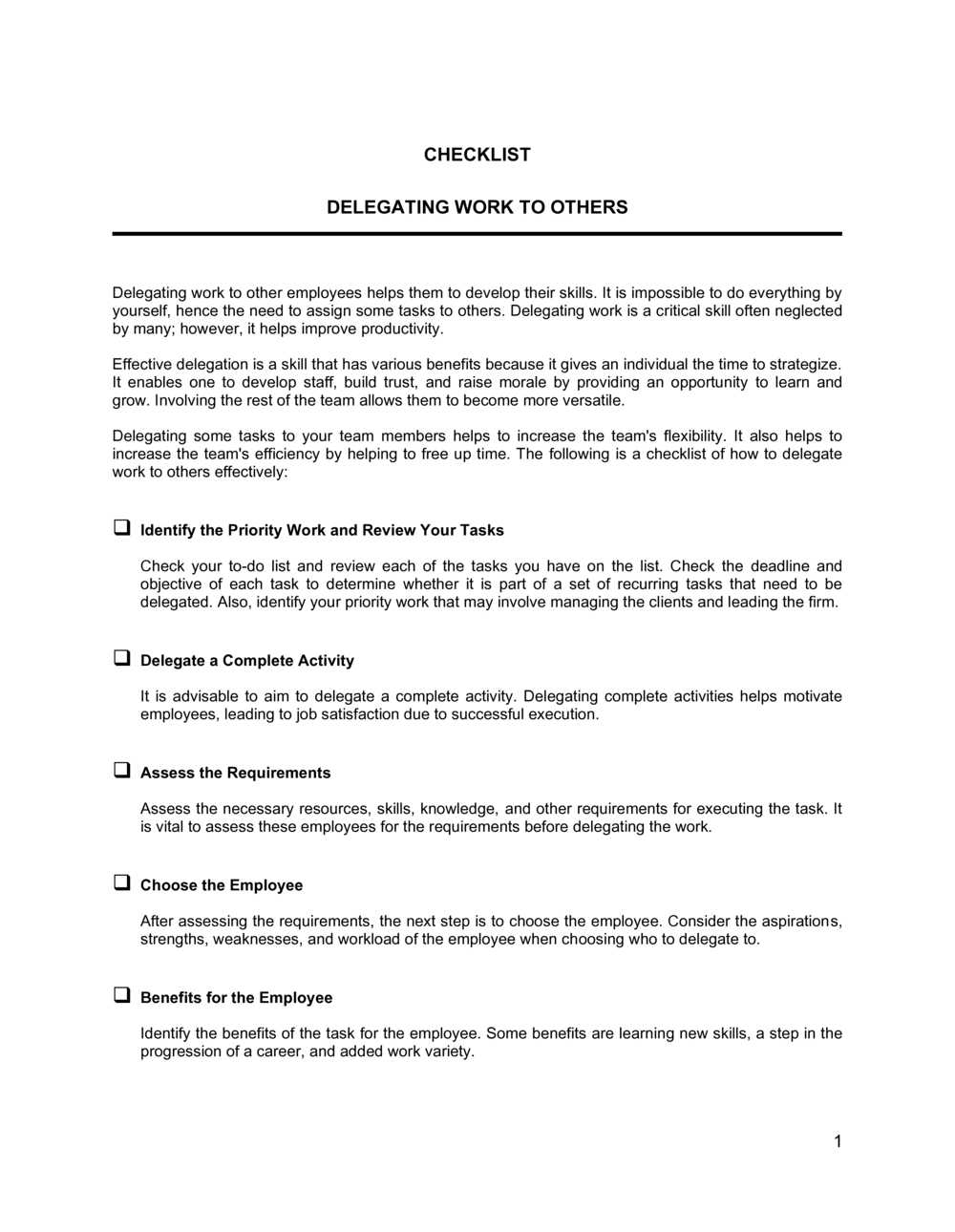
A Delegating Work To Others Checklist is a structured one-page form that helps managers assign tasks clearly, define expectations, and track completion. This free Word download gives you a ready-to-use checklist you can edit online and share with your team in minutes.
When you need it
Use it whenever you are handing off a task, project, or responsibility to a direct report, colleague, or contractor β€” especially when the work involves multiple steps, a firm deadline, or a quality standard that must be met.
What's inside
Task description, assignee details, priority level, deadline, required resources, success criteria, check-in schedule, and a completion sign-off field β€” everything needed to delegate once and follow up efficiently.

What is a Delegating Work To Others Checklist?

A Delegating Work To Others Checklist is a structured one-page form that captures every piece of information a manager and assignee need to hand off a task cleanly β€” including the task description, due date, required resources, success criteria, authority level, and check-in schedule. It converts informal verbal assignments into a documented record that both parties can reference from handoff through completion. Rather than leaving scope and expectations to interpretation, the checklist makes them explicit before work begins, reducing the back-and-forth that erodes both productivity and trust.

Why You Need This Document

Delegating without a structured checklist is one of the most reliable ways to generate rework, missed deadlines, and frustration on both sides of the handoff. When tasks are assigned verbally or through a brief message, assignees fill in the gaps with assumptions β€” about quality standards, decision authority, and what "done" actually means. The result is deliverables that require revision, managers who feel compelled to micromanage, and team members who feel set up to fail. This checklist eliminates those gaps by forcing clarity upfront: who owns the task, what success looks like, what authority the assignee has, and when progress will be reviewed. For managers scaling beyond what they can personally execute, it is the operational foundation that makes delegation reliable rather than risky.

Which variant fits your situation?

If your situation is…Use this template
Assigning a single task to one team memberDelegating Work To Others Checklist
Managing multiple tasks across a full projectProject Task List
Tracking employee workload and capacity across the teamEmployee Task Tracker
Assigning work to an external contractor or freelancerWork Order Template
Documenting a repeatable process for handoffStandard Operating Procedure (SOP)
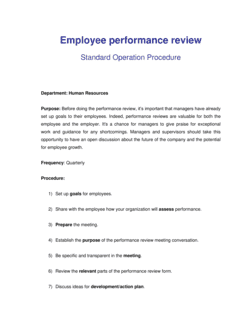
Setting performance expectations tied to delegated goalsEmployee Performance Review

Common mistakes to avoid

❌ Delegating without defining success criteria

Why it matters: Without a measurable definition of done, the assignee and manager each carry a different mental picture of what acceptable output looks like, making rework almost inevitable.

Fix: Write two to three specific, observable conditions the deliverable must meet before the task is considered complete.
❌ Assigning to a team instead of a named individual

Why it matters: Shared ownership becomes no ownership β€” when a task belongs to everyone, each person assumes someone else is handling it.

Fix: Name one specific person as the assignee for every task, even when multiple people contribute to the work.

❌ Delegating responsibility without delegating authority

Why it matters: An assignee who must seek manager approval for every minor decision cannot make meaningful progress, and the manager saves no time at all.

Fix: Explicitly state which decisions the assignee can make independently and set a dollar or impact threshold above which they need approval.

❌ No check-ins scheduled before the due date

Why it matters: Discovering on the deadline that the work took the wrong direction leaves no time to recover β€” the task misses its window and trust erodes.

Fix: Add at least one mid-point check-in to every delegated task, calendared before the checklist is handed off.

The 9 key fields, explained

Task title and description

Assignee name and role

Task owner and delegating manager

Due date and priority level

Required resources and access

Success criteria and expected output

Authority level and decision scope

Check-in schedule

Completion sign-off

How to fill it out

  1. 1

    Write a specific task title and description

    Name the task clearly and write 2–4 sentences describing what must be done, what the output looks like, and why it matters to the business. Avoid one-word titles.

    πŸ’‘ A good description answers: what is the deliverable, who will use it, and by when does it need to be ready?

  2. 2

    Name the assignee and confirm their capacity

    Enter the assignee's full name and role. Before finalizing, confirm they have the bandwidth to take on the task by the stated deadline.

    πŸ’‘ Checking capacity takes 60 seconds and prevents the most common reason delegated tasks miss their deadlines.

  3. 3

    Set a specific due date and priority level

    Enter a calendar date β€” not 'ASAP' or 'end of week.' Classify the priority as high, medium, or low and flag whether the deadline is hard or flexible.

    πŸ’‘ Reserve 'high priority' for no more than 20% of active tasks so the classification retains meaning.

  4. 4

    List required resources and arrange access

    Identify every tool, system, budget item, or person the assignee needs. Arrange access before handing off the checklist so the assignee can start immediately.

    πŸ’‘ Walk through the task mentally from first action to final deliverable to catch every resource dependency before they block progress.

  5. 5

    Define success criteria

    Write two to three specific, measurable conditions that define when the task is complete. Link them to the quality standard or business outcome the work supports.

    πŸ’‘ If you cannot write a concrete success criterion, the task is not yet clear enough to delegate.

  6. 6

    State the authority level explicitly

    Specify which decisions the assignee owns independently and which require your approval. Note any immediate escalation triggers β€” budget overruns, stakeholder objections, or technical blockers.

    πŸ’‘ Erring toward more autonomy speeds execution; reserve approval gates for decisions with meaningful financial or reputational consequences.

  7. 7

    Schedule check-ins and share the checklist

    Add two or three check-in dates to both calendars before sharing the checklist. Walk through it with the assignee verbally to confirm shared understanding of scope and expectations.

    πŸ’‘ The handoff conversation is as important as the document β€” use it to surface questions before work begins, not after.

Frequently asked questions

What is a delegating work to others checklist?

A delegating work to others checklist is a structured one-page form that captures every piece of information an assignee needs to complete a task successfully β€” including the task description, due date, required resources, success criteria, authority level, and check-in schedule. It replaces informal verbal handoffs with a documented record that both the manager and assignee can refer back to throughout execution.

Why is a checklist useful for delegation?

Verbal delegation is the single most common source of missed deadlines and rework. A checklist forces the manager to think through scope, resources, and success criteria before handing off the task, and gives the assignee a written reference they can consult without interrupting the manager. Studies on team productivity consistently show that written task assignments reduce errors and improve on-time completion rates compared to verbal instructions alone.

What should a delegation checklist include?

At minimum: a clear task title and description, the assignee's name and role, the delegating manager's name, a specific due date, a priority level, a list of required resources and access, measurable success criteria, the authority level granted to the assignee, scheduled check-in dates, and a completion sign-off field. Missing any of these creates ambiguity that typically surfaces as a problem partway through execution.

How is a delegation checklist different from a task list?

A task list is a personal productivity tool that tracks what one person needs to do. A delegation checklist is a structured handoff document between a manager and an assignee β€” it defines expectations, grants authority, and establishes accountability across two people. A task list tells you what to do; a delegation checklist tells the other person what to do, how well, and by when.

What tasks should not be delegated?

Tasks that should generally remain with the manager include performance reviews and formal feedback for direct reports, decisions involving confidential personnel matters, work that requires the manager's specific relationships or authority to be credible, and strategic decisions with organization-wide consequences. Everything else is a candidate for delegation once the right person and clear expectations are identified.

How do I delegate without micromanaging?

Define the outcome clearly upfront, grant decision-making authority proportionate to the task, schedule a small number of pre-agreed check-ins rather than ad hoc check-ups, and resist the urge to review work before it is due. The delegation checklist supports this by making success criteria explicit at the start β€” both parties agree on what good looks like before work begins, so interim supervision is rarely needed.

Can this checklist be used for delegating to external contractors?

Yes. The checklist works for any situation where one person hands off defined work to another. When delegating to contractors, pay particular attention to the authority level field β€” contractors typically have narrower decision-making scope than employees β€” and the required resources section, since contractors may need system access or NDAs before they can begin.

How many tasks should I delegate at once?

There is no fixed limit, but each task should have its own completed checklist. Bundling multiple distinct tasks into a single checklist obscures priorities and makes it difficult to track progress on each deliverable independently. If you find yourself listing more than three or four deliverables in a single task description, split the work into separate checklists with separate due dates.

How this compares to alternatives

vs Standard Operating Procedure (SOP)

An SOP documents how a repeatable process should be performed step by step β€” it is a reference guide for anyone doing the task. A delegation checklist is a one-time handoff document assigning a specific task to a specific person with a specific deadline. Use the SOP to show how; use the delegation checklist to confirm who, by when, and to what standard.

vs Project Task List

A project task list tracks all work items across a full project, often for multiple assignees simultaneously. A delegation checklist focuses on a single task and a single assignee, with detail on authority, resources, and success criteria that a task list row cannot capture. Use both together β€” the task list for visibility, the delegation checklist for individual handoffs.

vs Work Order Template

A work order is a formal authorization document used primarily in maintenance, facilities, and manufacturing to request and approve specific physical work. A delegation checklist is a broader management tool suited to any type of task β€” analytical, operational, or creative. Work orders typically feed into billing and inventory systems; delegation checklists feed into team accountability.

vs Employee Performance Review

A performance review evaluates how well an employee has performed over a period of time against agreed goals. A delegation checklist is a forward-looking tool that sets the expectations for a single task before it begins. Delegation checklists create the documented record of assigned work that makes performance reviews more objective and evidence-based.

Industry-specific considerations

Professional services

Partners delegate client deliverables to associates with defined quality standards and client communication boundaries to protect the client relationship.

Construction and project management

Site managers delegate specific trade tasks with material lists, safety requirements, and inspection sign-off criteria tied to project milestones.

Healthcare administration

Department managers delegate compliance, scheduling, and reporting tasks with strict escalation paths for any patient-safety or regulatory issues.

Retail and operations

Store managers delegate opening, closing, and inventory tasks to shift leads with explicit authority limits around discounts, returns, and staff scheduling.

Template vs pro β€” what fits your needs?

PathBest forCostTime
Use the templateManagers and business owners delegating tasks to employees, contractors, or colleaguesFree5–10 minutes per task
Template + professional reviewOrganizations standardizing delegation practices across multiple managers or departments$100–$300 for an HR or operations consultant review1–2 days
Custom draftedEnterprises integrating delegation tracking into project management or HRIS platforms$500–$2,000 for custom workflow design1–2 weeks

Glossary

Delegation
The act of assigning responsibility and authority for a specific task or decision to another person while retaining accountability for the outcome.
Assignee
The individual who receives and accepts responsibility for completing a delegated task.
Task Owner
The manager or leader who originally held responsibility for the work and is transferring it to an assignee.
Priority Level
A classification β€” typically high, medium, or low β€” indicating how urgently a task must be completed relative to other work.
Success Criteria
The specific, measurable conditions that must be met for a delegated task to be considered complete and acceptable.
Check-In Schedule
Pre-agreed points in time when the task owner and assignee review progress, remove blockers, and confirm the work is on track.
Authority Level
The degree of decision-making power granted to the assignee β€” for example, whether they can spend budget, approve changes, or escalate issues independently.
Escalation Path
The defined route an assignee should follow when a problem or decision exceeds their authority level during task execution.

Part of your Business Operating System

This document is one of 3,000+ business & legal templates included in Business in a Box.

  • Fill-in-the-blanks β€” ready in minutes
  • 100% customizable Word document
  • Compatible with all office suites
  • Export to PDF and share electronically

Create your document in 3 simple steps.

From template to signed document β€” all inside one Business Operating System.
1
Download or open template

Access over 3,000+ business and legal templates for any business task, project or initiative.

2
Edit and fill in the blanks with AI

Customize your ready-made business document template and save it in the cloud.

3
Save, Share, Send, Sign

Share your files and folders with your team. Create a space of seamless collaboration.

Save time, save money, and create top-quality documents.

β˜…β˜…β˜…β˜…β˜…

"Fantastic value! I'm not sure how I'd do without it. It's worth its weight in gold and paid back for itself many times."

Managing Director Β· Mall Farm
Robert Whalley
Managing Director, Mall Farm Proprietary Limited
β˜…β˜…β˜…β˜…β˜…

"I have been using Business in a Box for years. It has been the most useful source of templates I have encountered. I recommend it to anyone."

Business Owner Β· 4+ years
Dr Michael John Freestone
Business Owner
β˜…β˜…β˜…β˜…β˜…

"It has been a life saver so many times I have lost count. Business in a Box has saved me so much time and as you know, time is money."

Owner Β· Upstate Web
David G. Moore Jr.
Owner, Upstate Web

Run your business with a system β€” not scattered tools

Stop downloading documents. Start operating with clarity. Business in a Box gives you the Business Operating System used by over 250,000 companies worldwide to structure, run, and grow their business.

Start freeΒ Β·Β No credit card required