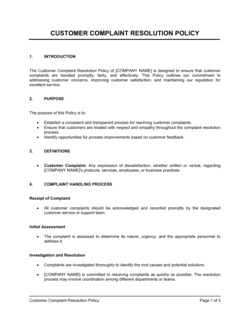
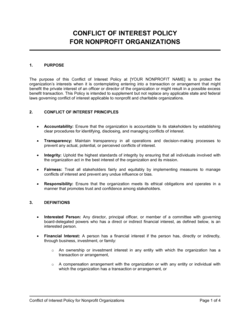
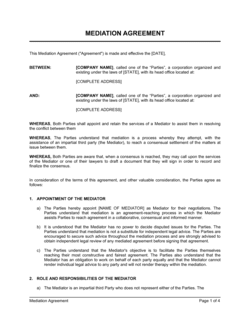
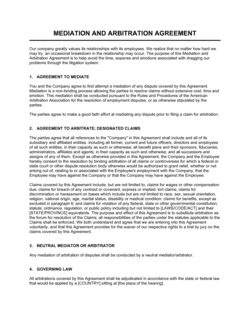
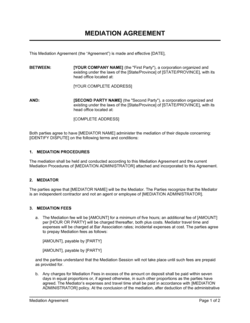
Conflict Resolution and Mediation Policy Template

Free Word download β€’ Edit online β€’ Save & share with Drive β€’ Export to PDF

2 pagesβ€’20–25 min to fillβ€’Difficulty: Standard
Learn more ↓
FreeConflict Resolution and Mediation Policy Template

At a glance

What it is
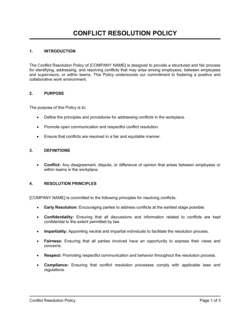
A Conflict Resolution and Mediation Policy is a formal internal document that defines how an organization identifies, addresses, and resolves workplace disputes between employees, teams, or management. This free Word download gives you a structured, ready-to-customize template covering grievance intake, mediation procedures, escalation paths, and recordkeeping β€” editable online and exportable as PDF for inclusion in your employee handbook or HR policy library.
When you need it
Use it when formalizing HR practices for a growing team, onboarding new employees who need a clear framework for raising concerns, or responding to recurring interpersonal conflicts that lack a documented resolution path. It is also essential when an employee handbook update is overdue or when a compliance audit requires evidence of a documented dispute resolution process.
What's inside
The template covers policy scope and objectives, definitions of conflict types, informal resolution steps, formal grievance procedures, mediation process and mediator selection, escalation to senior management or HR, confidentiality obligations, anti-retaliation protections, and recordkeeping requirements.

What is a Conflict Resolution and Mediation Policy?

A Conflict Resolution and Mediation Policy is a formal internal document that defines the structured process an organization uses to identify, address, and resolve workplace disputes β€” whether between colleagues, between an employee and a manager, or across teams. It establishes a tiered procedure moving from informal direct resolution through formal grievance, mediation, and escalation to senior decision-makers, while setting out confidentiality rules, anti-retaliation protections, and recordkeeping obligations. The policy functions as both an operational guide for HR and a rights document for employees, ensuring that every dispute is handled consistently, fairly, and at the lowest appropriate level.

Why You Need This Document

Without a documented conflict resolution process, disputes that could be resolved in days become months-long grievances β€” or resignation letters. Managers handle similar situations differently, employees lose confidence in the organization's fairness, and unresolved tensions erode team performance and retention. From a legal standpoint, employment tribunals and labor regulators in most jurisdictions examine whether an employer had a documented, accessible grievance procedure before assessing liability in unfair dismissal or constructive dismissal claims; the absence of one consistently worsens the employer's position. A written policy also removes ambiguity at the moment a conflict arises β€” when emotions run high and the pressure to act quickly is greatest. This template gives you a complete, customizable policy you can add to your employee handbook and distribute to your team in under two hours, replacing ad hoc management judgment with a process that protects both employees and the organization.

Which variant fits your situation?

If your situation is…Use this template
Addressing individual employee grievances against managementEmployee Grievance Policy
Resolving disputes between co-founders or business partnersPartnership Dispute Resolution Agreement
Documenting anti-harassment and anti-bullying standardsWorkplace Harassment Policy
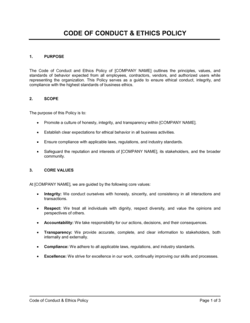
Setting expectations for respectful conduct across the organizationCode of Conduct
Managing performance disputes tied to disciplinary actionProgressive Discipline Policy
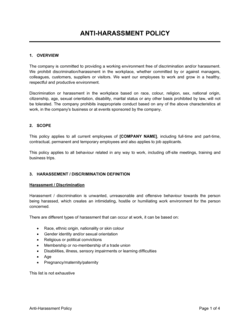
Outlining the full range of HR policies in a single reference documentEmployee Handbook
Addressing disputes between vendors or external partnersDispute Resolution Agreement

Common mistakes to avoid

❌ Making mediation mandatory

Why it matters: Courts and employment tribunals generally require mediation to be voluntary for it to retain legal protection as a 'without prejudice' process. Mandatory mediation can expose the company to claims of procedural coercion.

Fix: Frame mediation as an option that 'may be offered or requested at any stage' rather than a required step before escalation.

❌ Routing harassment complaints through the general conflict procedure

Why it matters: Harassment and discrimination complaints require a dedicated investigation process with different evidence standards, documentation obligations, and legal thresholds. Using the general policy risks an inadequate investigation and significant legal liability.

Fix: Add a clear carve-out directing harassment and discrimination allegations to a separate policy, and cross-reference both documents.

❌ Omitting specific timelines for each procedural stage

Why it matters: A policy with no stated timelines leaves HR with no accountability benchmark and leaves employees in uncertainty β€” which typically escalates the conflict rather than containing it.

Fix: Assign a specific business-day target for every procedural milestone: acknowledgment, investigation completion, decision notification, and appeal response.

❌ Storing grievance records in the employee's personnel file

Why it matters: Grievance records placed in a general personnel file can improperly influence future performance reviews, promotion decisions, or disciplinary actions β€” creating a paper trail that looks retaliatory even when it is not.

Fix: Maintain a separate, access-controlled grievance file for each matter, clearly segregated from the employee's employment record.

❌ No named reporting path for retaliation concerns

Why it matters: Anti-retaliation language without an actionable reporting mechanism is unenforceable. Employees who fear retaliation and have nowhere to report it will simply not use the policy.

Fix: Specify a named role (not an individual's name) and an alternative contact in case the primary contact is involved in the complaint.

❌ Publishing the policy without employee acknowledgment

Why it matters: An unacknowledged policy is difficult to enforce. Employees can claim they were unaware of the procedure, complicating disciplinary action for policy violations.

Fix: Collect signed or electronically confirmed acknowledgments from all employees at onboarding and whenever the policy is materially updated.

The 9 key sections, explained

Policy scope and objectives

Definitions of conflict types

Informal resolution step

Formal grievance procedure

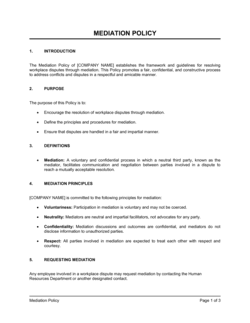
Mediation process

Escalation path

Confidentiality obligations

Anti-retaliation protection

Recordkeeping and documentation

How to fill it out

  1. 1

    Define the policy scope

    Insert your company name and specify which worker classifications are covered β€” employees, contractors, volunteers, or all of the above. Confirm whether the policy applies to remote, hybrid, and on-site workers equally.

    πŸ’‘ If you engage contractors through a staffing agency, confirm with legal counsel whether they are covered before including them in scope.

  2. 2

    Classify conflict types relevant to your organization

    Review the default conflict categories in the template and add or remove categories that match your industry and workforce. Reference your existing harassment and discrimination policy by name so the two documents work together.

    πŸ’‘ Keep the definitions concrete β€” 'disputes about task allocation' is more useful than 'interpersonal differences.'

  3. 3

    Set timelines for each procedural stage

    Fill in the bracketed day counts for grievance acknowledgment, investigation completion, and decision notification. Typical ranges: 3–5 business days to acknowledge, 10–20 business days to investigate, 5–10 business days to issue a decision.

    πŸ’‘ Choose timelines you can realistically meet with your current HR capacity β€” missed deadlines undermine trust in the policy.

  4. 4

    Identify your mediator pool

    Decide whether mediation will be handled by an internal HR representative, an external accredited mediator, or both depending on severity. Name the role (not an individual) responsible for mediator selection.

    πŸ’‘ For organizations under 50 employees, pre-identifying one or two external mediators in advance saves significant time when a dispute actually arises.

  5. 5

    Name the escalation decision-makers by role

    Replace all placeholder titles (e.g., '[HR Director]') with the specific roles in your organization that hold escalation authority at each level. Confirm that these roles exist and that the individuals in them are aware of their obligations.

    πŸ’‘ If your organization is flat, a two-person review panel (e.g., CEO + a neutral department head) provides objectivity at the final escalation stage.

  6. 6

    Add the anti-retaliation reporting mechanism

    Insert the specific contact (role and email) to whom retaliation concerns should be reported. If the concern involves HR, provide an alternative contact β€” such as the CEO or a board member β€” so there is always a neutral reporting path.

    πŸ’‘ A dedicated, anonymized reporting channel (e.g., a third-party ethics hotline) significantly increases the likelihood that retaliation is reported and addressed early.

  7. 7

    Set the record retention period

    Fill in the retention period for grievance records. Five years from resolution date is a common minimum; some industries or jurisdictions require longer. Confirm with legal counsel if you operate in a regulated sector.

    πŸ’‘ Store grievance records in a separate, access-controlled HR system β€” not in the employee's main personnel file β€” to prevent improper use in future employment decisions.

  8. 8

    Distribute and acknowledge the policy

    Add the policy to your employee handbook and collect signed acknowledgments from all employees. For existing staff, issue the policy with a 30-day review period before it takes effect.

    πŸ’‘ A brief 15-minute team briefing explaining the policy's purpose β€” not just its existence β€” increases employee confidence and willingness to use the process early.

Frequently asked questions

What is a conflict resolution and mediation policy?

A conflict resolution and mediation policy is a formal workplace document that defines how an organization handles disputes between employees, teams, or management. It typically outlines a tiered process β€” informal resolution, formal grievance, mediation, and escalation β€” along with confidentiality obligations and anti-retaliation protections. The policy gives employees a clear, fair path to raise and resolve concerns without resorting to litigation or resignation.

Why does a company need a conflict resolution policy?

Without a documented process, disputes are handled inconsistently β€” some get resolved quickly, others fester until they become resignations, tribunal claims, or legal actions. A written policy sets clear expectations for both employees and managers, reduces the risk of costly litigation, and demonstrates to regulators and auditors that the organization has a functional workplace dispute mechanism. It also reduces the burden on senior leadership by resolving issues at the lowest appropriate level.

What is the difference between conflict resolution and mediation?

Conflict resolution is the broader process of addressing and settling a workplace dispute β€” it includes informal conversations, formal grievance procedures, and escalation paths. Mediation is one specific tool within that process: a facilitated, voluntary session led by a neutral party designed to help both sides reach a mutually acceptable agreement. Mediation typically occurs after informal resolution has failed and before full escalation to senior management or an external body.

Is workplace mediation legally required?

Mediation is not a legal requirement in most jurisdictions, but it is strongly encouraged by employment regulators in the UK, the EU, and several US states as a cost-effective alternative to formal tribunal proceedings. In the UK, the ACAS Code of Practice on Disciplinary and Grievance Procedures recommends mediation for unresolved workplace disputes. Having a documented mediation option can also demonstrate good faith in employment tribunal proceedings.

Who should act as mediator in a workplace dispute?

For smaller organizations, a trained HR professional with no prior involvement in the dispute can serve as an internal mediator. For more serious or sensitive disputes, or when internal neutrality is in question, an external accredited mediator is preferable. The key requirement is that both parties agree the mediator is neutral. Avoid appointing the direct manager of either party or anyone with a personal relationship to the complainant or respondent.

How long should a grievance investigation take?

A typical target is 10–20 business days from the date the formal grievance is received to the date a written decision is issued, depending on complexity. Simple disputes involving two parties with clear documentation can be resolved in 10 business days. Disputes involving multiple witnesses, documentary evidence, or concurrent HR investigations may reasonably take longer. The policy should state a target timeline and a process for communicating delays to both parties.

Can an employee be disciplined for raising a grievance?

No. Disciplining, demoting, or otherwise disadvantaging an employee for raising a grievance in good faith constitutes retaliation β€” which is unlawful in most jurisdictions and a separate disciplinary matter under this policy. The anti-retaliation protection extends to witnesses and anyone who participates in the mediation or investigation process. Employees who raise vexatious or bad-faith complaints may be subject to separate disciplinary action, but this must be handled carefully and with documented evidence of bad faith.

How does this policy interact with a harassment policy?

Allegations of harassment, discrimination, or bullying should be routed to a dedicated harassment policy rather than handled under the general conflict resolution procedure. The two policies should cross-reference each other so employees know which path applies. In some cases β€” such as a dispute that begins as an interpersonal conflict and surfaces harassment behavior during investigation β€” both procedures may run concurrently, which should be addressed explicitly in both documents.

How often should a conflict resolution policy be reviewed?

An annual review aligned to your broader HR policy calendar is standard. In addition, trigger a review whenever employment legislation changes in your jurisdiction, when a significant organizational restructure occurs, or when a grievance reveals a gap in the current procedure. Document each review date and the name of the reviewer in the policy's version history section.

How this compares to alternatives

vs Workplace Harassment Policy

A harassment policy focuses specifically on prohibited conduct β€” sexual harassment, bullying, and discrimination β€” and typically requires a formal investigation with defined legal standards. A conflict resolution policy covers the broader range of workplace disputes, including interpersonal disagreements and management decisions that fall short of harassment. The two policies should cross-reference each other, with harassment allegations routed to the dedicated policy.

vs Employee Handbook

An employee handbook is a comprehensive reference document covering all HR policies, benefits, and workplace expectations. A conflict resolution policy is a single focused document that may be embedded in the handbook or stand alone. For organizations that need to distribute or update the conflict procedure independently β€” for compliance audits or legal proceedings β€” a standalone policy is the better choice.

vs Code of Conduct

A code of conduct defines behavioral expectations and ethical standards across the organization. A conflict resolution policy defines the procedural mechanism for addressing violations or disputes when they occur. The code of conduct describes what is expected; the conflict resolution policy describes what happens when expectations are not met.

vs Progressive Discipline Policy

A progressive discipline policy governs how the employer responds to employee performance or conduct failures β€” with defined steps from verbal warning to termination. A conflict resolution policy governs disputes between parties at any level, including employee complaints about management. The two documents are complementary: a conflict raised through the grievance process may result in disciplinary action governed by the progressive discipline policy.

Industry-specific considerations

Technology / SaaS

Remote and distributed teams require asynchronous grievance intake options and virtual mediation capabilities built explicitly into the policy.

Healthcare

Patient safety and professional licensing concerns may require concurrent reporting to regulatory bodies alongside the internal grievance process.

Professional Services

Client-facing staff disputes require confidentiality provisions that account for client relationship sensitivity and billable-hour continuity during investigations.

Manufacturing

Shift-based workforces and union agreements may require the policy to explicitly address collective bargaining procedures alongside individual grievance rights.

Retail / Hospitality

High staff turnover and seasonal employment mean dispute procedures must be simple enough to execute quickly without lengthy HR involvement at each stage.

Nonprofit

Volunteer and paid-staff dynamics require the policy to address conflicts between volunteers as well as between volunteers and employed staff.

Template vs pro β€” what fits your needs?

PathBest forCostTime
Use the templateSmall and mid-sized businesses formalizing their HR policies without a dedicated legal teamFree1–2 hours to customize and distribute
Template + professional reviewOrganizations in regulated industries, those with existing union agreements, or companies operating across multiple jurisdictions$300–$800 for an HR consultant or employment lawyer review3–5 business days
Custom draftedLarge enterprises, organizations with complex workforce structures, or businesses that have experienced a recent formal grievance or tribunal claim$1,500–$4,000+ for a fully custom policy drafted by employment counsel2–4 weeks

Glossary

Grievance
A formal complaint raised by an employee about a workplace issue, concern, or perceived unfair treatment.
Mediation
A voluntary, confidential process in which a neutral third party helps disputing parties reach a mutually acceptable resolution.
Mediator
A trained neutral facilitator β€” internal or external β€” who guides the mediation session without imposing a decision.
Escalation
The process of moving an unresolved dispute to a higher level of authority, such as senior HR, a department head, or an external body.
Informal Resolution
An early-stage attempt to resolve a conflict directly between the parties involved, without triggering the formal grievance procedure.
Anti-Retaliation Protection
A policy provision prohibiting adverse employment actions against any employee who raises a grievance or participates in a mediation or investigation in good faith.
Respondent
The individual against whom a grievance or complaint has been filed.
Complainant
The individual who initiates a grievance or formally raises a workplace dispute.
Binding Arbitration
A dispute resolution mechanism in which a neutral arbitrator issues a final, enforceable decision β€” a more formal alternative to mediation.
Good Faith Participation
The obligation of all parties in a mediation or grievance process to engage honestly and constructively, without attempting to obstruct or delay resolution.

Part of your Business Operating System

This document is one of 3,000+ business & legal templates included in Business in a Box.

  • Fill-in-the-blanks β€” ready in minutes
  • 100% customizable Word document
  • Compatible with all office suites
  • Export to PDF and share electronically

Create your document in 3 simple steps.

From template to signed document β€” all inside one Business Operating System.
1
Download or open template

Access over 3,000+ business and legal templates for any business task, project or initiative.

2
Edit and fill in the blanks with AI

Customize your ready-made business document template and save it in the cloud.

3
Save, Share, Send, Sign

Share your files and folders with your team. Create a space of seamless collaboration.

Save time, save money, and create top-quality documents.

β˜…β˜…β˜…β˜…β˜…

"Fantastic value! I'm not sure how I'd do without it. It's worth its weight in gold and paid back for itself many times."

Managing Director Β· Mall Farm
Robert Whalley
Managing Director, Mall Farm Proprietary Limited
β˜…β˜…β˜…β˜…β˜…

"I have been using Business in a Box for years. It has been the most useful source of templates I have encountered. I recommend it to anyone."

Business Owner Β· 4+ years
Dr Michael John Freestone
Business Owner
β˜…β˜…β˜…β˜…β˜…

"It has been a life saver so many times I have lost count. Business in a Box has saved me so much time and as you know, time is money."

Owner Β· Upstate Web
David G. Moore Jr.
Owner, Upstate Web

Run your business with a system β€” not scattered tools

Stop downloading documents. Start operating with clarity. Business in a Box gives you the Business Operating System used by over 250,000 companies worldwide to structure, run, and grow their business.

Start freeΒ Β·Β No credit card required