Certification Enclosing Financial Statements Template

Free Word download • Edit online • Save & share with Drive • Export to PDF

1 page20–30 min to fillDifficulty: StandardSignature requiredLegal review recommended
Learn more ↓
FreeCertification Enclosing Financial Statements Template

At a glance

What it is
A Certification Enclosing Financial Statements is a signed legal document in which an authorized officer — typically a CEO, CFO, or controller — formally attests that the accompanying financial statements are accurate, complete, and prepared in accordance with the applicable accounting standards. This free Word download gives you a ready-to-edit template that you can tailor to your reporting period, certifying officer, and recipient — then export as PDF and sign before submission.
When you need it
Use it when transmitting audited or unaudited financial statements to a lender, investor, board of directors, regulatory body, or counterparty who requires a formal officer-level attestation alongside the statements. It is commonly required under loan covenants, shareholder agreements, and regulatory filings.
What's inside
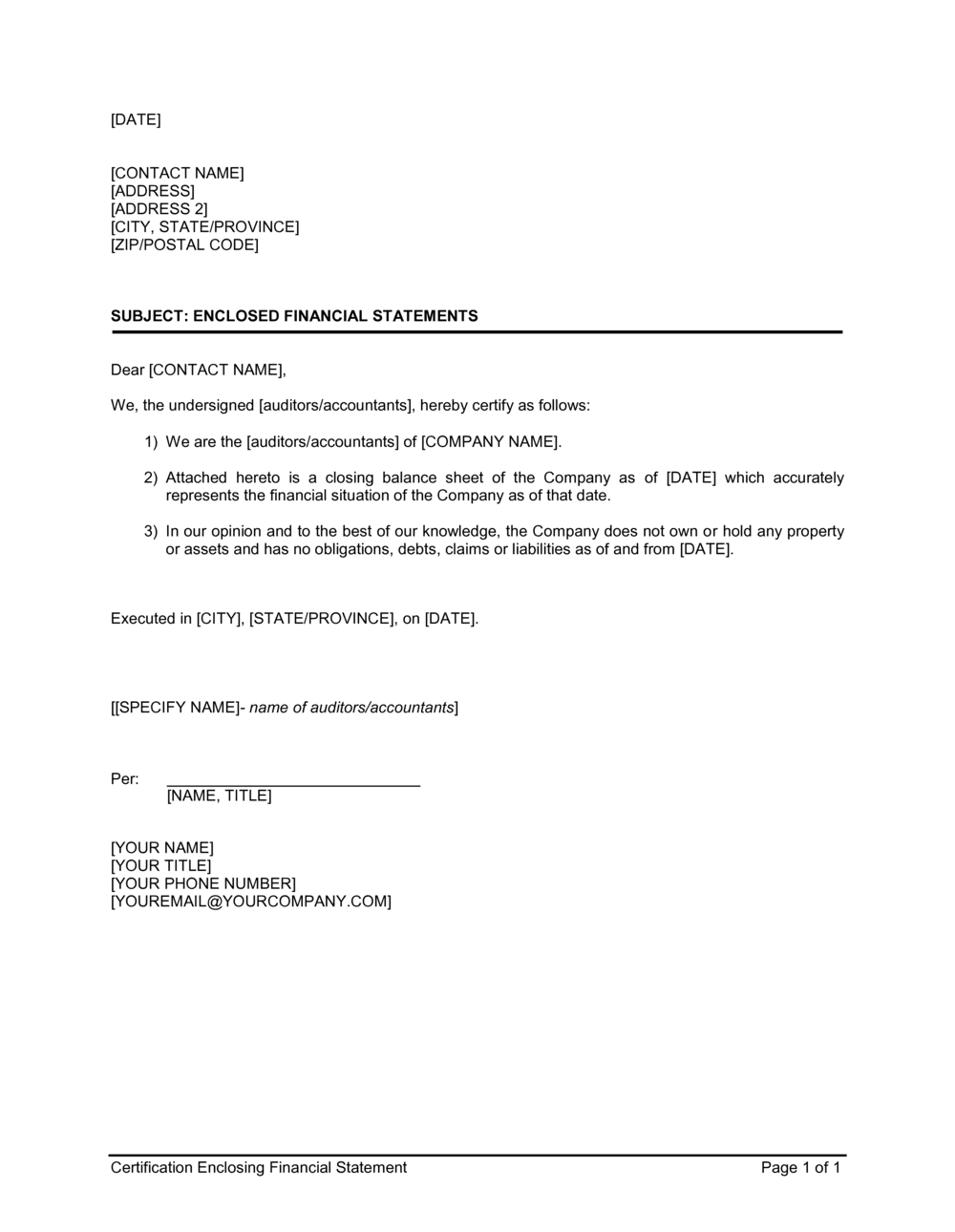
Identification of the certifying officer and their authority, a description of the enclosed financial statements and the period they cover, representations on accuracy and compliance with GAAP or IFRS, disclosure of known material misstatements or omissions, a statement on internal controls, and the officer's dated signature block with title.

What is a Certification Enclosing Financial Statements?

A Certification Enclosing Financial Statements is a signed legal document in which an authorized company officer — typically a CEO, CFO, or controller — formally attests that the accompanying financial statements are accurate, complete, and prepared in accordance with the applicable accounting standards (GAAP or IFRS). It functions as a binding representation from management to the recipient — whether a lender, investor, board of directors, or regulatory body — that the enclosed financial reports fairly present the company's financial position and results of operations in all material respects. Unlike an auditor's report, which provides independent third-party assurance, this certification reflects management's own knowledge and accountability, creating direct contractual and legal liability for the certifying officer if the representation proves false.

Why You Need This Document

Without a properly executed financial statements certification, you risk a technical default under your credit agreement, a breach of information rights under your shareholder agreement, or a rejected regulatory filing — all triggered not by inaccurate numbers, but by a missing or defective cover document. Lenders treat the delivery of certified financials as a condition to continued borrowing availability; missing the deadline or submitting a certification signed by the wrong officer can trigger a default notice even when the underlying financials are sound. The certification also protects the certifying officer by clearly documenting the scope of their attestation and applying appropriate knowledge qualifiers — so that an error they genuinely did not know about does not expose them to strict personal liability. This template gives you a professionally structured, attorney-reviewed starting point with all material representations, proper knowledge qualifiers, and exhibit references built in — so you can meet your delivery obligations accurately and on time.

Which variant fits your situation?

If your situation is…Use this template
Certifying financials under a bank loan or credit agreement covenantCertification Enclosing Financial Statements (Lender)
Attesting to internal controls alongside annual financial statementsManagement Report on Internal Controls
Officer certification required under SEC reporting rules for a public companySOX Section 302 Certification
Accompanying a compiled financial statement prepared by a CPACompilation Report Cover Letter
Transmitting audited financials with a formal cover letterAuditor's Transmittal Letter
Certifying accuracy of financial data in a due diligence packageDue Diligence Financial Certification
Confirming accuracy of financial representations in a loan applicationFinancial Information Certification (Loan Application)

Common mistakes to avoid

❌ Wrong officer signs the certification

Why it matters: Credit agreements and shareholder agreements typically define which officer title is authorized to certify. A signature from an unauthorized person renders the certification defective and can trigger a technical default or investor rights violation.

Fix: Before preparing the certification, read the definition of 'Responsible Officer' or equivalent in the governing agreement and confirm the signatory's title matches exactly.

❌ Signing without verifying covenant compliance

Why it matters: Certifying compliance when a financial covenant is actually breached — even by a small margin — constitutes a misrepresentation and can accelerate the entire debt obligation or trigger cross-default provisions.

Fix: Run a covenant compliance model against the final financial figures before the officer signs. If a covenant is breached, request a waiver before delivering the certification.

❌ Omitting known subsequent events

Why it matters: A material adverse change that occurs between the period end date and the signing date — and is known to the officer — must be disclosed. Silence is treated as a representation that no such event occurred.

Fix: Conduct a formal post-period review within the week before signing and document the results. Disclose any material events in a schedule attached to the certification.

❌ Backdating the certification to the period end date

Why it matters: The certification represents the officer's knowledge as of the signing date, not the period end. Backdating misrepresents the knowledge cutoff and can constitute fraud or a false statement under securities or banking laws.

Fix: Always use the actual date of signing. If the agreement requires a specific delivery date, coordinate the signing to occur on or before that date — never backdate.

❌ Using absolute accuracy language instead of a knowledge qualifier

Why it matters: Stating 'there are no misstatements' creates strict liability for any error discovered later, even one unknown to the officer at signing. Courts have held officers personally liable under this language.

Fix: Use knowledge-qualified language: 'to the best of the undersigned's knowledge and belief' or 'the undersigned is not aware of any material misstatement.'

❌ Delivering an unsigned or incomplete exhibit package

Why it matters: A certification that references exhibits not yet finalized — or that is transmitted without all referenced attachments — is technically defective and gives the recipient grounds to reject the delivery.

Fix: Finalize all exhibits before the officer signs. Create a single PDF combining the signed certification and all exhibits before transmitting to the recipient.

The 10 key clauses, explained

Identification of Parties and Authority

In plain language: Names the company, the certifying officer, their title, and confirms they are authorized to make the certification on the company's behalf.

Sample language
The undersigned, [OFFICER NAME], [TITLE] of [COMPANY LEGAL NAME], a [STATE/PROVINCE] [ENTITY TYPE] ('Company'), hereby certifies on behalf of the Company as of [DATE] as follows.

Common mistake: Using a title that does not match the officer's authority under the company's governing documents. If the credit agreement requires CFO certification and a controller signs instead, the lender may declare a covenant breach.

Description of Enclosed Financial Statements

In plain language: Identifies the specific financial statements being transmitted — the type, reporting period, and whether they are audited, reviewed, or unaudited.

Sample language
Enclosed herewith are the [audited / unaudited] [consolidated / standalone] financial statements of the Company for the [fiscal year / quarter] ended [DATE], including the balance sheet, income statement, statement of cash flows, and statement of changes in equity.

Common mistake: Failing to specify whether the statements are audited or unaudited. Lenders and investors treat these differently; ambiguity can trigger a technical default or investor complaint.

Certification of Accuracy and Fair Presentation

In plain language: The core attestation — the officer states the financial statements fairly present the company's financial position and results of operations in all material respects.

Sample language
The financial statements enclosed herewith fairly present, in all material respects, the financial condition and results of operations of the Company for the period then ended, in accordance with [GAAP / IFRS], consistently applied.

Common mistake: Omitting the accounting standard reference. A bare accuracy statement without specifying GAAP or IFRS is unenforceable because there is no objective benchmark against which to measure the representation.

No Material Misstatements or Omissions

In plain language: The officer represents that they are not aware of any errors or omissions in the financial statements that would be material to a reasonable reader.

Sample language
The undersigned is not aware of any material misstatement or omission in the enclosed financial statements that would cause them to be misleading to a reasonable user relying on such statements for financial decision-making purposes.

Common mistake: Using absolute language ('there are no misstatements') rather than a knowledge qualifier ('the undersigned is not aware of'). Absolute statements expose the officer to strict liability for errors they genuinely did not know about.

Compliance with Applicable Agreements

In plain language: Confirms the company is in compliance with the financial covenants and reporting obligations in any applicable credit agreement, shareholder agreement, or regulatory requirement.

Sample language
As of the date hereof, the Company is in compliance with all financial covenants and reporting obligations set forth in the [CREDIT AGREEMENT / SHAREHOLDER AGREEMENT] dated [DATE], and no Event of Default has occurred or is continuing.

Common mistake: Certifying compliance without running a covenant compliance check first. Signing a compliance certification when a covenant is actually breached — even inadvertently — creates a misrepresentation claim and can accelerate loan repayment.

Disclosure of Material Changes

In plain language: Requires the officer to disclose any material adverse change in the company's financial condition or business since the date of the financial statements.

Sample language
Since [PERIOD END DATE], there has been no material adverse change in the financial condition, results of operations, or business prospects of the Company that has not been disclosed in the enclosed financial statements or in Schedule [X] attached hereto.

Common mistake: Treating this clause as boilerplate and not actually reviewing for subsequent events. Courts and lenders have successfully pursued officers for signing this certification when a known material event — a major customer loss, litigation, or regulatory action — had occurred post-period.

Statement on Internal Controls

In plain language: The officer attests that the company maintains internal controls over financial reporting adequate to ensure the integrity of the enclosed statements.

Sample language
The Company maintains internal controls over financial reporting that are designed to provide reasonable assurance regarding the reliability of financial reporting and the preparation of financial statements in accordance with [GAAP / IFRS].

Common mistake: Including this clause without reviewing whether the internal controls actually function as described. If a material weakness in controls is known and not disclosed, this clause becomes a false representation.

Going Concern Qualification (if applicable)

In plain language: Discloses any going concern uncertainty identified by management or auditors, preventing the recipient from later claiming they were misled about the company's viability.

Sample language
The financial statements enclosed herewith [do not include / include, as described in Note [X],] any going concern qualification. [If applicable: Management has identified conditions that raise substantial doubt about the Company's ability to continue as a going concern, as further described in Note [X].]

Common mistake: Omitting this clause entirely when a going concern issue exists. Failing to disclose a known going concern qualification in a certification letter exposes the officer to fraud or negligent misrepresentation claims.

Officer's Signature Block and Date

In plain language: The executing officer's printed name, title, company name, and the date of execution — which must match or post-date the financial statement period end.

Sample language
IN WITNESS WHEREOF, the undersigned has executed this Certification as of [DATE]. [OFFICER NAME] | [TITLE] | [COMPANY LEGAL NAME]

Common mistake: Dating the certification with the period end date rather than the actual signing date. The certification represents conditions as of the signing date — backdating it misrepresents the officer's knowledge cutoff and can constitute fraud.

Exhibit Reference and Attachment List

In plain language: Lists all financial statements and schedules enclosed with the certification, ensuring the recipient can confirm they received a complete package.

Sample language
Attached hereto as Exhibit A are the financial statements described herein. Attached hereto as Exhibit B is the covenant compliance certificate required under Section [X] of the [CREDIT AGREEMENT].

Common mistake: Signing the certification before all exhibits are finalized and attached. A certification that references an incomplete or draft financial statement can be challenged as inaccurate on its face.

How to fill it out

  1. 1

    Confirm the certifying officer's authority

    Identify the officer required to sign under the applicable agreement — credit agreement, shareholder agreement, or regulatory rule. Confirm their title matches exactly what the agreement requires.

    💡 Check the definitions section of the underlying agreement for 'Responsible Officer' or 'Financial Officer' — these terms often have specific definitions that limit who can sign.

  2. 2

    Identify the financial statements being certified

    Enter the exact period end date, statement types (balance sheet, income statement, cash flow, equity), and whether the statements are audited, reviewed, or unaudited.

    💡 Match the period description word-for-word with the language in the underlying agreement — 'fiscal year ended December 31' and 'year ended December 31' can create ambiguity in a compliance dispute.

  3. 3

    Confirm the accounting standard applied

    State whether the financial statements were prepared under GAAP or IFRS. If a hybrid or special-purpose framework was used, identify it precisely.

    💡 If your company switched accounting standards during the period — for example, from US GAAP to IFRS upon a cross-border listing — disclose the change in the certification body.

  4. 4

    Run the covenant compliance check before signing

    Before completing the compliance clause, verify each financial covenant — debt-to-equity ratio, minimum liquidity, EBITDA threshold — against the actual figures in the financial statements.

    💡 Prepare a separate covenant compliance certificate (often required alongside the certification) and cross-reference the figures before signing either document.

  5. 5

    Review for subsequent events and material changes

    Between the period end date and the signing date, identify any material adverse changes — major litigation, key customer loss, regulatory action, or significant asset impairment — and disclose them in the material changes clause or an attached schedule.

    💡 Set a calendar reminder for 5 business days before the certification deadline to conduct a post-period review with your finance and legal teams.

  6. 6

    Address the going concern assessment

    Determine whether management or the auditors have identified any going concern uncertainty. If yes, include the required disclosure language and cross-reference the relevant note in the financial statements.

    💡 Even if the auditor has not issued a going concern opinion, include this clause with affirmative 'no going concern' language — omitting it entirely creates an implied gap.

  7. 7

    Attach and number all exhibits

    Finalize the financial statements and any required schedules, label each as an exhibit, and complete the exhibit reference list before the officer signs.

    💡 PDF the entire package — certification letter plus all exhibits — into a single document before obtaining the signature so the certified version and the enclosed statements cannot be separated.

  8. 8

    Execute with the correct date and deliver within the required deadline

    The officer signs and dates the certification on or before the delivery deadline in the underlying agreement. Deliver the complete package to the required recipient by the method specified — email, secure portal, or physical delivery.

    💡 Track your delivery deadline in your contract management system with a 10-business-day lead reminder — lenders treating late certification delivery as a covenant breach is more common than most borrowers expect.

Frequently asked questions

What is a certification enclosing financial statements?

A certification enclosing financial statements is a signed legal document in which an authorized company officer — typically a CEO or CFO — formally attests that the accompanying financial statements are accurate, complete, and prepared in accordance with the applicable accounting standards. It is commonly required by lenders under loan covenants, by investors under information rights provisions, and by regulatory bodies as part of periodic reporting obligations.

Who is required to sign a financial statements certification?

The required signatory depends on the underlying agreement. Credit agreements and shareholder agreements typically define an authorized officer — often the CEO, CFO, or controller — who must sign. Certifications required under securities laws (such as SOX Section 302) must be signed by the principal executive officer and principal financial officer. Always check the governing document for the specific title requirement before preparing the certification.

Is a certification enclosing financial statements legally binding?

Yes. A signed financial statements certification is generally enforceable as a contractual representation. If the certified statements are materially inaccurate and the recipient suffers loss as a result, the certifying officer and the company may face breach of contract, negligent misrepresentation, or — in cases of deliberate falsehood — fraud liability. In regulated contexts (public companies, banking), false certifications can also trigger criminal penalties.

What accounting standard should the certification reference?

The certification should reference the standard under which the financial statements were actually prepared — most commonly US GAAP for domestic US entities, IFRS for Canadian, UK, EU, and most international companies, or a specific special-purpose framework if applicable. Check the underlying credit or shareholder agreement for a defined accounting standard; if the agreement specifies GAAP and the company has switched to IFRS, a waiver or amendment is typically required before the certification can be issued.

What happens if I miss the deadline for delivering a certified financial statement?

Most credit agreements and shareholder agreements treat late delivery of certified financial statements as a covenant breach or event of default. Depending on the agreement, a grace period of 5–30 days may apply before the lender or investor can exercise remedies — but even during the grace period, borrowers typically cannot draw additional funds. Proactively requesting a waiver before the deadline passes is far less costly than relying on the grace period.

What is the difference between a financial statements certification and an audit opinion?

An audit opinion is issued by an independent external auditor who has examined the financial statements and provides assurance on their accuracy. A financial statements certification is issued by management — an internal officer of the company — attesting to accuracy based on their own knowledge. The two can accompany the same set of financial statements; the certification represents management's attestation while the audit opinion represents independent third-party assurance. Lenders often require both.

Does a financial statements certification need to be notarized?

In most commercial lending and investor contexts, notarization is not required — a dated signature by the authorized officer is sufficient. Some government contracts, regulatory filings, or international transactions may require notarization or an apostille. Review the specific requirements of the underlying agreement or regulatory rule before preparing the certification.

What disclosures are required in the certification if a going concern issue exists?

If management or the auditors have identified conditions raising substantial doubt about the company's ability to continue as a going concern, the certification must disclose this — either within the certification body or by cross-referencing the relevant note in the financial statements. Omitting a known going concern qualification from the certification exposes the certifying officer to fraud or negligent misrepresentation claims from lenders or investors who relied on the document.

Can a controller or accounting manager sign if the CFO is unavailable?

Only if the governing agreement expressly permits it. Most credit agreements define a specific list of authorized officers and require one of them to sign. If the designated officer is unavailable, the typical path is to either obtain a board resolution authorizing a substitute officer or request a short extension from the lender. A certification signed by an unauthorized person is technically defective even if the underlying financial statements are perfectly accurate.

How this compares to alternatives

vs Auditor's Report

An auditor's report is issued by an independent external CPA after conducting an audit and provides third-party assurance on the financial statements. A certification enclosing financial statements is a management document — signed by a company officer — attesting to accuracy based on internal knowledge. Lenders and investors often require both: the certification for management accountability, the audit for independent verification.

vs Compliance Certificate

A compliance certificate is a separate lender-required document confirming that specific financial covenants — debt service coverage, minimum liquidity, leverage ratio — are satisfied as of the reporting date. A certification enclosing financial statements transmits the underlying financials and certifies their accuracy. The two documents typically accompany each other under credit agreements but serve distinct purposes.

vs Management Representation Letter

A management representation letter is addressed to the external auditor and forms part of the audit evidence package, confirming management's responsibility for the financial statements and disclosing known misstatements. A certification enclosing financial statements is addressed to a lender, investor, or regulator and accompanies the statements as a formal delivery document. The audiences and legal frameworks differ even though both involve officer-level attestation.

vs SOX Section 302 Certification

A SOX Section 302 Certification is a statutory requirement for public company CEOs and CFOs under US securities law, filed with the SEC alongside quarterly and annual reports. A certification enclosing financial statements is a contractual document used in private company lending and investor contexts. SOX certifications carry specific criminal penalties under federal law; contractual certifications carry liability under contract and tort law.

Industry-specific considerations

Banking and Lending

Covenant-driven delivery schedules require quarterly and annual certified financials; lenders often impose strict officer-title requirements and treat late or defective certifications as events of default.

Private Equity and Venture Capital

Portfolio company information rights provisions in shareholder agreements mandate periodic certified financial statements; accuracy of these certifications directly affects valuation and follow-on funding decisions.

Real Estate

Commercial mortgage and construction loan agreements routinely require certified operating statements and rent rolls; certifications must cover property-level and entity-level financials separately.

Healthcare

Government reimbursement programs and hospital credit facilities require certified cost reports and financial statements; regulatory penalties for false certification are particularly severe in this sector.

Manufacturing

Asset-based revolving credit facilities require monthly borrowing base certificates alongside certified receivables and inventory schedules; officer certification is required for each draw request.

SaaS / Technology

Venture debt facilities and Series B+ shareholder agreements impose quarterly certified financial reporting obligations; certifications must address ARR, churn, and deferred revenue classification under ASC 606.

Jurisdictional notes

United States

For public companies, CEO and CFO certifications are mandatory under Sarbanes-Oxley Sections 302 and 906, with criminal penalties for false statements. For private companies, certification obligations arise from contract — typically credit agreements or shareholder agreements — rather than statute. State fraudulent misrepresentation laws apply to false officer certifications, and the FTC has pursued enforcement actions in regulated lending contexts.

Canada

Canadian public companies must file CEO and CFO certifications with SEDAR under National Instrument 52-109, which mirrors SOX in structure. For private companies, certification obligations are contractual and governed by provincial law — Ontario, BC, and Alberta all apply general contract and tort principles to false representations in financial certifications. IFRS is the required standard for publicly accountable enterprises; ASPE is available for private companies.

United Kingdom

UK directors have statutory duties under the Companies Act 2006 to approve and sign financial statements that give a true and fair view; attaching a certification letter reinforces this obligation in a contractual context. Listed companies must comply with the UK Corporate Governance Code on financial reporting. For private lending transactions, the certification's legal effect is governed by the Misrepresentation Act 1967 and general contract law. IFRS or UK-adopted IFRS is standard for larger entities.

European Union

EU member states implement the Transparency Directive, requiring listed companies to include management responsibility statements in annual and half-yearly reports — these function similarly to financial statement certifications. IFRS as adopted by the EU is mandatory for consolidated statements of listed companies. For private lending and investor transactions, certification obligations are contractual and vary by member state; France, Germany, and the Netherlands each apply distinct civil law frameworks to officer representations and liability.

Template vs lawyer — what fits your deal?

PathBest forCostTime
Use the templatePrivate companies delivering certified financials under straightforward loan covenants or standard investor information rights provisionsFree30–60 minutes per reporting period
Template + legal reviewCompanies with complex multi-lender credit facilities, known covenant concerns, or first-time certification under a new agreement$300–$800 for a one-time attorney review of the certification and underlying covenant requirements1–3 days
Custom draftedPublic companies, regulated financial institutions, cross-border transactions, or situations involving known going concern issues or material restatements$1,500–$5,000+ depending on complexity and jurisdiction1–2 weeks

Glossary

Certifying Officer
The individual — typically a CEO or CFO — who signs the certification and assumes personal liability for the accuracy of the representations made.
Financial Statements
Formal accounting reports — typically a balance sheet, income statement, cash flow statement, and statement of equity — covering a defined reporting period.
GAAP
Generally Accepted Accounting Principles — the standardized accounting rules used to prepare financial statements in the United States.
IFRS
International Financial Reporting Standards — the accounting framework used in Canada, the UK, the EU, and most jurisdictions outside the US.
Material Misstatement
An error or omission in financial statements significant enough that it would change the decision of a reasonable user relying on those statements.
Loan Covenant
A contractual condition in a credit agreement requiring the borrower to deliver financial statements — often with officer certification — on a defined schedule.
Internal Controls
Policies and procedures a company maintains to ensure the integrity of financial reporting, prevent fraud, and comply with laws and regulations.
Information Rights
Contractual rights granted to investors or lenders entitling them to receive periodic financial statements and other business information from the company.
Representation
A statement of fact made by one party to another on which the recipient is entitled to rely — false representations can give rise to legal liability.
Going Concern
The assumption that a business will continue to operate for the foreseeable future; a going concern qualification signals doubt about the company's ability to continue.
Compilation
The lowest level of financial statement preparation by a CPA, involving no assurance — the CPA presents management's numbers without independently verifying them.

Part of your Business Operating System

This document is one of 3,000+ business & legal templates included in Business in a Box.

  • Fill-in-the-blanks — ready in minutes
  • 100% customizable Word document
  • Compatible with all office suites
  • Export to PDF and share electronically

Create your document in 3 simple steps.

From template to signed document — all inside one Business Operating System.
1
Download or open template

Access over 3,000+ business and legal templates for any business task, project or initiative.

2
Edit and fill in the blanks with AI

Customize your ready-made business document template and save it in the cloud.

3
Save, Share, Send, Sign

Share your files and folders with your team. Create a space of seamless collaboration.

Save time, save money, and create top-quality documents.

★★★★★

"Fantastic value! I'm not sure how I'd do without it. It's worth its weight in gold and paid back for itself many times."

Managing Director · Mall Farm
Robert Whalley
Managing Director, Mall Farm Proprietary Limited
★★★★★

"I have been using Business in a Box for years. It has been the most useful source of templates I have encountered. I recommend it to anyone."

Business Owner · 4+ years
Dr Michael John Freestone
Business Owner
★★★★★

"It has been a life saver so many times I have lost count. Business in a Box has saved me so much time and as you know, time is money."

Owner · Upstate Web
David G. Moore Jr.
Owner, Upstate Web

Run your business with a system — not scattered tools

Stop downloading documents. Start operating with clarity. Business in a Box gives you the Business Operating System used by over 250,000 companies worldwide to structure, run, and grow their business.

Free Forever Plan · No credit card required