Product Launch Templates
★★★★★4.7from 280+ reviews· Trusted by 20M+ businesses
Plan, execute, and track every product launch with ready-to-use templates built for product managers and founders.
WordEditable onlinePDF11+ product launch templates
Other Product Management categories
Most popular product launch templates
Product management operations
250K+Clients
20M+Free users
20+Years
190+Countries
10,000+Law firms
50M+Downloads
Trusted across review platforms
- Capterra★★★★☆4.649 reviews
- G2★★★★☆4.713 reviews
- GetApp★★★★☆4.649 reviews
- Google Play★★★★☆4.6179 ratings
- Google Reviews★★★★☆4.567 reviews
Frequently asked questions
What should a product launch plan include?
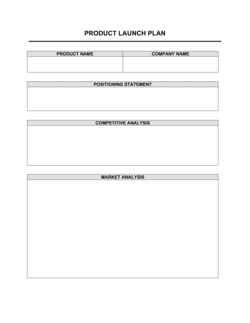
A product launch plan should include the product overview, target audience, launch goals and KPIs, a detailed timeline with milestones, task owners, go-to-market channels, distribution readiness, customer communication drafts, and a post-launch review date. The level of detail scales with the complexity of the launch — a feature update needs far less than an entirely new product line.
How far in advance should you start planning a product launch?
Most product teams begin formal launch planning six to twelve weeks before the target date for a standard software or physical product. Complex launches involving new distribution channels, regulatory approvals, or international markets can require three to six months of planning. The launch checklist template is a reliable way to work backwards from the launch date and identify how early each workstream needs to start.
What is the difference between a product brief and a product spec?
A product brief is a short strategic document that describes why a product is being built, for whom, and what success looks like — it is audience-facing and written for stakeholders and teams. A product spec (or specification) is a detailed technical document that describes exactly how the product will be built, covering functionality, edge cases, and engineering requirements. The brief comes first to align direction; the spec comes later to guide build.
What is a minimum viable product (MVP)?
An MVP is the smallest version of a product that can be released to real users to test a core assumption. It is not a rough prototype — it is a functional release with just enough features to validate whether the product solves the target problem well enough that customers want more. The MVP Framework template helps teams define scope boundaries and the specific hypothesis each MVP is designed to test.
How do you measure whether a product launch was successful?
Success is measured against the KPIs defined before launch, which typically include customer acquisition numbers (sign-ups, units sold), engagement metrics (activation rate, feature adoption), revenue against forecast, and customer satisfaction scores. Setting these benchmarks in the launch plan before launch day is the only way to distinguish a genuine success from a good-looking vanity metric.
Do I need a product distribution agreement for a new product?
If you are selling through a third-party retailer, wholesaler, or online marketplace rather than directly to end customers, a product distribution agreement is essential. It defines territory rights, pricing controls, minimum purchase commitments, and liability for defects. Without one, a distributor can undercut your pricing, sell in prohibited markets, or make claims about the product that expose you to liability.
What is a product roadmap and who is it for?
A product roadmap is a high-level visual plan that shows what will be built and when, organised by themes, features, or milestones across a planning horizon — typically one to four quarters. Roadmaps serve different audiences depending on the version: internal roadmaps detail engineering priorities; executive roadmaps show strategic bets and resource allocation; customer-facing roadmaps communicate planned value without committing to specific dates.
Can a small team or solo founder use these templates?
Yes. Most templates in this folder are designed to scale down as well as up. A solo founder preparing a first launch can use the product brief, MVP framework, and launch checklist with minimal adaptation. Larger teams will find the roadmap, development plan, and distribution agreement more relevant. Start with the checklist and brief, then add the other documents as the team and product complexity grow.
Product Launch vs. related documents
A product launch plan is a tactical document focused on the specific activities, owners, and dates required to bring one release to market. A product roadmap is a longer-horizon strategic document that shows how a product will evolve across multiple releases and quarters. Use the roadmap for stakeholder alignment and portfolio planning; use the launch plan for sprint-level execution of a single release.
A product brief defines what is being built for a single initiative — the problem, audience, and success metrics for one product or feature. A product strategy sheet sets the direction for an entire product line or business unit over a longer period. Start with the strategy sheet at the portfolio level, then create a brief for each individual initiative that flows from it.
The launch checklist is scoped to the final weeks before and after a specific release — covering marketing, legal, support readiness, and announcement tasks. The product management checklist covers the ongoing operational rhythm of a product team across the full lifecycle, not just launch events. Use both together for a thorough launch cycle.
An MVP framework defines the smallest testable version of a product and the assumptions it will validate — it is lean by design. A new product development plan covers the complete build cycle from concept to commercial launch, including funding, resourcing, and go-to-market. Start with the MVP framework for early-stage validation, then graduate to the development plan when committing to a full build.
Key clauses every Product Launch contains
Across the product launch category, certain sections appear in nearly every planning and strategy document regardless of format.
- Product overview and objectives. Describes what the product is, the problem it solves, and the measurable goals the launch is intended to achieve.
- Target audience definition. Identifies the primary customer segment, their pain points, and the criteria used to profile them.
- Scope and feature set. Lists what is included in the launch version and, equally important, what is explicitly out of scope.
- Launch timeline and milestones. Maps key dates — feature freeze, beta, soft launch, general availability — against owners and dependencies.
- Go-to-market channels. Specifies which marketing, sales, and distribution channels will be activated at launch and in what sequence.
- Success metrics and KPIs. Defines the quantitative signals — activation rate, revenue, customer satisfaction — used to evaluate launch performance.
- Risks and contingencies. Identifies the most likely launch risks (supply, demand, technical) and the mitigation steps assigned to each.
- Post-launch review cadence. Sets the date and format for the first retrospective to assess what worked and what needs immediate adjustment.
How to write a product launch plan
A product launch plan turns a good idea into a coordinated sequence of actions with owners and deadlines. Here's how to build one from scratch.
1
Define the product and the problem it solves
Write a one-paragraph product overview that any stakeholder can read and immediately understand what is launching and why it matters.
2
Identify and size the target audience
Name the primary customer segment, estimate its size, and describe the specific problem or job this product addresses for them.
3
Set measurable launch goals
Choose three to five KPIs — units sold, trial sign-ups, net promoter score — with numeric targets and a time frame for each.
4
Map the launch timeline
Work backwards from the launch date to assign milestones: content ready, sales enablement complete, support team trained, announcement sent.
5
Assign owners to every task
Every item on the launch checklist needs one named owner and a due date — shared ownership reliably produces missed deadlines.
6
Confirm distribution and supply readiness
Verify that inventory, fulfilment, digital delivery, or deployment infrastructure can handle the expected day-one demand before you announce.
7
Draft and schedule customer communications
Prepare the announcement letter, demo invitations, and any in-app or in-store messaging so they are ready to send at the exact launch moment.
8
Schedule the post-launch review
Book the retrospective before launch day so the team knows it is coming and collects data against the KPIs from day one.
At a glance
- What it is
- A product launch template is a structured document that guides a team through the planning, coordination, and execution of bringing a new product to market. Templates cover everything from the initial product brief and roadmap to the go-to-market checklist and post-launch communication.
- When you need one
- Any time a team is preparing to release a new product, feature, or service — whether that's a first MVP or an established company's next product line.
Which Product Launch do I need?
The right template depends on where you are in the product launch cycle — discovery, planning, execution, or post-launch. Match your current stage to the scenario below.
Your situation
Recommended template
Starting a new product from scratch and need a structured plan
Covers the full development journey from concept through commercial release.Summarizing a product concept for stakeholder or team alignment
Captures objectives, audience, and success criteria in a single concise document.Planning timelines, milestones, and feature delivery over quarters
Visualises priorities and delivery windows across teams and stakeholders.Coordinating every task and owner in the weeks before launch
Itemises every pre-launch activity so nothing falls through the cracks.Building and testing the smallest version of a product first
Defines MVP scope, assumptions, and validation criteria before development begins.Writing a full business case for a new product investment
Combines market analysis, financial projections, and launch strategy in one plan.Communicating the launch to customers or a distribution channel
Ready-to-send announcement letter for external audiences at launch date.Inviting key customers or prospects to see the product in action
Professional demo invitation that drives attendance and pre-launch interest.Glossary
- Product brief
- A short strategic document that defines the purpose, audience, and success criteria for a single product initiative.
- Product roadmap
- A prioritised plan showing which features or milestones will be delivered and in what time frame.
- Minimum viable product (MVP)
- The smallest functional version of a product released to real users to validate a core assumption before committing to a full build.
- Go-to-market (GTM) plan
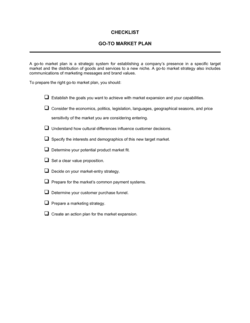
- The strategy for reaching target customers and generating demand at the moment a product launches.
- Product-market fit
- The point at which a product satisfies a strong market demand, typically evidenced by high retention and organic growth.
- Product lifecycle
- The stages a product moves through from introduction to growth, maturity, and eventual decline or discontinuation.
- Feature freeze
- A pre-launch cut-off date after which no new features are added, allowing the team to focus on testing and stabilisation.
- Launch checklist
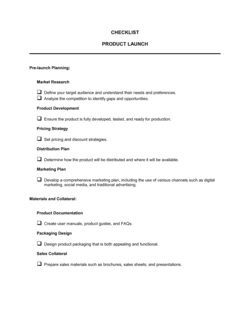
- A task list covering every activity — marketing, legal, support, technical — that must be completed before a product goes live.
- Distribution agreement
- A contract between a supplier and a third party that authorises the third party to sell the product in a defined territory or channel.
- Product defect notice
- A formal written notice issued when a product does not meet agreed quality standards, triggering a remedy or recall process.
- KPI (key performance indicator)
- A measurable value used to evaluate how well a launch or product is achieving its defined objectives.
What is a product launch template?
A product launch template is a structured document — or a set of documents — that guides a product team, founder, or business through the process of planning, preparing, and executing the release of a new product or service. Launch templates provide a repeatable framework so that every critical step — from defining the audience and setting goals to coordinating marketing, distribution, and post-launch review — is accounted for before the first customer ever sees the product.
Product launches fail most often not because the product is wrong, but because the coordination around it breaks down. Someone misses a milestone. Communications go out early. Distribution isn't ready. A well-structured set of launch documents reduces those coordination failures by making responsibilities, timelines, and decisions explicit. Templates in this folder span the full launch lifecycle: the early-stage product brief and MVP framework, the mid-stage roadmap and development plan, the tactical launch plan and checklist, and the post-launch agreements, notices, and communications that keep the product in market.
When you need a product launch template
Whether you are shipping a first MVP, releasing a major feature update, or taking a new product line to a distribution network, the moment you involve more than one person in the process, a shared document becomes necessary. Without it, assumptions stay unspoken, tasks fall between teams, and launch dates slip.
Common triggers:
- A startup is preparing to release its first product to paying customers
- A product team is coordinating a cross-functional launch across engineering, marketing, and customer success
- A founder needs a business case to secure internal or external funding for a new product
- A company is entering a new market and needs to brief distributors or resellers
- A product manager is onboarding a new team member who needs to understand the roadmap and strategy
- A business is formalising its returns, warranty, or defect-handling process for a new product line
- A small team wants a repeatable process so that each subsequent launch is faster and more consistent than the last
Skipping the planning documents rarely saves time — it transfers the cost of that missing structure into firefighting, rework, and missed revenue at launch. Starting with even a short product brief and a launch checklist gives teams a shared source of truth they can update as conditions change.
Award-winning platform
- Great Place to Work 2025
- BIG Award — Product of the Year 2025
- Smartest Companies 2025
- Global 100 Excellence 2026
- Best of the Best 2025