PM Operations Templates

4.7from 280+ reviews Trusted by 20M+ businesses

Standardize every process, policy, and agreement your operations team needs — from SOPs to vendor management.

WordEditable onlinePDF10+ PM operations templates

Other Product Management categories

250K+Clients
20M+Free users
20+Years
190+Countries
10,000+Law firms
50M+Downloads

Trusted across review platforms

  • Capterra★★★★☆4.649 reviews
  • G2★★★★☆4.713 reviews
  • GetApp★★★★☆4.649 reviews
  • Google Play★★★★☆4.6179 ratings
  • Google Reviews★★★★☆4.567 reviews

Related categories

Frequently asked questions

What should an operations manual include?
An operations manual typically includes company overview and mission, organizational structure and reporting lines, roles and responsibilities, key business processes, policies (HR, IT, safety, vendor), and contact directories. It should be detailed enough that a new team member or replacement could understand how the business functions without requiring extensive onboarding. The level of detail varies by industry and company size, but every operations manual should answer: who does what, how, and when.
What is the difference between an SOP and an operations manual?
An SOP is a step-by-step instruction for a single, specific task or process — for example, how to process a customer return or how to open a restaurant at the start of service. An operations manual is the broader document that governs the entire business and may reference or link to individual SOPs. Think of the manual as the framework and SOPs as the detailed instructions that sit within it.
Does every LLC need an operating agreement?
In most US states, an operating agreement is not legally required for an LLC, but it is strongly recommended. Without one, state default rules govern your LLC — which may not reflect your actual intentions regarding profit splits, voting rights, or what happens if a member leaves. Multi-member LLCs in particular should always have a signed operating agreement. Some states, including California, New York, and Delaware, require them by statute.
What is a vendor risk assessment used for?
A vendor risk assessment evaluates the financial stability, security practices, regulatory compliance, and operational reliability of a supplier before you engage them — or on a recurring basis after the relationship begins. It helps procurement and operations teams identify risks (supply disruption, data breach, reputational damage) early enough to negotiate mitigations, require certifications, or select an alternative supplier.
How detailed should an SOP be?
An SOP should be detailed enough that a qualified new hire could complete the task correctly on their first attempt without supervision. Each step should be a single action, written in plain language, with clear decision points and references to any tools, systems, or reference documents needed. Overly long SOPs are rarely read; aim for the minimum level of detail that prevents errors and ensures consistency.
When do I need a franchise operations manual?
A franchise operations manual is required any time you grant franchisees the right to operate under your brand, systems, and processes. It defines brand standards, operating procedures, supply chain requirements, training protocols, and compliance obligations. Most franchise regulators require franchisors to provide a current operations manual as part of their Franchise Disclosure Document (FDD).
What is a supply chain plan and when should I create one?
A supply chain plan documents how you source, procure, produce, and deliver goods or services — including supplier relationships, lead times, inventory targets, and contingency plans for disruptions. Create one when launching a product-based business, when diversifying your supplier base, or after a supply disruption reveals gaps in your current approach.
Can I use an LLC operating agreement template for a multi-member LLC?
Yes, but choose a template specifically designed for multiple members. Single-member operating agreements lack provisions for profit allocation among members, voting procedures, deadlock resolution, and buyout mechanics — all of which are critical in multi-member structures. The LLC Multiple Members Operating Agreement template in this folder is designed specifically for that scenario.

PM Operation vs. related documents

Operations Manual vs. Standard Operating Procedures

An operations manual is a high-level reference document covering the entire business — org structure, policies, processes, and responsibilities. Standard operating procedures (SOPs) are granular, step-by-step instructions for specific, repeatable tasks. Most organizations need both: the manual sets the framework, and the SOPs define how individual tasks get executed within it.

Operating Agreement vs. Partnership Agreement

An operating agreement governs an LLC — defining member roles, ownership percentages, profit distribution, and voting rights under LLC law. A partnership agreement serves a similar function for general or limited partnerships. The key difference is the legal entity: LLCs use operating agreements; partnerships use partnership agreements. If your business is an LLC, use an operating agreement.

Vendor Management Policy vs. Supplier Code of Conduct

A vendor management policy defines your internal process for selecting, evaluating, and managing vendors — it's primarily an internal governance document. A supplier code of conduct is an external-facing document that communicates the ethical, legal, and quality standards you require suppliers to meet. Both are complementary and are often used together in a mature procurement function.

Operating Budget vs. Pricing List

An operating budget is an internal financial planning tool that projects revenues, costs, and cash flow over a period. A pricing list is an external-facing document that communicates what customers or clients will pay for goods or services. One drives internal decisions; the other drives revenue conversations.

Key clauses every PM Operation contains

Across the operations document category, a core set of provisions appears — whether you're drafting an SOP, a vendor policy, or an operating agreement.

  • Scope and purpose. Defines which processes, entities, or relationships the document governs and what outcome it is designed to achieve.
  • Roles and responsibilities. Assigns clear ownership of tasks, decisions, and compliance obligations to specific individuals or teams.
  • Procedures and steps. Documents the sequence of actions required to complete a process, typically including decision points and escalation paths.
  • Performance standards. Sets measurable quality, timeliness, or output benchmarks that individuals or vendors must meet.
  • Review and update cycle. Specifies how frequently the document must be reviewed and who is responsible for keeping it current.
  • Compliance and governance. Identifies applicable laws, regulations, or internal policies and establishes accountability for adherence.
  • Recordkeeping and documentation. Defines what records must be created, how long they must be retained, and who controls access.
  • Consequences of non-compliance. Describes corrective actions, penalties, or termination provisions if standards or procedures are not followed.

How to write an operations document

A well-structured operations document — whether an SOP, a manual, or a vendor policy — follows the same foundational logic.

  1. 1

    Define the scope

    State exactly what the document covers: which processes, teams, vendors, or entities it applies to, and what it does not cover.

  2. 2

    Identify the owner and audience

    Assign a named owner responsible for maintaining the document and list the roles that must follow or reference it.

  3. 3

    Map the current process or situation

    Before writing, document how things actually work today — interviews, observations, and existing records are faster than starting from scratch.

  4. 4

    Write procedures in plain, sequential language

    Use numbered steps, active voice, and specific verbs — 'click Save,' not 'the save function should be used.'

  5. 5

    Add decision points and exceptions

    Identify where the process branches (if X, do Y; otherwise do Z) and document what happens in edge cases or exceptions.

  6. 6

    Set performance standards and KPIs

    Where relevant, specify measurable outcomes: turnaround times, error rates, approval thresholds, or vendor scorecard metrics.

  7. 7

    Define the review cycle and version control

    Date the document, assign a version number, and specify who must approve updates and how often a full review is required.

  8. 8

    Distribute, train, and confirm acknowledgment

    Share the final document with all stakeholders, provide training where needed, and capture signed acknowledgment for accountability.

At a glance

What it is
PM operations templates are ready-made documents that help businesses define, document, and govern how work gets done — covering standard operating procedures, operations manuals, vendor policies, operating agreements, and related job descriptions.
When you need one
Any time you're scaling a team, onboarding vendors, formalizing processes, or structuring a new business entity, a purpose-built operations template shortens the time from blank page to signed, enforceable document.

Which PM Operation do I need?

The right template depends on whether you're documenting internal processes, governing a legal entity, managing external suppliers, or hiring for an operations role. Pick the scenario that matches yours.

Your situation
Recommended template

Documenting step-by-step processes for your team to follow consistently

Captures repeatable workflows so any team member can execute them reliably.

Creating a comprehensive reference guide for how the whole business operates

Covers policies, responsibilities, and processes across every function in one document.

Setting up governance rules for a new or existing LLC

Defines member rights, profit distribution, and decision-making for an LLC.

Planning and tracking the company's operational budget for the year

Structures projected revenues, expenses, and cash flow for an operating period.

Defining rules and expectations for all vendors and suppliers

Sets selection criteria, performance standards, and compliance expectations.

Assessing the risk profile of a new or existing vendor

Identifies financial, operational, and compliance risks before engaging a supplier.

Hiring a Chief Operating Officer for a growing company

Covers COO accountabilities, qualifications, and reporting structure.

Documenting SOPs for a hotel or hospitality operation

Tailored to hospitality workflows including guest services, housekeeping, and facilities.

Glossary

Standard operating procedure (SOP)
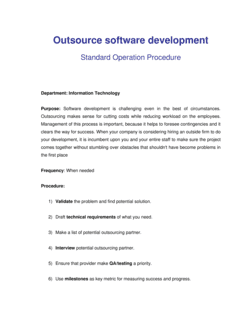
A documented, step-by-step instruction for completing a specific recurring task in a consistent and controlled way.
Operations manual
A comprehensive reference document that describes how a business or a major function within it operates, including policies, processes, and responsibilities.
Operating agreement
A legal contract among the members of an LLC that governs ownership, management, profit distribution, and decision-making.
Vendor risk assessment
A structured evaluation of a supplier's financial, operational, and compliance risk before or during an engagement.
Supplier code of conduct
A document that communicates the ethical, environmental, and quality standards a company requires its suppliers to meet.
Operating budget
A financial plan projecting revenues, operating costs, and cash flow for a defined period, typically one fiscal year.
Supply chain plan
A document defining how a company sources materials, manages inventory, and delivers products or services to customers.
Material requirement planning (MRP)
A production planning method that calculates the materials and components needed to manufacture a product on schedule.
Quality management plan
A document that defines quality standards, inspection procedures, and accountability for delivering consistent outputs.
Version control
A system for tracking changes to a document over time, including who made changes, when, and what was modified.
PLLC
A Professional Limited Liability Company — an LLC structure available to licensed professionals such as doctors, lawyers, and accountants in many US states.

What is an operations management document?

An operations management document is any template, policy, procedure, or agreement that defines how a business runs its day-to-day activities — from the step-by-step instructions a team follows to complete a task, to the legal agreement that governs how an LLC is owned and managed. Operations documents bring structure, accountability, and consistency to the work that keeps a company functioning.

The category is broad by design. It includes standard operating procedures that guide frontline staff through repeatable tasks, operations manuals that give new employees (or franchisees) a complete picture of how the business works, operating agreements that define the legal structure of an LLC, and vendor management policies that set expectations for every supplier in the chain. What unites them is their purpose: replacing informal, person-dependent knowledge with documented, transferable processes.

Well-maintained operations documents reduce errors, speed up onboarding, support compliance audits, and make a business more resilient when key people leave or roles change.

When you need an operations document

Operations documents become urgent the moment your business outgrows informal communication — when you can no longer rely on everyone knowing the process because they learned it from the person who built it. Common triggers:

  • You're scaling a team and need new hires to perform consistently from day one
  • A franchise expansion requires franchisees to follow brand and operational standards
  • A vendor incident exposes gaps in your supplier selection or monitoring process
  • You're forming an LLC and need to define member rights, profit splits, and governance
  • An audit or regulatory review requires documented evidence of your processes and controls
  • A key employee leaves and their institutional knowledge leaves with them
  • You're preparing to sell or raise investment, and buyers require documented operations

Skipping operations documentation doesn't eliminate the processes — it just makes them invisible, inconsistent, and impossible to enforce. The templates in this folder give you a starting structure for every major operations document type, so you spend your time on the specifics of your business rather than on formatting and structure.

Award-winning platform

  • Great Place to Work 2025
  • BIG Award — Product of the Year 2025
  • Smartest Companies 2025
  • Global 100 Excellence 2026
  • Best of the Best 2025

Create your document in 3 simple steps.

From template to signed document — all inside one Business Operating System.
1
Download or open template

Access over 3,000+ business and legal templates for any business task, project or initiative.

2
Edit and fill in the blanks with AI

Customize your ready-made business document template and save it in the cloud.

3
Save, Share, Send, Sign

Share your files and folders with your team. Create a space of seamless collaboration.

Save time, save money, and create top-quality documents.

★★★★★

"Fantastic value! I'm not sure how I'd do without it. It's worth its weight in gold and paid back for itself many times."

Managing Director · Mall Farm
Robert Whalley
Managing Director, Mall Farm Proprietary Limited
★★★★★

"I have been using Business in a Box for years. It has been the most useful source of templates I have encountered. I recommend it to anyone."

Business Owner · 4+ years
Dr Michael John Freestone
Business Owner
★★★★★

"It has been a life saver so many times I have lost count. Business in a Box has saved me so much time and as you know, time is money."

Owner · Upstate Web
David G. Moore Jr.
Owner, Upstate Web

Run your business with a system — not scattered tools

Stop downloading documents. Start operating with clarity. Business in a Box gives you the Business Operating System used by over 250,000 companies worldwide to structure, run, and grow their business.

Free Forever Plan · No credit card required