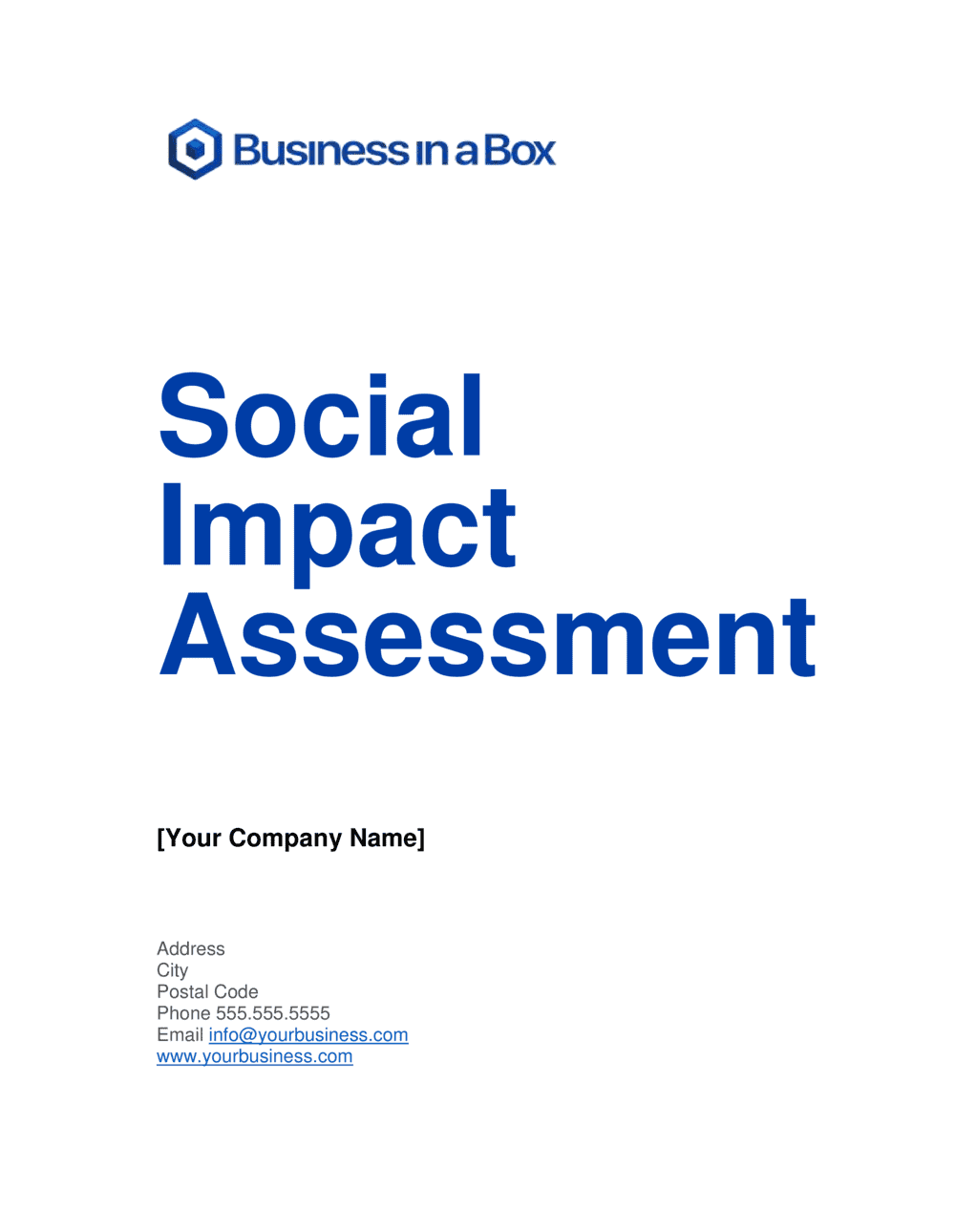
Social Impact Assessment Template

Free Word download • Edit online • Save & share with Drive • Export to PDF

14 pages35–45 min to fillDifficulty: ComplexSignature requiredLegal review recommended
Learn more ↓
FreeSocial Impact Assessment Template

At a glance

What it is
A Social Impact Assessment (SIA) is a formal document that identifies, evaluates, and records the anticipated and actual effects of a project, policy, or business activity on the people, communities, and social systems it touches. This free Word download gives you a structured, stakeholder-ready starting point you can edit online and export as PDF for regulatory submissions, investor disclosures, or internal governance review.
When you need it
Use it before launching a major project, infrastructure development, or business expansion that will materially affect local communities, workers, or vulnerable populations — and whenever regulators, lenders, or institutional investors require documented social due diligence.
What's inside
Project scope and stakeholder identification, baseline social conditions, impact prediction and significance rating, mitigation and management plans, monitoring and reporting commitments, grievance mechanisms, and signatory approval blocks for accountable parties.

What is a Social Impact Assessment?

A Social Impact Assessment (SIA) is a formal document that systematically identifies, predicts, evaluates, and plans for the social consequences — positive and negative — of a proposed project, policy, or business activity on the people and communities it affects. It records existing baseline conditions, forecasts how those conditions will change as a result of the activity, rates the significance of each impact, and sets out binding commitments to avoid, minimize, or compensate for harm. Unlike a general corporate social responsibility statement, an SIA is a project-specific, evidence-based document with named responsible parties and a measurable monitoring framework, making it suitable for regulatory submissions, lender compliance, and stakeholder accountability purposes.

Why You Need This Document

Without a completed Social Impact Assessment, a project proponent has no documented basis for managing community relations, no record of stakeholder consultation, and no binding mitigation commitments to present to regulators or lenders — all of which create material liability exposure before the first shovel breaks ground. Regulatory bodies applying NEPA, Canada's Impact Assessment Act, or EU EIA Directive requirements can suspend or deny approvals where social impact documentation is absent or inadequate. Institutional lenders operating under the Equator Principles will not disburse project finance without evidence of a compliant assessment and Social Management Plan. When impacts on indigenous communities, vulnerable groups, or physical displacement are involved, the absence of an SIA removes the only documented shield against human rights claims, litigation, and reputational damage that can halt a project entirely. This template gives you the structure to conduct a credible assessment, document your commitments in enforceable language, and demonstrate to every approving body that your organization has exercised the due diligence the project demands.

Which variant fits your situation?

If your situation is…Use this template
Large-scale infrastructure or extractive industry projectEnvironmental and Social Impact Assessment (ESIA)
Urban development or real estate project affecting a neighborhoodCommunity Impact Assessment
Corporate ESG reporting and annual disclosureESG Report Template
Pre-investment social due diligence by a fund or lenderSocial Due Diligence Questionnaire
Assessing workforce impacts of a restructuring or layoffWorkforce Impact Assessment
Evaluating supply chain labor and human rights risksHuman Rights Due Diligence Report
Measuring outcomes of a nonprofit program or interventionProgram Evaluation Report

Common mistakes to avoid

❌ Treating the SIA as a one-time filing rather than a living document

Why it matters: Conditions change during construction and operation — an SIA written only at project approval and never updated fails to capture emerging impacts, creating unmanaged liability and regulatory non-compliance.

Fix: Build a formal review trigger into the assessment — any material project change, new community concern, or impact monitoring finding that exceeds predicted thresholds must initiate a documented reassessment.

❌ Using aspirational language for mitigation commitments

Why it matters: Phrases like 'will seek to minimize' or 'intends to consult' create no enforceable obligation and provide no basis for monitoring compliance — leaving affected communities without recourse.

Fix: Replace all aspirational language with specific, measurable commitments: who will do what, by when, to what standard, with what consequence for non-performance.

❌ Omitting vulnerable or minority stakeholder groups from consultation

Why it matters: Regulatory bodies and lenders applying IFC or Equator Principles standards specifically check for evidence that marginalized groups — women, indigenous peoples, persons with disabilities — were meaningfully included. Omission creates grounds for project suspension.

Fix: Conduct a disaggregated stakeholder mapping that explicitly identifies vulnerable subgroups and documents targeted engagement methods used to reach them.

❌ Presenting national or regional statistics as the project-area baseline

Why it matters: A project affecting a remote rural community with median incomes 60% below the national average cannot be assessed using national-level data — the baseline will understate impact severity and produce flawed significance ratings.

Fix: Commission community-level surveys or use sub-regional administrative data where national statistics do not accurately represent the affected population.

❌ Separating the social management plan entirely into an annex with no executive summary

Why it matters: Decision-makers — boards, regulators, and lenders — who review only the body of the assessment will miss accountability structures, budgets, and responsible persons, weakening governance oversight.

Fix: Include a one-page SMP summary table in the main body listing each commitment, responsible party, deadline, and KPI, with a cross-reference to the full annex.

❌ Obtaining only a single junior-level signature on the assessment

Why it matters: A Social Impact Assessment signed only by a project manager carries insufficient authority to mobilize capital expenditure on mitigation, respond to regulatory inquiries, or bind the organization in dispute proceedings.

Fix: Require signatures from at least one C-suite executive or board-level representative alongside the project lead, confirming organizational adoption of all commitments.

The 10 key clauses, explained

Project description and scope

In plain language: Defines the project, activity, or policy being assessed — including its purpose, geographic footprint, duration, and the proponent responsible for it.

Sample language
[PROJECT NAME], operated by [COMPANY LEGAL NAME], involves [DESCRIPTION OF ACTIVITY] within [GEOGRAPHIC AREA] over a period of [DURATION], commencing [START DATE]. The proponent is responsible for all social impact obligations set out in this Assessment.

Common mistake: Describing the project in engineering terms rather than in terms of how and where it will interact with people — leaving assessors unable to identify the correct stakeholder groups.

Stakeholder identification and engagement summary

In plain language: Lists all affected and interested parties, describes how they were consulted, and records the key concerns raised during the engagement process.

Sample language
Stakeholders identified include [LIST OF GROUPS]. Engagement was conducted between [DATE RANGE] through [METHODS — e.g., community meetings, written submissions, interviews]. Key concerns raised: [SUMMARY OF ISSUES]. Consultation records are attached as Annex [X].

Common mistake: Listing only supportive or neutral stakeholders and omitting groups who raised objections — creating a documented record of incomplete consultation that undermines regulatory approval.

Baseline social conditions

In plain language: Documents the existing social, demographic, economic, and cultural conditions in the project area before activities begin — the reference point for all impact measurement.

Sample language
The project area encompasses a population of approximately [NUMBER] people, with a median household income of $[X], [X]% employment in [SECTOR], and the following significant cultural or heritage features: [DESCRIPTION]. Data sourced from [CENSUS/SURVEY SOURCE, YEAR].

Common mistake: Relying on national statistics instead of locally sourced data. Using country-level averages for a project affecting a small, distinct community produces a baseline that bears no relationship to actual conditions.

Impact identification and prediction

In plain language: Systematically identifies the direct, indirect, and cumulative social impacts the project is expected to cause — both positive and negative — across the project lifecycle.

Sample language
The following impacts have been identified: (a) [IMPACT DESCRIPTION] — predicted to affect [WHO], during [PHASE], for a duration of [TIMEFRAME]; (b) [IMPACT DESCRIPTION] — cumulative with [OTHER PROJECT OR ACTIVITY]. Residual positive impacts include [DESCRIPTION].

Common mistake: Identifying only direct impacts and ignoring cumulative or induced effects — particularly important in regions with multiple concurrent developments, where combined effects can be significantly greater than any single project.

Impact significance assessment

In plain language: Rates each identified impact by magnitude, spatial scale, duration, reversibility, and the sensitivity of the affected population — producing a documented significance finding for each.

Sample language
Impact [ID]: Displacement of [NUMBER] households. Magnitude: High. Spatial scale: Local. Duration: Permanent. Reversibility: Irreversible. Population sensitivity: High (includes [VULNERABLE GROUP]). Overall significance: Major adverse — mitigation required.

Common mistake: Assigning significance ratings without defining the scoring criteria in the document itself — making the ratings unverifiable and vulnerable to challenge during regulatory review.

Mitigation and enhancement measures

In plain language: For each significant adverse impact, specifies the concrete actions the proponent commits to taking to avoid, minimize, restore, or compensate for harm — following the mitigation hierarchy.

Sample language
For Impact [ID]: The proponent will (a) avoid [ACTION]; (b) minimize by [MEASURE]; (c) restore [RESOURCE/COMMUNITY ASSET] within [TIMEFRAME]; and (d) provide compensation of [AMOUNT OR IN-KIND BENEFIT] to [AFFECTED PARTY] in accordance with Schedule [X].

Common mistake: Stating mitigation measures in aspirational language — 'will endeavor to minimize' — rather than specific, enforceable commitments. Aspirational language creates no binding obligation and offers no basis for monitoring compliance.

Social management plan and responsibilities

In plain language: Translates the mitigation commitments into a time-bound, budgeted action plan with named responsible parties, implementation milestones, and performance indicators.

Sample language
The Social Management Plan (Annex [X]) sets out all mitigation actions, responsible personnel, implementation deadlines, budget allocations, and key performance indicators. The designated Social Manager is [NAME/TITLE], reporting to [EXECUTIVE SPONSOR]. Budget allocated: $[AMOUNT] for [PERIOD].

Common mistake: Placing the social management plan entirely in an annex with no summary table in the body of the assessment — making it easy for reviewers and regulators to overlook accountability details.

Grievance mechanism

In plain language: Establishes a formal channel for affected stakeholders to raise concerns or complaints about project-related impacts and receive a documented, timely response.

Sample language
Affected stakeholders may submit grievances to [CONTACT PERSON/TITLE] by [METHODS — email, phone, written letter, in-person] within [HOURS] of a grievance arising. The proponent will acknowledge receipt within [X] business days and provide a written response within [X] business days. Unresolved grievances may be escalated to [BODY].

Common mistake: Providing only a single contact method — typically an email address — without an accessible in-person or telephone option for community members with limited digital access.

Monitoring, reporting, and review schedule

In plain language: Defines how and how often the proponent will measure impact outcomes against baseline conditions and mitigation commitments, and requires periodic reporting to affected stakeholders and regulators.

Sample language
The proponent shall conduct social impact monitoring at [FREQUENCY] intervals using [METHODS]. Monitoring reports shall be submitted to [REGULATOR/LENDER/COMMUNITY BODY] within [X] days of each reporting period end. A formal review of this Assessment shall be triggered if [MATERIAL CHANGE CRITERIA].

Common mistake: Setting monitoring frequencies that are too infrequent to detect emerging impacts early — annual monitoring in the construction phase of a high-impact project is rarely sufficient.

Signatory and approval block

In plain language: Records the names, titles, and signatures of the proponent representatives who formally adopt the assessment and accept binding responsibility for its commitments.

Sample language
This Social Impact Assessment is adopted by [COMPANY LEGAL NAME] as of [DATE]. Signed by: [NAME], [TITLE] _______________; [NAME], [TITLE] _______________. Approved by: [REGULATORY BODY / LENDER / BOARD COMMITTEE] on [DATE].

Common mistake: Obtaining only one signature from a mid-level manager without board or executive-level endorsement — limiting the document's authority and making it difficult to mobilize budget for mitigation commitments.

How to fill it out

  1. 1

    Define the project scope and proponent details

    Enter the full legal name of the responsible organization, a plain-language description of the project activity, the geographic boundaries, and the project start and end dates.

    💡 Write the project description for a non-technical audience — community members, not engineers, are among the primary readers.

  2. 2

    Map and document all stakeholders

    Identify every group that may be affected by or have an interest in the project — residents, workers, indigenous communities, NGOs, regulators, and adjacent businesses. Record how each group was engaged and what they said.

    💡 Create a stakeholder register spreadsheet before drafting this section so you can cross-reference engagement records against each group as you write.

  3. 3

    Establish baseline social conditions

    Collect locally sourced demographic, economic, and cultural data for the project area. Use census data, community surveys, and field interviews where national statistics are insufficient.

    💡 Date-stamp every data source explicitly — regulators and lenders will check whether your baseline predates the project announcement to rule out strategic omissions.

  4. 4

    Identify and describe each anticipated impact

    Work systematically through the project lifecycle — pre-construction, construction, operation, and closure — and list every foreseeable effect on people and social systems, positive and negative.

    💡 Use a structured impact register table with columns for impact ID, description, affected group, phase, and spatial scale to ensure no gaps.

  5. 5

    Rate impact significance using defined criteria

    Define your scoring criteria first — magnitude scale (minor to major), duration scale (temporary to permanent), and population sensitivity levels — then apply them consistently to each identified impact.

    💡 Document your scoring rationale for each high-significance finding — unsupported ratings are the most common basis for regulatory challenge.

  6. 6

    Specify concrete mitigation measures for each adverse impact

    Follow the mitigation hierarchy: avoid first, then minimize, then restore, then compensate. Write each measure as a specific, verifiable commitment — not a general intention.

    💡 If compensation is the only feasible mitigation option, document in writing why avoidance and minimization were not practicable — this is required under IFC Performance Standards and most national frameworks.

  7. 7

    Build the social management plan and assign responsibilities

    Transfer each mitigation commitment into an action table with a responsible person, implementation deadline, budget line, and measurable KPI. Name the designated Social Manager and their reporting line.

    💡 Get executive sign-off on the budget allocation before the document is finalized — mitigation commitments without confirmed funding are unenforceable in practice.

  8. 8

    Establish the grievance mechanism and monitoring schedule

    Set up at least two accessible complaint channels, define response timeframes, and create a monitoring calendar tied to the project phase. Specify what triggers a formal reassessment.

    💡 Share the draft grievance mechanism with community representatives before finalizing — their feedback on accessibility is the most reliable indicator of whether it will actually be used.

Frequently asked questions

What is a social impact assessment?

A social impact assessment is a formal process of identifying, predicting, evaluating, and managing the effects of a project, policy, or business activity on people, communities, and social systems. It documents baseline conditions, predicted impacts, their significance, and the concrete measures an organization commits to taking to avoid or mitigate harm. It is used for regulatory compliance, investor disclosure, and stakeholder accountability across infrastructure, extractive, development, and corporate sectors.

When is a social impact assessment legally required?

Legal requirements vary by jurisdiction and project type. In the US, the National Environmental Policy Act (NEPA) requires social analysis as part of environmental impact statements for federal projects. In Canada, the Impact Assessment Act mandates social components for designated projects. In the UK, town planning and infrastructure development frameworks often require social impact statements. Internationally, the IFC Performance Standards and Equator Principles require SIAs for projects financed by member institutions. Even where not strictly mandated, institutional lenders and ESG-rated investors increasingly require them.

What is the difference between a social impact assessment and an environmental impact assessment?

An environmental impact assessment (EIA) evaluates effects on the natural environment — air, water, soil, biodiversity. A social impact assessment evaluates effects on people and social systems — livelihoods, health, cultural heritage, community cohesion, and access to services. The two are often conducted together as an Environmental and Social Impact Assessment (ESIA), particularly for large infrastructure projects, but they address distinct categories of impact and typically require different data, methods, and expertise.

Who should conduct a social impact assessment?

A credible SIA is typically led by a qualified social scientist or specialist consultant with experience in the relevant sector and geographic context — not by the project's engineering or legal team alone. The proponent organization is responsible for commissioning and adopting the assessment. For projects affecting indigenous communities or involving potential displacement, independent third-party oversight is standard practice under international frameworks such as the IFC Performance Standards.

What is the IFC Performance Standards, and how do they relate to social impact assessments?

The International Finance Corporation (IFC) Performance Standards are a set of eight standards covering social and environmental risk management, adopted by the IFC and widely referenced by private lenders under the Equator Principles. Performance Standard 1 specifically requires assessment and management of environmental and social risks for all IFC-financed projects. Compliance with these standards — including a documented SIA and Social Management Plan — is a contractual condition of project financing from IFC member institutions and Equator Principles signatories.

Does a social impact assessment need to be signed?

Yes. To be enforceable and credible with regulators, lenders, and affected communities, an SIA must be formally adopted by the proponent organization through a signed approval block. Signatures should come from at least one executive-level representative who has the authority to commit organizational resources to mitigation measures. Some regulatory frameworks also require counter-signature or endorsement from the relevant government authority or independent reviewer.

How long does a social impact assessment take to complete?

For a small to medium project with a well-defined impact footprint, a credible SIA typically takes 6–12 weeks from scoping to final document. Large infrastructure or extractive projects with extensive stakeholder consultation requirements — particularly those involving indigenous communities requiring FPIC processes — commonly take 6–18 months. The baseline data collection and stakeholder engagement phases are the primary time drivers, not the document drafting itself.

What is the difference between a social impact assessment and a social impact report?

A social impact assessment is a forward-looking, predictive document completed before a project begins — it forecasts impacts and commits to mitigation measures. A social impact report is a retrospective document that measures and communicates what actually occurred, typically published annually or at project closure. Both are important: the assessment creates binding commitments; the report demonstrates whether those commitments were met.

Can I use a template for a social impact assessment, or do I need a consultant?

A structured template is an effective starting point for organizing the assessment and ensuring all required components are present. However, the substantive content — baseline data collection, stakeholder engagement, impact prediction, and significance rating — requires professional expertise and cannot be adequately produced by template alone. For projects with low community impact and no regulatory mandate, a template-based approach with internal review is reasonable. For projects involving displacement, indigenous communities, or regulatory submissions, a qualified specialist should conduct or review the assessment.

How this compares to alternatives

vs Environmental Impact Assessment

An environmental impact assessment focuses on effects to the natural environment — ecosystems, air and water quality, and biodiversity. A social impact assessment focuses on effects to people — livelihoods, health, cultural heritage, and community cohesion. Large projects typically require both, often integrated as an ESIA. The social assessment requires different data sources and stakeholder engagement methods than the environmental component.

vs ESG Report

An ESG report is a periodic backward-looking disclosure of an organization's environmental, social, and governance performance across its operations. A social impact assessment is a forward-looking, project-specific document predicting impacts before they occur and committing to mitigation. The SIA informs ESG reporting but addresses a narrower, project-level question rather than corporate-wide performance.

vs Community Benefits Agreement

A community benefits agreement is a negotiated contract between a developer and a community organization specifying tangible benefits — jobs, affordable housing, local procurement — as a condition of project approval. A social impact assessment is the analytical document that identifies what impacts require mitigation; the community benefits agreement is one mechanism for delivering that mitigation. The SIA often precedes and informs the benefits agreement.

vs Human Rights Due Diligence Report

A human rights due diligence report addresses a company's obligations under international human rights frameworks — the UN Guiding Principles on Business and Human Rights — across its entire value chain. A social impact assessment is project-specific and evaluates community-level social effects at a defined geographic location. Human rights due diligence is broader in scope; the SIA is deeper in project-level detail. Both may be required simultaneously for high-risk projects.

Industry-specific considerations

Infrastructure and construction

Displacement and resettlement planning, traffic and noise impacts on residential areas, and community benefit agreements tied to construction employment.

Extractive industries (mining, oil, and gas)

FPIC obligations for indigenous landholders, long-term livelihood restoration plans, and cumulative impact assessment across multiple concurrent operations.

Financial services and impact investing

Pre-investment social due diligence aligned to IFC Performance Standards, ongoing portfolio monitoring, and ESG disclosure to limited partners.

Real estate and urban development

Gentrification and displacement risk analysis, affordable housing obligation assessment, and planning authority consultation documentation.

Technology and platform companies

Labor market displacement from automation, algorithmic bias impacts on vulnerable populations, and digital access inequality in underserved communities.

Nonprofit and international development

Donor and grant reporting on intended versus actual beneficiary outcomes, unintended harm documentation, and program exit strategy impact planning.

Jurisdictional notes

United States

The National Environmental Policy Act (NEPA) requires federal agencies to analyze social and economic effects as part of Environmental Impact Statements for major federal actions. The Council on Environmental Quality regulations explicitly include social impacts within the scope of NEPA review. State-level equivalents — such as California's CEQA — impose similar requirements for state-funded or state-permitted projects. Tribal consultation obligations under Section 106 of the National Historic Preservation Act add a distinct FPIC-adjacent process for projects affecting tribal lands or cultural resources.

Canada

The Impact Assessment Act (2019) replaced the Canadian Environmental Assessment Act and introduced explicit requirements for health, social, and economic impact analysis for designated projects. The Crown's duty to consult and accommodate Indigenous peoples is a constitutional obligation under Section 35 of the Constitution Act — not merely a best-practice standard. Province-specific assessment requirements exist in British Columbia, Ontario, and Quebec. French-language consultation documentation is required for projects in Quebec under the Charter of the French Language.

United Kingdom

Social impact considerations are required as part of Environmental Impact Assessment regulations for Schedule 1 and Schedule 2 development under the Town and Country Planning (Environmental Impact Assessment) Regulations 2017. The Planning Practice Guidance explicitly references health and social wellbeing as material planning considerations. The Modern Slavery Act 2015 adds supply chain and labor impact disclosure obligations for companies with annual turnover above £36 million. Post-Brexit, the UK operates its own EIA framework independent of EU Directives, though substantive requirements remain closely aligned.

European Union

The EU EIA Directive (2014/52/EU) requires assessment of significant effects on population and human health, material assets, and cultural heritage for Annex I and Annex II projects. The Corporate Sustainability Due Diligence Directive (CS3D), adopted in 2024, creates mandatory human rights and environmental due diligence obligations for large EU companies and non-EU companies with significant EU turnover — including supply chain social impact assessment requirements. GDPR applies to personal data collected during stakeholder consultations, requiring a lawful basis for processing and data minimization in all community engagement records.

Template vs lawyer — what fits your deal?

PathBest forCostTime
Use the templateSmall projects with limited community impact and no regulatory filing requirementFree2–4 weeks (self-directed research and drafting)
Template + legal reviewProjects requiring regulatory submission, lender compliance, or ESG investor disclosure$2,000–$8,000 for specialist consultant review and stakeholder engagement support6–10 weeks
Custom draftedLarge infrastructure, extractive, or displacement-risk projects with IFC, Equator Principles, or statutory compliance obligations$15,000–$150,000+ depending on project scale, geography, and consultation requirements3–18 months

Glossary

Social Impact Assessment (SIA)
A process of analyzing, monitoring, and managing the intended and unintended social consequences — positive and negative — of a planned intervention on people and communities.
Stakeholder
Any individual, group, or organization that may be affected by or can affect the outcomes of a project, including community members, workers, regulators, and NGOs.
Baseline Conditions
The documented state of social, economic, and demographic conditions in the affected area before a project begins — the reference point against which change is measured.
Impact Significance Rating
A qualitative or quantitative score that weighs the magnitude, duration, geographic scope, and reversibility of a predicted social impact.
Mitigation Hierarchy
A four-step framework for addressing adverse impacts: avoid, minimize, restore or rehabilitate, then offset or compensate — applied in that order of preference.
Free, Prior, and Informed Consent (FPIC)
The right of indigenous and tribal peoples to be consulted and to give or withhold consent before projects affecting their lands, resources, or rights are approved.
Grievance Mechanism
A formal channel through which affected stakeholders can raise concerns, complaints, or disputes about a project and receive a timely, documented response.
Cumulative Impact
The combined effect of a project together with other past, present, or reasonably foreseeable actions on a shared community or social system.
Social Management Plan (SMP)
A documented set of measures, responsibilities, timelines, and budgets for implementing impact mitigation commitments throughout a project's lifecycle.
Vulnerable Groups
Populations that may be disproportionately affected by project impacts due to age, gender, disability, ethnicity, poverty, or other factors that limit their ability to adapt.
Resettlement Action Plan (RAP)
A binding plan required when a project physically or economically displaces people, specifying compensation, relocation support, and livelihood restoration measures.
ESG (Environmental, Social, and Governance)
A framework used by investors, lenders, and regulators to evaluate a company's management of non-financial risks and its contribution to sustainable development.

Part of your Business Operating System

This document is one of 3,000+ business & legal templates included in Business in a Box.

  • Fill-in-the-blanks — ready in minutes
  • 100% customizable Word document
  • Compatible with all office suites
  • Export to PDF and share electronically

Create your document in 3 simple steps.

From template to signed document — all inside one Business Operating System.
1
Download or open template

Access over 3,000+ business and legal templates for any business task, project or initiative.

2
Edit and fill in the blanks with AI

Customize your ready-made business document template and save it in the cloud.

3
Save, Share, Send, Sign

Share your files and folders with your team. Create a space of seamless collaboration.

Save time, save money, and create top-quality documents.

★★★★★

"Fantastic value! I'm not sure how I'd do without it. It's worth its weight in gold and paid back for itself many times."

Managing Director · Mall Farm
Robert Whalley
Managing Director, Mall Farm Proprietary Limited
★★★★★

"I have been using Business in a Box for years. It has been the most useful source of templates I have encountered. I recommend it to anyone."

Business Owner · 4+ years
Dr Michael John Freestone
Business Owner
★★★★★

"It has been a life saver so many times I have lost count. Business in a Box has saved me so much time and as you know, time is money."

Owner · Upstate Web
David G. Moore Jr.
Owner, Upstate Web

Run your business with a system — not scattered tools

Stop downloading documents. Start operating with clarity. Business in a Box gives you the Business Operating System used by over 250,000 companies worldwide to structure, run, and grow their business.

Start free · No credit card required