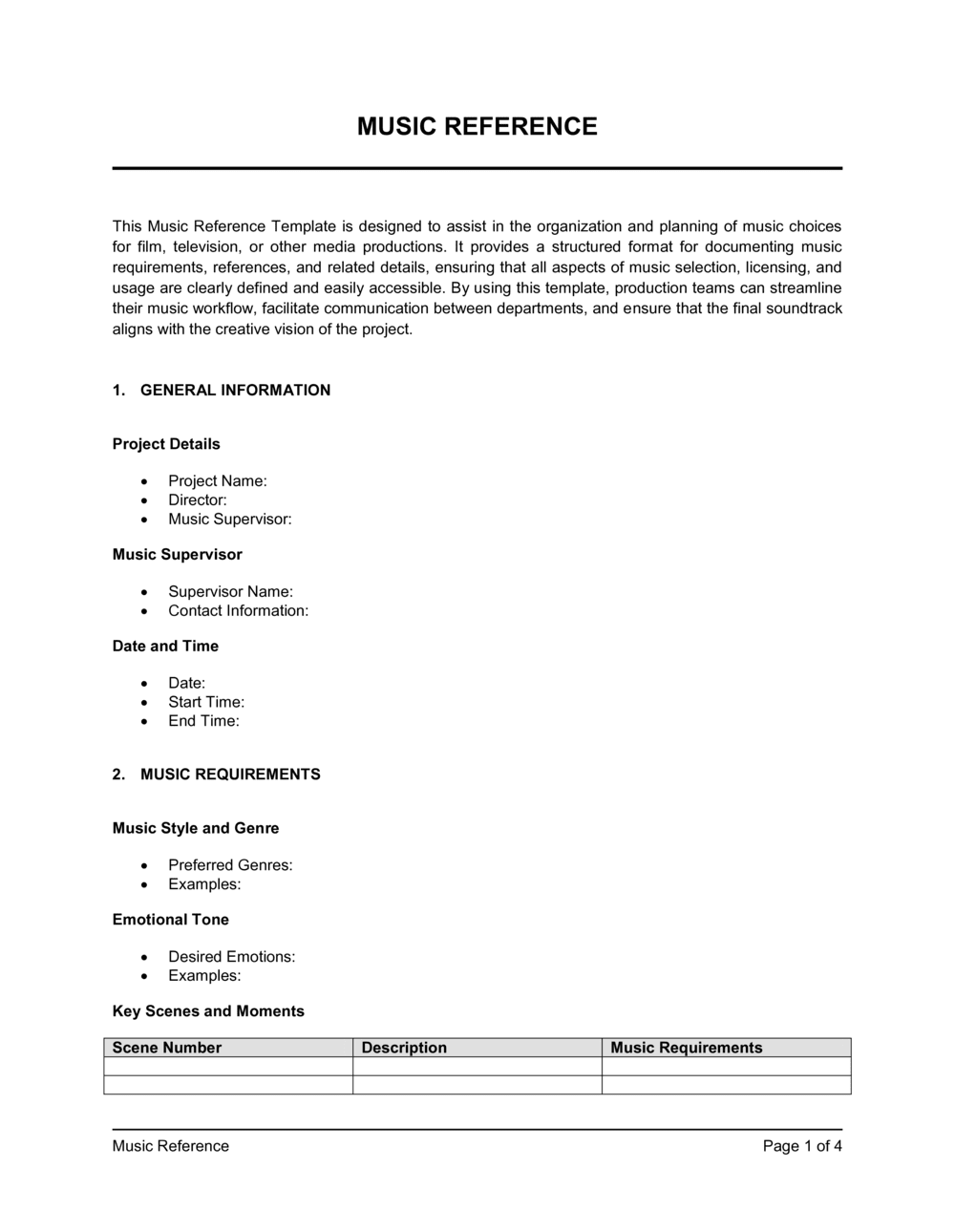
Music Reference Template

Free Word download β€’ Edit online β€’ Save & share with Drive β€’ Export to PDF

4 pagesβ€’20–30 min to fillβ€’Difficulty: Standardβ€’Signature requiredβ€’Legal review recommended
Learn more ↓
FreeMusic Reference Template

At a glance

What it is
A Music Reference is a formal written document β€” or reference agreement β€” used in the music industry to attest to a musician's, composer's, or music professional's skills, conduct, and professional track record. This free Word download gives you a structured, legally grounded starting point you can edit online and export as PDF, suitable for record label submissions, conservatory applications, touring contracts, and licensing negotiations.
When you need it
Use it when a musician, producer, or music professional requires a formal written attestation from a prior employer, collaborator, or venue β€” or when a music business needs to document the professional standing of a contractor before entering a recording, licensing, or touring agreement.
What's inside
Referee and subject identification, the nature and duration of the professional relationship, an assessment of technical skills and professional conduct, specific performance achievements, confidentiality provisions, and a signature block with the referee's credentials.

What is a Music Reference?

A Music Reference is a formal written document in which a qualified music industry professional β€” a record producer, venue operator, label executive, or music educator β€” provides a structured, signed attestation of a musician's, composer's, or music professional's technical skills, professional conduct, and verifiable track record. Unlike an informal recommendation email, a properly prepared music reference includes specific credits, an IP confirmation clause, a confidentiality and permitted-use restriction, a liability disclaimer, and a verified signature block that authenticates the document for submission to record labels, licensing agencies, conservatories, arts councils, and festival promoters.

The document functions both as a professional endorsement and as a legal instrument: its contents can be relied upon by third parties making material decisions β€” signing an artist, awarding a grant, issuing a sync license β€” and statements of fact within it carry legal weight in defamation and negligent misrepresentation frameworks across all major jurisdictions.

Why You Need This Document

Submitting an informal recommendation email in place of a formal music reference signals to professional recipients that neither the referee nor the subject understands how the music industry handles due diligence. Record labels and licensing agencies routinely discard unstructured letters because they cannot verify the referee's credentials, confirm the scope of the relationship, or assess whether IP rights are unencumbered. Without a confidentiality and permitted-use clause, a reference issued for one purpose β€” a grant application β€” can be reproduced and submitted to a record label without the referee's consent, placing their statements in a context they never approved.

From the referee's perspective, an undisclaimed reference creates genuine legal exposure: a negligently inaccurate professional opinion that causes a third party financial loss can ground a misrepresentation claim in the US, Canada, and the UK regardless of intent. A well-drafted music reference, completed in 20–30 minutes using this template, closes that exposure with a knowledge qualifier, a date, and a limitation of liability β€” protecting both parties while giving the document the formal standing that music industry decision-makers require.

Which variant fits your situation?

If your situation is…Use this template
Attesting to a musician's live performance skills and reliabilityMusician Performance Reference Letter
Formally recommending a composer for a film or media scoring contractComposer Reference Letter
Providing a reference for a music educator or instructor roleMusic Teacher Reference Letter
Supporting a grant or arts-council residency applicationArtist Recommendation Letter
Documenting a session musician's studio professionalism for a record labelSession Musician Reference Letter
Attesting to a music producer's track record for a co-production agreementMusic Producer Reference Letter
Confirming a band's touring history before a festival booking contractTouring Artist Reference Letter

Common mistakes to avoid

❌ Using a stage name instead of the subject's legal name

Why it matters: Record labels, licensing agencies, and conservatories perform background checks and rights searches using legal names. A reference in a stage name cannot be matched to contract, PRO, or tax records, stalling the entire process.

Fix: Always confirm the subject's legal name from a prior contract, invoice, or government ID before drafting the reference. Include the stage name in parentheses if it aids identification.

❌ Issuing an open-ended reference with no named recipient or stated purpose

Why it matters: A reference with no scope can be submitted to any organization in any context, potentially placing the referee's statements in a misleading frame and exposing them to defamation or misrepresentation claims.

Fix: Always name the recipient organization and state the specific purpose β€” grant application, record deal, licensing submission, or conservatory application β€” in the confidentiality and permitted-use clause.

❌ Omitting the IP confirmation clause when the reference supports a licensing deal

Why it matters: If the referenced work turns out to carry an unresolved mechanical or sync rights dispute, the commissioning party may seek damages from all parties involved in the due-diligence chain, including the referee who provided an unqualified reference.

Fix: Include the IP confirmation clause with a clear knowledge qualifier ('to the best of the referee's knowledge as of [DATE]') and instruct the subject to provide a separate rights clearance certificate if the licensing value is material.

❌ Signing with a printed name instead of a wet or verified electronic signature

Why it matters: A printed name is not an authenticating signature. Most professional music organizations β€” record labels, PROs, and arts councils β€” explicitly require a handwritten or verified electronic signature to process a reference.

Fix: Use a wet signature for physical submissions or a platform-verified electronic signature (DocuSign, BIB eSign) for digital submissions. Never submit a typed name as a substitute.

The 10 key clauses, explained

Parties and Relationship Identification

In plain language: Identifies the referee and the subject by full legal name and professional role, and describes the nature and duration of their professional relationship.

Sample language
This Music Reference is provided by [REFEREE FULL NAME], [TITLE] at [ORGANIZATION NAME], in respect of [SUBJECT FULL NAME], who served as [ROLE] from [START DATE] to [END DATE].

Common mistake: Using a professional nickname or stage name instead of the subject's legal name. If the reference is submitted alongside a contract or licensing agreement, a name mismatch can delay or void the process.

Scope of Professional Engagement

In plain language: Describes the specific projects, performances, or roles the subject undertook during the relationship β€” giving the recipient concrete context for evaluating the reference.

Sample language
During the engagement period, [SUBJECT NAME] performed as [ROLE] on [NUMBER] productions, including [PROJECT NAME] and [PROJECT NAME], contributing [SPECIFIC DELIVERABLE] on each.

Common mistake: Providing only a generic job title with no project detail. Recipients in the music industry β€” particularly sync agencies and record labels β€” rely on specific credits to verify the reference independently.

Technical Skills Assessment

In plain language: Provides the referee's professional assessment of the subject's technical competencies β€” instrument proficiency, production skills, compositional ability, or studio technique.

Sample language
[SUBJECT NAME] demonstrated advanced proficiency in [INSTRUMENT / SKILL], consistently delivering [SPECIFIC STANDARD] across all recorded sessions. Their sight-reading ability and arrangement work on [PROJECT] were particularly noteworthy.

Common mistake: Using vague superlatives like 'excellent musician' with no specifics. Unsubstantiated praise is discounted by professional readers who cannot distinguish it from a form letter.

Professional Conduct and Reliability

In plain language: Attests to the subject's punctuality, communication, collaborative behavior, and adherence to deadlines and contractual obligations.

Sample language
[SUBJECT NAME] maintained a [PUNCTUALITY / ATTENDANCE] record of [X]% across all scheduled sessions and consistently met delivery deadlines without requiring follow-up. They communicated professionally with all creative and technical stakeholders.

Common mistake: Omitting conduct entirely and focusing only on talent. Music industry professionals weigh reliability heavily β€” a technically skilled musician who misses sessions is a production liability.

Specific Achievements and Credits

In plain language: Lists verifiable professional achievements β€” released recordings, chart positions, award nominations, or prominent performances β€” that support the reference.

Sample language
Notable credits during our engagement include [RELEASE/PROJECT NAME] ([LABEL/PLATFORM], [YEAR]), which achieved [CHART POSITION / STREAMING MILESTONE], and [PERFORMANCE/VENUE] in [YEAR].

Common mistake: Listing credits without dates or labels. Undated credits cannot be independently verified and reduce the reference's credibility in due-diligence contexts.

Rights and IP Confirmation

In plain language: Confirms, to the referee's knowledge, that the subject's prior work under the engagement was properly rights-cleared and that no unresolved IP or royalty disputes arise from the described relationship.

Sample language
To the best of [REFEREE NAME]'s knowledge, all recordings and compositions produced by [SUBJECT NAME] under the above engagement were properly licensed, credited, and free from any unresolved intellectual property or royalty dispute as of the date of this reference.

Common mistake: Skipping the IP confirmation clause when the reference is used to support a licensing or sync deal. Discovering an unresolved rights dispute after a licensing agreement is executed is costly and time-consuming to unwind.

Confidentiality and Permitted Use

In plain language: Restricts use of the reference to the stated purpose and recipient, and prohibits unauthorized reproduction or circulation of its contents.

Sample language
This reference is provided solely for the purpose of [STATED PURPOSE β€” e.g., application to [ORGANIZATION]] and is addressed to [RECIPIENT NAME / ORGANIZATION]. It may not be reproduced, forwarded, or cited in any other context without the written consent of [REFEREE NAME].

Common mistake: Issuing an open-ended reference with no stated recipient or purpose. A reference without scope limitations can be reproduced and presented in contexts where its contents are misleading or damaging to the referee.

Disclaimer and Limitation of Liability

In plain language: States that the reference reflects the referee's personal professional opinion as of the date of writing and limits the referee's liability for decisions made in reliance on its contents.

Sample language
This reference reflects the personal professional opinion of [REFEREE NAME] based on direct experience with [SUBJECT NAME] and is accurate to the best of their knowledge as of [DATE]. [REFEREE NAME] accepts no liability for any decision made by [RECIPIENT] in reliance upon this reference.

Common mistake: Omitting the date and knowledge qualifier. A reference without a date cannot be evaluated for currency β€” industry relationships, skill levels, and professional standing evolve, and recipients need to know when the assessment was made.

Governing Law

In plain language: Specifies the jurisdiction whose law governs the interpretation and enforcement of the reference document.

Sample language
This reference is governed by the laws of [STATE / PROVINCE / COUNTRY]. Any dispute arising from its contents or use shall be subject to the exclusive jurisdiction of the courts of [JURISDICTION].

Common mistake: Omitting governing law entirely on the assumption that a reference letter has no legal weight. In defamation or misrepresentation claims arising from a false or misleading reference, the governing law clause determines which jurisdiction's standards apply.

Signature Block and Credentials

In plain language: Provides the referee's full name, title, organization, contact information, and handwritten or electronic signature β€” authenticating the document.

Sample language
Signed: [REFEREE SIGNATURE] | [REFEREE FULL NAME] | [TITLE] | [ORGANIZATION NAME] | [ADDRESS] | [EMAIL] | [PHONE] | Date: [DATE]

Common mistake: Signing with a rubber stamp or printed name only. A printed name without a wet or verified electronic signature is routinely rejected by record labels, conservatories, and licensing bodies as insufficient authentication.

How to fill it out

  1. 1

    Identify the parties using full legal names

    Enter the referee's full legal name, professional title, and organization in the header. Enter the subject's full legal name β€” not their stage name β€” and their role or title during the engagement.

    πŸ’‘ Confirm the subject's legal name against a prior contract or invoice before drafting β€” a mismatch with submission documents will cause rejection.

  2. 2

    Define the scope and duration of the professional relationship

    Enter the exact start and end dates of the engagement, the subject's specific role, and the type of work performed β€” studio sessions, live performance, composition, production, or a combination.

    πŸ’‘ If the relationship is ongoing, state 'present' as the end date and note the frequency of engagement β€” e.g., 'approximately 40 sessions per year.'

  3. 3

    Complete the technical skills assessment with specifics

    Identify two to four concrete technical competencies the subject demonstrated and link each to a specific project, recording, or performance. Avoid generic praise β€” name the instruments, the software, or the compositional techniques.

    πŸ’‘ Pull specific project names and release years from the subject's discography or performance history before writing this section β€” it makes verification by the recipient straightforward.

  4. 4

    Document professional conduct with measurable detail

    Assess punctuality, communication, and reliability. Where possible, include a quantified measure β€” session attendance rate, on-time delivery percentage, or number of revisions requested β€” rather than qualitative adjectives alone.

    πŸ’‘ If you cannot recall specific metrics, review session logs, email threads, or booking records before completing this clause.

  5. 5

    List verifiable credits with dates and labels

    Enter a minimum of two to three specific credits with project name, label or platform, and year. Limit the list to credits where the subject's contribution can be independently verified β€” streaming databases, physical releases, or published set lists.

    πŸ’‘ Cross-check credits against Discogs, AllMusic, or the relevant PRO database before including them β€” an incorrect credit is worse than omitting it.

  6. 6

    Complete the IP confirmation and confidentiality clauses

    State the specific purpose and named recipient of the reference in the confidentiality clause. Confirm that the referee has no knowledge of unresolved IP or royalty disputes covering the described work.

    πŸ’‘ If there are any known rights disputes, consult a music attorney before completing this clause rather than making a blanket confirmation that may later prove inaccurate.

  7. 7

    Add the disclaimer date and sign

    Enter the exact date of signing in the disclaimer clause and the signature block. Both parties should retain a signed copy β€” the referee for their records and the subject for submission.

    πŸ’‘ Use Business in a Box eSign to timestamp the signature and store the executed copy in BIB Drive, giving both parties a verifiable execution record.

  8. 8

    Confirm governing law matches the submission jurisdiction

    Check the governing law clause against the jurisdiction of the recipient organization β€” a UK conservatory or a US record label will apply different legal standards to a defamation or misrepresentation claim.

    πŸ’‘ When the referee and recipient are in different countries, choose the referee's home jurisdiction as governing law β€” they bear the greater risk if the reference is challenged.

Frequently asked questions

What is a music reference?

A music reference is a formal written document in which a qualified professional β€” a record label executive, venue operator, producer, or music educator β€” attests to a musician's or music professional's technical skills, professional conduct, and track record. It is used to support applications for recording deals, licensing agreements, conservatory admission, grant funding, and touring contracts. Unlike an informal recommendation email, a properly drafted music reference includes liability limitations, confidentiality provisions, and a verified signature.

Who can provide a music reference?

A music reference carries most weight when provided by someone with direct professional experience of the subject's work β€” a record producer who supervised studio sessions, a venue or festival booker who contracted the artist for performances, a music director who employed the musician, or a conservatory faculty member who taught them. Personal acquaintances without a professional relationship are typically not accepted by record labels or licensing agencies.

Is a music reference legally binding?

A music reference is not a contract in the traditional sense β€” it does not create mutual obligations to perform. However, a signed reference is a legal document: false or misleading statements in it can give rise to defamation or negligent misrepresentation claims in most jurisdictions. A governing law clause, disclaimer, and liability limitation are essential to protect the referee from claims arising from decisions made in reliance on the reference.

What is the difference between a music reference and a recommendation letter?

A recommendation letter is typically an informal, open-ended letter of support addressed to 'whom it may concern.' A music reference is a structured legal document with named parties, a defined scope of use, IP confirmation, confidentiality provisions, a disclaimer, and a verified signature. For high-stakes submissions β€” sync licensing deals, major label applications, or arts council grants β€” a formal music reference is the appropriate document, not an informal letter.

Can a music reference be used in a lawsuit?

Yes. A signed music reference can be entered as evidence in defamation, negligent misrepresentation, or breach of contract proceedings. If a referee makes false statements of fact β€” as distinct from honest opinions β€” and a third party suffers loss by relying on them, the referee may be liable. This is why a well-drafted music reference includes a knowledge qualifier, a disclaimer of liability, and a limitation on permitted use.

Do I need a lawyer to prepare a music reference?

For standard professional references to support grant applications, conservatory admissions, or routine performance bookings, a high-quality template is generally sufficient. Legal review is advisable when the reference will support a material licensing deal, a major label signing, or any transaction where the subject's IP ownership is in question. A one-hour music attorney review typically costs $200–$400 and is worthwhile when significant financial agreements depend on the reference.

What happens if the information in a music reference turns out to be inaccurate?

If the inaccuracy was an honest mistake qualified by a 'to the best of my knowledge' clause, most jurisdictions provide the referee with meaningful protection from liability. If the inaccuracy was deliberate or reckless, the referee may face defamation or fraudulent misrepresentation claims. The recipient may also have a claim against the subject if the inaccuracy was introduced or encouraged by the subject themselves. This is why the disclaimer and knowledge-qualification clauses are non-negotiable components of the document.

How long should a music reference be?

A music reference used in professional music industry contexts typically runs one to two pages. It should be long enough to include specific credits, a skills assessment, and the required legal clauses, but concise enough to be read quickly by a busy A&R manager or licensing director. Padding a reference with generic praise reduces its impact and signals that the referee does not have substantive professional knowledge of the subject.

Can a music reference be used for an artist in multiple countries?

A single music reference can be submitted to organizations in multiple countries, but the governing law clause will determine which jurisdiction's legal standards apply to any dispute arising from it. If the subject is applying to organizations in several jurisdictions simultaneously, consider whether the confidentiality and permitted-use clause is broad enough to cover all intended submissions, or whether separate references addressed to each recipient organization are more appropriate.

How this compares to alternatives

vs Recommendation Letter

A recommendation letter is an informal, open-ended expression of support with no legal structure β€” no named recipient, no IP clause, no liability disclaimer. A music reference is a formal legal document with defined scope, governing law, and a verified signature. Use a recommendation letter for informal introductions; use a music reference when the submission will support a contract, licensing deal, or formal application with legal consequences.

vs Artist Management Agreement

An artist management agreement governs the ongoing commercial relationship between a musician and their manager β€” commissions, duties, term, and termination. A music reference is a one-time attestation document with no ongoing obligations. A music reference may be required as part of the due diligence preceding an artist management agreement, but the two documents serve entirely different functions.

vs Music Publishing Agreement

A music publishing agreement transfers or licenses composition rights between a songwriter and a publisher and creates long-term royalty obligations. A music reference does not transfer any rights β€” it attests to the professional standing of the person who may enter such an agreement. A licensing body may require a music reference as a precondition to executing a publishing agreement with an unknown composer.

vs Independent Contractor Agreement

An independent contractor agreement governs the terms under which a session musician, composer, or producer delivers specific work β€” payment, deliverables, IP ownership, and termination. A music reference is provided after an engagement to attest to how well the contractor performed under such an agreement. The two documents are complementary: the contractor agreement governs the work; the reference documents its outcome.

Industry-specific considerations

Music Recording and Production

Record labels and independent studios use music references during artist due diligence to verify studio professionalism, prior credits, and the absence of unresolved rights disputes before executing a recording agreement.

Film, TV, and Media

Sync licensing agencies and music supervisors require references that include an IP confirmation clause to ensure the composer or producer holds clear rights to the works being licensed for placement.

Arts Education and Conservatories

Music conservatories and university programs require formal structured references from professional mentors or prior instructors as part of audition and admission packages, with verified signatures and specific skill assessments.

Live Music and Events

Festival promoters and venue operators use music references to document a touring act's reliability and professional conduct history before committing to a multi-date booking or headline slot contract.

Jurisdictional notes

United States

In the US, a false or misleading statement of fact in a reference letter can give rise to defamation claims under state law β€” standards vary by state, with some requiring proof of actual malice. The Copyright Act governs IP confirmation language; referees should be aware that work-for-hire determinations under US law depend on specific contract language, and an unqualified IP confirmation may inadvertently imply ownership clarity that does not legally exist. Several states also impose obligations on employers who provide references for former employees, requiring that negative references be provably accurate.

Canada

Canadian defamation law provides a qualified privilege defence for references given in good faith on matters of common interest β€” but this protection is defeated if the referee acted with malice or reckless disregard for the truth. In Quebec, civil law principles apply rather than common-law defamation doctrine, and the standard for liability is negligence rather than malice. SOCAN governs performing rights in Canada, and references touching on a composer's rights history should confirm SOCAN registration status where relevant.

United Kingdom

UK defamation law under the Defamation Act 2013 requires a claimant to show serious harm before a defamation claim succeeds, providing referees with meaningful protection for honest professional assessments. However, the duty of care established in Spring v Guardian Assurance [1994] means a negligently inaccurate UK reference can still ground a negligent misrepresentation claim. PRS for Music governs performing and mechanical rights in the UK, and any IP confirmation clause should be qualified accordingly. References for employees are not legally required under UK law but are standard in the music industry.

European Union

GDPR applies to any personal data processed in connection with a music reference issued about an EU-based subject β€” the referee must have a lawful basis for processing and sharing the subject's professional information, typically consent or legitimate interest. In Germany, employees have a statutory right to a reference (Arbeitszeugnis) that is benevolently worded, which creates tension with the honest-assessment standard for professional music references. France and other civil-law member states apply strict liability frameworks under which an inaccurate reference may result in damages without proof of fault. EU Copyright Directive provisions on performers' rights should inform any IP confirmation language.

Template vs lawyer β€” what fits your deal?

PathBest forCostTime
Use the templateStandard references for grant applications, conservatory admissions, routine performance bookings, and non-material licensing submissionsFree20–30 minutes
Template + legal reviewReferences supporting material sync licensing deals, major label applications, or submissions where the subject's IP ownership is in question$200–$400 (1-hour music attorney review)1–2 days
Custom draftedHigh-value licensing transactions, cross-border submissions involving multiple rights regimes, or references required as part of a formal litigation or arbitration process$800–$2,500+3–7 days

Glossary

Referee
The individual or organization providing the written reference β€” typically a former employer, collaborator, or venue booker with direct professional knowledge of the subject.
Subject
The musician, composer, or music professional on whose behalf the reference is being provided.
Work-for-Hire
An arrangement in which creative output β€” a composition, recording, or arrangement β€” is produced by a contractor and legally owned by the commissioning party from the moment of creation.
Mechanical Rights
The right to reproduce a musical composition in a recorded format, governed by statute in most jurisdictions and typically licensed through a performing rights organization or direct agreement.
Sync License
A license granting permission to pair a piece of music with visual media β€” film, TV, advertisement, or game β€” in exchange for a negotiated fee.
Performing Rights Organization (PRO)
A body such as ASCAP, BMI, SOCAN, PRS, or SACEM that collects and distributes performance royalties on behalf of composers and publishers.
Master Recording Rights
Ownership of a specific recorded performance of a song, as distinct from the underlying composition rights held by the songwriter or publisher.
Professional Conduct
A reference's assessment of the subject's reliability, communication, punctuality, and collaborative behavior β€” distinct from technical skill.
Attestation
A formal declaration, typically signed and dated, confirming that the statements in a document are true to the best of the declarant's knowledge.
Indemnification
A clause in which one party agrees to hold another harmless from claims, losses, or liabilities arising from specific acts or omissions.
Confidentiality Clause
A provision restricting one or both parties from disclosing the contents of the reference or related professional information to unauthorized third parties.

Part of your Business Operating System

This document is one of 3,000+ business & legal templates included in Business in a Box.

  • Fill-in-the-blanks β€” ready in minutes
  • 100% customizable Word document
  • Compatible with all office suites
  • Export to PDF and share electronically

Create your document in 3 simple steps.

From template to signed document β€” all inside one Business Operating System.
1
Download or open template

Access over 3,000+ business and legal templates for any business task, project or initiative.

2
Edit and fill in the blanks with AI

Customize your ready-made business document template and save it in the cloud.

3
Save, Share, Send, Sign

Share your files and folders with your team. Create a space of seamless collaboration.

Save time, save money, and create top-quality documents.

β˜…β˜…β˜…β˜…β˜…

"Fantastic value! I'm not sure how I'd do without it. It's worth its weight in gold and paid back for itself many times."

Managing Director Β· Mall Farm
Robert Whalley
Managing Director, Mall Farm Proprietary Limited
β˜…β˜…β˜…β˜…β˜…

"I have been using Business in a Box for years. It has been the most useful source of templates I have encountered. I recommend it to anyone."

Business Owner Β· 4+ years
Dr Michael John Freestone
Business Owner
β˜…β˜…β˜…β˜…β˜…

"It has been a life saver so many times I have lost count. Business in a Box has saved me so much time and as you know, time is money."

Owner Β· Upstate Web
David G. Moore Jr.
Owner, Upstate Web

Run your business with a system β€” not scattered tools

Stop downloading documents. Start operating with clarity. Business in a Box gives you the Business Operating System used by over 250,000 companies worldwide to structure, run, and grow their business.

Start freeΒ Β·Β No credit card required