Different Business Structures Explained Template

Free to read • Save or share with one click

FreeDifferent Business Structures Explained Template

At a glance

What it is
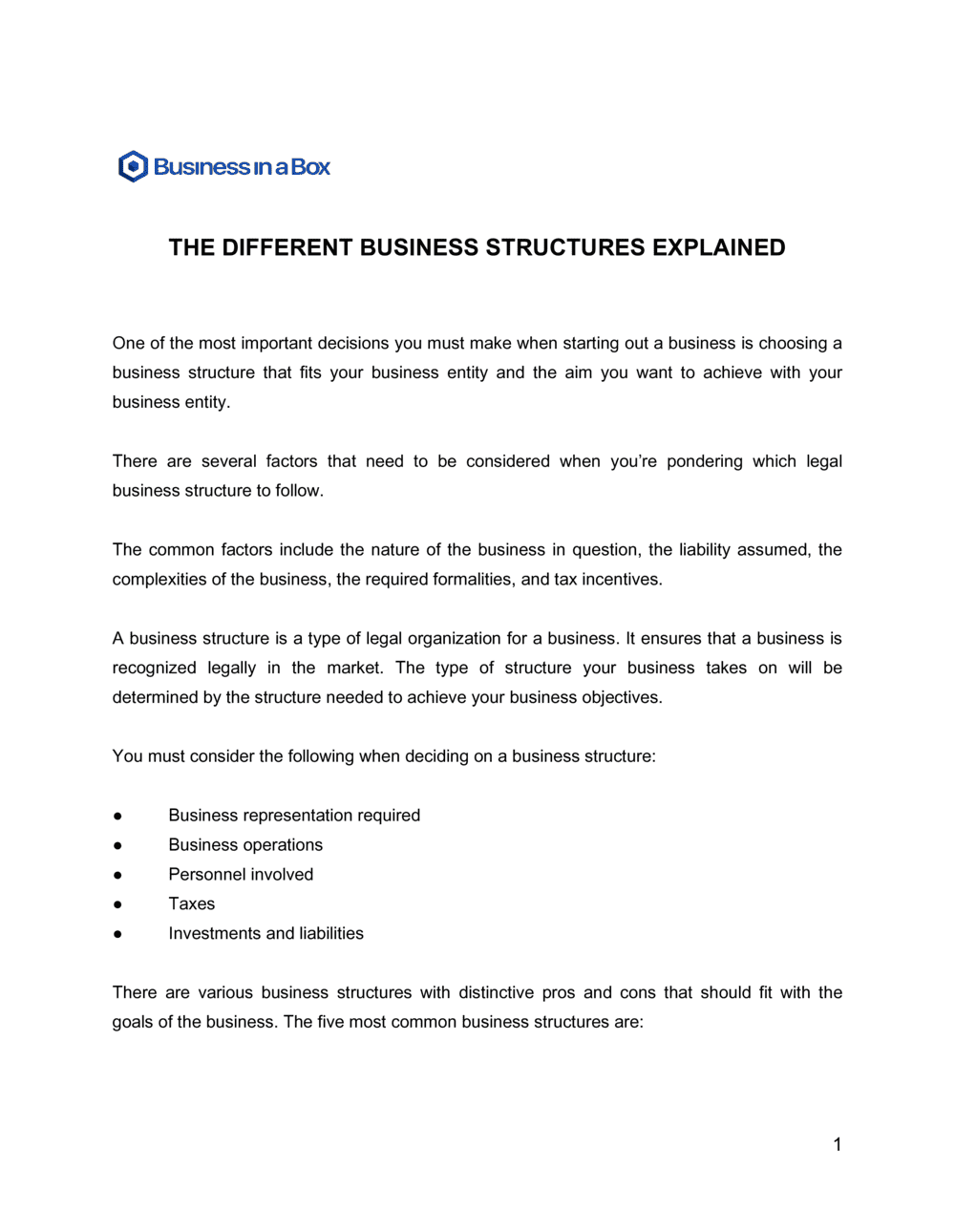
Different Business Structures Explained is a structured reference and decision-support document that compares every major legal entity type — sole proprietorship, general partnership, limited partnership, LLC, S corporation, C corporation, and nonprofit — across liability, taxation, governance, and formation requirements. This free Word download gives founders, advisors, and operators a single editable reference they can annotate, share with counsel, or use as the basis for an entity-selection memo before filing formation documents.
When you need it
Use it when launching a new venture and choosing a legal entity, when restructuring an existing business to optimize for tax or liability, or when advising a client on the trade-offs between entity types before filing articles of incorporation or organization.
What's inside
Side-by-side comparison tables for all major entity types, plain-English explanations of personal liability exposure, pass-through versus double taxation, governance and ownership rules, formation requirements by jurisdiction, and a decision checklist that maps business goals to the most appropriate structure.

What is Different Business Structures Explained?

Different Business Structures Explained is a structured legal reference document that compares every major business entity type — sole proprietorship, general partnership, limited partnership, LLC, S corporation, C corporation, and nonprofit — across the four dimensions that matter most when forming or restructuring a business: personal liability exposure, tax treatment, governance and ownership rules, and formation and ongoing compliance requirements. It functions as both a decision-support tool for founders choosing an entity before their first filing and a reference document for attorneys, CPAs, and advisors walking clients through the trade-offs in a structured, side-by-side format. This free Word download is fully editable, exportable as PDF, and designed to be annotated with jurisdiction-specific notes before sharing with counsel or a formation agent.

Why You Need This Document

Choosing the wrong business structure is one of the most expensive mistakes a founder can make — and it is rarely obvious until years later when a tax bill, a lawsuit, or a failed capital raise reveals the problem. A sole proprietor who should have formed an LLC faces unlimited personal liability on every contract and tort claim. An LLC owner who should have made an S corp election overpays self-employment tax by thousands of dollars per year. A startup that formed an LLC instead of a C corporation loses its first venture capital term sheet because the fund's LPA prohibits investments in pass-through entities. This document forces the entity-selection decision into a structured framework before any money is spent on formation filings — mapping your specific goals to the structure that actually serves them. It also ensures that the people advising you (your attorney and CPA) are working from the same factual baseline, reducing the risk that tax and legal advice pull in opposite directions.

Which variant fits your situation?

If your situation is…Use this template
Starting a one-person business with minimal administrative burdenSole Proprietorship Setup Checklist
Forming an LLC with multiple membersLLC Operating Agreement
Launching a C corporation for venture capital fundingCorporate Bylaws
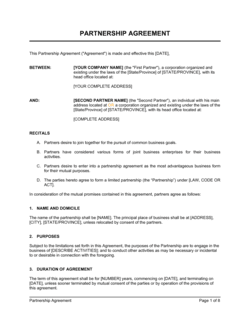
Creating a partnership between two or more co-foundersGeneral Partnership Agreement
Establishing a nonprofit organizationNonprofit Bylaws
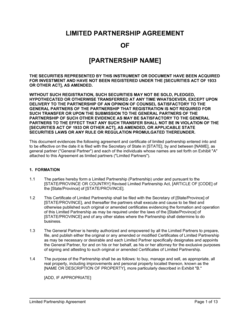
Forming a limited partnership with passive investorsLimited Partnership Agreement
Choosing between S corp and C corp for tax optimizationS Corporation Shareholders Agreement

Common mistakes to avoid

❌ Choosing an entity based only on formation cost

Why it matters: A sole proprietorship costs nothing to start but exposes personal assets to unlimited liability and may generate a higher lifetime tax burden than an LLC or S corp over five years.

Fix: Model a five-year total cost of ownership for each entity option — formation fees, annual compliance, and estimated tax liability — before deciding. The cheapest structure at formation is rarely the cheapest over time.

❌ Skipping corporate formalities after formation

Why it matters: Courts disregard entity liability protection when owners commingle personal and business funds, skip annual meetings, or fail to document major decisions in writing — exposing personal assets to business creditors.

Fix: Open a dedicated business bank account on day one, hold annual meetings, document resolutions for significant transactions, and file all required annual reports on time.

❌ Making an S corp election without analyzing shareholder eligibility

Why it matters: S corporations are limited to 100 shareholders, all of whom must be US citizens or permanent residents — a single ineligible shareholder automatically terminates the S election, triggering a retroactive C corp tax liability.

Fix: Confirm every current and prospective shareholder meets IRS eligibility requirements before filing Form 2553. Review the shareholder list annually and before any equity transfer.

❌ Abandoning a business entity without formal dissolution

Why it matters: An entity that remains on state records accumulates annual fees, tax obligations, and potential penalties indefinitely — and those liabilities can attach to the last registered officer or agent.

Fix: File articles of dissolution, settle all outstanding debts, close tax accounts with the IRS and state revenue agency, and confirm the state has issued a certificate of dissolution before considering the entity closed.

❌ Forming in Delaware without understanding dual-state compliance

Why it matters: A Delaware entity that operates in another state must register as a foreign entity in that state, pay that state's franchise tax, and file tax returns there — doubling compliance costs for small businesses with no Delaware operations.

Fix: Form in Delaware only when you genuinely need Delaware's corporate law advantages — typically for venture-backed C corporations. For operating businesses without outside investors, form in your home state.

❌ Selecting an LLC for a venture-backed startup

Why it matters: Most institutional venture capital funds cannot legally invest in pass-through entities due to UBTI (unrelated business taxable income) restrictions. An LLC structure can disqualify a company from receiving VC investment entirely.

Fix: If a venture capital raise is in your 12–24 month horizon, form a Delaware C corporation from the start or plan and budget for the conversion before approaching investors.

The 10 key clauses, explained

Entity type overview and definitions

In plain language: Defines each recognized business structure — sole proprietorship, general partnership, limited partnership, LLC, S corp, C corp, and nonprofit — in plain language with their distinguishing characteristics.

Sample language
A Limited Liability Company ([STATE] LLC) is a legal entity formed under [STATE] LLC Act, Chapter [X], that separates the personal assets of its members from the debts and obligations of the business.

Common mistake: Conflating an LLC with a corporation in the definitions section — they are governed by different statutes, have different governance requirements, and offer different tax flexibility. Mixing the two leads to incorrect formation and compliance steps.

Personal liability exposure comparison

In plain language: Compares how each structure exposes owners to personal liability for business debts, lawsuits, and obligations — from unlimited exposure in sole proprietorships to limited exposure in LLCs and corporations.

Sample language
Under a Sole Proprietorship, [OWNER NAME] is personally liable for all debts, judgments, and obligations of the business without limit. Under an LLC or corporation, members or shareholders are generally not personally liable beyond their capital contribution, provided corporate formalities are observed.

Common mistake: Assuming that forming an LLC automatically eliminates all personal liability. Courts can pierce the corporate veil if owners commingle funds, fail to capitalize the entity adequately, or ignore governance requirements.

Taxation treatment by entity type

In plain language: Explains how each entity is taxed — pass-through for sole proprietorships, partnerships, and LLCs; pass-through by election for S corps; double taxation for C corps — and the self-employment tax implications for each.

Sample language
A sole proprietorship reports all business income and expenses on Schedule C of the owner's Form 1040. An LLC with two or more members is treated as a partnership by default and files Form 1065, with each member receiving a Schedule K-1.

Common mistake: Ignoring self-employment tax when comparing pass-through entities. A sole proprietor or general partner pays 15.3% SE tax on net earnings — an LLC member who performs active services faces the same burden unless an S corp election is made.

Formation and registration requirements

In plain language: Lists the filing documents, state or provincial registrations, filing fees, and timelines required to legally establish each entity type.

Sample language
To form an LLC in [STATE], the organizer must file Articles of Organization with the [STATE] Secretary of State, pay a filing fee of $[AMOUNT], designate a registered agent with a [STATE] address, and — in most states — publish a notice of formation within [X] days.

Common mistake: Treating formation as complete at the state filing stage. Most jurisdictions also require a federal EIN, an operating agreement or bylaws, an initial meeting resolution, and separate bank accounts before the entity is operationally compliant.

Ownership and equity structure

In plain language: Describes how ownership is held and transferred in each structure — membership interests for LLCs, shares for corporations, and partnership interests for general and limited partnerships — and the restrictions that apply.

Sample language
A C corporation issues [NUMBER] shares of common stock at $[PAR VALUE] per share. Shares may be transferred subject to a right of first refusal in favor of existing shareholders as set out in the Shareholders Agreement dated [DATE].

Common mistake: Launching a corporation without documenting the initial share issuance. Undocumented founder equity leads to cap table disputes, broken 83(b) elections, and complications during due diligence for any subsequent funding round.

Governance and management structure

In plain language: Outlines who runs the business day-to-day — managers or members for LLCs, a board of directors and officers for corporations, general partners for partnerships — and the decision-making authority each holds.

Sample language
The LLC shall be managed by [MEMBER-MANAGED / MANAGER-MANAGED]. In a manager-managed LLC, [MANAGER NAME] has authority to bind the Company in contracts up to $[THRESHOLD] without member approval. Contracts exceeding $[THRESHOLD] require approval of members holding at least [X]% of interests.

Common mistake: Defaulting to member-managed for a multi-member LLC without considering operational implications. When all members can legally bind the company, a single member's unauthorized contract can expose the entire entity — designating a manager limits this risk.

Compliance and ongoing obligations

In plain language: Summarizes the annual reporting, minutes, fees, tax filings, and regulatory obligations required to keep each entity in good standing with state, federal, and local authorities.

Sample language
The Corporation shall hold an annual meeting of shareholders no later than [DATE] each year, maintain written minutes of all board and shareholder meetings, file an Annual Report with the [STATE] Secretary of State by [DATE], and pay the annual franchise tax of $[AMOUNT] by [DATE].

Common mistake: Skipping annual meeting minutes and resolutions for small closely-held corporations. Courts treat the absence of corporate minutes as evidence that the entity is an alter ego of its owners — the primary basis for piercing the corporate veil.

Conversion and restructuring provisions

In plain language: Addresses how a business can convert from one entity type to another — e.g., sole proprietorship to LLC, LLC to S corp, or C corp to LLC — and the tax and legal consequences of each conversion.

Sample language
The LLC may convert to a corporation under [STATE] conversion statute by filing a Certificate of Conversion and Articles of Incorporation, subject to a member vote of [X]% approval. The conversion is treated as a tax-free reorganization under IRC §368(a) if [CONDITIONS] are met.

Common mistake: Converting a C corporation to an LLC without analyzing the built-in gains tax. The conversion is treated as a deemed liquidation — triggering corporate-level tax on appreciated assets — which can result in significant unexpected tax liability.

Dissolution and winding up

In plain language: Covers the process for legally dissolving each entity type — filing dissolution documents, settling debts, distributing remaining assets to owners, and notifying tax authorities.

Sample language
Upon dissolution, the LLC shall (a) file Articles of Dissolution with the [STATE] Secretary of State, (b) notify all known creditors in writing within [X] days, (c) liquidate assets sufficient to satisfy all outstanding obligations, and (d) distribute remaining assets to members in proportion to their membership interests.

Common mistake: Abandoning a business entity without formally dissolving it. An entity that continues to exist on state records accumulates annual report obligations, franchise taxes, and potential penalties — which become the personal liability of the registered agent or last known officer.

Entity selection decision checklist

In plain language: A structured checklist that maps the owner's goals — liability protection, tax minimization, investor readiness, administrative simplicity, employee ownership — to the entity type best suited for each objective.

Sample language
If your primary goals are: (1) personal liability protection — YES, (2) pass-through taxation — YES, (3) raising venture capital — NO → Recommended structure: LLC with S corp election. If raising venture capital — YES → Recommended structure: C corporation (Delaware preferred).

Common mistake: Choosing an entity type based solely on formation cost. A sole proprietorship costs nothing to start but offers no liability protection and may cost far more in taxes and litigation exposure over a five-year horizon than the $300–$800 cost of forming an LLC.

How to fill it out

  1. 1

    Identify your primary business goals

    Before completing any section, list your three to five most important objectives — liability protection, tax efficiency, investor readiness, administrative simplicity, employee ownership plans — in order of priority. These drive every entity-selection decision.

    💡 If you cannot rank your objectives, the entity selection section will be inconclusive. Force-rank them even if priorities feel equal.

  2. 2

    Complete the entity type overview for your jurisdiction

    Confirm which entity types are available in your operating state or province. Most US states offer all major types, but availability and governing statutes differ — Wyoming LLCs, for example, have stronger charging-order protection than California LLCs.

    💡 Delaware is the default for venture-backed C corporations and offers predictable case law. For operating businesses with no outside investors, form in your home state to avoid dual-state compliance costs.

  3. 3

    Fill in the liability comparison for your specific situation

    For each entity type you are considering, document your personal assets at risk (home, savings, other investments) and the realistic worst-case liability exposure of the business (client claims, product liability, lease obligations). The gap between the two determines how much liability protection you need.

    💡 Professional service providers — doctors, lawyers, accountants — face personal malpractice liability that an LLC cannot fully shield. A professional corporation (PC) or professional LLC (PLLC) may be required by state licensing boards.

  4. 4

    Map the tax treatment section to your income projections

    Estimate first-year and third-year net income for the business. For incomes above $50,000–$80,000, compare the self-employment tax savings of an S corp election against the additional compliance costs of payroll and a separate corporate return.

    💡 An S corp election only generates meaningful tax savings when net profit exceeds roughly $40,000–$60,000 above a reasonable owner salary. Below that threshold, the added compliance cost outweighs the savings.

  5. 5

    Document the formation requirements for your chosen structure

    List every filing, fee, and deadline required in your state or province for the entity type you are selecting. Include the federal EIN application, state tax registrations, business licenses, and any publication requirements.

    💡 Some states — New York and Arizona — require LLCs to publish a formation notice in designated newspapers, a requirement that can cost $200–$2,000 depending on the county.

  6. 6

    Record governance and compliance obligations

    For the chosen entity, list every annual obligation: annual report filing date and fee, meeting and minutes requirements, tax filing deadlines (Form 1065, 1120, or 1120-S), and state franchise tax due dates.

    💡 Set calendar reminders for every compliance deadline the moment you form the entity. Missed annual reports result in administrative dissolution — which terminates the liability protection you paid to create.

  7. 7

    Run the decision checklist and document your selection

    Complete the entity selection checklist by answering each goal-mapping question. Record the recommended structure, the rationale, and any conditions or caveats — for example, 'LLC now, convert to C corp if raising Series A within 24 months.'

    💡 Document this reasoning in writing even if you are the sole decision-maker. It provides a record for your attorney, accountant, and any future investors or partners who ask why the entity was structured as it was.

  8. 8

    Review with a business attorney and CPA before filing

    Use the completed document as the agenda for a one-hour joint session with a business attorney and CPA. Confirm the entity selection, formation steps, and tax elections before spending money on any filings.

    💡 A combined attorney-CPA review typically costs $300–$800 and surfaces jurisdiction-specific issues — such as California's $800 annual LLC minimum franchise tax — that a template cannot anticipate.

Frequently asked questions

What are the main types of business structures?

The main business structures are sole proprietorship, general partnership, limited partnership, limited liability company (LLC), S corporation, C corporation, and nonprofit organization. Each differs in personal liability exposure, tax treatment, governance requirements, and the administrative burden of ongoing compliance. The right choice depends on your industry, income level, liability exposure, and whether you plan to raise outside capital.

What is the difference between an LLC and a corporation?

An LLC is a flexible pass-through entity governed by an operating agreement — it avoids double taxation and has fewer formal governance requirements than a corporation. A corporation issues shares of stock, is governed by a board of directors and bylaws, and — unless an S corp election is made — pays corporate income tax before distributing dividends to shareholders, who are taxed again on those distributions. Corporations are the preferred structure for venture-backed startups; LLCs are often better for small businesses and professional service firms.

What is pass-through taxation and why does it matter?

Pass-through taxation means the business itself does not pay income tax. Instead, profits and losses flow through to the owners' personal tax returns and are taxed at their individual rates. Sole proprietorships, partnerships, LLCs, and S corporations all receive pass-through treatment by default or election. C corporations do not — they pay a 21% federal corporate tax on profits, and shareholders pay personal income tax again on any dividends received. For small profitable businesses, pass-through treatment typically results in a lower combined tax burden.

Which business structure offers the best personal liability protection?

LLCs and corporations provide the strongest personal liability protection, shielding members or shareholders from business debts and lawsuits beyond their capital contribution — as long as corporate formalities are observed. Sole proprietorships and general partnerships offer no separation between personal and business assets. The protection is not absolute: courts can pierce the corporate veil if owners commingle funds, ignore governance requirements, or undercapitalize the entity.

When should I choose a C corporation instead of an LLC?

Choose a C corporation when you plan to raise venture capital, issue preferred stock to multiple investor classes, grant stock options to employees under an ISO plan, or seek a Delaware-incorporated entity that investors and acquirers expect. Most institutional VCs cannot invest in pass-through entities, making a C corporation effectively mandatory for companies on a venture-funding path. Delaware C corporations are the overwhelming standard because of Delaware's predictable corporate law and experienced courts.

What is an S corporation and who qualifies?

An S corporation is a C corporation that has elected pass-through tax treatment under Subchapter S of the Internal Revenue Code. It avoids double taxation while maintaining corporate liability protection and allowing owner-employees to reduce self-employment tax by splitting income between a reasonable salary and a profit distribution. To qualify, the corporation must have 100 or fewer shareholders, all of whom must be US citizens or permanent residents, and may issue only one class of stock. Foreign nationals, corporations, and most trusts are ineligible shareholders.

Do I need a lawyer to choose a business structure?

For straightforward sole proprietorships and single-member LLCs in low-liability industries, a high-quality template and basic research are often sufficient. However, for multi-member entities, corporations, professional service providers, businesses with significant liability exposure, or any situation involving venture capital or complex tax elections, consulting a business attorney and CPA before filing is strongly recommended. The cost of a one-hour joint consultation ($300–$800) is far lower than correcting a misclassified entity or a botched tax election after the fact.

Can I change my business structure after formation?

Yes, but the process and tax consequences vary significantly. Converting a sole proprietorship or partnership to an LLC is straightforward in most states and typically tax-neutral. Converting a C corporation to an LLC is treated as a deemed liquidation for tax purposes — potentially triggering corporate-level tax on appreciated assets. Converting an LLC to a C corporation can be done tax-free under IRC §368 if structured correctly. Always consult a CPA before initiating any conversion to model the tax impact.

What is the difference between a general partnership and a limited partnership?

In a general partnership, all partners share unlimited personal liability for the partnership's debts and have equal management authority. In a limited partnership, there is at least one general partner with unlimited liability and management control, and one or more limited partners whose liability is capped at their capital contribution but who have no active management role. Limited partnerships are commonly used for real estate investment and private equity fund structures where passive investors want liability protection without governance rights.

What ongoing compliance is required after forming a business entity?

Ongoing requirements vary by entity type and state but typically include: filing an annual report and paying a franchise tax or annual fee to the state of formation, holding annual meetings and maintaining written minutes (for corporations), maintaining a registered agent, filing the appropriate federal and state tax returns (Form 1065 for partnerships, 1120 for C corps, 1120-S for S corps), and updating the registered agent or principal address as needed. Failure to meet these requirements can result in administrative dissolution and the loss of liability protection.

How this compares to alternatives

vs LLC Operating Agreement

A business structures guide explains the trade-offs between entity types to support the initial formation decision. An LLC operating agreement is the governing document you draft after deciding to form an LLC — it defines member ownership, management authority, profit distribution, and dissolution procedures. The guide comes first; the operating agreement executes the decision.

vs General Partnership Agreement

A business structures guide compares partnership against other entity options including LLC, corporation, and sole proprietorship. A general partnership agreement is the binding contract you use once you have chosen the partnership structure — it defines partner contributions, profit sharing, and exit terms. The guide informs the choice; the agreement governs the relationship.

vs Corporate Bylaws

A business structures guide helps you decide whether a corporation is the right entity for your situation. Corporate bylaws are the internal governance document for a corporation that has already been formed — covering board composition, officer roles, meeting procedures, and voting thresholds. Use the guide before formation; use bylaws after incorporation.

vs Business Plan

A business plan documents your market opportunity, strategy, team, and financial projections for investors or lenders. A business structures guide focuses specifically on the legal entity question — liability, tax, governance, and formation. Both are needed before launch, but they serve different audiences: the business plan speaks to capital providers; the structures guide informs the legal and tax architecture.

Industry-specific considerations

Technology / SaaS

Delaware C corporation is the near-universal choice for venture-backed SaaS companies because of investor expectations, ISO stock option plans, and the ability to issue multiple share classes to investors.

Professional Services

Attorneys, physicians, and accountants often must use a professional corporation (PC) or professional LLC (PLLC) as required by state licensing boards, which limits standard LLC or corporate protections for malpractice claims.

Real Estate

Real estate investors commonly use single-asset LLCs for each property to isolate liability, with a holding LLC or S corp above them to manage distributions and protect against cross-property claims.

Retail / E-commerce

Single-member or multi-member LLCs are the dominant structure for retail and e-commerce businesses — they provide liability protection without the governance overhead of a corporation, and an S corp election becomes tax-advantageous once net profit exceeds approximately $60,000 annually.

Food and Beverage

Restaurant and food-service operators typically use LLCs for each location to isolate slip-and-fall, food safety, and lease liabilities, while a management company LLC or S corp above the operating entities handles shared staff and back-office functions.

Manufacturing

Manufacturing businesses with significant product liability exposure favor C corporations or LLCs with robust capitalization to ensure liability protection holds, and often use a holding company structure to separate IP ownership from operating assets.

Jurisdictional notes

United States

Entity types and formation rules are governed state by state — Delaware, Wyoming, and Nevada offer favorable corporate statutes and are popular for formation even when the business operates elsewhere. California imposes an $800 annual minimum franchise tax on all LLCs and corporations registered or operating there, regardless of revenue. The IRS governs federal tax elections including the S corp election (Form 2553) and the default LLC classification rules under the check-the-box regulations.

Canada

Canadian businesses can incorporate federally under the Canada Business Corporations Act (CBCA) or provincially under each province's corporations act — Ontario's OBCA and British Columbia's BCA are most common. Canada does not have a direct equivalent to the US LLC, though limited partnerships and corporations offer comparable protection. Professional corporations are available in most provinces for regulated professions. Quebec requires all business documents to be in French for provincially-regulated entities.

United Kingdom

The primary business structures in the UK are sole trader, general partnership, limited partnership, private limited company (Ltd), public limited company (PLC), and limited liability partnership (LLP). LLPs are popular for professional service firms — particularly law and accounting — as they provide liability protection with partnership-style governance and pass-through taxation. All companies must register with Companies House and file annual confirmation statements and accounts. UK corporations are subject to corporation tax at 25% (for profits over £250,000 as of 2023).

European Union

Business structures are governed by each EU member state's national company law — there is no single pan-EU formation process for most entity types. Common equivalents to the US LLC include the German GmbH, French SARL, Spanish SL, and Dutch BV. The EU's Societas Europaea (SE) allows a single company to operate across member states under one registration but requires at least two founding entities from different member states. GDPR compliance obligations attach to the entity regardless of structure and must be reflected in governance documents.

Template vs lawyer — what fits your deal?

PathBest forCostTime
Use the templateSole proprietors, single-member LLC founders in low-liability industries, and students or advisors preparing a business formation overviewFree1–2 hours to complete and review
Template + legal reviewMulti-member LLCs, S corp elections, professional service entities, or any business with employees or significant liability exposure$300–$800 for a combined attorney and CPA review session3–5 business days
Custom draftedVenture-backed corporations, complex multi-entity holding structures, cross-border formations, or businesses in heavily regulated industries$1,500–$5,000+ depending on complexity and jurisdiction1–3 weeks

Glossary

Sole Proprietorship
A business owned and operated by a single individual with no legal separation between the owner and the business entity.
Limited Liability Company (LLC)
A hybrid entity that provides personal liability protection for its members while allowing pass-through taxation and flexible governance.
Pass-Through Taxation
A tax treatment in which business profits and losses flow directly to the owners' personal tax returns, avoiding a separate entity-level tax.
Double Taxation
The taxation of corporate profits first at the corporate level and again at the shareholder level when dividends are distributed — the default for C corporations.
Piercing the Corporate Veil
A court action that holds business owners personally liable for company debts when they fail to observe proper corporate formalities or commingle personal and business funds.
Articles of Incorporation
The foundational filing document that legally creates a corporation with the state or provincial government, stating the entity's name, purpose, and authorized shares.
Operating Agreement
An LLC's internal governance document that defines member ownership percentages, voting rights, profit distribution, and management structure.
S Corporation Election
An IRS tax designation that allows a corporation to be taxed as a pass-through entity, subject to restrictions on the number and type of shareholders.
General Partner
A partner in a general or limited partnership who has unlimited personal liability for partnership debts and active management authority.
Registered Agent
A person or company designated to receive legal notices, tax forms, and official government correspondence on behalf of a business entity.
Fiduciary Duty
The legal obligation of directors, officers, or managing members to act in the best interests of the entity and its owners rather than in their own self-interest.

Part of your Business Operating System

This document is one of 3,000+ business & legal templates included in Business in a Box.

  • Fill-in-the-blanks — ready in minutes
  • Compatible with all office suites
  • Export to PDF and share electronically

Create your document in 3 simple steps.

From template to signed document — all inside one Business Operating System.
1
Download or open template

Access over 3,000+ business and legal templates for any business task, project or initiative.

2
Edit and fill in the blanks with AI

Customize your ready-made business document template and save it in the cloud.

3
Save, Share, Send, Sign

Share your files and folders with your team. Create a space of seamless collaboration.

Save time, save money, and create top-quality documents.

★★★★★

"Fantastic value! I'm not sure how I'd do without it. It's worth its weight in gold and paid back for itself many times."

Managing Director · Mall Farm
Robert Whalley
Managing Director, Mall Farm Proprietary Limited
★★★★★

"I have been using Business in a Box for years. It has been the most useful source of templates I have encountered. I recommend it to anyone."

Business Owner · 4+ years
Dr Michael John Freestone
Business Owner
★★★★★

"It has been a life saver so many times I have lost count. Business in a Box has saved me so much time and as you know, time is money."

Owner · Upstate Web
David G. Moore Jr.
Owner, Upstate Web

Run your business with a system — not scattered tools

Stop downloading documents. Start operating with clarity. Business in a Box gives you the Business Operating System used by over 250,000 companies worldwide to structure, run, and grow their business.

Start free · No credit card required