Product Strategy Templates
★★★★★4.7from 280+ reviews· Trusted by 20M+ businesses
Define your product direction, plan launches, and align your team with ready-to-use strategy documents.
WordEditable onlinePDF10+ product strategy templates
Other Product Management categories
Most popular product strategy templates
250K+Clients
20M+Free users
20+Years
190+Countries
10,000+Law firms
50M+Downloads
Trusted across review platforms
- Capterra★★★★☆4.649 reviews
- G2★★★★☆4.713 reviews
- GetApp★★★★☆4.649 reviews
- Google Play★★★★☆4.6179 ratings
- Google Reviews★★★★☆4.567 reviews
Frequently asked questions
What should a product strategy document include?
At minimum, a product strategy document should include a vision statement, a clearly defined target market, a positioning and differentiation rationale, measurable goals, a high-level roadmap, and the pricing model. Stronger documents also capture market sizing, key risks, and the assumptions the strategy rests on. The goal is to give anyone who reads it a clear answer to why this product exists, who it's for, and how it wins.
How is a product strategy different from a product roadmap?
A product strategy defines direction — the market, the positioning, the goals. A roadmap defines execution — the features, milestones, and timelines that deliver on the strategy. Strategy answers why and who; the roadmap answers what and when. You should have a strategy in place before building a roadmap, because without strategic context a roadmap is just a list of features with dates.
How often should a product strategy be updated?
Most product teams revisit strategy quarterly and revise it when major market signals change — a new competitor enters, customer research invalidates a core assumption, or a pivot is needed. Annual updates are a minimum for stable markets. In early-stage or fast-moving categories, monthly check-ins against the strategy are common. The document should be a living reference, not a shelf artifact.
Who owns the product strategy in an organization?
The product manager or head of product typically owns the strategy document and is accountable for keeping it current. Input comes from engineering, design, marketing, sales, and finance. In smaller companies, the founder or CEO often drives product strategy directly. Ownership matters because someone needs to make the call when priorities conflict.
Do I need a product strategy template for a single product?
Yes — even a single-product company benefits from a documented strategy because it forces explicit decisions about market, positioning, and priorities. Without a written strategy, different team members default to different assumptions about what the product is for and who it serves, which creates misalignment that compounds over time.
What is the difference between a product strategy and a business strategy?
A business strategy covers the entire company — its markets, revenue model, competitive moat, and operational priorities. A product strategy is scoped to one product or product line and feeds into the broader business strategy. In a product-led company, the two overlap significantly. In a services or multi-revenue-stream business, they may address very different considerations.
How detailed should a product roadmap template be?
The right level of detail depends on the audience. Executive roadmaps typically show themes and quarterly horizons. Engineering roadmaps go to sprint-level features and acceptance criteria. A product roadmap template should let you adjust fidelity — high-level for stakeholder communication, detailed for team execution — without maintaining two separate documents.
Can I use a product strategy template for a service rather than a physical product?
Yes. The core structure — problem definition, target market, positioning, goals, roadmap — applies equally to services, software products, and physical goods. The main adjustment is in the pricing and delivery model sections, which will reflect service-specific considerations like capacity, recurring engagements, and scope definition rather than unit economics.
Product Strategy vs. related documents
A product strategy defines the why — the market, the goals, the positioning, and the success criteria. A product roadmap defines the what and when — the features, milestones, and timelines that deliver on the strategy. You need the strategy in place before the roadmap is meaningful. Without a strategy, a roadmap is just a to-do list.
A business strategy covers the entire company — revenue model, competitive positioning, operational priorities, and growth targets. A product strategy is scoped to one product or product line and feeds into the business strategy. In product-led companies, the two are closely linked; in service businesses, they may diverge significantly.
A go-to-market plan focuses on how you will bring a specific product to a specific market at a specific time — pricing, channels, messaging, and launch execution. A product strategy is broader and longer-horizon, covering the product's entire lifecycle direction. The go-to-market plan is a subset of execution that flows from product strategy decisions.
A product brief is a short, scoped document written for a single development cycle or feature set, aligning engineering and design on user needs and acceptance criteria. A product strategy document spans a longer time horizon and answers higher-level questions about market fit, differentiation, and business objectives. Briefs are tactical; strategy documents are directional.
Key clauses every Product Strategy contains
Effective product strategy documents — regardless of variant — share a common set of core sections that turn intent into executable direction.
- Product vision statement. A one- or two-sentence description of the product's long-term purpose and the problem it solves.
- Target market and customer segment. Defines who the product is built for, including firmographic, demographic, or behavioral attributes.
- Market opportunity and sizing. Quantifies the addressable market and the business case for pursuing it.
- Positioning and differentiation. Articulates what makes the product distinct and why the target customer should prefer it over alternatives.
- Strategic goals and success metrics. Sets measurable outcomes — revenue targets, adoption rates, NPS scores — that define success.
- Roadmap and key milestones. Outlines the high-level sequence of deliverables and the timeframes attached to them.
- Pricing and revenue model. Specifies how the product will be monetized and the rationale behind the chosen pricing approach.
- Risks and assumptions. Documents the key bets the strategy rests on and the risks that could invalidate them.
How to write a product strategy
A product strategy is built in layers — start with market context, work toward specific goals, then sequence the work that gets you there.
1
Define the problem you're solving
Write a crisp problem statement that describes the customer pain, the market gap, or the job to be done — without referencing your solution yet.
2
Identify and size the target market
Name the specific customer segment you're targeting and estimate the addressable market using bottom-up or top-down sizing.
3
Articulate your positioning
Write a positioning statement that explains how your product is different from alternatives and why that difference matters to the target customer.
4
Set measurable strategic goals
Define 3–5 outcomes — revenue, adoption, retention, market share — with specific numbers and timeframes attached.
5
Choose your pricing and revenue model
Decide how the product generates revenue and validate that the model matches customer buying behavior and competitive norms.
6
Build the roadmap
Sequence the features, milestones, and releases that deliver on your goals, and assign owners and target dates to each.
7
Document risks and open assumptions
List the key assumptions your strategy depends on and the conditions that would require you to revisit the plan.
8
Align stakeholders and set a review cadence
Share the document with leadership, engineering, and go-to-market teams, and schedule a quarterly review to update it as you learn.
At a glance
- What it is
- A product strategy template is a structured document that captures a product's vision, target market, goals, and roadmap in a format teams can act on. It replaces blank-page guesswork with a proven framework that keeps stakeholders aligned from discovery through launch.
- When you need one
- Any time you're defining, repositioning, or launching a product, a strategy template ensures decisions are deliberate, documented, and tied to business outcomes rather than assumptions.
Which Product Strategy do I need?
The right template depends on where you are in the product lifecycle and what decision you need to document next. Match your situation below.
Your situation
Recommended template
Setting the overall direction and goals for a product
Captures vision, target market, positioning, and success metrics in one page.Planning features and milestones over the next 6–18 months
Structures timelines, themes, and priorities for cross-functional alignment.Launching a new product to market for the first time
Covers go-to-market steps, responsibilities, and success criteria end to end.Defining the brief before a product development sprint
Aligns engineering, design, and marketing on scope and user needs upfront.Exploring new ways to evolve or differentiate an existing product
Provides a structured approach to evaluating and prioritizing innovation options.Deciding which pricing model to adopt for a product
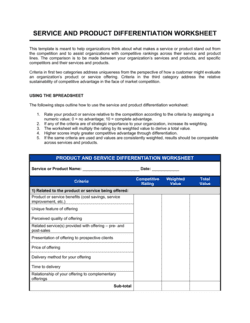
Walks through competitive, cost-plus, and value-based pricing frameworks.Comparing your product against competing options in the market
Side-by-side feature and value comparison to sharpen positioning decisions.Running a final readiness check before go-live
Ensures no launch step is missed across marketing, ops, and support teams.Glossary
- Product vision
- A brief statement describing the long-term purpose of a product and the future state it aims to create for its users.
- Product roadmap
- A time-ordered plan showing the features, milestones, and releases a team intends to deliver against strategic goals.
- Go-to-market (GTM) plan
- An execution plan for bringing a specific product to a specific market, covering pricing, channels, messaging, and launch timing.
- Positioning statement
- A concise articulation of how a product is different from alternatives and why that difference matters to the target customer.
- Addressable market (TAM/SAM/SOM)
- Estimates of the total, serviceable, and obtainable market size used to size the business opportunity for a product.
- Product brief
- A short document scoped to a single development cycle that aligns engineering and design on user needs and acceptance criteria.
- OKRs (Objectives and Key Results)
- A goal-setting framework that pairs a qualitative objective with measurable key results, widely used to track product strategy progress.
- Minimum viable product (MVP)
- The smallest version of a product that delivers enough value to validate key strategy assumptions with real users.
- Pricing strategy
- The deliberate choice of how a product is priced relative to cost, competition, and perceived customer value.
- Product-market fit
- The condition where a product satisfies a strong market demand, typically evidenced by retention, word-of-mouth growth, and willingness to pay.
- Feature prioritization
- The process of ranking potential product features by their impact on strategic goals relative to the effort required to build them.
What is a product strategy?
A product strategy is a high-level plan that defines what a product is meant to achieve, who it is built for, and how it will compete and generate value over time. It answers three foundational questions: what problem does this product solve, for whom, and why will customers choose it over alternatives. Without a documented strategy, product decisions default to the loudest stakeholder, the most recent customer complaint, or the most technically interesting feature — none of which reliably produce a product the market wants.
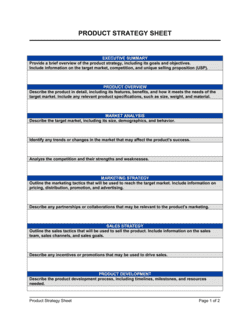
Product strategy documents range from a single-page strategy sheet that fits on a wall to multi-section frameworks covering market sizing, competitive analysis, pricing models, and multi-year roadmaps. What they have in common is that they make implicit assumptions explicit, force prioritization decisions early, and give cross-functional teams — engineering, design, marketing, sales — a shared reference point for daily decisions.
When you need a product strategy
You need a product strategy document any time a product enters a new phase: initial conception, a major pivot, a new market expansion, or a pricing overhaul. The document is also essential when team size grows past the point where everyone can absorb strategy through daily conversation.
Common triggers:
- A founding team is preparing to build a first product and needs to validate market fit before committing engineering resources
- A product manager is aligning engineering, design, and marketing around a new development cycle
- A company is expanding an existing product into a new customer segment or geography
- A leadership team is deciding whether to invest in a feature extension or a new product line
- A startup is preparing a fundraising pitch and needs a documented product direction to share with investors
- A product is losing market share and the team needs to reassess positioning and differentiation
- A new hire joins the product team and needs to understand the product's goals and history quickly
Skipping the strategy document doesn't eliminate the need for a strategy — it just means the strategy lives in someone's head, gets communicated inconsistently, and can't be updated systematically. A written product strategy is the cheapest alignment tool a product team has. The templates in this folder give you the structure to build one in hours rather than weeks.
Award-winning platform
- Great Place to Work 2025
- BIG Award — Product of the Year 2025
- Smartest Companies 2025
- Global 100 Excellence 2026
- Best of the Best 2025