- Differentiation
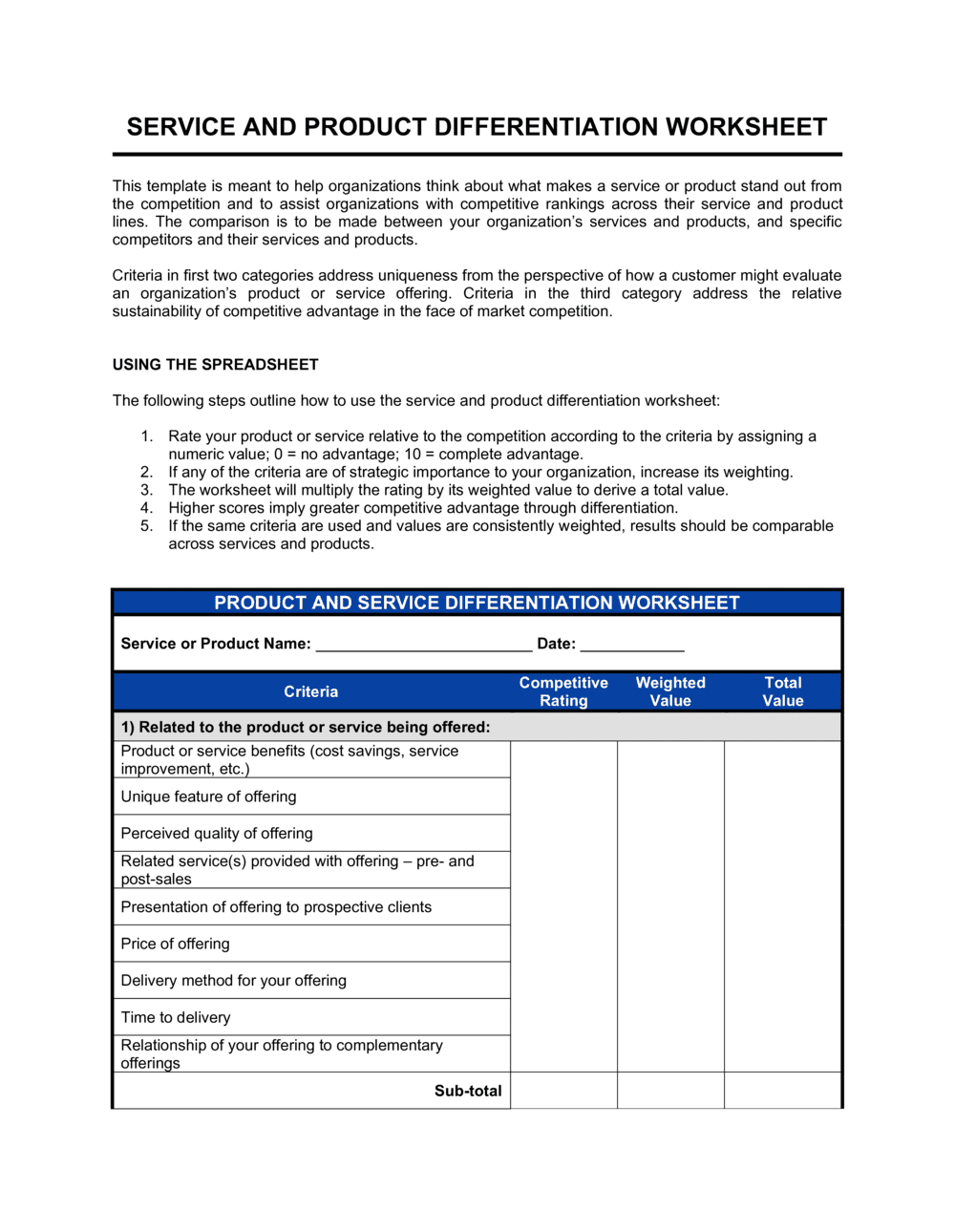
- The process of identifying and documenting the specific attributes that make a product or service meaningfully distinct from competing alternatives in the eyes of the target customer.
- Value Proposition
- A concise statement explaining what benefit a product or service delivers, to whom, and why it is better or different than the alternatives available.
- Competitive Advantage
- A measurable edge — lower cost, faster delivery, proprietary technology, or superior outcomes — that a company holds over competitors in a specific market segment.
- Unique Selling Proposition (USP)
- The single most compelling reason a customer should choose your product or service over a competitor's, expressed in plain language.
- Feature Parity
- A state in which two competing products offer essentially the same capabilities, eliminating feature-based differentiation and shifting competition to price or brand.
- Positioning Statement
- A formal internal declaration defining the target segment, the category in which the product competes, the key benefit delivered, and the reason that benefit is credible.
- Price Differentiation
- A strategy in which a company charges a different price than competitors based on quality, service level, brand perception, or customer segment — rather than matching market rates.
- Total Cost of Ownership (TCO)
- The full financial cost of acquiring, operating, and retiring a product or service over its useful life, used to justify premium pricing against lower-sticker alternatives.
- Intellectual Property (IP)
- Legally protected creations — patents, trademarks, copyrights, or trade secrets — that underpin a product's differentiation and cannot be copied without infringing the owner's rights.
- Customer Segment
- A defined group of buyers sharing common characteristics — industry, company size, job role, or buying behavior — for whom a specific value proposition is designed.
- Competitive Moat
- A durable structural advantage — network effects, proprietary data, switching costs, or scale — that makes a company's competitive position hard to replicate over time.
- Benefit vs. Feature
- A feature is what a product does; a benefit is the outcome the customer experiences as a result. Differentiation documents should lead with benefits, not feature lists.