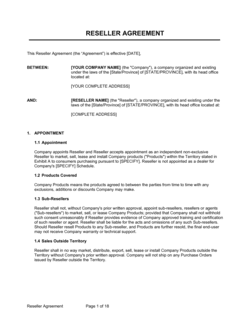
Revenue Growth Management Explained Template

Free Word download • Edit online • Save & share with Drive • Export to PDF

3 pages20–30 min to fillDifficulty: StandardSignature requiredLegal review recommended
Learn more ↓
FreeRevenue Growth Management Explained Template

At a glance

What it is
A Revenue Growth Management Agreement is a binding commercial contract that formalizes the pricing strategy, trade investment terms, promotional governance, and performance accountability frameworks between a supplier or manufacturer and its channel partners, distributors, or key accounts. This free Word download gives you a structured, enforceable starting point you can edit online and export as PDF for signature with retail buyers, wholesale distributors, or licensed resellers.
When you need it
Use it when entering a new distribution or retail channel, renegotiating annual trade terms with a key account, or codifying a joint business plan that includes pricing floors, volume rebates, and promotional funding commitments. It is also essential when aligning internal commercial teams around consistent pricing governance across multiple markets or SKUs.
What's inside
The agreement covers the parties and scope, pricing architecture and minimum advertised price (MAP) obligations, trade investment and rebate structures, promotional planning and approval workflows, volume and growth targets, data-sharing requirements, performance review cadences, and termination conditions — all in a single enforceable document.

What is a Revenue Growth Management Agreement?

A Revenue Growth Management Agreement is a binding commercial contract that formalizes the pricing governance, trade investment commitments, promotional funding framework, volume targets, and performance accountability structure between a supplier or manufacturer and its channel partners — typically retail chains, distributors, or licensed resellers. Unlike a general distribution agreement that covers logistics and legal supply terms, an RGM agreement governs the commercial economics of the channel relationship: how prices are set and protected, how promotional budgets are allocated and approved, how rebates are earned and paid, and how both parties are held accountable to growth targets through structured quarterly reviews. It converts the informal commercial understandings that often exist between suppliers and their trade partners into enforceable contractual obligations with defined consequences for non-performance.

Why You Need This Document

Without a written Revenue Growth Management Agreement, trade investment decisions are made verbally, promotional funding disputes are resolved by whoever has the better email trail, and MAP violations go unchallenged because there is nothing enforceable to point to. Suppliers routinely lose millions of dollars annually to improperly calculated rebate claims, unauthorized promotional deductions, and partners who receive trade funding without delivering the volume or placement commitments that justified the investment. A clearly drafted RGM agreement closes all of these gaps: it sets the rules for pricing, locks in the approval process for every promotional event, defines exactly how rebates are calculated on net purchases, and establishes a remediation ladder before any termination right is triggered — protecting both parties from the costly litigation that unstructured commercial relationships almost inevitably produce. This template gives you the framework to build that structure in hours, not weeks.

Which variant fits your situation?

If your situation is…Use this template
Establishing pricing and trade terms with a national retail chainKey Account Trade Terms Agreement
Governing MAP compliance for an e-commerce or marketplace channelMinimum Advertised Price (MAP) Policy Agreement
Structuring volume rebates and growth bonuses with a distributorDistributor Rebate Agreement
Formalizing a joint business plan with a strategic retail partnerJoint Business Plan Agreement
Defining co-op advertising and promotional funding commitmentsCo-op Advertising Agreement
Setting pricing and margin targets for a licensed reseller networkReseller Pricing and Margin Agreement
Governing a revenue-sharing arrangement between two commercial partiesRevenue Sharing Agreement

Common mistakes to avoid

❌ Applying MAP to transaction prices rather than advertised prices

Why it matters: Setting a floor on the actual selling price — not just the advertised price — constitutes resale price maintenance (RPM) in the US and is per se illegal under the Sherman Act. In the EU, it violates Article 101 TFEU. Penalties can include fines and private damages claims from resellers.

Fix: Draft the MAP clause explicitly as a restriction on public advertising only. Use language like 'Partner agrees not to advertise Products below MAP' rather than 'Partner agrees not to sell Products below MAP.' Issue MAP as a unilateral supplier policy, not a bilateral agreement.

❌ Measuring rebates on gross purchases without netting deductions

Why it matters: Calculating rebates on gross invoice value before returns, credits, and deductions systematically overpays partners. On large accounts, this can amount to six-figure annual overpayments that are contractually difficult to recover.

Fix: Define the rebate base explicitly as 'net purchases, calculated as gross purchases less returns, credits, promotional deductions, and chargebacks in the same measurement period.' Add a netting clause that allows the supplier to offset overpaid rebates against future payments.

❌ No JBP incorporation clause

Why it matters: When the JBP is treated as an informal document rather than a binding schedule, partners selectively enforce favourable commitments (trade funding) while denying unfavourable ones (volume targets). Disputes over what was agreed are resolved by whoever has better email records.

Fix: Execute the JBP as Schedule E to the agreement and include a clause stating it is incorporated by reference with full binding effect. Require wet or electronic signatures from authorised representatives on both sides before the agreement year begins.

❌ Terminating a distribution relationship without a cure period

Why it matters: Abrupt termination of a commercial distribution agreement, even for genuine underperformance, exposes the terminating party to claims for wrongful termination, loss of goodwill compensation, and — in some EU jurisdictions — statutory indemnity payments. Legal costs and damages awards frequently exceed the value of the terminated account.

Fix: Build a two-stage remediation process: a written Performance Improvement Notice followed by a 60-day cure period before any termination right is triggered. Document all performance data that forms the basis of the PIN in case you need to defend the process in court.

The 10 key clauses, explained

Parties, scope, and effective date

In plain language: Identifies the supplier and the channel partner as legal entities, defines which products, SKUs, and geographic markets fall within the agreement, and states the commencement date and term.

Sample language
This Revenue Growth Management Agreement ('Agreement') is entered into as of [EFFECTIVE DATE] between [SUPPLIER LEGAL NAME], a [STATE/COUNTRY] [ENTITY TYPE] ('Supplier'), and [PARTNER LEGAL NAME], a [STATE/COUNTRY] [ENTITY TYPE] ('Partner'). This Agreement governs the commercial relationship with respect to the Products listed in Schedule A within the Territory defined in Schedule B.

Common mistake: Failing to attach a Schedule A with a specific SKU list. Without it, disputes arise over which products are subject to the MAP policy, rebate tiers, or promotional funding obligations — and the agreement becomes unenforceable on those terms.

Pricing architecture and MAP obligations

In plain language: Establishes the supplier's suggested retail price (SRP) structure, sets the minimum advertised price for each product tier, and specifies the consequences of MAP violations — including potential suspension of promotional support or account termination.

Sample language
Partner agrees to advertise all Products at or above the Minimum Advertised Prices ('MAP') set out in Schedule C. MAP applies to all public-facing digital and print advertising. Violation of MAP on three or more SKUs within any [30]-day period constitutes a material breach. Supplier may, at its sole discretion, suspend promotional funding or terminate this Agreement on [30] days' written notice.

Common mistake: Applying MAP to the transaction price rather than the advertised price. In the US, MAP policies can govern advertising; setting floor transaction prices risks resale price maintenance (RPM) liability under antitrust law. The clause must be drafted to cover advertising only.

Trade investment and promotional funding

In plain language: States the total trade investment budget for the agreement period, how it is allocated across event types (feature ads, end-cap placement, temporary price reductions), the approval process for individual events, and how funds are disbursed.

Sample language
Supplier commits a total trade investment of $[AMOUNT] for the [PERIOD] ('Trade Budget'). Allocations by event type are set out in Schedule D. Partner must submit a Promotional Event Request Form at least [45] days in advance of the event start date. Approved funds are disbursed by [credit memo / EFT] within [30] days of Supplier's receipt of event performance data.

Common mistake: Committing a lump-sum trade budget without specifying the approval workflow or disbursement trigger. Partners draw down funds against vague commitments, suppliers dispute ROI, and year-end reconciliation becomes a protracted negotiation rather than a contractual process.

Volume targets, growth tiers, and rebates

In plain language: Sets the baseline volume or net revenue target, defines incremental growth tiers that trigger rebate payments, specifies the measurement period and currency, and states when rebates are calculated and paid.

Sample language
Partner's baseline purchase commitment for the Agreement Year is $[BASE AMOUNT] net. For purchases exceeding the baseline by [X]%–[Y]%, Supplier will pay a rebate of [Z]% of net purchases above baseline. For purchases exceeding baseline by more than [Y]%, the rebate rate increases to [W]%. Rebates are calculated quarterly and paid within [45] days of period end, subject to Partner's written acceptance of the calculation.

Common mistake: Measuring rebates against gross purchases rather than net purchases after returns and deductions. Rebate overpayments on returned or deducted product are a top source of supplier-distributor disputes and are difficult to claw back without an explicit netting clause.

Joint business planning and promotional calendar

In plain language: Requires both parties to prepare and agree on a joint business plan (JBP) at the start of each agreement year, covering agreed volume targets, promotional events, in-store execution standards, and investment levels — and establishes what happens if the JBP cannot be agreed.

Sample language
No later than [DATE] of each Agreement Year, the parties shall meet to agree on a Joint Business Plan ('JBP') for the forthcoming year, covering the items in Schedule E. If the parties fail to agree on a JBP within [30] days of the scheduled meeting, the prior year's JBP terms shall continue to apply until a new JBP is executed in writing.

Common mistake: Treating the JBP as an informal document rather than an executed schedule to the agreement. When trade funding or volume commitments are set in a JBP that is not incorporated by reference, neither party can enforce its terms if the other walks away mid-year.

Data sharing and performance reporting

In plain language: Obligates the partner to share sell-out, inventory, and promotional scan data at a defined frequency, specifies the format and transmission method, and grants the supplier audit rights to verify reported figures.

Sample language
Partner shall provide Supplier with point-of-sale scan data, store-level inventory reports, and promotional lift summaries on a [weekly / biweekly] basis via [EDI / secure file transfer / Partner's retailer portal]. Supplier has the right, on [15] days' written notice, to audit Partner's relevant sales and inventory records up to [2] years prior to the audit date.

Common mistake: No data-sharing obligation at all, or an obligation with no format or frequency specification. Without timely sell-out data, the supplier cannot trigger rebate accruals, validate promotional lift claims, or make replenishment decisions — making the entire commercial model unmanageable.

Performance review and remediation

In plain language: Establishes a regular review cadence (quarterly business reviews, QBRs) where both parties assess performance against JBP targets, identifies consequences for persistent underperformance, and sets a structured remediation process before any termination right is triggered.

Sample language
The parties shall conduct Quarterly Business Reviews ('QBR') within [15] days of each quarter-end. If Partner's cumulative net purchases fall more than [20]% below the agreed volume target for two consecutive quarters, Supplier may issue a Performance Improvement Notice ('PIN'). Partner has [60] days from receipt of a PIN to restore performance to within [10]% of target before Supplier may exercise its termination right under Clause [X].

Common mistake: Jumping directly from underperformance to termination without a remediation step. In most jurisdictions, abrupt termination of a distribution relationship without a cure period exposes the terminating party to claims for wrongful termination or loss of goodwill compensation.

Intellectual property and brand standards

In plain language: Grants the partner a limited, non-exclusive license to use the supplier's trademarks and brand assets solely for the purpose of marketing and selling the products under the agreement, subject to brand guidelines, and reserves all IP ownership with the supplier.

Sample language
Supplier grants Partner a non-exclusive, non-transferable, royalty-free license to use the Supplier Marks listed in Schedule F solely for the purpose of advertising and selling the Products in the Territory during the Agreement Term, subject to Supplier's then-current Brand Guidelines. All goodwill arising from Partner's use of Supplier Marks shall inure to Supplier.

Common mistake: Omitting a brand guidelines reference and approval process for partner-created promotional materials. Partners create non-compliant advertising that damages brand equity, and the supplier has no contractual basis to require removal without this clause.

Confidentiality and data protection

In plain language: Prevents either party from disclosing the other's pricing data, trade terms, financial information, and commercial strategy to third parties — and, where personal data is processed (e.g., loyalty program data), sets out compliance obligations under applicable data protection law.

Sample language
Each party agrees to hold the other's Confidential Information in strict confidence and not to disclose it to any third party without prior written consent. 'Confidential Information' includes but is not limited to pricing schedules, rebate rates, trade investment amounts, and JBP targets. Where either party processes Personal Data in connection with this Agreement, it shall comply with applicable data protection legislation, including [GDPR / CCPA / PIPEDA] as relevant.

Common mistake: Using a generic NDA clause that does not specifically protect pricing and rebate data. In channel disputes, trade investment terms and rebate rates are frequently leaked to competing suppliers — a targeted confidentiality clause with specific categories of protected information is far more enforceable.

Term, termination, and post-termination obligations

In plain language: States the initial agreement term, renewal mechanics, the notice period required for either party to terminate without cause, conditions permitting immediate termination for cause, and what happens to outstanding rebate balances, promotional accruals, and inventory upon termination.

Sample language
This Agreement commences on the Effective Date and continues for an initial term of [1 year], renewing automatically for successive [1-year] periods unless either party provides [90] days' written notice of non-renewal. Either party may terminate for material breach on [30] days' written notice if the breach is not cured within that period. On termination, all outstanding rebate accruals shall be calculated and paid within [60] days; Partner shall cease using Supplier Marks immediately.

Common mistake: No provision for post-termination inventory. When an agreement ends, distributors are often left holding stock purchased under the prior trade terms with no guaranteed right to return or sell through. Failing to address this creates stranded-inventory disputes that frequently escalate to litigation.

How to fill it out

  1. 1

    Identify the legal entities and attach product and territory schedules

    Enter both parties' full registered legal names, not trade names. Prepare Schedule A (product and SKU list) and Schedule B (territory definition) before executing — the body of the agreement references them throughout.

    💡 Match the entity name on this agreement to the entity name on any purchase orders or invoices already exchanged. Mismatched names create payment processing delays and complicate enforcement.

  2. 2

    Set the pricing architecture and MAP levels in Schedule C

    List each SKU or product tier with its SRP and MAP. If MAPs vary by channel (brick-and-mortar vs. e-commerce), create separate columns. Draft the MAP clause to cover advertised prices only — not transaction prices — to avoid resale price maintenance liability.

    💡 Issue MAP as a unilateral supplier policy communicated to all resellers simultaneously, not as a negotiated bilateral term, to reduce antitrust risk under US and EU competition law.

  3. 3

    Define the trade investment budget and approval workflow

    Specify the total trade budget for the agreement year in Schedule D, broken down by event type. Write out the event request and approval workflow, including the submission deadline, approval authority, and disbursement trigger.

    💡 Require a signed Promotional Event Request Form as a condition of disbursement — verbal approvals create multi-million-dollar disputes in major retail accounts.

  4. 4

    Structure the rebate tiers and measurement mechanics

    Enter the baseline purchase commitment and each growth tier with its corresponding rebate rate. Specify that rebates are calculated on net purchases after returns and deductions. Define the measurement period (annual, semi-annual, or quarterly) and the payment window.

    💡 Cap the maximum rebate rate in the highest tier to protect margin. Uncapped open-ended rebate structures can erode net margin to zero at unexpected volume levels.

  5. 5

    Draft and incorporate the joint business plan as Schedule E

    Prepare a Schedule E template with fields for agreed volume targets, promotional event dates, investment levels, and in-store execution standards. State in the body of the agreement that the JBP is incorporated by reference and has the same binding force as the agreement itself.

    💡 Include a deadlock clause: if the parties cannot agree on a new JBP by the deadline, the prior year's JBP terms roll over automatically. This prevents bad-faith negotiating tactics at year-end.

  6. 6

    Specify data-sharing obligations with format and frequency

    Name the specific data sets required (POS scan data, inventory reports, promotional performance), the format or portal through which they are delivered, and the delivery frequency. Include an audit right clause with a defined look-back period.

    💡 State explicitly that the supplier's rebate calculation is final and binding unless the partner disputes it in writing within 30 days of receipt — this prevents retroactive disputes at year-end close.

  7. 7

    Set the QBR cadence and PIN process

    Define what constitutes a material underperformance trigger (e.g., 20% below target for two consecutive quarters), the notice requirements for issuing a Performance Improvement Notice, the cure period, and the step that follows if the cure period expires without recovery.

    💡 Keep the PIN process proportionate — a 60-day cure period is standard in most distribution relationships. Shorter periods may be challenged as commercially unreasonable in court.

  8. 8

    Address post-termination inventory and accrual settlement

    Include an explicit clause covering what happens to open promotional accruals, outstanding rebates, and partner-held inventory on termination. Options include a buyback right, a sell-through window, or an accrual forfeiture clause for termination-for-cause scenarios.

    💡 Agree on a post-termination sell-through window (typically 90–180 days) for distributor-held inventory. Without it, terminated distributors have been awarded damages for stranded stock in courts across multiple jurisdictions.

Frequently asked questions

What is a Revenue Growth Management Agreement?

A Revenue Growth Management Agreement is a binding commercial contract that governs the pricing strategy, trade investment terms, promotional funding commitments, volume targets, and performance accountability framework between a supplier or manufacturer and its channel partners. It translates the principles of revenue growth management — optimizing price, mix, and promotion to grow both revenue and margin — into enforceable contractual obligations for both parties.

Who typically uses a Revenue Growth Management Agreement?

Consumer goods manufacturers, food and beverage companies, and FMCG suppliers use them with retail chains, distributors, and e-commerce marketplace operators. Sales directors, key account managers, and revenue operations leaders are the primary signatories on the supplier side. Any business that uses trade investment, volume rebates, or MAP policies to manage channel economics benefits from formalizing those arrangements in a single enforceable document.

What is the difference between a Revenue Growth Management Agreement and a standard distribution agreement?

A standard distribution agreement governs the logistics and legal terms of product supply — delivery obligations, title transfer, warranty, and liability. A Revenue Growth Management Agreement governs the commercial economics of the channel relationship — pricing floors, trade investment budgets, rebate tiers, promotional calendars, and growth targets. In practice, the two documents work together: the distribution agreement covers what is supplied; the RGM agreement covers how the commercial relationship is structured to grow profitably.

Is a MAP policy legally enforceable?

In the United States, a unilaterally established MAP policy that restricts only advertised prices — not transaction prices — is generally enforceable under the Colgate doctrine. Bilateral MAP agreements that set transaction price floors risk per se illegality under the Sherman Act. In the EU, MAP restrictions between suppliers and resellers are subject to Article 101 TFEU and the Vertical Block Exemption Regulation. Enforceability depends on market share thresholds and whether the policy is genuinely unilateral. Legal review is strongly recommended before rolling out a MAP policy across a commercial channel.

How should rebate structures be designed to avoid margin erosion?

Effective rebate design starts with measuring the rebate base on net purchases — not gross invoices — after returns and deductions are netted out. Each volume tier should be modelled against your actual gross margin at that volume level before the rate is set. Include a cap on the maximum rebate rate in the highest tier to prevent margin erosion at unexpected volume levels. Require partners to accept your rebate calculation in writing within 30 days, after which it becomes final — this eliminates retroactive disputes at year-end close.

What data should partners be required to share under this agreement?

At minimum: point-of-sale scan data at the store and SKU level, current inventory positions by location, and post-promotional performance summaries within 14 days of each event's end date. For e-commerce partners, add marketplace listing data and pricing history. The agreement should specify the format, delivery method, and frequency for each data type, and include a supplier audit right covering the prior two years of records. Without reliable sell-out data, rebate accruals, promotional ROI calculations, and replenishment decisions are all guesswork.

What happens to trade investment accruals when the agreement terminates?

This depends entirely on what the agreement says. Without a post-termination provision, both parties argue from self-interest — the partner claims all accrued funds are owed; the supplier argues accruals are forfeit on termination for cause. Best practice is to include an explicit clause stating that accruals earned through the termination date are paid within 60 days regardless of the termination reason, unless the agreement was terminated for cause by the supplier, in which case accruals may be offset against any damages claimed. Document the basis for any cause termination carefully before withholding accruals.

Is this agreement suitable for international channel relationships?

The template provides a solid starting framework for international use, but jurisdiction-specific modifications are typically required. EU distribution relationships are subject to the Vertical Block Exemption Regulation, which imposes conditions on territorial restrictions and resale price terms. In Canada, distribution agreements affecting competition may be reviewed under the Competition Act. In the UK, post-Brexit competition law mirrors EU rules for now but may diverge. For any cross-border channel arrangement, engage local counsel to confirm that MAP policies, rebate structures, and exclusivity terms comply with the applicable competition law framework.

Does this agreement need to be reviewed by a lawyer?

For straightforward domestic channel arrangements with a single retailer or distributor, a well-completed template is often sufficient with a brief commercial review. Legal review is strongly recommended when the agreement involves MAP policies in the US or EU, cross-border distribution, significant trade investment budgets (above $250K annually), exclusivity provisions, or a channel partner that represents more than 20% of the supplier's revenue. The cost of a 2–3 hour contract review ($400–$900) is minimal compared to the exposure from an unenforceable MAP clause or a wrongful termination claim from a terminated distributor.

How this compares to alternatives

vs Distribution Agreement

A distribution agreement governs the legal and logistical terms of product supply — territory, exclusivity, delivery obligations, warranty, title transfer, and liability. A Revenue Growth Management Agreement governs the commercial economics layered on top: pricing floors, trade investment, rebates, promotional calendars, and growth targets. Most supplier-distributor relationships need both documents, with the RGM agreement incorporated by reference or executed as a commercial addendum to the distribution agreement.

vs Revenue Sharing Agreement

A revenue sharing agreement divides a percentage of gross or net revenue between two parties — typically a platform and a content creator, or two business partners. It does not govern pricing governance, MAP compliance, trade investment, or promotional funding. A Revenue Growth Management Agreement is forward-looking and performance-driven; a revenue sharing agreement is a passive income-split mechanism with no promotional or pricing governance components.

vs Joint Venture Agreement

A joint venture agreement creates a shared legal entity or formal partnership to pursue a specific commercial objective, with shared ownership, risk, and profit. A Revenue Growth Management Agreement keeps the supplier and channel partner as independent commercial entities and governs their trading relationship — it does not create shared equity or joint liability. When two companies want to collaborate on pricing strategy without merging operations, the RGM agreement is the appropriate instrument.

vs Non-Disclosure Agreement

An NDA protects confidential information shared between parties before or during a commercial relationship but creates no commercial obligations — no pricing commitments, no volume targets, no trade investment. A Revenue Growth Management Agreement includes confidentiality provisions as one clause among many, making a standalone NDA redundant for established channel partnerships. Use an NDA during early-stage negotiations before the full RGM agreement is executed.

Industry-specific considerations

Consumer Packaged Goods (CPG)

Category management integration, promotional scan data requirements, and retailer-specific MAP enforcement across brick-and-mortar and e-commerce channels.

Food and Beverage

Seasonal promotional calendars, perishability-driven inventory buyback rights, and promotional lift thresholds tied to freshness-date compliance.

Technology and Electronics

Rapid price erosion on hardware SKUs requires aggressive MAP enforcement, short-cycle rebate periods, and model-year transition inventory provisions.

Retail and E-commerce

Marketplace pricing parity obligations, algorithmic repricing carve-outs, and digital trade investment tied to sponsored product placement performance metrics.

Pharmaceutical and Health

Regulatory constraints on promotional claims, chargeback and government pricing compliance obligations, and GPO contract interaction clauses.

Manufacturing and Industrial

Long-cycle distributor relationships, project pricing overrides, and rebate structures tied to end-user registration rather than distributor purchase volume.

Jurisdictional notes

United States

MAP policies must be structured as unilateral supplier policies under the Colgate doctrine to avoid per se liability under Section 1 of the Sherman Act. Bilateral agreements setting transaction price floors are resale price maintenance and are per se illegal in most circuits. State-level franchise and distributor protection statutes — particularly in New Jersey, Wisconsin, and California — can impose notice requirements and limit termination rights beyond what the contract specifies. The Robinson-Patman Act requires that volume discounts and promotional allowances offered to competing buyers be available on proportionally equal terms.

Canada

The Competition Act prohibits price maintenance arrangements that have an adverse effect on competition, including MAP-style restrictions that set a floor on transaction prices. Reviewable conduct provisions apply to distribution arrangements that restrict territorial access or pricing flexibility. Provincial distribution protection statutes — notably in Ontario and Quebec — may require written notice periods of 90–180 days before terminating a distribution arrangement, regardless of what the contract states. French-language contract requirements apply for Quebec-based parties under the Charter of the French Language.

United Kingdom

Post-Brexit, the UK applies its own domestic competition framework under the Competition Act 1998 and the retained Vertical Agreements Block Exemption Order (VABEO), which broadly mirrors the EU VBER but with UK-specific market share thresholds (30% on each side). The CMA has signaled active enforcement of resale price maintenance in consumer goods sectors. Distribution agreements with exclusivity provisions must be reviewed against the VABEO to confirm they qualify for block exemption. Termination of longstanding distribution relationships may attract scrutiny under the implied duty of good faith in certain commercial contexts.

European Union

The 2022 Vertical Block Exemption Regulation (VBER, Reg. 2022/720) and its accompanying Guidelines govern supplier-distributor pricing and promotional arrangements. Resale price maintenance — including MAP applied to transaction prices — is a hardcore restriction excluded from block exemption and presumed anti-competitive. Dual pricing (different wholesale prices for online vs. offline resellers) is permitted in limited circumstances under the new VBER but requires careful structuring. GDPR applies to any personal data processed in connection with loyalty programs, consumer scan data, or promotional targeting shared between the supplier and the channel partner.

Template vs lawyer — what fits your deal?

PathBest forCostTime
Use the templateDomestic supplier-retailer or supplier-distributor relationships with straightforward rebate and promotional funding termsFree2–4 hours
Template + legal reviewAccounts representing more than 20% of revenue, MAP policies in the US or EU, or cross-border distribution arrangements$400–$9003–5 days
Custom draftedNational retail chain agreements, international multi-market channel rollouts, or arrangements involving regulatory pricing obligations (pharmaceutical, alcohol)$2,500–$8,000+2–4 weeks

Glossary

Revenue Growth Management (RGM)
A commercial discipline that optimizes pricing, product mix, promotional investment, and trade terms to grow both top-line revenue and net margin simultaneously.
Minimum Advertised Price (MAP)
The lowest price at which a reseller is permitted to advertise a supplier's product, set unilaterally by the supplier as a pricing policy.
Trade Investment
Funds paid by a supplier to a channel partner — in cash, credit, or promotional support — in exchange for shelf placement, feature advertising, or volume commitment.
Rebate
A retrospective payment made by a supplier to a buyer after the buyer reaches a defined purchase volume or growth threshold within a measurement period.
Net Revenue
Gross revenue minus trade discounts, allowances, returns, and promotional deductions — the revenue figure used to measure profitability after channel costs.
Price Pack Architecture
The deliberate design of product sizes, pack configurations, and price points to serve distinct shopper missions and channel requirements without cannibalizing margin.
Promotional Lift
The incremental volume sold during a promotional event above the baseline volume the product would have achieved without the promotion.
Gondola / Feature Placement
A contractual commitment by a retailer to position a product at a high-visibility location — end cap, front-of-aisle, or feature display — in exchange for trade funding.
Accrual Rate
The percentage of net sales set aside as a liability to fund future promotional events or rebate payments owed to channel partners.
Post-Event Analysis (PEA)
A structured review of a completed promotional event that compares actual lift, cost, and return against the pre-event forecast to inform future investment decisions.
Net Margin Dilution
The reduction in gross or net margin caused by excessive trade investment, deep promotional discounting, or unfavorable channel mix shifts.
Volume Tier
A defined purchase quantity threshold that triggers a progressively higher discount rate, rebate percentage, or other commercial benefit.

Part of your Business Operating System

This document is one of 3,000+ business & legal templates included in Business in a Box.

  • Fill-in-the-blanks — ready in minutes
  • 100% customizable Word document
  • Compatible with all office suites
  • Export to PDF and share electronically

Create your document in 3 simple steps.

From template to signed document — all inside one Business Operating System.
1
Download or open template

Access over 3,000+ business and legal templates for any business task, project or initiative.

2
Edit and fill in the blanks with AI

Customize your ready-made business document template and save it in the cloud.

3
Save, Share, Send, Sign

Share your files and folders with your team. Create a space of seamless collaboration.

Save time, save money, and create top-quality documents.

★★★★★

"Fantastic value! I'm not sure how I'd do without it. It's worth its weight in gold and paid back for itself many times."

Managing Director · Mall Farm
Robert Whalley
Managing Director, Mall Farm Proprietary Limited
★★★★★

"I have been using Business in a Box for years. It has been the most useful source of templates I have encountered. I recommend it to anyone."

Business Owner · 4+ years
Dr Michael John Freestone
Business Owner
★★★★★

"It has been a life saver so many times I have lost count. Business in a Box has saved me so much time and as you know, time is money."

Owner · Upstate Web
David G. Moore Jr.
Owner, Upstate Web

Run your business with a system — not scattered tools

Stop downloading documents. Start operating with clarity. Business in a Box gives you the Business Operating System used by over 250,000 companies worldwide to structure, run, and grow their business.

Free Forever Plan · No credit card required