MVP & Prototyping Templates
★★★★★4.7from 280+ reviews· Trusted by 20M+ businesses
Plan, validate, and ship your first product iteration with structured templates built for product teams.
WordEditable onlinePDF10+ MVP & prototyping templates
Other Product Management categories
Essential MVP and prototyping documents
More mvp & prototyping templates
250K+Clients
20M+Free users
20+Years
190+Countries
10,000+Law firms
50M+Downloads
Trusted across review platforms
- Capterra★★★★☆4.649 reviews
- G2★★★★☆4.713 reviews
- GetApp★★★★☆4.649 reviews
- Google Play★★★★☆4.6179 ratings
- Google Reviews★★★★☆4.567 reviews
Frequently asked questions
What is an MVP in product management?
An MVP — minimum viable product — is the simplest version of a product that can be released to real users to test a core assumption. It includes only the features needed to generate feedback, not a finished product. The goal is to learn as much as possible with as little build effort as possible, then use that learning to decide what to build next.
What should an MVP framework document include?
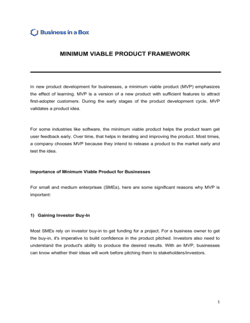
At minimum, an MVP framework should include a problem statement, a testable hypothesis, a scoped feature list, success metrics, a target user segment, a testing approach, and a timeline. Templates like the Minimum Viable Product Framework in this folder provide a ready-made structure so teams don't have to start from scratch.
How is an MVP different from a prototype?
A prototype is typically a non-functional or limited mockup used to test design and usability. An MVP is a functional (though minimal) product released to real users to test a business or behavioural hypothesis. Prototypes are usually internal; MVPs are usually released to a subset of real customers.
How do I avoid scope creep when building an MVP?
The most effective tool is a written feature scope that distinguishes between what is in the MVP and what is explicitly deferred. Committing that scope to a document — and requiring a formal decision to change it — creates a forcing function against the natural tendency to add features. A structured MVP framework template helps enforce this discipline from the start.
Do I need an MVP framework if my team uses agile or scrum?
Yes. Agile and scrum define how work is organised and delivered in sprints; an MVP framework defines what problem you're testing and whether the product direction is worth continuing. They operate at different levels and complement each other. Many agile teams treat the MVP framework as the input to their first sprint planning session.
What makes a good success metric for an MVP?
A good MVP success metric is specific, measurable, and tied directly to the hypothesis being tested. For example, "40% of users who try feature X return within 7 days" is a good metric; "users like the product" is not. Agree on thresholds before launch, not after, to avoid rationalising results.
Can small businesses use MVP and prototyping templates?
Yes, and they often benefit more than large companies because they have less capacity to absorb the cost of building the wrong product. The templates in this folder are designed to scale down to a one-person team or a two-person startup, not just enterprise product organisations.
MVP & Prototyping vs. related documents
An MVP framework focuses narrowly on the smallest testable version of a product — just enough to validate a core assumption. A PRD documents the complete feature set, user stories, and acceptance criteria for a finished product. Start with an MVP framework to de-risk the direction; graduate to a full PRD once the concept is validated.
MVP & Prototyping vs. Prototype
A prototype is a tangible artifact — a clickable mockup, a wireframe, or a working demo — used to test a design or concept. An MVP framework template is the planning document that defines what the prototype or early product must prove, and how you will measure success. The template comes before the prototype is built.
A product roadmap shows the planned sequence of features and releases over months or quarters. An MVP framework covers only the first, smallest release — the one designed to test whether the product idea is worth building at all. The MVP framework informs the first milestone on the roadmap.
A business case argues whether an investment is financially justified. An MVP framework focuses on how to test a product hypothesis as cheaply and quickly as possible, before the full investment is committed. The two documents are complementary: the business case frames the strategic decision; the MVP framework guides the execution of the test.
Key clauses every MVP & Prototyping contains
Every MVP or prototyping document — regardless of format — is built around the same core components.
- Problem statement. A concise description of the specific customer problem the product is designed to solve.
- Core hypothesis. The testable assumption the MVP is designed to prove or disprove, stated as an if-then statement.
- Feature scope. The minimal set of features required to test the hypothesis — nothing more, nothing less.
- Success metrics. The quantitative or qualitative measures that will determine whether the MVP has validated the hypothesis.
- Target user segment. The specific audience whose behavior will be observed during the MVP test.
- Testing approach. How validation data will be collected — interviews, analytics, sign-ups, usage logs, or a combination.
- Timeline and milestones. Key dates for build, release, data collection, and go/no-go decision.
- Launch readiness checklist. A sequential list of pre-launch tasks across product, marketing, legal, and operations to prevent gaps.
How to write an MVP framework
A well-structured MVP framework keeps your team aligned on what you're building, why, and how you'll know if it worked.
1
Define the problem you're solving
Write a single sentence describing the specific pain point your target user experiences that the product addresses.
2
State your core hypothesis
Articulate the testable assumption at the centre of the MVP — for example, 'If users can do X, they will convert at Y rate.'
3
Identify the target user segment
Name the specific user group whose behaviour will validate or invalidate the hypothesis.
4
Scope the minimum feature set
List only the features required to test the hypothesis; defer everything else to future iterations.
5
Define success metrics
Set quantitative thresholds — activation rate, retention, sign-ups, or NPS — that will constitute validation.
6
Plan the testing and data-collection approach
Decide how you will gather evidence: user interviews, analytics events, waitlist conversions, or usability sessions.
7
Set a go/no-go decision date
Commit to a specific date when the team will review results and decide whether to iterate, pivot, or proceed to full build.
At a glance
- What it is
- MVP and prototyping templates are structured documents that guide product teams through defining, scoping, and validating a minimum viable product before committing to full development. They capture assumptions, success criteria, feature priorities, and launch readiness in one place.
- When you need one
- Any time a team is preparing to build and test a new product or feature, these templates prevent scope creep and keep validation efforts focused.
Which MVP & Prototyping do I need?
The right template depends on where you are in the product development cycle — scoping your MVP concept or managing the full pre-launch checklist.
Your situation
Recommended template
Defining scope, assumptions, and success metrics for a new MVP
Structures the core hypothesis, feature set, and validation criteria before a single line of code is written.Tracking every product management task before a launch or release
Ensures no launch step is missed by covering strategy, testing, and go-to-market readiness in sequence.Glossary
- MVP (minimum viable product)
- The smallest functional version of a product that can be used to test a specific hypothesis with real users.
- Prototype
- An early, often non-functional model of a product used to explore design, flow, or usability before building.
- Hypothesis
- A testable assumption about user behaviour or market demand that the MVP is designed to prove or disprove.
- Feature scope
- The agreed-upon list of features included in a specific release, used to prevent scope creep.
- Scope creep
- The gradual addition of features or requirements beyond the original scope, which increases cost and delays validation.
- Validation
- The process of gathering evidence from real users to confirm or reject a product hypothesis.
- Go/no-go decision
- A structured team decision at a defined date to proceed with full development, pivot the concept, or abandon it.
- Iteration
- A single build-test-learn cycle; each iteration refines the product based on evidence from the previous cycle.
- User segment
- A specific, defined group of users whose behaviour the MVP is designed to observe and learn from.
- Success metric
- A measurable threshold agreed upon before launch that determines whether the MVP has validated its hypothesis.
What is an MVP and prototyping template?
An MVP and prototyping template is a structured document that helps product managers, founders, and development teams define, scope, and validate a minimum viable product before committing to full-scale development. Rather than building from intuition, these templates force a team to write down the problem they are solving, the hypothesis they are testing, the features they will include, and the metrics that will tell them whether the experiment worked.
The discipline behind MVPs comes from lean product development: ship the smallest thing that can generate real learning, measure the result against pre-defined criteria, and use that evidence to decide whether to iterate, pivot, or invest further. Templates make this process faster and more consistent by providing a ready-made structure — so teams spend their time thinking about the right questions, not formatting a blank document.
When you need an MVP or prototyping template
If your team is about to build something new — a product, a feature, a service, or a process — and you haven't yet confirmed that customers want it, you need an MVP framework before you write a line of code or spend a dollar on development.
Common triggers:
- A startup is preparing to build its first product and needs to define what to test in the first release
- A product team is scoping a new feature and needs to agree on the smallest testable version
- A founder is pitching to investors and needs to show a disciplined validation plan
- A team is preparing for a product launch and needs a checklist to verify nothing is missing
- A product manager is onboarding a new engineering team and needs a shared understanding of goals and scope
- A company is evaluating whether to expand an existing product into a new market or user segment
Skipping this stage is one of the most common and expensive mistakes in product development. Teams that build without a structured hypothesis and success criteria often discover — after months of work — that they built the right features for the wrong users, or the wrong features for the right users. A one-page MVP framework, completed before development begins, is the lowest-cost way to reduce that risk.
Award-winning platform
- Great Place to Work 2025
- BIG Award — Product of the Year 2025
- Smartest Companies 2025
- Global 100 Excellence 2026
- Best of the Best 2025