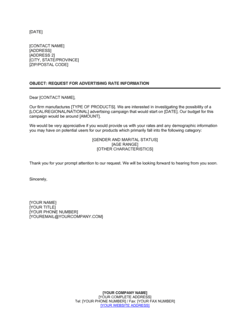
Advertising Templates

4.7from 280+ reviews Trusted by 20M+ businesses

Plan, contract, and launch advertising campaigns with the right document for every step.

WordEditable onlinePDF10+ advertising templates

Other Sales & Marketing categories

250K+Clients
20M+Free users
20+Years
190+Countries
10,000+Law firms
50M+Downloads

Trusted across review platforms

  • Capterra★★★★☆4.649 reviews
  • G2★★★★☆4.713 reviews
  • GetApp★★★★☆4.649 reviews
  • Google Play★★★★☆4.6179 ratings
  • Google Reviews★★★★☆4.567 reviews

Related categories

Frequently asked questions

Do I need a written agreement with my advertising agency?
Yes. A written advertising agency agreement protects both sides. It defines the scope of work, fee structure, creative ownership, and what happens if the relationship ends. Without a written contract, disputes about who owns the ad creative, who approved a campaign spend, or what the agency was actually hired to do are difficult and expensive to resolve.
What is the difference between an advertising plan and a marketing plan?
An advertising plan focuses specifically on paid media: which channels to use, what budget to allocate, and what creative strategy to follow. A marketing plan is broader and covers all marketing activity — branding, content, PR, events, sales enablement, and advertising. An advertising plan is typically a component of a larger marketing plan.
Who owns the creative assets produced by an advertising agency?
Ownership depends on what the contract says. In most jurisdictions, the creating party (the agency) owns the copyright unless the agreement transfers it. Many advertisers negotiate a full assignment of creative assets as part of the fee. If ownership is not addressed in the agreement, you should assume the agency retains it and negotiate a license at minimum.
What should an advertising proposal include?
A strong advertising proposal covers the client's objectives, your proposed strategy and channel mix, specific deliverables, campaign timeline, budget breakdown, expected results with supporting rationale, and your team's relevant experience. Including a pricing summary and a clear next-step call to action increases conversion rates.
Do I need a privacy release for people who appear in my ads?
Yes, in virtually every jurisdiction. Anyone whose image, voice, or likeness appears in advertising material — including social media ads, video spots, and printed collateral — should sign a multimedia publicity and privacy release before the material is published. Using someone's likeness without consent can expose you to claims for invasion of privacy or right-of-publicity violations.
What is an affiliate program agreement used for?
An affiliate program agreement formalizes the relationship between a business and third-party publishers (affiliates) who promote its products in exchange for a commission on sales or leads. It defines commission rates, cookie windows, acceptable promotional methods, payment terms, and how fraud is handled. Without a written agreement, disputes about whether a sale was validly referred are common.
How do I evaluate whether an advertising campaign worked?
Start by comparing actual results against the KPIs you agreed on before the campaign launched — impressions, clicks, cost per acquisition, revenue attributed, and return on ad spend are the most common. A marketing campaign evaluation template provides a structured framework for documenting what ran, what the numbers show, what worked, and what should change in the next cycle.
What is a co-branding agreement?
A co-branding agreement is a contract between two companies that agree to appear together in advertising or on products. It governs how each brand can use the other's trademarks, who controls quality standards, how costs and revenues are split, and what happens if one party's reputation is damaged. Co-branding without a written agreement creates significant IP and reputational risk for both parties.
Can I advertise my business for free?
Yes. Several channels — organic social media, Google Business Profile, content marketing, email newsletters, press releases, and referral programs — can generate meaningful exposure without paid media spend. The guide "How To Advertise Your Business For Free" in this folder outlines the most effective no-cost channels and how to structure a basic free advertising program.

Advertising vs. related documents

Advertising Agency Agreement vs. Advertising Sales Representation Agreement

An advertising agency agreement governs a company you hire to create and manage advertising on your behalf — strategy, creative, media buying, and reporting all flow through the agency. An advertising sales representation agreement governs a third party that sells your own advertising inventory to buyers, earning a commission on each sale. If you are the advertiser, you likely need the agency agreement. If you are the media owner or publisher, you likely need the sales rep agreement.

Advertising Plan vs. Marketing Campaign Brief

An advertising plan is a broader, longer-horizon document that sets annual or quarterly advertising strategy: channels, budget, audience, and measurement framework. A marketing campaign brief is a shorter, tactical document scoped to a single campaign — it defines the objective, message, audience, and deliverables for one initiative. Use the plan to govern overall investment; use the brief to brief agencies or internal teams on each activation.

Co-Branding Agreement vs. Online Promotion Agreement

A co-branding agreement governs a longer-term partnership where two brands appear together on products, packaging, or campaigns — it covers brand usage rights, revenue sharing, and quality control. An online promotion agreement is typically shorter in duration and narrower in scope, covering a specific digital promotion such as a sponsored post, a giveaway, or a co-hosted webinar. For an ongoing strategic brand partnership, use the co-branding agreement; for a one-off digital campaign, use the online promotion agreement.

Advertisement Approval vs. Multimedia Publicity – Privacy Release

An advertisement approval document records internal or client sign-off on creative content before it goes live — it protects against disputes about what was authorized. A multimedia publicity and privacy release is signed by a person (not a company) giving permission for their image, voice, or likeness to be used in advertising materials. You typically need both: the release from any individuals who appear in the ad, and the approval form for the finished creative.

Key clauses every Advertising contains

Advertising contracts and plans across this category share a common set of clauses — the language varies by context, but the structure does not.

  • Scope of services. Defines exactly what advertising activities are covered: channels, formats, frequency, and geographic reach.
  • Budget and fee structure. Sets the total spend, payment schedule, agency commission or markup rates, and any performance bonuses.
  • Creative ownership and approval. Specifies who owns finished ad creative and who must approve it before it runs.
  • Performance metrics and reporting. Identifies the KPIs both parties will track — impressions, clicks, conversions, ROAS — and how often they are reported.
  • Term and termination. States how long the agreement runs and the conditions under which either party can end it early.
  • Exclusivity. Restricts whether the agency or rep can work with direct competitors during the engagement.
  • Intellectual property and licensing. Covers the advertiser's right to use logos, trademarks, and third-party content in the campaign materials.
  • Confidentiality. Protects campaign strategy, pricing, and audience data from disclosure to competitors or the public.
  • Indemnification and liability. Allocates responsibility if an ad causes a legal claim — for example, a copyright infringement or a false advertising complaint.

How to write an advertising agreement or plan

Whether you are documenting a campaign strategy or formalizing a relationship with an agency or media partner, every advertising document needs the same core information in the same logical order.

  1. 1

    Identify the parties and their roles

    State the full legal names of the advertiser, agency, publisher, or rep firm, and define who is responsible for which decisions.

  2. 2

    Define the advertising objective

    Be specific: brand awareness, lead generation, e-commerce sales, app installs — each drives different channel and creative choices.

  3. 3

    Describe the scope of work in detail

    List every deliverable — ad units, copy variations, placements, campaign flights — so nothing is assumed by either side.

  4. 4

    Set the budget and payment terms

    Specify total budget, agency fees or commissions, invoicing schedule, and any budget reallocation approval process.

  5. 5

    Establish the approval process

    Document who reviews creative, who has final approval authority, and how many revision rounds are included.

  6. 6

    Define success metrics and reporting cadence

    Agree on KPIs before the campaign launches so there is no dispute about whether it worked.

  7. 7

    Add legal protections

    Include confidentiality, IP ownership, indemnification, governing law, and termination clauses before anyone signs.

  8. 8

    Sign, distribute, and store

    Ensure all authorized parties sign the agreement and that each party holds an executed copy for their records.

At a glance

What it is
Advertising templates are pre-structured business documents that cover every phase of the advertising process — from planning a campaign and hiring an agency to approving creative and measuring results. They save time, reduce legal risk, and ensure nothing is left out when spending budget to promote a product or service.
When you need one
Any time you are commissioning, running, or evaluating paid advertising — whether in print, digital, broadcast, or direct mail — a written document protects your investment and keeps all parties aligned.

Which Advertising do I need?

The right advertising template depends on what you are trying to accomplish: contracting a service provider, planning a campaign, requesting rate information, or evaluating results. Match your situation below.

Your situation
Recommended template

Hiring an advertising agency to manage campaigns on your behalf

Defines scope, fees, approval rights, and ownership of creative assets.

Pitching a client or brand on a paid advertising program

Structures your offer with deliverables, pricing, and expected outcomes.

Building an annual or quarterly advertising plan for your business

Organizes goals, channels, budget allocation, and timeline in one document.

Running paid advertising on digital or social media channels

Tailored structure for digital-specific KPIs, audiences, and channel mix.

Contracting a publisher or platform for internet ad placements

Covers placement specs, pricing, impressions, and liability for online ads.

Partnering with a rep firm to sell advertising on your behalf

Sets commission structure, territory, exclusivity, and performance targets.

Launching a direct mail campaign and need a step-by-step checklist

Covers every operational step from list selection to postage and tracking.

Getting formal sign-off on ad creative before it runs

Creates a written record of who approved which creative and when.

Glossary

Advertiser
The company or individual paying for advertising space or services to promote a product, service, or brand.
Advertising agency
A business hired to plan, create, and manage advertising campaigns on behalf of an advertiser.
Media buy
The purchase of advertising space or airtime in a specific channel — digital, print, broadcast, or out-of-home.
Campaign brief
A short document that defines the objective, audience, message, budget, and deliverables for a single advertising campaign.
Creative assets
The finished advertising materials — images, videos, copy, display ads — produced for a campaign.
Affiliate
A third-party publisher or individual who promotes a product and earns a commission for each sale or lead generated.
Co-branding
A marketing arrangement where two companies promote their brands together on a product, campaign, or event.
Return on ad spend (ROAS)
Revenue generated for every dollar spent on advertising; a core metric for evaluating paid campaign performance.
Flight
The scheduled start and end dates of a specific advertising campaign or media buy.
Impression
A single instance of an ad being displayed to a user, whether or not it is clicked.
Commission
A percentage of revenue or a fixed fee paid to an agency, sales rep, or affiliate for advertising services or referrals.
Right of publicity
A person's legal right to control commercial use of their name, image, or likeness in advertising.

What is an advertising template?

An advertising template is a professionally structured document designed to support a specific task in the advertising lifecycle — drafting a contract with an agency, planning a campaign, approving creative, or evaluating results. Rather than starting from a blank page, advertising templates give businesses a complete framework with the right sections, legal language, and logic already in place. They are used by marketing teams, business owners, agencies, and media companies to move faster and reduce the risk of disputes or missed steps.

Advertising documents fall into three broad categories. Contracts and agreements — such as agency agreements, internet advertising agreements, and affiliate program agreements — formalize the legal relationship between the parties involved in buying or selling advertising. Planning documents — such as advertising plans, campaign briefs, and direct mail checklists — guide the strategy and execution of a campaign. Evaluation and approval documents — such as campaign evaluation forms and advertisement approval records — create a paper trail that protects all parties after a campaign runs.

When you need an advertising template

Any time money is changing hands or creative is being produced for advertising purposes, a written document reduces ambiguity and protects your investment. The cost of a poorly scoped agency agreement or an undocumented approval is often far greater than the time it takes to complete the right template upfront.

Common triggers:

  • Hiring an advertising or digital marketing agency for the first time or a new engagement
  • Commissioning a media publisher, website, or app to run display or sponsored content ads
  • Building a formal advertising plan before allocating next year's marketing budget
  • Launching a direct mail, email, or digital campaign that involves multiple vendors
  • Entering a co-branding or affiliate arrangement with another company
  • Getting written approval on ad creative before it goes live with a client or regulator
  • Measuring the results of a completed campaign against the objectives set at the start
  • Using a person's image, voice, or likeness in any advertising material

Without the right documents in place, disputes about creative ownership, budget authority, approval records, and performance expectations become difficult to resolve. The templates in this folder cover every major advertising situation so you can protect your budget, your brand, and your business relationships at every stage of the process.

Award-winning platform

  • Great Place to Work 2025
  • BIG Award — Product of the Year 2025
  • Smartest Companies 2025
  • Global 100 Excellence 2026
  • Best of the Best 2025

Create your document in 3 simple steps.

From template to signed document — all inside one Business Operating System.
1
Download or open template

Access over 3,000+ business and legal templates for any business task, project or initiative.

2
Edit and fill in the blanks with AI

Customize your ready-made business document template and save it in the cloud.

3
Save, Share, Send, Sign

Share your files and folders with your team. Create a space of seamless collaboration.

Save time, save money, and create top-quality documents.

★★★★★

"Fantastic value! I'm not sure how I'd do without it. It's worth its weight in gold and paid back for itself many times."

Managing Director · Mall Farm
Robert Whalley
Managing Director, Mall Farm Proprietary Limited
★★★★★

"I have been using Business in a Box for years. It has been the most useful source of templates I have encountered. I recommend it to anyone."

Business Owner · 4+ years
Dr Michael John Freestone
Business Owner
★★★★★

"It has been a life saver so many times I have lost count. Business in a Box has saved me so much time and as you know, time is money."

Owner · Upstate Web
David G. Moore Jr.
Owner, Upstate Web

Run your business with a system — not scattered tools

Stop downloading documents. Start operating with clarity. Business in a Box gives you the Business Operating System used by over 250,000 companies worldwide to structure, run, and grow their business.

Start free · No credit card required