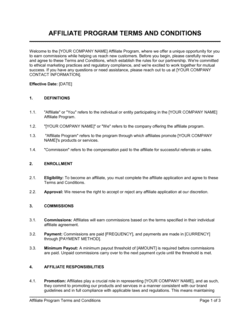
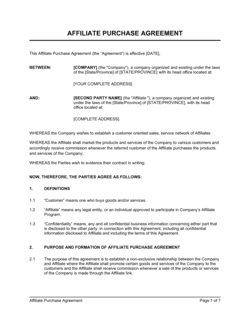
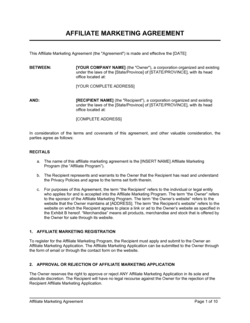
Affiliate Program Agreement Template

Free Word download • Edit online • Save & share with Drive • Export to PDF

10 pages30–40 min to fillDifficulty: ComplexSignature requiredLegal review recommended
Learn more ↓
FreeAffiliate Program Agreement Template

At a glance

What it is
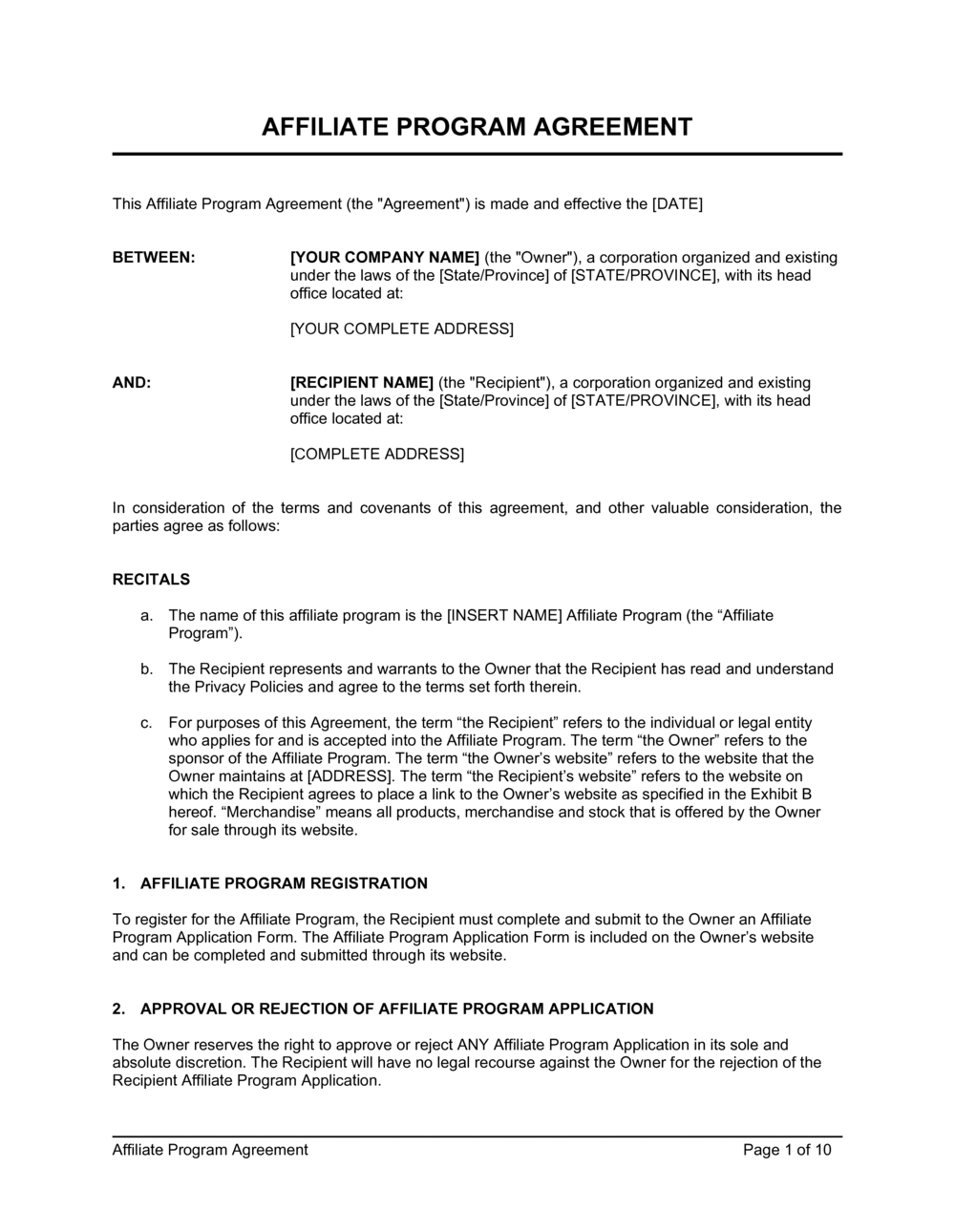
An Affiliate Program Agreement is a legally binding contract between a merchant and an affiliate that governs how the affiliate promotes the merchant's products or services in exchange for a commission on qualifying sales or leads. This free Word download lets you define commission rates, cookie windows, approved promotional methods, IP usage rights, payment schedules, and termination conditions in a single document you can edit online and export as PDF before onboarding your first partner.
When you need it
Use it before any affiliate starts promoting your products — whether you are launching a formal affiliate program, signing an individual content creator, or expanding an existing partner network. It is also required when joining another company's affiliate program as the partner entity.
What's inside
Merchant and affiliate identification, program enrollment conditions, commission structure and calculation method, cookie duration and attribution rules, approved and prohibited promotional methods, IP license for use of logos and creative assets, payment schedule and minimum thresholds, audit rights, confidentiality, representations and warranties, and termination with post-termination obligations.

What is an Affiliate Program Agreement?

An Affiliate Program Agreement is a legally binding contract between a merchant and an affiliate that establishes the full terms under which the affiliate may promote the merchant's products or services in exchange for a commission on qualifying sales, leads, or other defined actions. It defines how commissions are calculated and paid, how referrals are tracked, which promotional methods are permitted or prohibited, how the merchant's brand assets may be used, and what obligations continue after the relationship ends. Unlike a simple handshake arrangement or an informal email, a properly drafted affiliate agreement creates enforceable obligations on both sides — giving merchants control over how their brand is represented at scale and giving affiliates a guaranteed, documented basis for payment.

Why You Need This Document

Operating an affiliate program without a written agreement exposes your business on several fronts simultaneously. Without prohibited-methods language, affiliates can bid on your branded keywords in Google Ads — driving up your own acquisition costs while earning commissions on traffic you would have captured for free. Without an FTC disclosure requirement, you share regulatory liability for an affiliate's undisclosed promotional posts. Without a clear commission definition tied to net revenue, systematic overpayment on discounted or refunded orders compounds quietly as your program grows. And without termination and IP revocation provisions, a deactivated affiliate can continue displaying your logos and product images indefinitely. This template gives you a complete, enforceable starting point that closes all four gaps — covering commission structure, attribution rules, promotional compliance, IP licensing, payment terms, and post-termination obligations in a single document you can execute before your first affiliate sends a single link.

Which variant fits your situation?

If your situation is…Use this template
Launching a public affiliate program open to any applicantAffiliate Program Agreement (Standard)
Signing a single high-value influencer or media partnerInfluencer Marketing Agreement
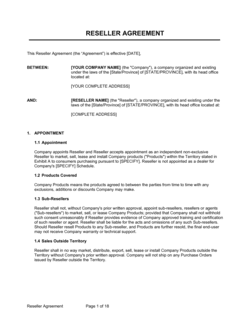
Authorizing a reseller to sell your product at a margin rather than on commissionReseller Agreement
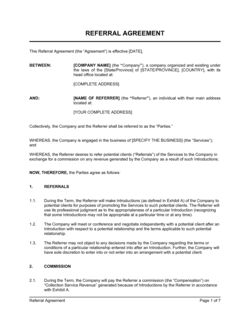
Paying a flat referral fee per qualified lead rather than a percentage of salesReferral Agreement
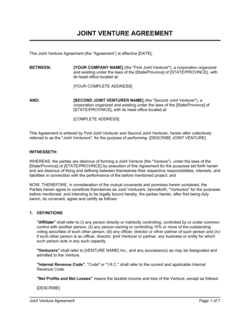
Engaging a co-marketing partner for joint campaigns with shared revenueJoint Venture Agreement
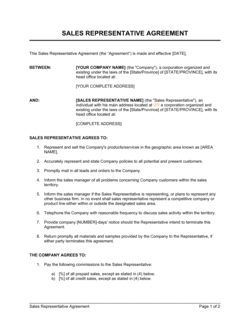
Appointing an exclusive regional representative to drive sales on commissionSales Representative Agreement
Running a white-label arrangement where the partner resells under their own brandWhite Label Agreement

Common mistakes to avoid

❌ No branded keyword bidding restriction

Why it matters: Affiliates bidding on your brand name in Google Ads drive up your own cost-per-click and cannibalize traffic you would have acquired for free. The financial damage can exceed the affiliate's commission earnings.

Fix: Add an explicit prohibition on bidding on the merchant's brand name, product names, and any confusingly similar variations in any paid search platform, and make it a basis for immediate termination.

❌ Omitting the FTC disclosure requirement

Why it matters: Merchants can share regulatory liability for an affiliate's failure to disclose the paid relationship. FTC enforcement actions and consumer complaints can follow a single viral post with no disclosure.

Fix: Include a specific clause requiring clear and conspicuous disclosure in all promotional content, citing the FTC Endorsement Guides, and add a cure-or-terminate mechanism for non-compliance.

❌ Defining commission on gross order value

Why it matters: Commissions calculated on gross revenue — before discounts, taxes, and refunds — result in systematic overpayment that compounds as volume grows and refund rates fluctuate.

Fix: Define 'Net Revenue' explicitly and state that all commissions are calculated on this figure. Specify that refunds and chargebacks trigger proportional commission reversals.

❌ No minimum payout threshold

Why it matters: Without a threshold, the merchant must process payment for any balance — including $1.47 — on each payment date, creating payment processing costs that can exceed the commission value for low-volume affiliates.

Fix: Set a minimum payout threshold of $25–$50 and state that balances below the threshold roll forward to the next payment period until the threshold is met.

❌ Silent on sub-affiliate arrangements

Why it matters: If an affiliate recruits sub-affiliates without restriction, the merchant loses visibility into who is promoting the brand, making compliance monitoring and FTC disclosure enforcement impossible.

Fix: Include an explicit clause either prohibiting sub-affiliates entirely or requiring prior written approval and specifying that the primary affiliate is contractually responsible for all sub-affiliate conduct.

❌ No post-termination IP revocation mechanism

Why it matters: An affiliate whose account is terminated can continue displaying your brand logos and product images indefinitely if the IP license contains no automatic revocation clause tied to termination.

Fix: State clearly that the IP license terminates automatically and immediately upon any termination of the agreement, and require the affiliate to destroy or remove all merchant-owned assets within a specified period — typically 5 business days.

The 10 key clauses, explained

Enrollment and acceptance

In plain language: Establishes that the affiliate relationship begins only upon the merchant's written approval of the affiliate's application, and that the merchant may reject or revoke enrollment at any time.

Sample language
Affiliate's participation in the Program is subject to [MERCHANT NAME]'s written acceptance of Affiliate's application. [MERCHANT NAME] reserves the right to approve or reject any application at its sole discretion and to terminate enrollment at any time.

Common mistake: Omitting an approval step and treating submission of an application as automatic acceptance. This allows brand-misaligned or fraudulent affiliates to begin promoting before any vetting occurs.

Commission structure and calculation

In plain language: Defines the commission rate or flat fee, what events trigger a commission (sale, lead, or click), and how the commission amount is calculated — typically on net revenue after discounts and taxes.

Sample language
Merchant shall pay Affiliate a commission of [X]% of Net Revenue from each Qualifying Sale attributed to Affiliate's unique tracking link. 'Net Revenue' means the purchase price actually received by Merchant, excluding shipping, taxes, and any applied discounts.

Common mistake: Defining commission on gross revenue rather than net revenue. This creates overpayment on discounted or tax-inclusive transactions and complicates reconciliation.

Tracking, attribution, and cookie policy

In plain language: Specifies the tracking technology used, the cookie duration, and the attribution model (e.g., last-click), so both parties understand how commissions are counted and disputes are resolved.

Sample language
Referrals are tracked via Affiliate's unique tracking link. A cookie window of [X] days applies from the date of first click. Attribution is on a last-click basis. Merchant's tracking system is the definitive record for all commission calculations.

Common mistake: Not specifying that the merchant's tracking system is the authoritative record. Without this, affiliates can dispute commission counts using their own analytics, creating unresolvable disagreements.

Approved and prohibited promotional methods

In plain language: Lists the specific marketing channels and tactics the affiliate may and may not use — including restrictions on paid search bidding on branded keywords, spam, misleading claims, and coupon/loyalty site restrictions.

Sample language
Affiliate shall not (a) bid on [MERCHANT NAME] or any confusingly similar brand keywords in paid search, (b) send unsolicited commercial email, (c) use cookie stuffing or other fraudulent tracking methods, or (d) make any representations about [PRODUCT/SERVICE] not expressly approved in writing by Merchant.

Common mistake: Listing only broad prohibitions like 'no spam' without addressing branded keyword bidding. Brand keyword PPC by affiliates drives up the merchant's own ad costs and cannibalizes direct traffic — it is one of the most financially damaging affiliate abuses.

FTC and regulatory disclosure obligations

In plain language: Requires the affiliate to clearly and conspicuously disclose their material connection to the merchant in all promotional content, in compliance with FTC guidelines and applicable local advertising law.

Sample language
Affiliate shall include a clear and conspicuous disclosure of the material relationship between Affiliate and [MERCHANT NAME] in all promotional content, including but not limited to: '#ad', '#sponsored', or 'This post contains affiliate links for which I may receive a commission.'

Common mistake: Treating disclosure as the affiliate's problem and omitting it from the agreement entirely. Merchants can share FTC liability for an affiliate's non-disclosure — requiring it contractually creates a paper trail and shifts the risk.

Intellectual property license

In plain language: Grants the affiliate a limited, non-exclusive, revocable license to use the merchant's logos, product images, and approved creative assets strictly for program promotion, and prohibits any modification of those assets.

Sample language
Merchant grants Affiliate a limited, non-exclusive, non-transferable, revocable license to use Merchant's approved logos, trademarks, and creative materials solely for the purpose of promoting the Program. Affiliate shall not alter, modify, or create derivative works from any Merchant-owned asset.

Common mistake: Granting an IP license with no revocation mechanism. If the affiliate's account is terminated, a license without a revocation clause allows them to continue using your brand assets indefinitely.

Payment terms and chargeback policy

In plain language: States the payment schedule (e.g., monthly, Net 30 after period close), the minimum payout threshold, the payment method, and the process for reversing commissions on refunded or fraudulent orders.

Sample language
Commissions are paid monthly, Net 30 following the close of each calendar month, provided the balance meets the minimum threshold of $[X]. Commissions on orders subsequently refunded or charged back will be deducted from the next payment cycle.

Common mistake: Setting no minimum payout threshold. Processing dozens of micro-payments to affiliates earning $2–$5 per month creates administrative cost that exceeds the commission value.

Representations and warranties

In plain language: Each party confirms they have the legal authority to enter the agreement, and the affiliate specifically warrants that their promotional activities comply with all applicable laws and do not infringe third-party rights.

Sample language
Each party represents and warrants that (a) it has full authority to enter into this Agreement; and (b) its performance will not violate any applicable law or third-party right. Affiliate further warrants that all promotional content is accurate, non-deceptive, and compliant with applicable advertising standards.

Common mistake: Including only merchant representations and omitting affiliate warranties. The merchant's primary legal exposure comes from affiliate conduct — warranties from the affiliate create a contractual basis for indemnification claims.

Indemnification

In plain language: Requires the affiliate to indemnify the merchant against claims, losses, and costs arising from the affiliate's promotional activities, misrepresentations, or violations of the agreement.

Sample language
Affiliate shall indemnify, defend, and hold harmless [MERCHANT NAME] from any claim, damage, loss, or expense (including reasonable attorneys' fees) arising out of or related to Affiliate's promotional activities, breach of this Agreement, or violation of applicable law.

Common mistake: Writing a mutual indemnification clause without carving out affiliate-specific conduct. The merchant's primary risk is affiliate-generated — a one-sided indemnification from the affiliate is standard and appropriate here.

Termination and post-termination obligations

In plain language: Allows either party to terminate with or without cause on written notice, and specifies what happens to earned but unpaid commissions, IP license rights, and tracking link deactivation after termination.

Sample language
Either party may terminate this Agreement with [14] days' written notice. Merchant may terminate immediately for cause. Upon termination, Affiliate's license to use Merchant IP is immediately revoked, all tracking links are deactivated, and any earned commissions through the termination date will be paid in the next regular payment cycle, subject to chargeback reversals.

Common mistake: Providing no guidance on what happens to commissions in the pipeline at termination. Affiliates who are owed money after termination will dispute payment if the process is not spelled out — leading to small-claims filings over $50 commission balances.

How to fill it out

  1. 1

    Identify both parties with legal entity names

    Enter the merchant's full registered business name and state or country of incorporation, and the affiliate's legal name — individual or entity. For individual affiliates, include their address and the business name under which they operate, if any.

    💡 If you run a public affiliate program, use a standard acceptance clause that incorporates the agreement by reference when affiliates click 'I agree' during signup — this creates a binding contract at scale without individual wet signatures.

  2. 2

    Define the commission structure precisely

    Specify the commission rate or flat fee, the triggering event (sale, lead, or click), and the exact definition of Net Revenue. If you offer tiered commissions based on volume, include a table showing each threshold and corresponding rate.

    💡 State explicitly that commissions are calculated on Net Revenue after refunds, discounts, and taxes — not gross order value. Ambiguity here is the most common source of affiliate payment disputes.

  3. 3

    Set the cookie duration and attribution model

    Enter the cookie window (typically 30–90 days for e-commerce, 60–120 days for SaaS) and confirm last-click attribution or your chosen model. State that the merchant's tracking platform is the definitive record.

    💡 Shorter cookie windows favor the merchant; longer windows incentivize affiliates to promote more actively. A 30-day cookie is widely accepted as a baseline for consumer products.

  4. 4

    List approved and prohibited promotional methods

    Explicitly enumerate what affiliates may and may not do — including branded keyword bidding, email marketing requirements, coupon site restrictions, and social media disclosure rules. Be specific rather than relying on catch-all language.

    💡 Create a separate Promotional Guidelines document and reference it as an exhibit to the agreement. This lets you update tactics guidelines without amending the contract.

  5. 5

    Add FTC disclosure requirements

    Include a clause requiring the affiliate to display a clear and conspicuous material connection disclosure in every piece of promotional content. Specify acceptable disclosure language and placement requirements.

    💡 Reference the FTC's current Endorsement Guides by name so the obligation is tied to the regulatory standard, not just your internal policy — this matters if you ever need to enforce the clause.

  6. 6

    Complete the payment terms block

    Set the payment schedule (monthly is standard), the Net 30 or Net 60 lag period after period close, the minimum payout threshold, and the accepted payment method (PayPal, ACH, check). Include the chargeback reversal process.

    💡 A Net 45 or Net 60 payment lag after the close of the earning period gives you enough time to process refunds before commissions are paid — preventing negative balance situations that are difficult to collect.

  7. 7

    Attach your IP usage guidelines as an exhibit

    Reference a Schedule A or Exhibit 1 containing approved logos, brand colors, and usage rules. The body clause grants the license; the exhibit defines exactly what is permitted.

    💡 Include a sentence expressly stating that assets not included in the approved exhibit may not be used. This prevents affiliates from pulling unapproved images from your website.

  8. 8

    Execute before the affiliate begins any promotion

    Both parties must sign — or, for a self-service program, the affiliate must complete a verifiable click-through acceptance — before any promotional activity begins. Store executed copies in a secure document management system.

    💡 For high-volume programs, use a click-wrap acceptance embedded in your affiliate portal registration flow. Courts in the US and UK generally treat these as binding contracts when the acceptance mechanism is clear and the agreement is readily available for review.

Frequently asked questions

What is an affiliate program agreement?

An affiliate program agreement is a legally binding contract between a merchant and an affiliate that governs how the affiliate may promote the merchant's products or services and how commissions are earned, calculated, and paid. It sets the rules for tracking, approved promotional methods, IP usage, FTC disclosure obligations, and what happens when either party wants to end the relationship. Without one, both parties rely on informal understandings that are difficult to enforce when disputes arise.

Is an affiliate program agreement legally required?

No law in most jurisdictions mandates a formal written affiliate agreement, but operating without one exposes both parties to significant risk. For merchants, the absence of a contract makes it nearly impossible to enforce branded keyword restrictions, prohibited promotional methods, or FTC disclosure obligations. For affiliates, an unsigned arrangement provides no guarantee of commission rates, payment timelines, or cookie duration — all of which a merchant can change unilaterally without notice.

What commission rate should I use in my affiliate agreement?

Commission rates vary widely by industry and product margin. Physical goods programs typically pay 5–15% of net revenue; digital products and SaaS programs commonly pay 20–40% or a flat recurring fee per subscriber. High-margin digital products sometimes exceed 50% for promotional launches. The agreement should specify the exact rate, whether it applies to the first purchase only or to recurring billing, and any tiered structure based on monthly volume.

Does my affiliate agreement need to address FTC disclosure?

Yes, particularly for US-facing programs. The FTC Endorsement Guides require affiliates to clearly and conspicuously disclose their material connection to the merchant in all promotional content — social posts, blog articles, YouTube videos, and email. Merchants can share liability if they know or should know that affiliates are not disclosing. Including a contractual disclosure requirement, with a cure-or-terminate mechanism, creates a documented compliance obligation and shifts liability to the affiliate.

What happens to commissions when the affiliate agreement is terminated?

The agreement should specify that commissions earned on qualifying sales completed before the termination date will be paid in the next regular payment cycle, subject to any chargeback reversals within the refund window. Commissions on sales generated after termination — even if the affiliate's tracking link technically still resolves — are typically forfeited. This should be stated explicitly to prevent disputes.

Can I use a click-wrap acceptance instead of a wet signature?

For most standard affiliate programs, a click-wrap acceptance embedded in the affiliate portal registration flow is generally enforceable as a binding contract in the US, UK, Canada, and the EU, provided the agreement is clearly displayed and the acceptance action is unambiguous. For high-value individual partners — influencers with six-figure promotional reach or agency-level affiliates — a countersigned PDF provides stronger evidence of specific terms agreed.

What is the difference between an affiliate agreement and a reseller agreement?

An affiliate earns a commission on sales they refer but never takes title to the product — the merchant handles fulfillment, billing, and customer service. A reseller purchases inventory from the merchant (or is authorized to resell at a margin) and typically has its own customer relationship. Affiliates are primarily a marketing channel; resellers are a distribution channel. The legal obligations, payment structures, and IP considerations differ significantly between the two.

Do I need a lawyer to draft an affiliate program agreement?

For a standard consumer-facing affiliate program, a well-structured template is typically sufficient. Engage a lawyer when the program involves significant financial exposure (high commission volumes), when affiliates are in multiple jurisdictions with conflicting advertising laws, when the agreement includes exclusivity or non-compete provisions, or when the affiliate is a large media company negotiating custom terms. A 1–2 hour template review typically costs $200–$500 and is worthwhile for programs expecting more than $50,000 in annual commission payouts.

What should prohibited promotional methods include?

At minimum: bidding on branded keywords in paid search, sending unsolicited commercial email, cookie stuffing or other fraudulent tracking manipulation, making false or misleading claims about the merchant's products, and promoting on platforms or in categories the merchant has not approved. For programs in regulated industries — supplements, financial products, or healthcare — prohibited methods should also reference specific regulatory standards the affiliate must not violate.

How this compares to alternatives

vs Referral agreement

A referral agreement typically pays a flat fee for each qualified lead or introduction, regardless of whether a sale results. An affiliate program agreement ties compensation to a completed transaction and involves an ongoing promotional relationship with tracking technology, IP licensing, and promotional guidelines. Referral agreements are simpler and better suited to professional networks; affiliate agreements are designed for volume-based digital marketing programs.

vs Reseller agreement

A reseller purchases products from the merchant and resells them, taking title and managing their own customer relationships. An affiliate never takes title — they direct traffic to the merchant's store and earn a commission on resulting sales. Reseller agreements involve pricing margins, inventory terms, and distribution rights; affiliate agreements focus on tracking, commissions, and promotional compliance.

vs Influencer marketing agreement

An influencer agreement typically covers a specific campaign or content deliverable — a fixed number of posts, videos, or stories — in exchange for a flat fee or gifted product, with or without a performance component. An affiliate program agreement establishes an ongoing, performance-only relationship where the affiliate earns solely based on attributed sales. Influencer agreements emphasize content deliverables and usage rights; affiliate agreements emphasize tracking mechanics and commission terms.

vs Sales representative agreement

A sales representative agreement engages an individual or firm to actively sell on behalf of the merchant — often with territory exclusivity, a base draw, and a commission on closed deals. Affiliates are passive referral channels who publish links; sales representatives are active selling agents. The legal classification, tax treatment, and compliance obligations differ significantly between the two relationships.

Industry-specific considerations

E-commerce and retail

Commission on net order value after refunds, branded keyword bidding bans, coupon and loyalty site policies, and cookie windows aligned to average purchase consideration cycles.

SaaS and software

Recurring commission on monthly or annual subscriptions, chargeback handling on failed renewals, trial-to-paid attribution rules, and longer cookie windows reflecting B2B sales cycles.

Financial services and fintech

Strict FCA and FINRA advertising compliance requirements, prohibition on performance claims, lead-quality thresholds, and enhanced disclosure requirements beyond standard FTC rules.

Health, wellness, and supplements

FDA and FTC restrictions on health claims, mandatory disclaimer language in all promotional content, prohibition on testimonials that imply medical efficacy, and enhanced monitoring obligations.

Jurisdictional notes

United States

The FTC Endorsement Guides (revised 2023) require clear and conspicuous disclosure of material connections in all affiliate promotional content. Several states — notably California, New York, and Illinois — have enacted affiliate nexus tax laws that may create sales tax obligations for the merchant when affiliates are located in those states. Non-compete provisions tied to affiliate agreements are rarely enforceable in California. The agreement should specify governing state law.

Canada

Canada's Anti-Spam Legislation (CASL) imposes strict requirements on commercial electronic messages, including affiliate email promotions — affiliates must have express consent from recipients before sending. Quebec's Consumer Protection Act imposes additional advertising standards. Commission payments to Canadian affiliates may trigger GST/HST remittance obligations depending on the affiliate's revenue level. Consider whether PIPEDA or provincial privacy law affects how affiliate tracking data is collected.

United Kingdom

The ASA CAP Code and Consumer Protection from Unfair Trading Regulations 2008 require affiliates to clearly label promotional content as advertising. The ICO's PECR rules apply to affiliate email marketing and cookie-based tracking — affiliates must comply with consent requirements for non-essential cookies. Post-Brexit, UK and EU data protection regimes are separate; cross-border data transfers between UK affiliates and EU-based merchant systems may require additional safeguards.

European Union

GDPR significantly affects affiliate tracking — cookie-based attribution requires valid user consent under the ePrivacy Directive, and affiliate tracking data qualifies as personal data. The EU Omnibus Directive and member-state consumer protection laws impose strict standards on promotional claims made by affiliates. Commission payments to EU-based affiliates may involve VAT considerations, particularly under the reverse-charge mechanism for B2B transactions. Germany and France have particularly active advertising regulatory enforcement environments.

Template vs lawyer — what fits your deal?

PathBest forCostTime
Use the templateStandard digital affiliate programs for e-commerce or SaaS with no exclusivity or territory restrictionsFree30–60 minutes
Template + legal reviewPrograms paying over $50,000 annually in commissions, or involving regulated industries such as finance or health$200–$5001–3 days
Custom draftedLarge affiliate networks, exclusivity arrangements, multi-jurisdiction programs, or partnerships with major media companies requiring custom negotiated terms$1,000–$4,000+1–3 weeks

Glossary

Affiliate
The individual or entity that promotes a merchant's products or services in exchange for a commission on qualifying actions.
Commission Rate
The percentage of a qualifying sale — or a fixed dollar amount per lead or action — paid to the affiliate as compensation.
Cookie Duration
The period during which a tracking cookie remains active on a referred visitor's browser; any purchase made within this window is attributed to the affiliate.
Attribution
The method used to credit a sale or lead to a specific affiliate — typically last-click, first-click, or assisted conversion.
Qualifying Sale
A completed transaction that meets all conditions for commission payment, such as not being refunded, not being a self-referral, and falling within the cookie window.
Chargeback
A reversal of a previously paid commission triggered by a customer return, disputed transaction, or fraudulent purchase.
FTC Disclosure
A legally required statement informing consumers that the affiliate has a financial relationship with the merchant — mandatory in the US under FTC guidelines.
Sub-affiliate
A third party recruited by the primary affiliate to promote the merchant's products; whether sub-affiliates are permitted must be explicitly addressed in the agreement.
Minimum Payout Threshold
The minimum accrued commission balance an affiliate must reach before the merchant is obligated to issue a payment.
Prohibited Methods
Promotional tactics explicitly banned by the agreement, such as paid search on branded keywords, cookie stuffing, spam, or false advertising.
Net 30 / Net 60 (Affiliate Context)
Payment terms stating commissions are paid 30 or 60 days after the end of the earning period, allowing time for refund reversals before settlement.

Part of your Business Operating System

This document is one of 3,000+ business & legal templates included in Business in a Box.

  • Fill-in-the-blanks — ready in minutes
  • 100% customizable Word document
  • Compatible with all office suites
  • Export to PDF and share electronically

Create your document in 3 simple steps.

From template to signed document — all inside one Business Operating System.
1
Download or open template

Access over 3,000+ business and legal templates for any business task, project or initiative.

2
Edit and fill in the blanks with AI

Customize your ready-made business document template and save it in the cloud.

3
Save, Share, Send, Sign

Share your files and folders with your team. Create a space of seamless collaboration.

Save time, save money, and create top-quality documents.

★★★★★

"Fantastic value! I'm not sure how I'd do without it. It's worth its weight in gold and paid back for itself many times."

Managing Director · Mall Farm
Robert Whalley
Managing Director, Mall Farm Proprietary Limited
★★★★★

"I have been using Business in a Box for years. It has been the most useful source of templates I have encountered. I recommend it to anyone."

Business Owner · 4+ years
Dr Michael John Freestone
Business Owner
★★★★★

"It has been a life saver so many times I have lost count. Business in a Box has saved me so much time and as you know, time is money."

Owner · Upstate Web
David G. Moore Jr.
Owner, Upstate Web

Run your business with a system — not scattered tools

Stop downloading documents. Start operating with clarity. Business in a Box gives you the Business Operating System used by over 250,000 companies worldwide to structure, run, and grow their business.

Start free · No credit card required