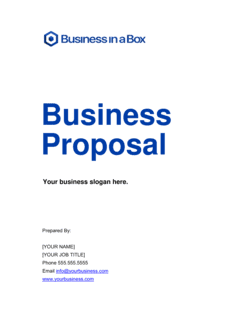
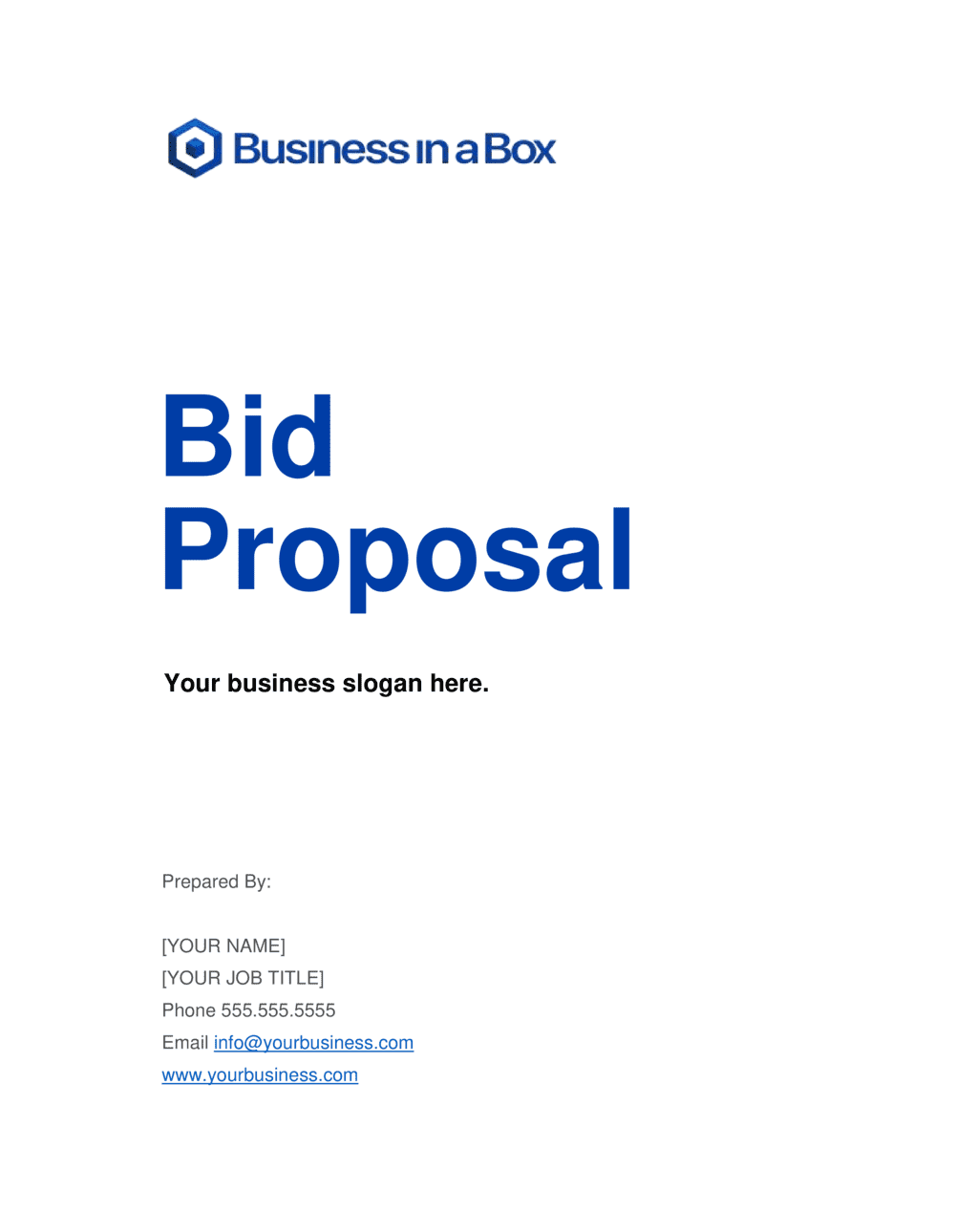
Bid Proposal Template

Free Word download β€’ Edit online β€’ Save & share with Drive β€’ Export to PDF

18 pagesβ€’35–50 min to fillβ€’Difficulty: Complex
Learn more ↓
FreeBid Proposal Template

At a glance

What it is
A Bid Proposal is a formal document a contractor, vendor, or service provider submits to a prospective client in response to a project opportunity or request for proposal (RFP). This free Word download gives you a structured, professional starting point you can edit online and export as PDF β€” covering scope of work, itemized pricing, timeline, qualifications, and terms in a single document.
When you need it
Use it when responding to a client RFP, a government tender, or a competitive solicitation where you need to present your approach, pricing, and credentials in a single persuasive document. It is also useful for proactively pitching a defined project scope to a prospective client before a formal RFP is issued.
What's inside
Cover page and executive summary, company overview and qualifications, detailed scope of work, project timeline with milestones, itemized cost breakdown, terms and conditions, and a call to action with submission instructions.

What is a Bid Proposal?

A Bid Proposal is a formal document submitted by a contractor, vendor, or service provider in response to a client's request for proposal, tender, or competitive solicitation. It presents the bidder's understanding of the project requirements, proposed scope of work, technical approach, project timeline, itemized pricing, and relevant qualifications β€” all in a single structured document designed to persuade the client to award the contract. Unlike a casual quote or informal pitch, a bid proposal follows a defined format that allows the client to evaluate multiple competing submissions on consistent criteria.

Why You Need This Document

Submitting an unstructured or incomplete bid is one of the fastest ways to lose a contract you are technically qualified to win. Clients evaluating multiple proposals score against defined criteria β€” understanding of requirements, technical approach, price transparency, and team credentials β€” and a proposal that skips or vagues out any of these categories loses points regardless of your actual capabilities. A well-structured bid proposal forces you to articulate exactly what you will deliver, when, and at what cost, which protects you from scope creep and timeline disputes after award. It also creates the paper trail that underpins a formal contract or statement of work. This template gives you a proven structure so you can focus your time on the content that wins β€” your specific solution, your relevant track record, and a price backed by real numbers.

Which variant fits your situation?

If your situation is…Use this template
Responding to a formal government or public-sector RFPGovernment Bid Proposal
Bidding on a construction or renovation projectConstruction Bid Proposal
Pitching a marketing or creative services engagementMarketing Proposal
Proposing a consulting or advisory engagementConsulting Proposal
Submitting a supplier or vendor quote for goodsPrice Quote
Pursuing a grant or non-profit funding opportunityGrant Proposal
Proposing a technology or software implementation projectIT Project Proposal

Common mistakes to avoid

❌ Submitting a generic proposal without tailoring it to the RFP

Why it matters: Evaluators immediately recognize copy-paste proposals. A bid that does not reference the client's specific requirements, terminology, or evaluation criteria scores poorly on understanding of need β€” often the highest-weighted category.

Fix: Allocate at least 30% of your writing time to the understanding of requirements section and the executive summary. Mirror the client's language and cite specific sections of the RFP.

❌ Providing a lump-sum price with no line-item breakdown

Why it matters: Clients cannot verify reasonableness, compare your bid against alternatives, or approve budget line items internally without a breakdown. Proposals without itemization are frequently eliminated before evaluation.

Fix: Break every cost into labor categories, materials, subcontractors, contingency, and overhead. Even a simple five-line breakdown is more credible than a single total.

❌ Omitting a proposal validity period

Why it matters: Without a stated expiry, a client can accept your bid months later at the original price β€” long after labor rates or materials costs have increased, leaving you to absorb the difference.

Fix: State a validity period of 30–90 days on the cover page and in the terms section. Include a process for price adjustment if acceptance occurs after expiry.

❌ Underestimating the timeline to impress the client

Why it matters: Promising an unrealistically fast timeline wins the bid but sets up a failure. Late delivery damages the relationship, triggers penalties, and costs more to fix than a longer schedule would have cost to win.

Fix: Build your timeline from a realistic bottom-up task estimate, add review cycles, and include contingency days. A credible timeline with a clear rationale beats an aggressive one with no support.

The 9 key sections, explained

Cover page and transmittal letter

Executive summary

Company overview and qualifications

Understanding of requirements

Scope of work and technical approach

Project timeline and milestones

Itemized cost breakdown

Qualifications and references

Terms, conditions, and validity period

How to fill it out

  1. 1

    Read the RFP in full before writing a single word

    Identify the evaluation criteria, required format, submission deadline, and any mandatory inclusions such as certifications or bond requirements. Note every question the client asks explicitly.

    πŸ’‘ Create a compliance checklist from the RFP requirements and tick each one off as you complete it β€” evaluators often score proposals on whether mandatory items are present before reading the content.

  2. 2

    Complete the company overview and qualifications section

    Summarize your company's founding, size, relevant licenses, and certifications. Select two to three projects that are most analogous to the current bid and draft concise case studies with measurable outcomes.

    πŸ’‘ Match the language in your qualifications section to the language the client used in the RFP β€” if they wrote 'commercial HVAC systems,' use that phrase, not 'climate control systems.'

  3. 3

    Write the understanding of requirements section

    Paraphrase the client's stated objectives and constraints in your own words. If you attended a pre-bid meeting, reference it. Identify the two or three factors the client cares about most and name them explicitly.

    πŸ’‘ If something in the RFP is ambiguous, note your interpretation here rather than guessing silently β€” this protects you if the client later disputes the scope.

  4. 4

    Define the scope of work with specific deliverables

    Break the project into phases or work packages. For each, list the activities you will perform, the deliverable the client will receive, and any acceptance criteria or standards it must meet.

    πŸ’‘ Explicitly state what is not included in the scope β€” exclusions are as important as inclusions for managing client expectations and preventing scope creep.

  5. 5

    Build the project timeline with review cycles included

    Map each phase to a calendar week or date range. Add buffer for client review and approval after every major deliverable. Flag any dependencies on client-provided information or third-party actions.

    πŸ’‘ State your timeline assumptions explicitly: 'This schedule assumes client feedback within 5 business days of each submission.' It gives you a defensible basis for a timeline extension if reviews run long.

  6. 6

    Prepare the itemized cost breakdown

    List every cost category β€” labor by role and hours, materials by item, subcontractor costs, equipment, contingency, and overhead β€” with unit rates and totals. Sum to a grand total and state whether taxes are included.

    πŸ’‘ Show a contingency line of 5–15% explicitly rather than burying it in other line items. Clients expect it; hiding it looks like padding.

  7. 7

    Write the executive summary last

    Pull the strongest two or three points from each completed section and compress them into half a page to one page. Lead with the client's problem, your solution, your key differentiator, and the total price.

    πŸ’‘ If the executive summary runs longer than one page, cut it. Procurement evaluators read dozens of proposals β€” a tight, confident summary signals a confident bidder.

  8. 8

    Review for compliance, pricing, and errors before submitting

    Check that every RFP requirement is addressed, that all arithmetic in the cost breakdown is correct, and that names, dates, and project references are accurate throughout.

    πŸ’‘ Have someone unfamiliar with the project read the executive summary and scope sections β€” if they cannot explain your approach back to you in plain language, the proposal needs clearer writing.

Frequently asked questions

What is a bid proposal?

A bid proposal is a formal document submitted by a contractor, vendor, or service provider to a prospective client in response to a project opportunity or request for proposal. It outlines the bidder's understanding of the project, proposed approach, scope of work, pricing, timeline, and qualifications. The client uses competing bids to select the vendor that best meets their requirements at an acceptable price.

What is the difference between a bid proposal and a business proposal?

A bid proposal is typically submitted in response to a formal solicitation β€” an RFP, RFQ, or tender β€” where multiple vendors compete on defined evaluation criteria. A business proposal is often proactively submitted to introduce a service or solution without a competitive solicitation. Bid proposals follow a more structured format driven by the client's RFP requirements; business proposals allow more flexibility in structure and emphasis.

What should a bid proposal include?

A complete bid proposal includes a cover page and transmittal letter, executive summary, company overview and qualifications, a section demonstrating understanding of the client's requirements, a detailed scope of work, project timeline with milestones, itemized cost breakdown, relevant case studies or references, and terms and conditions including a validity period. The exact structure may be dictated by the client's RFP format requirements.

How long should a bid proposal be?

Length depends on project complexity and RFP requirements. For mid-size service or construction projects, 8–15 pages plus a pricing appendix is typical. Government bids may specify page limits strictly β€” exceeding them can disqualify the proposal. For smaller projects, a 3–5 page proposal with a clear scope and itemized price is usually sufficient and often preferred. Follow the client's format guidance before defaulting to a length.

How do I price a bid proposal competitively without underpricing?

Start with a bottom-up cost estimate: calculate actual labor hours by role, materials, subcontractor costs, equipment, and overhead. Add a contingency of 5–15% depending on project risk. Research the market rate for comparable work in your area. Then set your margin on top. Underpricing to win a bid creates cash flow problems mid-project and damages client relationships when you need to request additional funds. A well-justified price with a clear breakdown is more credible than the lowest number.

What is the difference between an RFP and an RFQ?

A Request for Proposal (RFP) solicits a full proposal covering technical approach, qualifications, timeline, and price β€” evaluated holistically. A Request for Quotation (RFQ) solicits pricing only for a well-defined scope, with selection based primarily on cost. Bid proposals respond to RFPs; price quotes respond to RFQs. Submitting a full narrative proposal in response to an RFQ, or a bare price quote in response to an RFP, both signal a failure to read the solicitation.

How do I follow up after submitting a bid proposal?

Send a brief email to the procurement contact within two business days of submission confirming receipt and offering to answer questions. After the stated evaluation period, a single polite follow-up inquiry about the decision timeline is appropriate. Avoid multiple follow-ups before the evaluation period ends β€” it signals desperation rather than confidence. If you lose the bid, request a debrief; most clients will tell you where your proposal fell short, which is valuable for future submissions.

Do I need a lawyer to review a bid proposal?

For most standard commercial bid proposals, legal review is not required. However, if the project involves a public-sector contract, requires a performance or bid bond, includes indemnification or liquidated damages clauses in the draft contract attached to the RFP, or involves a contract value above $500K, having a lawyer review the terms section and any incorporated contract language is worthwhile. The bid proposal itself is not a binding contract, but accepting it may incorporate its terms.

What makes a bid proposal win over a lower-priced competitor?

Evaluators consistently score proposals higher when the bidder demonstrates a specific, credible understanding of the project requirements, provides a detailed scope with defined deliverables, backs up the price with a clear line-item breakdown, and presents relevant references with measurable outcomes. A higher price with strong evidence of delivery capability routinely beats a lower price with a vague scope β€” because clients fear cost overruns and failed delivery more than a modest premium upfront.

How this compares to alternatives

vs Business Proposal

A business proposal is typically submitted proactively to introduce a service or solution without a formal competitive solicitation. A bid proposal responds to a structured RFP with defined evaluation criteria and competing submissions. Bid proposals follow the client's required format and weighting; business proposals give the submitter more control over structure and emphasis. Use a bid proposal when responding to a formal tender; use a business proposal for unsolicited outreach.

vs Price Quote

A price quote responds to a request for pricing on a well-defined scope and is evaluated almost entirely on cost. A bid proposal includes a full technical approach, qualifications, timeline, and pricing β€” evaluated on multiple criteria. If the client knows exactly what they want and needs only a number, a price quote is appropriate. If they are selecting a partner based on capability and approach, a bid proposal is required.

vs Consulting Proposal

A consulting proposal is tailored to advisory or knowledge-based engagements where the deliverable is analysis, recommendations, or strategic guidance rather than a physical or technical output. It emphasizes the consultant's methodology and credentials more than materials or unit costs. A bid proposal is broader and is used across construction, IT, services, and supply contracts where a formal procurement process is in place.

vs Statement of Work

A statement of work (SOW) is a binding contractual document executed after a vendor is selected, defining the exact scope, deliverables, and obligations in enforceable terms. A bid proposal is a pre-selection marketing document β€” persuasive rather than contractual. The winning bid proposal typically becomes the basis for the SOW, but the two serve different functions at different stages of the procurement process.

Industry-specific considerations

Construction and Engineering

Proposals include detailed material takeoffs, subcontractor quotes, bonding requirements, safety plan references, and phased milestone payment schedules.

Information Technology

Technical approach section covers architecture, integration requirements, data security compliance, and post-go-live support terms alongside a staffing plan by role.

Professional Services

Emphasis on team qualifications, methodology, and past engagement outcomes rather than materials pricing; fees quoted by phase or deliverable rather than by unit.

Government and Public Sector

Strict format and page-limit compliance, mandatory certifications (DBE, MBE, SAM registration), bid bond requirements, and public-record submission protocols.

Template vs pro β€” what fits your needs?

PathBest forCostTime
Use the templateSmall businesses and independent contractors bidding on standard commercial or private-sector projectsFree2–6 hours per proposal
Template + professional reviewMid-size firms bidding on contracts above $250K or responding to government RFPs with strict compliance requirements$200–$800 for a bid writer or procurement consultant review1–3 days
Custom draftedLarge or complex bids above $1M, public-sector contracts requiring certified documentation, or highly technical proposals requiring specialist writers$1,500–$10,000+ for a professional bid-writing team1–4 weeks

Glossary

Request for Proposal (RFP)
A formal document issued by a client soliciting competitive bids from vendors or contractors for a defined project or service.
Scope of Work (SOW)
A detailed description of the tasks, deliverables, and boundaries of the work to be performed under the proposed engagement.
Bid Bond
A guarantee from a surety company that the bidder will honor the bid price and enter into a contract if selected β€” common in government and construction procurement.
Lump Sum Bid
A fixed total price for the entire scope of work, regardless of actual hours or materials consumed.
Unit Price Bid
A price structure where the bidder quotes a rate per unit of work (e.g., per square foot or per hour), and the total cost is determined by actual quantities completed.
Bid Leveling
The process by which the client normalizes and compares bids from multiple vendors to ensure they are evaluated on an equivalent basis.
Addendum
A formal written change issued by the client to modify the RFP requirements after the original solicitation is published β€” bidders must acknowledge receipt.
Evaluation Criteria
The weighted factors a client uses to score competing bids β€” typically a combination of price, technical approach, qualifications, and schedule.
Best and Final Offer (BAFO)
A client's request for bidders to submit their lowest price and strongest terms after an initial round of competitive review.
Retention
A percentage of payment withheld by the client until project completion or a defined milestone, used as security against defects or non-performance.

Part of your Business Operating System

This document is one of 3,000+ business & legal templates included in Business in a Box.

  • Fill-in-the-blanks β€” ready in minutes
  • 100% customizable Word document
  • Compatible with all office suites
  • Export to PDF and share electronically

Create your document in 3 simple steps.

From template to signed document β€” all inside one Business Operating System.
1
Download or open template

Access over 3,000+ business and legal templates for any business task, project or initiative.

2
Edit and fill in the blanks with AI

Customize your ready-made business document template and save it in the cloud.

3
Save, Share, Send, Sign

Share your files and folders with your team. Create a space of seamless collaboration.

Save time, save money, and create top-quality documents.

β˜…β˜…β˜…β˜…β˜…

"Fantastic value! I'm not sure how I'd do without it. It's worth its weight in gold and paid back for itself many times."

Managing Director Β· Mall Farm
Robert Whalley
Managing Director, Mall Farm Proprietary Limited
β˜…β˜…β˜…β˜…β˜…

"I have been using Business in a Box for years. It has been the most useful source of templates I have encountered. I recommend it to anyone."

Business Owner Β· 4+ years
Dr Michael John Freestone
Business Owner
β˜…β˜…β˜…β˜…β˜…

"It has been a life saver so many times I have lost count. Business in a Box has saved me so much time and as you know, time is money."

Owner Β· Upstate Web
David G. Moore Jr.
Owner, Upstate Web

Run your business with a system β€” not scattered tools

Stop downloading documents. Start operating with clarity. Business in a Box gives you the Business Operating System used by over 250,000 companies worldwide to structure, run, and grow their business.

Free Forever PlanΒ Β·Β No credit card required