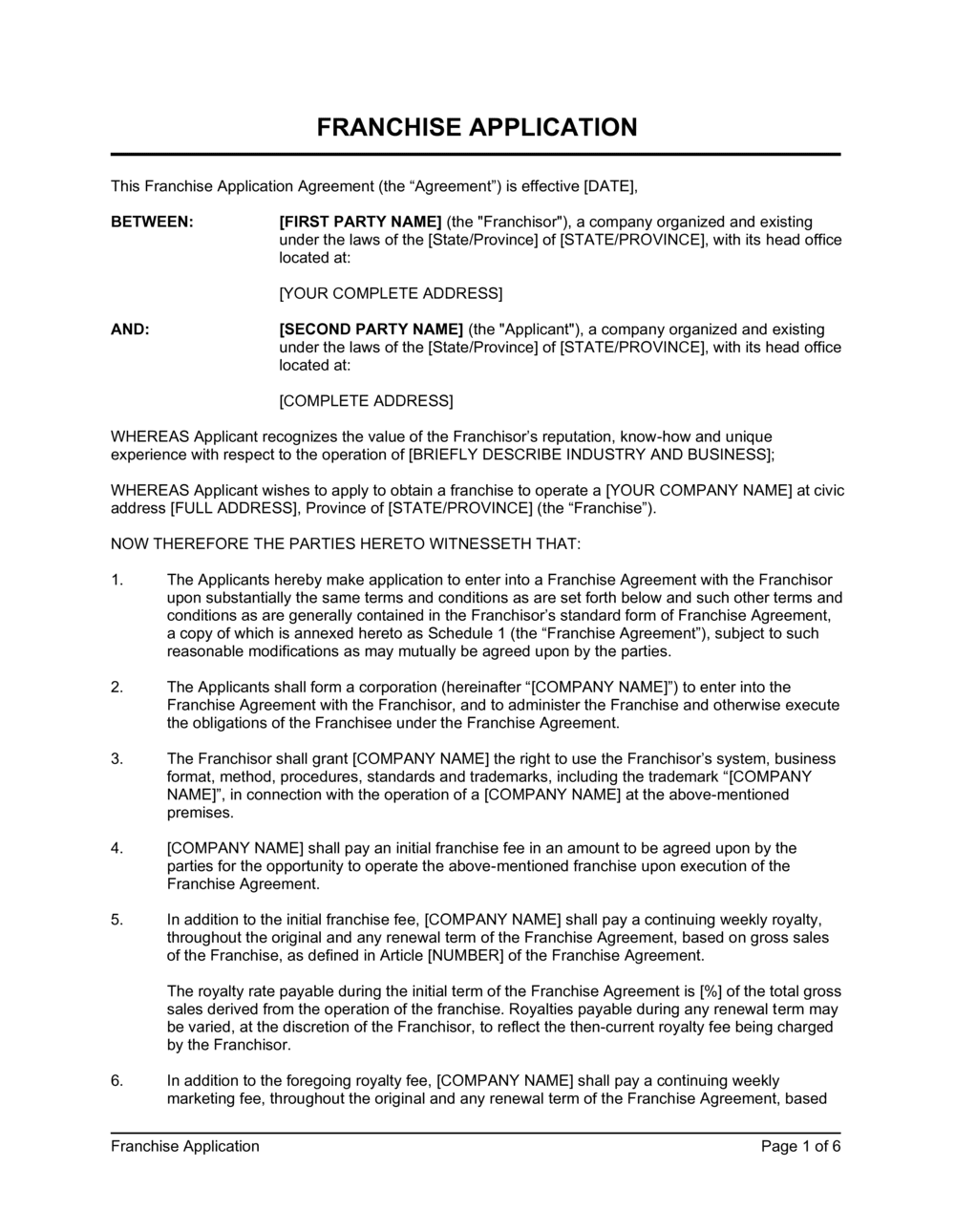
Franchise Application Template

Free Word download β€’ Edit online β€’ Save & share with Drive β€’ Export to PDF

6 pagesβ€’25–30 min to fillβ€’Difficulty: Standard
Learn more ↓
FreeFranchise Application Template

At a glance

What it is
A Franchise Application is a structured intake form a franchisor uses to collect and evaluate information from prospective franchisees before advancing them in the approval process. This free Word download lets you capture applicant background, financial qualifications, business experience, and motivations in a consistent format you can edit online and export as PDF.
When you need it
Use it whenever a prospective franchisee expresses interest in opening a location or territory β€” before any discovery day, franchise disclosure document, or franchise agreement is shared. It standardizes the screening step so you compare all candidates on the same criteria.
What's inside
Personal and business contact details, financial qualification fields, business and management experience, preferred territory or location, motivation and goals, reference contacts, and a certification block where the applicant confirms the information is accurate and complete.

What is a Franchise Application?

A Franchise Application is a structured intake form a prospective franchisee completes to give a franchisor the personal, financial, and professional information needed to evaluate their candidacy before advancing them in the approval process. It captures everything from liquid capital and net worth to business experience, preferred territory, and motivation β€” in a consistent format that lets the franchisor compare every candidate against the same criteria. The application is not a binding document; it is the gateway that determines who receives a Franchise Disclosure Document and an invitation to a discovery day.

Why You Need This Document

Without a standardized franchise application, franchisors rely on inconsistent phone conversations and informal emails to screen candidates β€” making it nearly impossible to compare applicants fairly or defend a selection decision later. A missing financial qualification step lets underfunded candidates advance to discovery day and legal review, wasting both parties' time and money. A well-designed application also creates an auditable record of what each applicant represented about their background and finances, which matters if a franchisee later disputes the basis for approval or rejection. This template gives franchisors a repeatable, defensible screening process from the very first inquiry.

Which variant fits your situation?

If your situation is…Use this template
Initial inquiry before any formal vetting beginsFranchise Inquiry Form
Screening a candidate after the application but before awarding rightsFranchise Agreement
Transferring an existing franchise unit to a new ownerFranchise Transfer Application
Adding a second or third location for an approved franchiseeMulti-Unit Development Agreement
Granting exclusive rights to develop a defined territoryArea Development Agreement
Documenting post-approval obligations before opening dayFranchise Operations Manual Acknowledgment

Common mistakes to avoid

❌ Understating liquid capital requirements

Why it matters: Franchisors set minimum liquidity thresholds to protect both parties β€” underfunded franchisees are the leading cause of early-stage failure and system-wide reputation damage.

Fix: Calculate your accessible cash accurately before applying. If you fall short, identify a financing path (SBA loan, partner capital) and note it explicitly in the application.
❌ Leaving the territory field vague

Why it matters: A vague territory preference delays the availability check, slows the review process, and signals that the applicant has not researched the market.

Fix: Name a specific city or metro area as your primary preference and include one alternative. Confirm availability with the development team before submitting.

❌ Providing personal references instead of professional ones

Why it matters: References from family members or personal friends cannot speak to business judgment or operational capability, so franchisors discount or ignore them entirely.

Fix: List two to three references from prior employers, business partners, or professional advisors who can speak specifically to your management and decision-making track record.

❌ Submitting without informing your references

Why it matters: References who receive an unexpected call often give cautious or incomplete answers β€” or miss the call entirely β€” which stalls the verification step.

Fix: Contact each reference before submitting the application, confirm their current contact information, and tell them what role and brand you are applying for.

The 10 key fields, explained

Applicant personal information

Co-applicant or entity information

Preferred territory or location

Financial qualification β€” net worth and liquid capital

Employment and business experience

Education background

Motivation and goals

Number of units and timeline

Professional references

Certification and accuracy declaration

How to fill it out

  1. 1

    Enter your full legal name and contact details

    Use your full name exactly as it appears on government-issued ID. Include a direct phone number and email address you check daily.

    πŸ’‘ If you plan to operate through an LLC or corporation, enter both your personal details and the entity's legal name β€” franchisors need both to prepare the franchise agreement.

  2. 2

    Specify your preferred territory

    Name a specific city, metro area, or defined region. If you have more than one preference, list a primary and an alternative.

    πŸ’‘ Check the franchisor's website or call the development team before applying to confirm your preferred territory is still available.

  3. 3

    Complete the financial qualification fields accurately

    Enter your estimated net worth and the amount of liquid capital you can access without taking on debt. Be honest β€” franchisors verify these figures before granting approval.

    πŸ’‘ If you plan to use an SBA loan to cover part of the investment, note that in the financing section. Many franchisors have preferred lenders who can accelerate approval.

  4. 4

    Summarize your relevant experience

    List your most recent role, years in that position, and any prior business ownership. Highlight management or operations experience β€” direct industry experience is usually less important than leadership track record.

    πŸ’‘ Quantify wherever possible: 'Managed a team of 12' is more persuasive than 'management experience.'

  5. 5

    Write a specific motivation statement

    Explain in two to four sentences why you chose this brand and what you plan to accomplish in Years 1 and 3. Reference something specific about the brand's model or market position.

    πŸ’‘ Vague answers like 'I want to be my own boss' are the most common and least persuasive. Reference a specific aspect of the brand's operating model or market position instead.

  6. 6

    List professional references with accurate contact details

    Provide at least two references who can speak to your professional judgment and business character. Include their current phone number and email β€” outdated contact info delays your application.

    πŸ’‘ Alert your references before submitting the application so they are expecting a call and can respond promptly.

  7. 7

    Read and sign the certification block

    Review the accuracy declaration carefully before signing. It authorizes the franchisor to verify all information you provided, including a credit and background check.

    πŸ’‘ Any inaccuracy discovered after signing β€” even unintentional β€” can result in automatic disqualification. Double-check all financial figures before submitting.

Frequently asked questions

What is a franchise application?

A franchise application is a structured intake form a prospective franchisee completes to provide a franchisor with the personal, financial, and professional information needed to evaluate their candidacy. It is the first formal step in the franchise sales process β€” submitted before a discovery day, before the franchisor issues an FDD, and well before any franchise agreement is signed.

What information does a franchise application ask for?

Most franchise applications collect personal and contact details, the legal entity name if applicable, preferred territory, estimated net worth and liquid capital, employment and business experience, education background, motivation and goals, number of units desired, professional references, and a certification that all information is accurate. Financial fields are the most heavily weighted in the initial screening.

Is a franchise application legally binding?

No. A franchise application is a screening and information-gathering form, not a contract. Submitting it does not obligate the applicant to buy a franchise or the franchisor to grant one. The binding document is the franchise agreement, which is signed only after the applicant receives and reviews the FDD for the required waiting period.

What financial qualifications do most franchisors require?

Requirements vary by brand and investment level, but most franchisors screen for a minimum net worth of 2–3 times the total investment and liquid capital equal to at least the full initial franchise fee plus 3–6 months of operating expenses. A mid-market food franchise, for example, might require $300,000 net worth and $100,000 liquid capital for a unit that costs $250,000 to open.

How long does franchise application review take?

Initial screening typically takes 3–10 business days after submission. If the applicant meets financial and background criteria, they are usually invited to a discovery day within 2–4 weeks. The full process from application to signed franchise agreement commonly runs 60–120 days, depending on the brand and the applicant's responsiveness.

Can I apply for multiple franchise brands simultaneously?

Yes. Applying to multiple franchisors at the same time is common and accepted practice. Each brand will conduct its own screening independently. Be transparent about your timeline and competing applications if a franchisor asks β€” attempting to rush one brand's process to match another's timeline is generally counterproductive.

What happens after the franchise application is approved?

After approval, the franchisor issues the Franchise Disclosure Document (FDD), which the applicant must review for a mandatory waiting period β€” 14 days in the US under FTC rules. After that period, the parties can execute the franchise agreement, the applicant pays the initial franchise fee, and pre-opening training begins.

Do I need a lawyer to complete a franchise application?

The application itself is a straightforward intake form that does not require legal counsel. However, before signing the franchise agreement β€” the binding contract that follows approval β€” engaging a franchise attorney to review the FDD and agreement is strongly advisable. Attorney review typically costs $1,500–$3,500 and can identify unfavorable clauses before you are committed.

How this compares to alternatives

vs Franchise Agreement

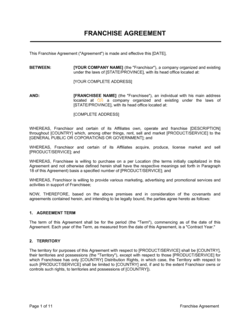
A franchise application is a pre-qualification intake form with no binding obligations β€” it determines whether a candidate advances in the process. A franchise agreement is the binding legal contract that grants operating rights, sets royalties, and governs the entire relationship. The application comes first; the agreement follows after the FDD review period.

vs Letter of Intent

A letter of intent signals mutual interest and may outline preliminary deal terms, but it is not a structured screening tool. A franchise application is a standardized form designed to collect consistent, comparable data across all candidates. Franchisors use applications to screen; they use letters of intent to document negotiated terms before drafting the final agreement.

vs Business Plan

Some franchisors request a business plan as a supplement to the application, particularly for multi-unit or area development candidates. A franchise application collects factual background data; a business plan demonstrates the applicant's operational thinking and market analysis. The application qualifies the person; the business plan qualifies their strategy.

vs Franchise Disclosure Document (FDD)

An FDD is a legally mandated disclosure document the franchisor provides to qualified applicants β€” it runs 200–500 pages and covers 23 required items under FTC rules. The franchise application precedes the FDD; it is the tool franchisors use to determine which applicants are qualified to receive it. Providing an FDD to every inquiry would be impractical and legally unnecessary.

Industry-specific considerations

Food and Beverage

Food franchises typically require the highest liquid capital thresholds and add health permit, food safety certification, and real estate experience fields to the standard application.

Retail

Retail franchise applications emphasize prior inventory management and customer service experience, and include questions about preferred mall, strip center, or standalone site formats.

Professional Services

Service-based franchises such as accounting, staffing, or consulting weight professional credentials and industry certifications heavily in the application screening criteria.

Health and Wellness

Fitness and wellness franchises often add fields for applicable professional licenses (personal training, physical therapy) and ask about the applicant's personal relationship with the brand's service category.

Template vs pro β€” what fits your needs?

PathBest forCostTime
Use the templateFranchisors screening applicants for standard single-unit or small multi-unit franchisesFree10–15 minutes to complete per applicant
Template + professional reviewFranchisors adding custom financial thresholds, background check authorizations, or brand-specific screening questions$200–$500 for a franchise consultant or attorney to tailor the form1–3 days
Custom draftedLarge franchise systems with complex territory structures, regulated industries, or multi-brand portfolios requiring integrated applicant tracking$1,000–$3,000+ for custom form design and legal review1–2 weeks

Glossary

Franchisee
The individual or entity that licenses the right to operate under a franchisor's brand, system, and trademark in exchange for fees and royalties.
Franchisor
The company that owns the brand, operating system, and intellectual property and grants franchisees the right to operate under those assets.
FDD (Franchise Disclosure Document)
A federally mandated document in the US that franchisors must provide to prospective franchisees at least 14 days before any agreement is signed.
Discovery Day
An in-person or virtual meeting where qualified applicants visit the franchisor's headquarters or a flagship location to evaluate fit before signing.
Franchise Fee
A one-time upfront payment the franchisee makes to the franchisor to obtain the license to operate under the brand.
Royalty
An ongoing percentage of gross sales paid by the franchisee to the franchisor, typically monthly, for continued use of the brand and support services.
Territory
A defined geographic area within which a franchisee has the right to operate, sometimes exclusively, under the franchise agreement.
Net Worth
Total assets minus total liabilities β€” used by franchisors to verify a candidate has sufficient financial resources to fund opening costs and sustain early operations.
Liquid Capital
Cash or assets quickly convertible to cash that an applicant can access without borrowing, used to verify readiness to fund start-up costs.
Area Developer
A franchisee who has contracted to open and operate multiple units across a defined region within an agreed development schedule.

Part of your Business Operating System

This document is one of 3,000+ business & legal templates included in Business in a Box.

  • Fill-in-the-blanks β€” ready in minutes
  • 100% customizable Word document
  • Compatible with all office suites
  • Export to PDF and share electronically

Create your document in 3 simple steps.

From template to signed document β€” all inside one Business Operating System.
1
Download or open template

Access over 3,000+ business and legal templates for any business task, project or initiative.

2
Edit and fill in the blanks with AI

Customize your ready-made business document template and save it in the cloud.

3
Save, Share, Send, Sign

Share your files and folders with your team. Create a space of seamless collaboration.

Save time, save money, and create top-quality documents.

β˜…β˜…β˜…β˜…β˜…

"Fantastic value! I'm not sure how I'd do without it. It's worth its weight in gold and paid back for itself many times."

Managing Director Β· Mall Farm
Robert Whalley
Managing Director, Mall Farm Proprietary Limited
β˜…β˜…β˜…β˜…β˜…

"I have been using Business in a Box for years. It has been the most useful source of templates I have encountered. I recommend it to anyone."

Business Owner Β· 4+ years
Dr Michael John Freestone
Business Owner
β˜…β˜…β˜…β˜…β˜…

"It has been a life saver so many times I have lost count. Business in a Box has saved me so much time and as you know, time is money."

Owner Β· Upstate Web
David G. Moore Jr.
Owner, Upstate Web

Run your business with a system β€” not scattered tools

Stop downloading documents. Start operating with clarity. Business in a Box gives you the Business Operating System used by over 250,000 companies worldwide to structure, run, and grow their business.

Start freeΒ Β·Β No credit card required